Gate and Slave market at Pernambuco, after Earle; view down street crowded with slaves, guarded by soldiers to right
Slave market at Pernambuco, Brazil. Includes black slaves sitting on the street while an auction is going on. Includes scene of beating, dwellings, sword, horse about to trample a baby, dog, and woman carrying a burden on her head.
Source creator: Callcott, Maria, Lady, 1785-1842 Source Title: Journal of a voyage to Brazil, and residence there, during part of the years 1821, 1822, 1823. By Maria Graham. Source place of publication: London
The Slave market at Rio; street where buyers examine slaves, one of whom sits on ground in left foreground, child slaves being inspected by man wearing hat and striped trousers, dog to right, soldiers in distance. 1813
A Jamaican Newspaper, the Gleaner, published an article entitled "Back pay for slavery," on 7 August 2011, by Carolyn Cooper, Contributor to the Gleaner:
THE PRINCIPLE of reparations was established long ago in the 1833 Act for the Abolition of Slavery throughout the British colonies. But there was a catch to the act - not much different in essence from the original sin of catching Africans for enslavement in the Americas. Reparations were to be made to the perpetrators of human trafficking, not to the victims.
This is how the act opens: "Whereas divers persons are holden (held) in slavery within divers of His Majesty's colonies, and it is just and expedient that all such persons should be manumitted and set free, and that a reasonable compensation should be made to the persons hitherto entitled to the services of such slaves for the loss which they will incur by being deprived of their right to such services ... ," etc.
This is a classic example of the diabolical mindset of 'wicked white people'. Slaveholders were legally entitled to the services of their slaves and therefore had a right to 'reasonable compensation' for loss of service. The enslaved had no such rights or entitlements. They were freed with nothing in their two long hands; just like that rather sad-looking couple standing in a basin of water in New Kingston's 'Emancipation Park'.
Statues in Emancipation Park, Kingston, Jamaica
When I talk about 'wicked white people' I don't mean specific individuals who have done me personal wrong. I'm not speaking about singular acts of evil. It's a far bigger issue. What concerns me is the collective crimes against humanity committed by gravalicious people who consider themselves absolutely entitled by God and nature to dominate the world. In many instances, these self-proclaimed rulers just happen to be white.
In the age of colonial conquest, 'wicked white people' as a special interest group committed crimes of unapologetic horror. They ravaged other people's bodies, souls, lands and histories; they vandalised sacred objects and then locked them away in 'museums' - those cemeteries of other people's culture. 'Wicked white people' invading and stealing, stealing, stealing without conscience.
I know I'm going to be accused of racism for exposing 'wicked white people' to public scrutiny in this way. But that's just another ploy of 'wicked white people' and their collaborators to perpetuate mental slavery. It's racism to talk about racist behaviour. But actual racist behaviour is not racism. It's just human nature. What an irony!
Justice versus expediency
So let's say instead that 'nice and decent' white people agreed that it was "just and expedient" to set the enslaved free. But the yoking of justice and expedience in the Act for the Abolition of Slavery reveals the central philosophical and practical dilemma at the heart of the emancipation enterprise.
Justice seemingly puts emancipation on solid moral ground. Expedience erodes all claims to moral authority. It was expedient to emancipate enslaved Africans because plantation slavery had become an expensive proposition. The substitution of beet for cane turned West Indian sugar into a rather sour deal.
After centuries of mostly verbal outrage - incessant talk, talk, talk about 'wicked white people' - we, the collective victims of transatlantic slavery, must finally decide to take legal action in the largest class-action suit in the history of the world. This is a truly wonderful idea. Not the wishy-washy, everyday sense of 'wonderful', meaning simply 'great'; it's the mind-blowing, original meaning of the word: full of wonder.
Five hundred years after the rape of the body and land of the original inhabitants of this part of the world; 500 years after the violent uprooting and enslavement of millions of Africans, we, their descendants, both native and immigrant, must lay claim to rights of reparation.
In the sweet by and by
Enslaved Sugar Plantation Labour
For many Africans in the diaspora, it is in religion that we find hope for reparations. The Christian religion seems to recommend long-term investment in the celestial stock market. The concept of reparations has best been expressed in pious hymns like this: "In the sweet by and by I'll have a mansion so bright and so fair, won't it be glorious when I get there in the sweet by and by?" God will repair the breach. God is the ultimate human rights arbitrator.
Then we have those Africans who want hard cold cash in the here and now. Think of the title song from the movie The Harder They Come: "They tell me bout the pie up in the sky waiting for me when I die. But between the day you born and when you die, they never seem to hear even your cry. So as long as the sun will shine, I'm gonna get my share, what's mine. The harder they come, the harder they fall, one and all."
That's an excellent anthem for the Reparations Movement, the Garveyism of our times. It's the same kind of daring that made Marcus Garvey conceive the Universal Negro Improvement Association and Communities League: a global movement of African peoples who see themselves as having a shared history and a common destiny.
And don't think it's a joke. With derisive laughter cynics like to say, 'when you get the money you can check me.' But the Jews got compensation from the Germans; Japanese-Americans got compensation for the atrocities committed against them. Why not Africans? I'd like to know what, exactly, our National Commission on Reparations is doing about it.
If you think that after 500 years it's now too late for reparations, just remember Psalm 90:4 in which David, himself a Jew, converses with the Supreme Arbitrator: "For a thousand years in thy sight are but as yesterday when it is past." Come to think of it, all we're really talking about is half a day's back pay. (source: The Gleaner)
From Reuters, "Panama Canal's Black Builders Await Due Credit," by Tim Gaynor: Panama City (Reuters) - In the year when the United States is to cede control of the Panama Canal to Panama, the waterway's governing body has named a tugboat for its longest serving and most reliable employee.
Tugboat Cecil F. Haynes on the Panama Canal
But for Cecil Haynes, 86, a soft-spoken Panamanian of West Indian descent, it is more than just a personal tribute. It is long-awaited recognition of the role played by black labor in the canal's history.
"West Indians made a very valuable contribution to the canal," he said, sitting in the offices where he has worked since joining the commission in 1928. "But we never got the credit we deserved."
Between 1904 and the canal's completion on the eve of the First World War, more than 25,000 West Indians heeded U.S. President Theodore Roosevelt's call to "make the dirt fly."
As the Dec. 31 transition to Panamanian control looms, Haynes hopes the thousands of black workers who labored to build the canal will finally be honored alongside its white engineers.
Panamanian West Indian Museum
Housed in a one-room former colonial church in Panama City's rundown Calidonia district, the Panamanian West Indian Museum has championed the memory of the canal's black work force since the museum opened in 1981.
"The Americans were known for their engineering skill," said Melva Lowe Goodin, the museum's president. "But it was the West Indians who gave the sweat and the blood."
Black Labor On A White Canal
For the black workers from Barbados, Jamaica and Martinique who made up two-thirds of the canal's labor force, the work was hard, dangerous and indifferently paid.
"My father came here in 1904 to dig the ditch. Back then it was just jungle and mosquitoes," Haynes recalled with a smile.
White employees of the Canal Commission were given comfortable housing, while many black workers lived in railway boxcars or shacks in the forests bordering the work site.
In the early years, malaria and yellow fever were rife and accidents were frequent. Records at the wooden museum show that of 5,600 employees killed by disease and accidents between 1904 and the project's completion 10 years later, 4,500 were black.
Particularly hazardous were the vast excavations at Culebra Cut, a 9-mile(5.6-km)-long navigation channel blasted through the cordillera, the range that divides Panama, with dynamite.
Work crews were vulnerable to landslides as they dug the unstable slopes of the cut and accidents with dynamite were common. An explosion in 1908 killed 23 workers and injured 40.
With tragic irony, an action by the Canal Commission intended to improve public health put workers in even greater danger from landslides and explosions.
"Many workers went deaf as a side effect of the heavy doses of quinine they were required to take to treat malaria," Lowe Goodin said. "They just didn't hear the shouted warnings to get out of the way."
Canal Zone Caste SystemMore than seven decades after drawing his first paycheck, Haynes recalls the two-tier pay system that led to segregation of white and black workers in the U.S.-controlled Canal Zone.
"While white workers were paid on the gold roll, in U.S. dollars, we were all paid on the silver roll in local currency," he said.
Silver roll employees had to drink at separate drinking fountains and stand at different lines in the post office under what one observer called the "Canal Zone caste system." The Canal Zone, a 10-mile(16-km)-wide security strip the length of the waterway, was run under U.S. federal laws, with its own court system and police force, until it reverted to Panamanian control in 1979.
"You couldn't go into gold roll shops," Haynes said. "And after working hours you couldn't be seen in the zone. You would be arrested for loitering or trespassing."
Black workers were classed as "helpers" although they might be qualified in a range of canal-related trades and were paid at half the rate of white co-workers.
African slaves in the fierce struggle for freedom against the Spanish Empire (the 'runaways') were also land in the jungle magic Portobelo. And after escaping deep into its dense forests and hills, the Maroons built fortified villages, known as Palenque, from which declared war against their former slavers. So successful were these courageous battle in the Spanish fugitives were forced to declare several truces, and finally to recognize their freedom and independence.
The traditions of the Congos consist of unwritten traditional performances, with characters from mythology, rituals, costumes, architecture, music, food and dance. Its impromptu street performances recall was metaphorically describe their ancestry and the victory of good over evil.
Congo culture survived thanks to the use of 'double effect' that enslaved Africans used as a weapon of resistance, which allowed them to communicate with one another while confusing the Spanish. By distorting the meaning, the reality becomes ambiguous making the African teachers in the exchange of information. The ability to communicate with each other without being discovered, they made it possible to plan escapes and riots, as well as operate an elaborate system of espionage. The result is a story full of symbolism and idiosyncratic culture, paradigms and metaphors that arouse fascination among visitors to Portobelo ready to be wrapped in mists of light.
One of the traditions of the people is the drummer of "Congos" during Carnaval this tradition dates from the time of slavery in colonial times.
One of the main traditions of the people is the drum of "Congos". It usually occurs during the carnival in February. This tradition dates back to slavery in the colony. It is a mockery of the Spanish kings and during the dance, which lasts several days, the participants assume the role of runaway slaves fleeing the Spanish. They hide in different parts of the village and take captive.
The dance has a story in which characters representing the Congolese fight against the devil, who is on the loose in those days. At the end are saving the "Queen Conga" with the help of "bird" and "John of God" in these traditions is easy to see the syncretism between Catholicism and African rituals Antilles.
Congo, Evocation of complaints from black ancestors and now facts and incidents of everyday life.
The Congo is the one that has persisted and is alternated with salsa dancing or popular. As for the special clothing is congo: change of chintz, striking large flowered skirt, head, crown fitted with colored ribbons, mirrors, flowers typical of the season (Caracucho, jasmine, papos, Havana), pinned at Trez in circle on the sides of the head.
Men use ketones, pants backwards subjects with rope, tape crowns interspersed with mirrors, a motet or quirky bag that serves to put few things picked up.
The Congos are the descendants of the Maroons, who have preserved the stories of their ancestors in a living tradition which is essentially a work of art. You travel back in time achieving power and strength as they approach their African ancestors of the seventeenth century. (source: Webscolar)
Amamda Todd of the Liberationreported, "Peruvian government apology for racism leaves out slavery," on 4 December 2009: The government of Peru has issued an apology to citizens of African descent for the first time. A public ceremony will be held for African Peruvians, who are 5 to 10 percent of the population.
Peruvian type: During the course of the slave trade, an estimated 95,000 slaves were brought into Peru from Africa. The last group arrived in 1850 and slavery was abolished in 1856.(Photographed by E. Maunoury of Lima.)
The statement admits that discrimination still exists, but makes no reference to slavery, referring instead only to the "abuse, exclusion and discrimination" of African Peruvians. The first Africans in Peru were the slaves of the Spanish conquistadors. More were brought over to work the land until slavery was abolished in 1854.
Not surprisingly, the apology did not mention what will or should be done to fix the racism and discrimination still present in society. Of course not. Racism is an institution that is part and parcel of capitalist society. Racism is a handy wedge to divide workers and keep them from banding together to fight for their common interest. It has been one of the most effective weapons against working-class struggle available to the rich. (source: The Liberation)
In her article, "Uruguay Spirit of Afro Resistance Alive in Candombe" from Upside Down World, Marie Trigona (a writer, radio producer and filmmaker based in Buenos Aires) reports: In the streets of Montevideo, Uruguay, Afro-Uruguayans celebrate an often-ignored part of their history - Candombe and resistance. For more than 200 years Afro descendants have maintained the tradition of Candombe, a rhythm that traveled from Africa to Uruguay with African slaves. The music carries centuries of resistance and liberation.
The word Candombe literally means "place and dance of Africans." The musical tradition evolved during the colonial era. Africans brought to Uruguay for slave labor used the rhythm of the tambores, or drums, to communicate with each other and defy colonialists.
Today the music thrives in Montevideo's working class neighborhoods, where African descendants have kept alive the tradition of the Llamadas, parades where Candombe is played. Candombe drummer Mitchel Navos says that Candombe didn't originate in Africa, but with Afro-descendants in Montevideo. "Candombe is specifically from Montevideo. Candombe like Montevideo's Candombe doesn't exist in any other part of the world." He also asserts that Candombe's spirit has been passed down for generations despite a historical void surrounding the music's origins.
Origins of Candombe Montevideo's colonial district is the birthplace of Uruguay's Candombe music. Africans from the Southern and Western regions (Bantú regions which include Congo, Angola and Mozambique) were brought to Uruguay and Argentina through the slave trade beginning in 1750. "Africans arriving from the Bantú region brought with them the Candombe rhythm," explains Navos. "Being from different nations and regions, they didn't have the possibility of communicating through language."
In whatever time their white masters allowed, slaves communicated through drums and dance. The first Llamadas took place at this time. Some historians assert that the word Llamadas - "parade of calls," refers to the drums Africans played to call out to each other in their homes. Each tribe had a particular rhythm that could be identified from afar.
Within these living quarters, African musicians gave birth to a rhythm and tradition which has been passed on for generations. Martin Silva is a young musician from Montevideo's Barrio Sur. His grandparents taught him the Candombe rhythm and the origins of Candombe. "Before the llamadas were held in Ansinas, which was a conventillo or a housing complex here on Isla de Flores and nearby streets. It was a huge housing complex where hundreds of families lived. The llamadas were held there, they paraded inside. It was a different kind of festivity. It's not the same as today."
Upper class whites tried to ban Candombe gatherings in the 19th century. One of the earliest historical documents tracing Candombe music is an 1808 police record, when citizens of Montevideo requested that these dances be severely repressed and completely prohibited. Afro descendants took their music underground, to defy the oppressive conditions of slavery.
"We can't refer to anything before 1900 with historical certainty," explains Navos. There exists an extensive historical void regarding Candombe practices between 1800 and 1900. "What exists today is what we could hide and preserve, which has led to the transformation of Candombe in what it is today, from generation to generation," he continues.
"Barrio Sur and Palermo were where the meat curing plants were located. Many of the black slaves had to work in the meat curing plants, but also many lived in the curing plants. That's where music from Africa mixed with Catholicism." Many historians assert that the first Llamadas took place in clandestine music halls, until they went public with the abolishment of slavery in the late 19th century. "The first Llamadas held was a procession from the Meat curing plants toward Montevideo's main cathedral, in the Old part of the city. In commemoration of Day of the Kings, they made a procession to give a tribute to the Catholic Saints of the Masters. That's when Western Traditions got mixed in. That's when the term Llamadas, or walking procession, came to be. Before it wasn't about walking in the streets, it was held in a hall or like a band performance."
Symbols of Afro descendants' painful past The dance and music are filled with symbols of African descendants' painful past. The troupes the perform the Llamadas are called comparsas, and are made up of cuerdas (drummers) and dancers. The drummers walk very slowly, barely separating their feet as they walk. This rhythm and style of procession is meant to symbolize Afro-descendants' past and historical roots when their ancestors were made to walk with chains and shackles. Three main characters lead the llamadas: the Mama Vieja (Grandmother), Gramillero (Old Doctor), and Escobero (Wizard). The Gramillero walks with a cane as if he's about to fall over. The Mama Vieja carries an umbrella attending to the Grammillero. The Escobero sweeps the ground with a great baton.
Navos describes the significance of these three characters. "The Escobero, I don't know if he's a magician or wizard, he's the person in charge of taking charge of the spirit of the comparsa. The Escobero walks in front of the flags to clean the bad spirits opening the way for the comparsa."
The Gramillero and Mama Vieja symbolize two key figures in Afro-Uruguayan history: the old doctor who uses medicinal herbs to cure and the grandmother, the matriarchal figure. Navos explains the significance of those characters. "Those characters are as important to us as our grandparents. In a family they are the roots. They are the oldest people in the comparsa. Their dance is about that. Simulating the pain in their slow dance, there's an expression of fatigue in their dance."
Candombe as a cultural tool
Some of the city's Candombe troops feature more than 50 drummers and dozens of dancers. Each neighborhood has its own rhythm and style. In Barrio Sur, where slaves took the music underground in the 19th century, new Candombe troops are emerging today.
According to Mario Suarez a young musician playing a traditional African drum in the Isla de Flores comparsa, the Llamadas is more than a performance. "The Llamadas and Candombe for the Afro descendants are a passion and a tradition. We have to maintain the tradition. The identity of the comparsa of Isla de Flores is strong, because it's part of the identity barrio Ansinas and Barrio Sur. The first Llamadas took place here in the barrio Ansinas and the barrio Sur."
Today Afro-Uruguayans number around 100,000, or about 6 percent of the population. For many Uruguayans of Afro descent, Candombe is part of everyday life and resistance in a continually discriminating society. The Llamadas ispracticed all year long, not just during Carnival. Uruguayans have also adopted the increasingly popular Candombe music as part of their national identity. Especially in the past 30 years, the music has influenced White musicians. The music was used to express resistance to the repressive regime during Uruguay's bloody military junta from 1973-1984. Today, Candombe isn't just heard in Montevideo but has spread to Uruguay's interior and echoes in Argentina.
"Candombe is not only a question of skin color, it's a way of thinking and being," says Diego Bonga Martinez from the Afro-cultural movement in Buenos Aires. In Buenos Aires, the Llamadas have been continually repressed by police and government officials. Martinez adds, "Candombe is a cultural weapon we have used to defend ourselves with, for our culture to live on." From the size and sound of the growing number of comparsas participating in the Llamadas in Montevideo, this tradition will be passed on for generations to come.
The word Samba, and the musical genre Samba, has for a long time being studied to uncover its origin. We are publishing here what we think it is the most accurate.The word "Samba," in Portuguese, was derived from semba, a word common to many West African bantu languages. To the African slaves brought to Brazil during the 17th, 18th, and 19th centuries, the word had a variety of meanings. It meant to pray, or invoke the spirits of the ancestors, or the Gods of African "pantheon." As a noun, it could mean a complaint, a cry, or something like "the blues".
In Brazil, Samba is a woman with the same function of an ekedi nagô in the Banto's temples: A sacred dancer, iaô, the daughter of the saint.
In Brazil also, the African slaves called samba a religious ceremony characterized by the rhythm and choreography of the batuque. (Batuque: the act of "batucar"; to make some kind of rhythm using any kind of instrument or object, and also a Rio's version of martial art "capoeira").
The Jongo, a variant of the Samba, until today is considered a religious dance. The first known appearance of the word Samba as a Portuguese word meaning a rhythm and a dance in print appeared in 1838, in the newspaper "O Carapuceiro", in an article written by father Lopes Gama.
In 1917, Ernesto dos Santos "Donga", recorded his song "Pelo telefone", and labeled Samba. This is officially the first Samba recording. Since then, the musicians descendants of slaves started to see the Samba as a new approach to the batuque from Angola, and determined themselves to integrate it to white society trough organizations they called Samba Schools.
A pioneer of Samba, Angenor de Oliveira, was quoted as saying "In my childhood, we played the Samba in the backyards of the old ladies, whom we call "tias" (aunts), and the police stopped us often, because the Samba, then, was considered a "thing" of bums and bandits."
Unfortunately, until today in Brazil if a "white" person dedicate himself to the samba art form, he is considered an intellectual, or eccentric, but if an African descendent does the same, he is seeing like somebody who does not want to get a job, or something in that level.
Unlike other societies that cherish the Blues, the Jazz, the Mambo, the Rumba, the Reggae and others, and sees these musical art forms as a national treasure and are proud of it, Brazilian society refuses to recognize the Samba as a culture, as Brazil's main culture and pays no respect to their masters. We do not have there a Samba museum, or any kind of award to neither people nor institutions dedicated toward the promotion and preservation of the Samba culture or even a well-organized structure of promotion of this culture to international markets. The Samba in Brazil, is still an underground culture.
However, thanks to some people in Brazil and around the world who sees the Samba otherwise, some artists with their love and dedication, Samba Schools, and to general people that gather to play, sing and dance the Samba, the culture will never die, and will continuously grow strong developing new approaches and evolving forever. (source: Brazilian Music )
 Gate and Slave market at Pernambuco, after Earle; view down street crowded with slaves, guarded by soldiers to right


 More than seven decades after drawing his first paycheck, Haynes recalls the two-tier pay system that led to segregation of white and black workers in the U.S.-controlled Canal Zone.


 One of the traditions of the people is the drummer of "Congos" during Carnaval this tradition dates from the time of slavery in colonial times.


 Montevideo's colonial district is the birthplace of Uruguay's Candombe music. Africans from the Southern and Western regions (Bantú regions which include Congo, Angola and Mozambique) were brought to Uruguay and Argentina through the slave trade beginning in 1750. "Africans arriving from the Bantú region brought with them the Candombe rhythm," explains Navos. "Being from different nations and regions, they didn't have the possibility of communicating through language."


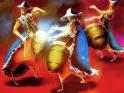


 In Brazil, Samba is a woman with the same function of an ekedi nagô in the Banto's temples: A sacred dancer, iaô, the daughter of the saint.


