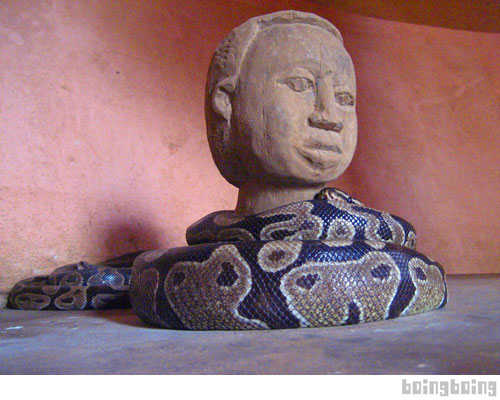
From the 17th to 19th centuries, millions of African people were sold into slavery, transported on ships to the Americas. With them came spiritual traditions including Voudun, which we now know as voodoo. Its roots are in the Dahomey kingdom on the West Coast of Africa, now the country of Benin.
The python temple in Ouidah, Benin, where voodooists invoke the "sacred"
We visit the Temple of Pythons and learn about Voudun religious practices, and witness some of the most important sites in the history of the slave trade.
We walk along a beach that was the single most highly-trafficked embarkation point for West African slaves headed over the Atlantic to the Americas. One million people were forced on to ships here, many transported to Haiti and Brazil, where Voudun transmuted into voodoo and Candombla.
Outsiders called this region the Slave Coast. Ouidah’s residents today call the former boarding platform on this otherwise idyllic beach the Gate of No Return.
BBC News, Benin, "Benin's Dark past of slavery," by Sue Branford: Few tourists reach Benin yet this West African nation has a remarkable story to tell about one of the most shameful episodes in history.
A massive, arched gateway, some 50 feet high, stands alone on the edge of one of the loveliest beaches in West Africa.
It is a striking - and in many ways a beautiful - structure, facing out across the Atlantic Ocean towards South America.
Yet it is also bleak beyond words.
Etched across the top of the arch are two long lines of naked, chained men disappearing into the sea.
Called the Gateway of No Return, it is a monument to the hundreds of thousands of Africans who were forced into slave boats on this beach, never to return.
I arrived at this gateway with a group of local historians. By the time I got there, I was choking back tears.
Not surprising really, as the monument comes at the end of a harrowing two-mile (3.2 km) trek from Ouidah.
Today Ouidah is an attractive town, the spiritual capital of Benin, with a thriving culture centred on the voodoo religion.
But once the very mention of Ouidah invoked fear among the local population.
Tree of Forgetfulness
The Portuguese, the Dutch, the British and the French all had forts near this town, built to defend their trading interests.
And for more than 200 years, the main commodity they traded was people.
Slave traders rounded up men, women and children, at times trapping them with nets.
Their catchment area stretched deep into Africa, even as far as Ethiopia and Sudan.
Once caught the slaves were forced to walk in chains, hundreds of miles to Ouidah.
Once there, they were subjected to a brutal process of brainwashing.
Taken down the slave route that I followed, they were made to walk around a supposedly magical tree called the Tree of Forgetfulness.
Men had to go round it nine times, women and children seven.
This experience, they were told, would make them forget everything - their names, their family, and the life they had once had.
As if this was not enough, the slaves were then locked into a dark room, built to resemble the hulk of a ship.
In the local language this room was called Zomai, meaning literally: "There, where the light is not allowed."
Its foundations are still visible and the place still seems to exude evil spirits and terror.
Brazil's role
Old Portugese Slave Fort - Ouidah. Old Portugese Slave Fort. The Slave Route
After several weeks - or even months - in this hell hole, the slaves were packed in ships for the long crossing to the Americas.
One of the historians told me that most of the slaves went to Brazil, at the time still ruled by Portugal and that some Brazilians played an important role in the trade.
Benin, Oyo, Asante And Dahomey Were Slave Trading Tribes
The most infamous was Don Francisco de Souza, an extraordinary wheeler-dealer who, arriving penniless from Brazil, made a fortune out of slave-trading while living in Benin.
He was a colourful figure, allegedly having 99 wives and hundreds of children.
He inspired one of Bruce Chatwin's most famous novels, The Viceroy of Ouidah.
In all, Brazil received some four million slaves from Africa - though not all, of course, from Ouidah.
This was many more than were sent to the United States.
Cultural impact
Economically, the slaves did not prosper, for blacks remain by far the poorest ethnic group in Brazil.
But culturally their impact was huge.
I lived in Brazil for many years and almost everything that makes Brazil that vibrant, warm country that so many of us love seems to be linked to Africa.
Carnival, samba, Candomble, capoeira - all were created by the descendants of former slaves.
I have always known this, but it was not until my recent trip to Benin that I became aware of just how tenaciously the slaves must have clung to their culture.
Huge efforts were made to cut them off from their past but they failed.
The "tree of forgetfulness" did not work.
Future tourism
Today there is a new twist to the tale.
As yet, Ouidah is unspoilt. Few tourists reach this relatively remote area of West Africa.
But tour operators have spotted the strong combination of wonderful beaches, hot climate, historical sites and, for Europeans, no jet lag.
Moreover, Benin is a relatively safe country with low levels of violence. The people are friendly.
Tourism is just the kind of industry that President Yayi Boni, who came to office earlier this year, is keen to promote.
He was a development banker before entering politics and wants to modernise the country.
Ouidah has a remarkable story to tell and local people need jobs.
But let us hope that Benin does not repeat the mistakes of other developing countries.
Too often tourism has had harmful effects.
Local communities have been evicted from their land. Water resources have been squandered on golf courses.
The local culture has been turned into a vulgar tourist attraction.
It would be ironic indeed if Benin's extraordinary heritage was to open the way for another cycle of exploitation by outsiders.
From Our Own Correspondent was broadcast on Thursday, 7 September, 2006 at 1100 BST on BBC Radio 4. Please check the programme schedules for World Service transmission times
From Africa Travel Magazine, "Discover the Slave Route in Nigeria," by Dr. Beryl Dorsett: A darker historical era saw many people of West Africa leave their shores for plantations in Europe, North and South America and the Caribbean. The infamous slave trade in Nigeria is not known to many people like the slave trade in Ghana, Senegal, Togo and Benin. Nigeria and Ghana were former British colonies. Senegal, Togo and Benin were former French colonies.
In December 2000, I attended the Fourth Eco-tourism Symposium in Nigeria as a delegate of the Africa Travel Association. The Lagos State Waterfront and Tourism Development Corporation invited conference delegates to a two-day pre-symposium tour of Lagos States. On the first day, we toured the city of Lagos. On the second day, we toured the town of Badagry and learned that Badagry was an important slave route in West Africa. Badagry is one of five divisions created in Lagos State in l968.
This ancient town of Badagry was founded around l425 A.D. Before its existence, people lived along the Coast of Gberefu and this area later gave birth to the town of Badagry. It is the second largest commercial town in Lagos State, located an hour from Lagos and half hour from the Republic du Benin. The Town of Badgry is bordered on the south by the Gulf of Guinea and surrounded by creeks, islands and a lake. The ancient town served mainly the Oyo Empire which was comprised of Yoruba and Ogu people. Today, the Aworis and Egun are mainly the people who reside in the town of Badagry as well as in Ogun State in Nigeria and in the neighboring Republic du Benin.
Slave Trade Route
In the early 1500's, slaves were transported from West Africa to America through Badagry. It is reported that Badagry exported no fewer than 550,000 African slaves to America during the period of the American Independence in l787. In addition, slaves were transported to Europe, South America and the Caribbean. The slaves came mainly from West Africa and the neighboring countries of Benin and Togo as well as others parts of Nigeria. The slave trade became the major source of income for the Europeans in Badagry.
Today, Badagry is an historic site because of the significant role it played as a major slave port in Nigeria. The town of Badagry is promoting an African Heritage Festival in May, 2001 to enlighten the world to its historic sites, landscapes, cultural artifacts and relics of human slavery. Badagry wants to share this world heritage site with others. They are preserving buildings, sites and memories of this iniquitous period so those tourists can unearth the dark impact of this era. Places of interest include the Palace of the Akran of Badagry and its mini ethnographic museum, the early missionaries cemetery, the District Officer's Office and Residence, the First Storey Building in Nigeria constructed by the Anglican missionaries, relics of slave chains in the mini museum of slave trade, cannons of war, the Vlekte slave Market, and the Slave Port established for the shipment of slaves before the l6th century.
The Lagos State Waterfront and Tourism Development Corporation is sponsoring the African Heritage Festival, May 2001, in collaboration with Nigerian Tourist Development Corporation, Badagry Local Government and some NGOs. Chief Moses Hungbo Owolabani is the Executive Chairman of Badagry Local Government Council. The tentative program of events encompasses initiation into Nigerian tribes, boat regatta, educational and economic forums, music and dance festivals, and numerous recreational activities and picnicking on miles of beach front property. (source: Africa Travel Magazine)
The Ghanaian Times article "Less-Known Participating Nations In The Slave Trade,"from 26 February, 2011, by Godwin Yirenkyi, discusses the history of the transatlantic slave trade:
Recently I asked a Chilean journalist after a tour of the Cape Coast Castle whether there are black people, that is, descendants of the many African slaves taken there during the period as is the case in other South American countries. She answered no, apart from occasional visitors, adding that Chile never took part in that abominable trade. I showed her references to the contrary that slaves were taken there and she was surprised.
This short introduction is one reason behind the multi-national initiative led by UNESCO for more research and education to break a long silence surrounding the sordid story of to pave way for total healing, reconciliation and peace.
For even though you will not find forts and castles (infamous for their use as stations for the trafficking of African captives for use as slaves in the Americas between the 15th-19th ) belonging to nations like France, Spain and the United States on the Ghanaian coast where most of these relics are found in Africa, historical records show that these nations, and others shown in this article were, nevertheless, active participants in the slave trade.
Though contemporary history say that the Portuguese were the first to discovering Ghana (the then Gold Coast in 1471, the French historians claim their travelers were the first to have arrived in 1383, having founded two short-lived settlements named Petit Paris and Petit Dieppe somewhere along the western coastline as well as built a lodge at Takoradi. They say that the French trade had ended by the time the Portuguese arrived but until 1872 when Britain formally colonized the Gold Coast, the French navy never stopped foraging frequently along the coast.
The bastion de France
Fort William at Anomabu, for example, started was originally a French trading post built by them in 1751 but was captured two years later by the British. In retaliation, according to Reindorf, the French bombarded Cape Coast Castle and seized it from the British, thus enabling them to gain access to the gold and slave trade. In 1779 they captured Fort Orange, Sekondi, from the British but left soon afterwards. The French are also believed to have established a small fort at Amoku, 10 kilometers east of Anomabu on land purchased for 450 ounces of gold. They stayed at Christiansborg for some years and probably built a trading station at Ada that lasted for some time. France became the fourth largest slave trading nation and Nantes, in the Bay of Biscay became the slave trade capital just as Liverpool won disrepute as England's slave trade capital.
Ghanaian sailors have a legend that the frequent storms in the bay are the result of the many slave corpses dumped in the place by the slave ships.
Slave Trade maps show that the French sent many slaves from East Africa to the Seycheles, Mauritius and Madagascar.
Bunce Island, Serra Leone
Until the late 1700s the Spaniards, who started the trans-Atlantic slave trade with the Portuguese and later became the main buyers of slaves in the Americas, obtained their supplies from other Europeans without coming to the West African mainland. By the 1494 Treaty of Tordesillas, signed between Spain and Portugal, the African coast was awarded to Portugal by the Pope. Hence the Spaniards who got the New World did not feature prominently in direct trading activities in West Africa except for their enclaves of Equatorial Guinea and Sao Thome. Early records, however, indicate that they traded for sometime at Arguin in modern Mauritania in the 15th century.
The nearest that Spain ever came to settling in the former Gold Coast was in 1756 when the Danes sent an agent, Prof. Moldenhauer, to Madrid to negotiate, unsuccessfully, the exchange of their fort at Ada on the Volta River for the Spanish Crab Island, also known as Bisque, in the West Indies. By 1830, the Spaniards were visiting the country during the governorship of Captain George Maclean, and one of the charges brought against the governor by his opponents during investigations into his activities was that he allowed Spanish slavers to buy provisions on the coast. In 1848, the British warship Kingfisher and an American cruiser Yorktown attacked the last slave trading station run by the Spaniards at Cess River, in Liberia, and freed 3,000 captives.
Elmina Castle
The activities of the Portuguese, after they were driven away from Elmina Castle by the Dutch in 1637 is also not well known since it was generally assumed that they were driven away completely from the country after they ceded the rest of their possessions to the Dutch in a treaty in 1641. The treaty stipulated that they should not trade here and that if they wanted to trade on the Lower Coast, that is at Fida (Ouidah) and Porto Novo, they should first drop anchor first at the Dutch fort and pay a large tariff. Records, however, show that the Danes bought Christiansborg from them in 1660 and built another small fort called Fort Xavier in 1679 in the area from where they were driven off in 1683. Around this period they were also said to have put up another less-known trading lodge along the Accra coast which they named Ft. Vicente. Between 1811 and 1816, Portuguese vessels frequented Accra looking for captives to buy. During the abolition period, a notorious Portuguese slave trader by name Don Jose Mora continued buying slaves in the Keta area till he finally moved to Little Popo and Grand Popo in modern Benin after the Danes tried to arrest him.
Ft. Groot Fredericksburg at Princess Town, Ghana
The Portuguese stayed on in Guinea Bissau, Principe and Sao Thome where they had established large sugar plantations since the late 15th and 16th centuries. Sao Thome also served as an entreport for the slave trade to Europe and the Americas. Further down they held the monopoly in Angola where millions of captives were sent to Brazil from Fort San Miguel, and also along the East African coast where they operated from Mozambique, Zanzibar and Lamu Islands as well as Mombasa in Kenya. Their main legacy in Ghana today is the Elmina Castle, near Cape Coast. Linguists claim they also left a few words that have become part of the local Ghanaian vocabulary such as dash (gift), paano (bread), palava (meeting), fetish (idol) and sabola (onion). The word used for slave catching, panyarring was also believed to have come from the Portuguse word panyar, meaning catch.
Ft. Groot Fredericksburg at Princess Town, Ghana
Due to the name change, people often forget that the Brandenburgs, who in 1683 built Ft. Groot Fredericksburg at Princess Town, and two other lodges at Akwida (1685) and Takrama (1687), were Germans. Brandenburg was the name of East Germany before it was united with neighboring provinces to become Germany. In the 17th cenury they took over a Spanish station at Arguin in Senegal and were also present at Whydah, Benin, for sometime. However, the full extent of German involvement in the slave trade in West Africa and the Americas is not known. At one time they tried to acquire a part of the Virgin Islands, but Togo and Cameroon were the main centers of their activities in West Africa.
Ft. Groot Fredericksburg at Princess Town, Ghana
Virtually unknown among the European slave traders of West Africa were the Courlanders, a small Germanic nation (population 200,000) situated in the present Republic of Latvia in the Baltics. The Courlabders built a small fort on St. Andrews Island (James Island) in the Gambia in 1652 and colonized Tobago in the 17th century and established sugar, cotton and rum plantations wiith about 7,000 slaves. The British seized James Island in 1661.
Ft. Groot Fredericksburg at Princess Town, Ghana
It is not known how far Brazil which received the largest number of slaves participated in slave buying since most documents of the slave trade were purposely burnt in that country. But one Brazillian slave trader called Cossar Corquila Lima was known to have established a large trading post at Vodza, near Keta. After his death in 1862, his domestic slave and agent who inherited him renamed himself Geraldo Lima, married his wives and continued with the trade, causing much trouble with the Adas and their Danish allies.
Ft. Groot Fredericksburg at Princess Town, Ghana
West Africa was not the only place that suffered from the ravages of the slave trade. The huge Congo, for example, was owned by King Leopold II of tiny Belgium, who had no colonies in the New World yet sold thousands of slaves to the Americas and enslaved the natives at home in a manner far worse than what Arab slave traders were doing before the Belgians arrived.
According to the National Geographic (Sept. 1992) the greatest number of slaves taken to the Americas came from the Congo-Angola region while another report (March 1973) indicated that the Congo endured more than three centuries of slaving, losing hundreds of thousands of people to the labour-hungry New World. From Boma, 90km inland, the Flemish traders assembled the captives then moved them to Banana Island at the mouth of the Congo River their main slave port for shipment.
Simultaneously, the native population at home was brutally forced to collect ivory and rubber in what became known as the rubber atrocities, rigorously implemented by state agents long after the abolition of slavery. Belgium's Royal Museum of Central Africa has on display symbols of the shameful trade including shackles and collar rings that once bonded Congolese slaves. In the same museum can be seen life-size mannequins depicting Congolese slaves and Arab slave buyers.
Records indicate that American slavers in the 1700s took part directly in the buying of captives from Africa, which they called the Circuit trade as distinct from Triangular Slave Trade. The first American slavers dispatched by Boston merchants in 1644 included the Rainbow which took a number of captives to Barbados. Later they became more active and started using what became known as rum boats, which were smaller and faster than the European ones, to cross the Atlantic with cargoes of rum to intoxicate potential African slave traders, and then return to America via the West Indies to offload their captives and stock up with molasses to take home and make it into more rum. One hundred and fifteen gallons of rum bought a male captive and ninety-five for a female. Records indicate that about twenty rum boats were in service by 1758.
The Swedes played an active role in the slave trade within the brief 17 years that they spent in the Gold Coast. By 1638 they had founded a colony called New Sweden on the Christina River around present Wilmington in the Delaware River valley of the United States which they held till 1655 when it was abandoned owing to pressure by the Dutch who were staging a comeback after losing it previously to local Indians. In 1640 they constructed Fort Witsen at Takoradi then began another one at Anomabo. Ten years later the Swedish African Company led by Heinrich Caerlof constructed a short-lived lodge at Butre. In 1657 they made Carolusburg Castle, Cape Coast, their headquarters, before they lost it together with Christiansborg, Osu, to the Danes. They were not heard of again after they were driven off by the Danes shortly afterwards. In the West Indies they had one island, St. Barthelemy, for themselves from 1784-1877.
Sweden's eastern neighbour, Norway also took part in the slave trade jointly with Denmark of which it was then a part. That explains why a slave ship called the Fredensborg, named after an erstwhile fort at old-Ningo, near Tema, which was returning to its home port after discharging a cargo of slaves at St. Croix in the Caribbean sunk near the town of Arundel, Norway, in 1768. Dr. Paul Isert, a Danish surgeon who wrote extensively about the period stated how, for some inexplicable reason the climate seemed unsuitable for the Norwegians. When they arrive in this land, the surgeon wrote, even though they have never before in their lives been ill, they behave like a fresh-water fish that has been placed in salt water. They become misanthropic, fretful, and do not know why. First they complain of a headache, usually accompanied by vomiting; after 24 hours often follow convulsions, and the patient dies a man who had been perfectly healthy 48 hours earlier.
Another less-known aspect of the trans-Atlantic slave is the fact that besides the United States, Central America, the West Indies and Brazil which are often mentioned, several thousands slaves were also taken to Bolivia, Colombia, Peru, Chile, Argentina, Ecuador, Venezuela, Paraguay and Uruguay. Lima became a major redistribution center from where slaves, some brought directly from Africa around Cape Horn were sent into the interior of the continent never to be heard of again.
The atrocities of slavery were not limited to the black people of Africa. At the time of the abolition of the trans-Atlantic slave trade, the British, French and Australians were tricking and kidnapping thousands of Melanesian captives to work in the sugarcane fields of Australia, Fiji, New Caledonia and other Pacific colonies. Among the kidnappers, also known as the black birders was one Ross Lewin who often disguised himself as an Anglican bishop to trick islanders to come to his ship, while another called James Murray enticed villagers to paddle their canoes to his schooner with promises of trade in beads, pipes and tobacco and then took them by force and sold them.
The BBC's Orla Guerin meets African Americans coming to Ghana in the hope of connecting spiritually with West African ancestors sold into slavery.
Tina Bailey feels the pull of Africa - so strongly that she has just traveled to Ghana from her home in Tennessee for the third time.
She is one of many African Americans coming to follow in the footsteps of ancestors they cannot name who were enslaved and sent to the New World.
The first stop for Tina's tour group is by the "slave river" at Assin Manso - where captives had their last bathe on African soil. Tina slips away from the group to spend a moment alone by the water's edge. She says it is hard to see all this again, but she feels compelled to.
"It's very hard, it's very hurtful," she says, speaking through her tears.
"But if this happened to my people, I can at least walk their path several times. It's my connection to home. It's probably the only way I'll know where home is."
Tina can't be sure her ancestors were Ghanaian. She knows they came from West Africa and is considering DNA testing to try to find out more. But for her this is a homecoming, and the history here is deeply personal.
"This is my pain," she says, "and my mother's pain, my family's pain, and it hurts a lot," she says.
Ghanaian welcome
Further down the coast, the slave castles built by the European powers still stand - brutal reminders of a time West Africa was robbed of the young and the strong, and the future was taken away in chains.
The first stop is at Cape Coast Castle - forbidding and fortified - which was at the centre of the slave trade.
Tina and her fellow tourists, who come from across the USA, descend to the dungeons. They are airless, dark, desperate places. Each one held up to 200 men, crammed in, struggling for breath. They waited a month for the slave ships to arrive. Local experts say more than half of them died.
The tourists form a circle, joining their hands and bowing their heads in honour of their dead ancestors.
Outside in the courtyard, Obasi Kitambi, a doctoral student from Chicago, says it was painful that his people "endured so much treachery and torture and pain, and even today people are not really acknowledging that".
But he says it is "critical" that African Americans make this journey.
Ghana is keen to bring back the descendants of the slaves, to visit, invest or take up residence.
It is urging every African in the diaspora to make a pilgrimage here at least once in their lifetimes, and bear witness to history. Some are doing more than that.
Rosa Kincaid, a doctor based in St Louis, has made a lasting connection to the Ghanaian village of Kanka.
Wearing traditional robes and draped in glittering jewellery, including an ornate crown, she was made an honorary chief of the village, where she hopes to build a clinic.
"I am the sister who has returned, the daughter who has returned," she told villagers at the ceremony "and I thank you for the opportunity to serve you all."
She says it will not be easy to deliver a clinic for the villagers but she hopes to be "empowered by the ancestors".
Sensing the horror
Two hundred years after Britain abolished the slave trade, there is talk in Ghana of the need for the West to address the debts of history - to begin a debate on the issue of reparations and what form they might take.
Many African Americans are haunted by slavery and its legacy, and feel they have not received an adequate apology.
According to the American civil rights activist, the Rev Jesse Jackson, "there must be some sense of remorse, and some commitment to attempt to repay the damage done".
On a visit to Ghana, he told BBC News that the beneficiaries of the slave trade, including Britain and America, should face the truth of the past.
"It's time for truth and reconciliation," he said.
"But those who want reconciliation want to avoid the truth of the exploitation. Africa is the foundation of Europe and America's wealth. Africa is the creditor. Europe and America are the debtors."
Back at the coast, the last stop for the tourists is Elmina Castle, which was built by the Portuguese in 1482 - before Columbus discovered America.
They squeeze through the narrow arch that leads to the "room of no return". It's grimy and claustrophobic, empty of everything but the sins of the past.
From here the slaves were forced on to ships that would take them across the Atlantic to toil and die.
"You can feel the spirits here," Tina Bailey says.
"You can smell what happened here. You can almost taste it. It was quite a holocaust, very inhumane, and I'd like to say never again - never, ever again."
For Tina, Ghana is journey's end. After her death she wants her ashes brought here from America and scattered at a beach along the coast. (source: BBC)
Between about 1750 and 1800, Bance Island was one of the major slave trading operations on the Rice Coast of West Africa. Bance Island (now Bunce) is located in the Sierra Leone River about twenty miles above modern Freetown. It is a small island, only one-third of a mile long and uninhabited today, but in the days of the Atlantic slave trade it was an economically strategic point. Because Bance Island was at the limit of navigability for ocean-going vessels, it was the natural meeting place for European slave traders arriving in large sailing ships and African traders following the rivers down from the interior. As early as 1672 the Royal African Company of England established a commercial fort on Bance Island, but that company was poorly managed and abandoned its operation. (source: Yale)
Map of Sierra Leone
Then, about 1750, the London firm of Grant, Sargent, and Oswald took control of Bance Island and made it into a commercial success. The London partners rebuilt the fort, established a shipyard, assembled a fleet of small vessels to cruise the Rice Coast in search of slaves, and expanded the African work force. They also concentrated heavily on supplying slaves to one particular market—Charlestown, South Carolina where local rice planters were eager to purchase slaves from Sierra Leone and the neighboring areas. (source: Yale)
The remains of the Bunce Island jetty where thousands of slaves began their horrific journey to the southern American states, where plantation owners paid high prices for slaves from the region (BBC)
Richard Oswald was the principal partner in the London firm that operated Bance Island. About 1756, Oswald established a close personal and business relationship with Henry Laurens, one of the wealthiest rice planters and slave dealers in the Colony of South Carolina. As Laurens' papers have been preserved by the South Carolina Historical Society (and recently published), we can reconstruct the complicated business arrangements between these two men. Oswald's agents at Bance island dispatched several ships a year to Charlestown, each containing between 250 and 350 slaves and goods such as ivory and camwood (a red dyewood). (source: Yale)
Cannons defended the island against outside attack. Bunce Island was attacked twice by pirates and four times by the French when it was a going concern. (BBC)
Laurens advertised the slaves, then sold them at auction to local rice planters for a ten percent commission. He used the substantial earnings from the sale to buy locally produced Carolina rice which he sent to Oswald in London, together with the ivory and camwood, and often in the same ship that brought the slaves from Africa. If Oswald's ship were headed directly back to Sierra Leone, Laurens sometimes loaded ship building supplies such as masts, spars and plank-the products of South Carolina's forest industry. At times, the wealthy Laurens sent his own ship directly from Charlestown to Bance Island to obtain Sierra Leonean slaves for his expansive rice plantations in South Carolina and Georgia. In a letter to Oswald, Henry Laurens once noted that slaves from Bance Island were "as advantageous as any" imported into South Carolina. (source: Yale)
Six forts were built on the site during its time as a major regional trading post. (BBC)
The profitable slave trade connection between Oswald and Laurens—between Sierra Leone and South Carolina—was significant enough to affect the course of American history. During the Revolutionary War Henry Laurens served as President of the Continental Congress (the provisional government) and was later appointed American envoy to Holland. Laurens was captured en route to his post by the British Navy and imprisoned in the Tower of London on a charge of high treason—the highest ranking American official ever captured during the Revolutionary War. Richard Oswald posted bail for his American business partner; and Laurens remained in London until the conclusion of the War, when he was freed in exchange for the British commander in North America. (source: Yale)
After the British Abolition Act of 1807, Bunce Island was used as a saw mill and trading post.(BBC)
Laurens was then appointed as one of the four American Peace Commissioners who negotiated United States independence under the Treaty of Paris. But, amazingly, it was Richard Oswald who was named to head the British negotiating team, no doubt, because of his American business contacts and friendship with Laurens. United States independence was, thus, negotiated, at least in part, between a British slave trader with operations in Sierra Leone and his agent for rice-growing slaves in South Carolina. The slave trade connection, based on rice, had helped to boost both men into positions of wealth and international prominence. (source: Yale)
Slaves held on the island awaiting transportation to the Americas were kept in cramped underground dungeons. (BBC)
Laurens was then appointed as one of the four American Peace Commissioners who negotiated United States independence under the Treaty of Paris. But, amazingly, it was Richard Oswald who was named to head the British negotiating team, no doubt, because of his American business contacts and friendship with Laurens. United States independence was, thus, negotiated, at least in part, between a British slave trader with operations in Sierra Leone and his agent for rice-growing slaves in South Carolina. The slave trade connection, based on rice, had helped to boost both men into positions of wealth and international prominence. (source: Yale)
Some slaves didn't survive captivity long enough to make the crossing and were buried on the island.(BBC)
Some of the traders also met their end on the island, British firms like the Royal Africa Company operated here from about 1670. (BBC)