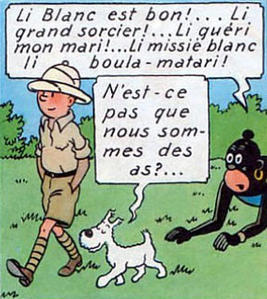
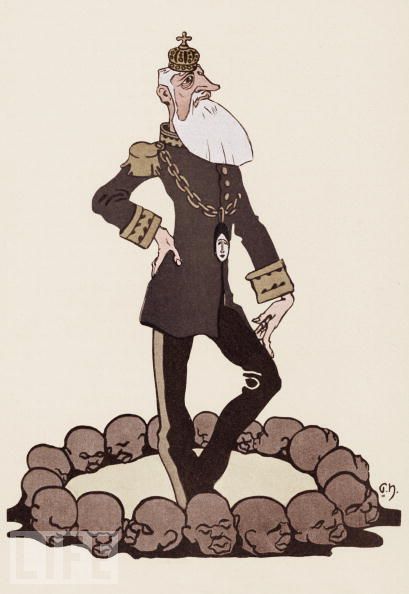
While deindividuation and the formation of enemy images are very common, they form a dangerous process that becomes especially damaging when it reaches the level of dehumanization.
Once certain groups are stigmatized as evil, morally inferior, and not fully human, the persecution of those groups becomes more psychologically acceptable. Restraints against aggression and violence begin to disappear. Not surprisingly, dehumanization increases the likelihood of violence and may cause a conflict to escalate out of control. Once a violence break over has occurred, it may seem even more acceptable for people to do things that they would have regarded as morally unthinkable before.
Parties may come to believe that destruction of the other side is necessary, and pursue an overwhelming victory that will cause one's opponent to simply disappear. This sort of into-the-sea framing can cause lasting damage to relationships between the conflicting parties, making it more difficult to solve their underlying problems and leading to the loss of more innocent lives.
Indeed, dehumanization often paves the way for human rights violations, war crimes, and genocide. For example, in WWII, the dehumanization of the Jews ultimately led to the destruction of millions of people.[9] Similar atrocities have occurred in Rwanda, Cambodia, and the former Yugoslavia.
It is thought that the psychological process of dehumanization might be mitigated or reversed through humanization efforts, the development of empathy, the establishment of personal relationships between conflicting parties, and the pursuit of common goals. (source: Beyond Intractability)
Mightier Than The Sword: “Uncle Tom’s Cabin” and the Battle for America
By David S. Reynolds; Illustrated. 351 pp. W. W. Norton & Company. $27.95
.
From the New York Times Book Review on June 24, 2011, "The Impact of ‘Uncle Tom’s Cabin’" reviewed by Andrew Delbanco:
No less an authority than Leo Tolstoy included “Uncle Tom’s Cabin” on his short list of “examples of the highest art flowing from love of God and man.” Fifty years later, James Baldwin called the same book a “very bad novel” full of “excessive and spurious emotion.” What goes on here? The question belongs in the present tense because it is by no means settled.
There’s nothing unsettled, however, about “Mightier Than the Sword,” David S. Reynolds’s informative account of the writing, reception and modern reputation of “Uncle Tom’s Cabin.” Reynolds unstintingly celebrates its author, Harriet Beecher Stowe, as a colossal writer who mobilized public opinion against slavery, and proved, against long odds, “a white woman’s capacity to enter into the subjectivity of black people.”
The novel began to germinate in Stowe’s mind while she was living in Cincinnati in the 1830s and ’40s, where she met fugitive slaves who had escaped through or from Kentucky, and where, as Reynolds puts it, “she loved spending time in the kitchen with servants like the African-American Zillah.” In the spring of 1850, having moved to Maine, where she followed the Congressional debates over a proposed new law that would deny fugitive slaves basic rights while imposing new penalties on anyone harboring them, she wrote to a magazine editor that “the time is come when even a woman or a child who can speak a word for freedom and humanity is bound to speak.” The result was a series of fictional sketches of slaves under physical or psychological assault — among them, the beautiful Eliza, who escapes from bounty hunters by leaping from ice floe to ice floe across the Ohio River with her baby in her arms; the brooding Cassy, who belongs to the brutal Simon Legree; and Tom himself, whose gentleness and generosity grow apace as he is sold farther and farther south, eventually to Legree, who torments and tortures him before ordering his overseers to beat him to death.
Harriet Beecher Stowe
When the magazine pieces were gathered and published in 1852 as “Uncle Tom’s Cabin; Or, Life Among the Lowly,” the first print run was 5,000. Within a year, the book had sold 300,000 copies in America, and over a million in Britain. As Reynolds points out, a contemporary periodical noted that the number of people who encountered the story may have been 10 times the number who bought the book — since it came out in an era when reading aloud was a common practice among family and friends.
If ever there was a publishing event to prove the principle that timing is everything, “Uncle Tom’s Cabin” was it. On both sides of the sectional divide the timber was dry — and Stowe struck the igniting spark. In the North, Frederick Douglass rejoiced that she had “baptized with holy fire myriads who before cared nothing for the bleeding slave.” In the South, her indictment of slavery through the odious figure of Legree was likened to a “malignant” attack on the institution of marriage, as if she had chosen a wife-beater to represent “the normal condition of the relation” between loving spouses.
A decade after the book appeared, Abraham Lincoln is said to have received Stowe at the White House with the greeting, “Is this the little woman who made this great war?” No one knows if Lincoln really said that, and as the historian David Potter once put it, “history cannot evaluate with precision the influence of a novel upon public opinion.” But Reynolds is sure that the influence of “Uncle Tom’s Cabin” was immense.
Not only, he says, had Stowe “paved the way” for Lincoln’s election, but after her death she may have helped Lenin, who admired her novel, evade the czar’s agents by escaping from Finland over “the breaking ice of the moderately frozen Orfjarden Sound.” Through stage versions of the novel, she helped Henry James develop a sense of “human feelings as performative and theatrical.” Through Chinese and Portuguese translations, she inspired anticolonialism in China and emancipation in Brazil, and she taught the advertising firm J. Walter Thompson how “great masses of people can be influenced through their emotions.”
Reynolds is a rewarding researcher. He illuminates the innumerable “Tom shows” that became a staple of American popular entertainment, as well as the use of Uncle Tom’s image to sell jigsaw puzzles, dolls, card games, stockings and — grotesquely enough — licorice. He identifies stage and screen stars who accepted (Betty Grable, Judy Garland) or refused (Lena Horne, Paul Robeson) roles based on Stowe’s characters. One film performance is surely still worth watching: Little Eva — the angelic white girl who dies after befriending Tom — as played by Lou Costello.
Reynolds has insightful things to say about Stowe’s efforts “to present Southerners as favorably as possible” even as she excoriated their peculiar institution. And in surveying Uncle Tom’s postpublication career, he makes a number of striking points. He suggests, for example, that it may have been Frederick Douglass who first used the term “Uncle Tom” as a pejorative epithet denoting the shuffling docility of a submissive black man, and he traces the ups and downs of the novel’s reputation — high in the Civil War years, low during much of the 20th century, when the romanticized account in Margaret Mitchell’s “Gone With the Wind” (1936) largely supplanted Stowe’s version of the antebellum South. Today, Reynolds says, “Uncle Tom’s Cabin” is again “one of the must-reads of American literature.”
s such, it is a challenging book with which to come to terms. In my experience, students can be embarrassed by it. They recognize it as a valuable document for understanding the history of what we now call the “conversation” about race in America. In response to the prevailing view of black people as inferior beings (a view long held in the North as well as the South), it lifted its black characters to the status of impossibly virtuous victims — just the elevation that James Baldwin felt was a kind of contempt. When Baldwin called Stowe less a novelist than an “impassioned pamphleteer,” he meant, in part, that her characters don’t seem capable of selfishness as well as self-sacrifice, or of pettiness and jealousy along with piety and wisdom. In short, they don’t seem human. Reynolds calls Baldwin’s a “blinkered critique,” though he concedes that Stowe trafficked in the clichés of “romantic racialism” while reminding us, fairly enough, that what now seems “like racial stereotyping” was “progressive” in her day.
Still, we are left at the end of this book with the unsettling question of how to think about “Uncle Tom’s Cabin” as part of our cultural inheritance. The case for it as a literary work of depth and nuance is dubious. Yet it belongs to the very short list of American books (including, say, “The Other America” by Michael Harrington and “Silent Spring” by Rachel Carson) that helped create or consolidate a reform movement — in Stowe’s case, the most consequential reform movement in our history. Perhaps the fact that readers today have trouble taking seriously its heroes and villains is a tribute to its achievement — since, in some immeasurable way, it helped bring on the war that rendered unimaginable the world that Stowe attempted to imagine.
City Talk: David Reynolds, author "Mightier than the Sword"
Ethnic Notions is Marlon Riggs' Emmy-winning documentary that takes viewers on a disturbing voyage through American history, tracing for the first time the deep-rooted stereotypes which have fueled anti-black prejudice. Through these images we can begin to understand the evolution of racial consciousness in America.
Marlon Riggs
Loyal Toms, carefree Sambos, faithful Mammies, grinning Coons, savage Brutes, and wide-eyed Pickaninnies roll across the screen in cartoons, feature films, popular songs, minstrel shows, advertisements, folklore, household artifacts, even children's rhymes. These dehumanizing caricatures permeated popular culture from the 1820s to the Civil Rights period and implanted themselves deep in the American psyche.
Narration by Esther Rolle and commentary by respected scholars shed light on the origins and devastating consequences of this 150 yearlong parade of bigotry. Ethnic Notions situates each stereotype historically in white society's shifting needs to justify racist oppression from slavery to the present day. The insidious images exacted a devastating toll on black Americans and continue to undermine race relations.
Ethnic Notions has quickly become a mainstay of university, high school, and public library collections. It is a basic audio visual text for American History, Sociology, Black Studies, Anthropology, Social Psychology, Media Studies, and any training program concerned with stereotyping and cross-cultural understanding.
Approaching a complex and delicate subject with great sensitivity, Ethnic Notions equips viewers to view media and other cultural representations with a more critical eye. It's a direct challenge to those who say, "It was just a joke."
Ethnic Notions
Ethnic Notions Transcript
VOICE-OVER: A is for Aunty, de odes 'er all, she rocks all us chil'ren t' sleep in her shawl. D is for Daniel, who tends to de do', he took care of massa, way back 'fo de woh. F is for Felix, who won't do no wuk, he's lazy and shif'less and ready to shirk. Z is for Zonia, chunky and small, but 'ere comes de Missus so I guess dis am all.
VIDEO/SYNC: (Cartoon) SCRUB ME MAMA WITH THE BOOGIE WOOGIE BEAT
"Listen, Mammy, that ain't no way to wash clothes. What you all need is rhythm!"
"Wh- wh- what do you all mean, rhythm?"
"Ha ha ha ha. I'll show you what I mean!" (music)
NARRATOR: The mammy … the pickaninny … the coon … the sambo … the uncle: Well into the middle of the twentieth century , these were some of the most popular depictions of black Americans
By 1941, when this cartoon was made, images like these permeated American culture.
These were the images that decorated our homes, that served and amused and made us laugh.
Taken for granted, they worked their way into the mainstream of American life. Of ethnic caricatures in America, these have been the most enduring.
Today there's little doubt that they shaped the most gut-level feelings about race.
LEVINE: When you see hundreds of them, uh in all parts of the country persisting over a very long period of time, they have to have meaning. They obviously appeal to people. They appeal to the creator, but the appeal also to the consumers, those who read the car - look at the cartoons, or read the novels, or buy the artifacts.
CHRISTIAN: It is not just that it's in the figurines, and the uhn coffee pots and so on, it is that we are seen that way, perceived that way, even in terms of public policy. And that our lives are lived under that shadow, and sometimes we then, even become to believe it ourselves.
LEVINE: Blacks don't really look like that. So why is it so appealing to people to think they look like that, and pretend they look like that, and to like to look at icons that look like that. You look at them often enough and black people begin to look like that, even though they don't. Um, so that they've had a great impact in our society.
They therefore tell us both about the inner desires of the people who create and consume them, and also they tell us about some of the forces that shape reality, for large portions of our population.
VIDEO/SYNC: UNCLE TOM'S CABANA
Well now chil'ren, ol' Uncle Tom's gon' tell you the real true story about Uncle Tom's Cabin
NARRATOR: Contained in these cultural images is the history of our national conscience striving to reconcile the paradox of racism in a nation founded on human equality - a conscience coping with this profound contradiction … through caricature.
From the sports pages of the Miami Herald, posted on May 29, 2011, "Le Batard: We may as well just call it the Miami Hate," by Dan Le Batard: Dan Le Batard writes, I was jarred by how the conversation felt with my radio audience last week.
[ Dan Le Batard] Me: Try to be classy, Miami Heat fans.
[Miami Radio]Audience: No.
[Dan Le Batard] Me: Isn’t there a high road to be taken here?
Audience: No.
[Dan Le Batard] Me: You can’t be throwing things at Charles Barkley.
Audience: Shut up.
It is ugly, and it is beautiful, and it is sports — tapping into emotions on the extremes. There isn’t very much, in other parts of life, that makes you scream curses at the TV while the baby sleeps in the other room. And I’m as guilty of being obnoxious about the Heat as anyone this season. This team, a symbol of civic pride in the only city I’ve ever loved, has made me unusually loud, defensive and emotional as America and its sports media roots against it. So I’m not wagging a parental finger from my soapbox at you, Heat fans. I’m just interested in exploring what it is about this team and city that mixes like gas and fire to produce this unprecedented Heat — and a rabid connection unlike any I’ve ever felt between our community and a sports team.
Joy is usually enough. Gratitude, too. But that’s not all you’ll find here. “Thank you!” is glued to “Bleep you!” The joy is mixed with anger, defiance and hostility. Grace, humility and civility are noble but not quite fun. And sometimes sports make us irrational, emotion trampling logic on the way to the party. Burning cars in a championship riot? That seems like a way to protest something, not celebrate it. It also speaks to a larger unhappiness in the homes and lives away from that arena.
If LeBron James ends the season holding up the trophy, our city runs the risk of becoming so unhinged that it will put off even more people from sea to shining sea. When we throw things at Barkley, a beloved icon, and shower him in curses during the Chicago series, we are just giving the media and America the snapshots and ammunition to smear all of us as barbaric, bandwagon baboons.
There is so much criticism in the coverage of this team that the Heat players get ripped for overcelebrating against Boston, changing the narrative almost immediately after the triumph. What is going to happen if a defensive, angry city overcelebrates with a radiator’s hissing relief after an entire season of abuse?
What is a hater?
This is all America’s fault. That’s what you are saying, right? Miami didn’t feel angry and defensive like this when the Heat won in 2006. How good and pure, and only good and pure, did Livan Hernandez's “I love you, Miami” feel in 1997? But America has been overly critical of this Heat team for months, rooting against it in a way so polluted that you can hear it even in the voices of an allegedly objective media. That’s a pretty negative way for America to experience sports, rooting for the other guy to lose instead of for your guy to win, but it is only part of the explanation.
The term “haters” is a plague. It is so dismissive. Lazy. It is either a conversation ender or an argument starter. It closes open minds. And the great soothing in it is that it never requires a mirror. It puts 100 percent of the blame elsewhere, on others, and wraps it in envy.
There is plenty of that at work here. Surely, anyone who cares about sports would want this team on its side. But we participate in exacerbating the envy the moment one frustrated fan throws something at Barkley to combat it, and we perpetuate it when the angry mob concurs that, yes, that is the proper rebuttal for haters. It is why the announcer kept pleading at the end of Game4 against Chicago, as debris filled the air, that anyone who threw things would be subject to arrest. The line between passion and stupidity gets crossed when you go from “In your face!” to “at your head.”
This team is a fascinating civic symbol. It is loud, flashy, cool, famous, passionate, envied, hated. Vanquished Chicago Bull Joakim Noah called the Heat “Hollywood as hell,” but “Miami as hell” would have been more accurate. Led by sugar daddy Pat Riley, the only way this team could be more Miami is if LeBron dunked while wearing Gucci sunglasses, Dwyane Wade smoked a Cohiba on his way to the rim and Chris Bosh played the post while sipping a cortadito (Erick Dampier, for the record, already holds up his end by playing as if wearing chancletas).
Best behavior
So even though these players have behaved honorably in representing the city all season, showing uncommon grace under uncommon pressure, it is easy to see why outsiders might think this team of ours wears too much cologne. Miami knows how to party, and these guys introduced themselves with a swaying, loud fiesta you don’t normally see before a ball has bounced. James, Wade and Bosh have said they don’t regret a moment of that introduction — that it was for Miami, not for anybody else. But too much of our city was built with drug money and is now plagued by foreclosures, so America views the assembly of this team as just another flashy Miami shortcut. And that stinks and stings if you have to witness it thrown in your face while shoveling snow from your driveway and trying to cheer Jamario Moon.
It is worth noting that Heat players, the ones who have actually carried the weight of criticism, have not reacted with defiance, though it would be understandable. In fact, after beating Boston, James not only knelt but took that moment of triumph, of validation, to finally apologize to Cleveland. It was a rather remarkable contrition, given what he has endured this season, choosing the moment you were right to concede where you were wrong. Many of us, after having our image run over by a convoy of 18-wheelers for a single Decision, might have spent the entire postgame constructing a parade float out of middle fingers.
But here’s the disconnect between James and the city that celebrates him so zealously now: He has a voice, a platform, a scoreboard and inordinate fast-twitch muscle fiber with which to defend himself. The Heat fan? Not as much. It’ll make you insane, not really having your desperate voice heard, and that is true whether you are at the bottom of a well or at the top of sports. New media like Facebook and Twitter has exploded in part because people just want to be heard — to have the platform old media has.
So poison and T-shirts and expletives get hurled at Barkley, ESPN personalities and all the media members who appear to be rooting against this team. Why? Because those people are a face and voice and symbol and punching bag. They represent every faceless “hater” in America who has rooted against this team. Barkley, meanwhile, can spew all over every newspaper, radio and TV platform without rebuttal — and be very popular everywhere outside of Miami while doing it.
When it escalates
The result? Hostility. Defensiveness. Frustration. Helplessness. (Until LeBron James dunks on your behalf.) And that leads you down an emotional path that is just a few exit ramps from taking pleasure in the pain of others. Just like those old Hurricane football anarchies, it isn’t just about your own team; it becomes about inflicting pain on someone else’s. I’m not certain if mixing the love and hate makes for a better sports experience, but it certainly makes for what feels like a bigger one.
I have a friend who travels the United States. He isn’t invested in this. He is impartial. He isn’t attached to this team, city or basketball. Everywhere he goes, when the NBA comes up, he hears, “I hate the Heat. I hope they lose.” When he asks them to articulate what they hate, exactly, they tend to sound dumb. Still, something about this team bothers people in a visceral way, and there are too many people that feel it, really feel it, to simply dismiss the legitimacy of it while filing it under hater.
But here’s how hostility escalates: Even Gandhi is going to get worn out if he hears “I hate you” over and over from every angle of America. People on the receiving end of “I hate you,” understandably, aren’t going to hear anything above that, no matter how rational, nuanced or muted the criticism becomes. And at some point, the basic human response simply morphs into this:
And the real story behind Fox’s faux pasClaudio Lomnitz
In a speech to a binational agribusiness audience this past May, Mexican President Vicente Fox complained about growing American barriers to Mexican immigration. Faced with an anti-immigrant vigilante movement, a forbidding wall raised on the Arizona border, and a Real ID program that denies Mexican illegals a driver’s license, a bank account, and legal identification, Fox confidently told his audience that “una solución win-win” was possible. After all, he said, Mexican immigrants are doing the jobs that “not even blacks are willing to do.”
Fox’s statement caused a political storm in the United States. Jesse Jackson traveled to Mexico and met with Fox. So did Al Sharpton. Both demanded explanations and apologies. The U.S. ambassador to Mexico, Tony Garza, expressed concern to his Mexican counterpart, and the White House issued a formal complaint. Mexican-American and African-American organizations decried the statement; African-American businessmen considered boycotting tourism to Mexico. The story was picked up by all the major American media—The Washington Post, the Los Angeles Times, The New York Times, CNN—and it caused an even bigger storm in Mexico: when the United States catches a cold, Mexico gets pneumonia.
Memín was described by his creator, Yolanda Vargas Dulché, as un chiquitín negrito de ojos enormes y muy chistoso – “a very funny little negrito with enormous eyes.” Although she drew the comic between 1945 and 1952, the series has been perpetually reprinted, and beloved, to this day. In 2005, when the Mexican Postal Service printed stamps in honor of Memín Pinguín, they sold out within a matter of hours. Various U.S. politicians, including Jesse Jackson, complained, ensuring the historical place of the stamps as collectors’ items. (Source: David Lido, Mostly Mexico City)
The ruckus completely overshadowed the original subject of debate; Mexican racism replaced immigration as the issue of the day. Then, just when the scandal had finally subsided, a new conflict broke out around a set of five Mexican postage stamps issued as part of a commemorative celebration of Mexico’s comic books. The stamps, which featured a cartoon character named Memín Pinguín, raised the accusation of Mexican racism once again.
Memín was created in the 1940s by Yolanda Vargas Dulché, an exuberant sentimentalist and blockbuster photo-novella writer. In a country in which newspaper runs rarely exceed 100,000, reprints of Memín still sell 125,000 copies a week. Memín has black skin, thick lips, a flat nose, and eyes like saucers. He lives alone with his mother, doña Eufrosina, an Aunt Jemima–like washerwoman who speaks Spanish with a Cuban accent. Memín, who was named after Vargas Dulché’s boyfriend, and later husband, Guillermo (“Memo”) de la Parra, loves his “Ma’ Linda,” who spoils him adoringly, though she does not spare the rod (her famous palo con clavo—board with a nail). Doña Eufrosina is, in any case, honest and clean, a dignified representative of the “working poor.”
Memín is the only black kid in a gang of four boys, all of whom attend the Benito Juárez public school in Mexico City. They are a multi-class group from the unmarked (i.e.,mestizo, or mixed-blood) portion of Mexico’s racial and class spectrum, with the exception of Ricardito, who is blond and rich, but (predictably) has unhappy family circumstances. Memín often provides comic relief in ways that are reminiscent of blackface minstrel theater (a well-developed genre in Cuba, where Yolanda Vargas Dulché first conceived of the Memín character, but with precedents in Mexico’s popular puppet theater of the 19th century).
The gang’s core characteristic is its absolute internal loyalty. When the gang travels to Texas to play soccer, for example, Memín’s friends defend him with indignation when he is subjected to Jim Crow laws and personal insults. The boys go on to win their game and triumphantly return to Mexico.
American reactions to Memín in June after the stamps had been released were not informed by the comic book’s plotline, which is of course virtually unknown in this country, but rested entirely on Memín’s image, which is deeply familiar to Americans. Inspired by the cartoon character Ebony White, from Will Eisner’s 1940s comic strip The Spirit, the Memín drawing is a variation of the Little Black Sambo theme.
The White House spokesman, Scott McLellan, condemned the Memín stamps, stating imperiously that such images “have no place in today’s world.” Jesse Jackson, who had just accepted a tortured and ambiguous apology from Fox for his May statement, saw the stamps as a deliberate insult. The African-American community agreed, and the question of Mexican racism against blacks again undermined the Mexican government’s ability to claim the moral high ground in immigration debates.
The Mexican public was caught by surprise in a storm that the Mexican press quickly dubbed “The Memíngate Affair.” Mexican racial attitudes had suddenly emerged as a factor in bilateral relations with the United States. How exactly had this happened? At what point did Mexicans start to be thought of as racist?
After all, Memín Pinguín is not the only comic book of the mid-20th century that was both wildly popular and racist, and that continues to be reissued and avidly consumed. Tintin, the character created by the Belgian Hergé, is a French journalist who, together with his lily-white dog Milú, goes around the globe straightening things out and protecting the feeble colonial races—Bedouins, Congolese, Chinese, Peruvian Indians—from their exploiters and from themselves.
Asterix and Obelix, a Gallic-nationalist duo, also have their racist moments and are nonetheless widely adored. They even have a theme park in France.
And the United States’s own Speedy Gonzalez has been massively popular. Speedy (“Arriba! Arriba! Andale! Andale!”) is a fast mouse in a town of drawling and anemiccompadres and beautiful mouse señoritas. Like Memín, Speedy fools and tricks arbitrary authority (in the form of a cat), while domesticating and reproducing prejudices about Mexicans.
With these images in mind, Mexican response to the Memín affair ranged from surprise to indignation: ethnic caricatures are a standard and relatively innocent form of entertainment, they claimed, and in any case, the United States should not cast stones from its glass house. At least in Memín the black kid is the hero; at least he has a lovable mother; at least he goes to the same public school as Ricardito.
But the roots of the dispute run deeper than American hypocrisy and Mexico’s refusal to inspect its own racism. The Memín affair reflects decades of profound and unacknowledged changes in the relations between the United States and Mexico.
Until the 1980s, Latin America, and especially its two great mestizo countries, Mexico and Brazil, claimed moral superiority to the United States on race relations. In the case of Mexico, their superiority was predicated, first, on Mexico’s early abolition of slavery in 1829, shortly after its independence. Because Mexico later went to war with the United States, and the United States has been a constant source of nationalist anxiety, Mexican superiority on race issues became an explicit theme of public discussion from the mid-19th century forward. Moreover, anxieties about annexation by the United States, which were a constant through the 19th and early 20th centuries, were fueled by American discrimination against Mexicans and Mexican-Americans in American territory. In short, the experience of discrimination in the United States has helped to sustain Mexican nationalism for a century and a half. (source:Boston Review, Nov./Dec. 2005, byClaudio Lomnitz. )
Continue reading this article click here.
Memin Pinguin: The Structural Violence of an Image, Afro Mexicans
Mexicans have 3% to 8% African blood when averaged out among all Mexicans, and 50% to 80% in places like Costa Chica in Mexico. At one point 33% of Mexico was inhabited by African slaves, over time most mixed in the the population. Most people consider themselves to be Mestizo (White and Native only) but genetically, most Mexicans are a combination of Amerindian, African, and European, in different degrees. Most Afro-Mexicans are only considered Negro when they have very dark skin, however the brown/lighter ones are considered to be Mestizo mainly because Mulatto/Negro has a negative stigma attached to it. Memin Pinguin is a great example if this stigma. In addition a significant amount of slaves were originated from Cuba, the Memin Pinguin character is also based on a Afro-Cuban character.
MAKAU MUTUA of the Daily Nation reviewed Tim Jeal's book Stanley: The Impossible Life of Africa’s Greatest Explorer, writes I am surprised that I managed to complete reading the biography Stanley: The Impossible Life of Africa’s Greatest Explorer without decomposing from revulsion.
Anyone who knows anything about African colonial history cannot fail to be provoked by one of the most relentless and carefully researched works on Henry Morton Stanley, the 19th century journalist-adventurer whose early claim to fame was locating David Livingstone, perhaps the most famous European adventurer, in the belly of Africa.
But if there is any consolation in my labour, it is that the book says more about the West and Tim Jeal than it does of Africa. It is a work that will be despised by many Africans but almost certainly lauded in the West.For a work from a writer who claims objectivity, the book is a concerted, even emotional, defense of the chilling life of a man many Africans would rather forget.
RECAST HISTORY
From the outset, Jeal embarks on a journey of redemption and salvation in which the writer seeks to recast history through the interpretation of a life lived in blood, racial hatred and ignominy. It is all about the white European conquest of Africa. Africans are themselves only accoutrements in this large European narrative of history.A typical example of this obsession with the feats of the so-called discoverers of Africa is the uninterrogated assertion that Stanley was the “first man in history to have followed that great river [the Congo River] 1,800 miles from the heart of the continent.” One finds it inconceivable that Africans themselves had never attempted and accomplished such a feat.
But perhaps to Jeal and his fellow Westerners, Africans do not count as “men.” To Jeal, before Stanley and Livingstone, “apart from the apparently inaccessible central and sub-Saharan Africa, the only significant parts of the planet left unexplored were the equally daunting polar regions, along with northern Greenland and the north-east and north-west passages.”
The allusion is clear: only beasts – or sub-humans – can live in such remote and inhospitable regions.
Even in his narration of Stanley’s early life, Jeal makes implausible apologies for a sad and unforgiving childhood. From his illegitimate, abusive and abandoned childhood, it should be clear that Stanley suffered life-long traumas that shaped his identity for the rest of his life.
Several of these include his proclivity for brutality and sadism, his penchant for outright misrepresentations and impossible exaggerations about his identity, paternity and achievements.
Not to mention his obvious racial self-hatred and desire to be classified as either English and later as an American rather than the Welshman that he was.
But rather than use the inhumanity of British society to explain why Stanley later became a pathological brute – including his racial animus toward American blacks during the Civil War – Jeal instead excuses and minimises these distortions of character.
STRUGGLES MIGHTILY
Henry Morton Stanley was gay?
Jeal struggles mightily to explain away or diminish Stanley’s every perceived character flaw or failure. One curious instance is Jeal’s attempt to swat away arguments that Stanley may have been gay or at least bisexual.
He perceives homosexuality as a problem that must be explained away or discounted. Elsewhere, Jeal states, rather incredulously, that Stanley was not a racist.
This despite the fact that Stanley had murdered in cold blood or flogged mercilessly many Africans who were in servitude to him on his expeditions. What Jeal misses over and over again is the permission that Europeans like Stanley gave themselves as the arbiters over the life and death of many an African.
Particularly troubling in Stanley is Jeal’s failure to situate Stanley, Livingstone and other early European explorers as the pathways to the colonisation and exploitation of Africa by Europe.
In Stanley’s case, apart from his connivance with Arab and European enslavers of Africans, it is impossible to separate him from the brutal fate of the Congo.
It was his work that led King Leopold II of Belgium to the Congo and the utter devastation of the region and its people. It was Stanley who set the example, stage and tone for the brutalities and pogroms of the Belgians in the Congo.
Any attempt that sidesteps or apologises for this inescapable connection between Stanley and colonialism is an inexcusable nod at crimes against humanity.
Jeal makes passing references to what he calls the predicament of Stanley and other early colonialists in Africa. He fails to situate the Stanley expeditions in their right historical context.
Here were hordes of uninvited and invading Europeans on the African continent.
If anything, Jeal proceeds as though the Europeans have a more superior moral claim to Africa than Africans themselves. That is why he tells the story of Stanley from the colonialist’s viewpoint, and treats Africans as fodder in the larger European mission of civilisation of the native.
LITTLE REFLECTION
There is surprisingly little reflection in Jeal’s Stanley about the fate of Africa and the role that the early European adventurists played in its construction.
At the very least, this is either an attempt at amnesia or simply bad scholarship on the part of a supposedly respected author. Since Stanley represents the point of cultural contact – and civilisational clash – between Africa and the West, it behoves the author to deliberate on the meaning of that encounter and its historical meaning.
Rather than lament that some writers now unfairly demonise Stanley – whom Jeal would have us believe was a saintly explorer – the author should have set aside any personal agendas and let history speak for itself. Instead, Jeal writes a political book in defence of a historical monster.
I do not deny that there is a place in scholarship for the reinterpretation of history, particularly of notable figures and their roles. But authors have to be careful that they are not so possessed with the desire to defend their icons that they lose sight of the moral purpose of scholarship.
The evidence of history, including in Stanley’s own words, is so overwhelming that a complete rewrite of the narrative – which is what Jeal attempts – is not convincing. Nothing is served – except the agenda of European exceptionalism – when a writer of repute resorts to such an untenable project.
Nor can racists, particularly of the harsh imperial hue of the brutal 19th century, be easily humanised. If Jeal’s attempt was the resurrection of a humane Stanley, then I must judge him a complete failure.
This article was written in French and was totally translated, from a post at dooyoo. After reading a number of articles regarding Tintin au Congo, this one seems to be sensitive to both the author of the Tintin comic series (the French call them "albums") and the reader. So many others simply dismiss the racism as "political correctness" running a muck. The Tintin images are difficult to view, in light of the historical atrocities of King Leopold. The King that impoverished a nation, enacted genocide and stole the wealth of a nation with the help of turn-coat former Confederate Henry Morgan Stanley. It's not "political correctness" that seems too trite and trivial in light of King Leopold's crimes. But, every great historical crime has a cute propaganda laden children's book to justify and whitewash the crime scene.
I don't know who the author is, but as stated before, it is well written, the ending needs a bit of tightening-up, but it could just be poorly translated. --Ron Edwards
******
Big fan of Hergé's work, I am always (and still am) found as the majority of readers, extremely uncomfortable to Tintin in the Congo.
While Tintin is generally regarded by all readers as a hero without fear and without reproach, always ready to go save the poor and to descramble the most dangerous political situations for democracy, yet there is two albums that make a part of shadow humanistic adventures of the hero: Tintin in the Land of the Soviets and Tintin in the Congo. These two albums, whose adventures are located respectively in the former Soviet empire and the former Belgian colony, attempt, too, in an exemplary way in the world history of the twentieth century. They are mostly illustrations "remarkable" the image that the West, here in Belgium, may get the rest of the world including the African people under the yoke of colonial nations. It is packed images that represent a very particular mindset.
As part of an academic work, I had to make a comparative study between the two versions of Tintin in the Congo (1930 and 1946), by attaching myself mainly on the theme of political correctness, and I will try to summarize in broad strokes.
The version we all know today, compared with the first edition published serially in the Little twentieth of June 5, 1930, has many changes (imutiles?) By Herge himself on the particular representation of black, d a graphical perspective, screenwriting, and linguistics. Indeed, in this period of beginning of the end of colonial empires, the birth of a culture of "discovery" of the world, some environmental awareness, the rebirth of a minority culture, Europe is guilty , and married a whole new ideology.
It was obvious that Tintin in the Congo experience a period of disgrace and bad press to do so Casterman, that forced the author to rework the album. Accusations of racism that Herge was a victim throughout his career started, and it was then to present the album in a form more acceptable.
I find it important to address the circumstances of the creation of the first Tintin in the Congo and the various deviations now seen the replay of this album (now found in facsimile) within ' hinge between a century racist ideology and patronizing, and rise of a collective consciousness to rehabilitate the image of minorities, ie the advent of political correctness: The story of the late nineteenth and early twentieth century is reflected in the heyday of the great European colonial powers. A colony, I need to remember is stricto sensu a territory occupied and administered by a nation outside its borders, and still attached to the mainland by close ties. The goal of the colonizing countries was of course take advantage of a territory and its riches, priceless in terms of Africa, but also assume, in all "sincerity," a civilizing mission and morally redeeming involving indigenous peoples, through technical progress, Christianity and labor.
The Western image of the indigenous at the time of colonial exhibitions, that is simply the recovery of indigenous ways of life in zoos is full of racism in the sense that the West is convinced of the quasi-animal blacks, and his intellectual and moral inferiority.
For reference, an extract of the definition of the word negro from the Grand Larousse dictionary of the nineteenth century, written by Pierre Larousse himself:
"It is in vain that some philanthropists have tried to prove that the species negro is as intelligent as white species (...) If the Negroes are similar to some animal species by their anatomical forms, by coarse instincts, they differ and approach the white men in other respects we must take utmost account. They are endowed with speech and words we can build relationships with them intellectual and moral, we can try to raise them to us (...) ". striking, no?
Collective representation shows blacks at worst aggressive at best totally incompetent, lazy, just smart and almost incapable of practicing a foreign language without distorting it.
Belgium is the beautiful part in this movement imperialist occupying the Congo, now Democratic Republic of Congo from 1876 to 1960. When Tintin returns from the Land of the Soviets, the first idea is to Hergé's hero from America to fight against gangsterism in Chicago. But this time the Belgian Congo in dire need of manpower and metropolitan officials. Tintin's popularity is so extraordinary and so the abbot Wallez Brussels Catholic priest, a staunch defender of the colonial cause and editor of the Petit Herge Twentieth which works before being recovered by Casterman in 1931 requires Hergé transpose the next adventures of the reporter in the Congo. The scenario of the album is very simple and you know Tintin, as is the case in all his first album, simply hand over the other continent as a reporter, with all the paraphernalia necessary for shooting and sound recording. Once there, the hero will live a succession of ups and downs with no real logical sequence leading to the imprisonment of American gangsters who wish to hand over the diamond mines of the country. It is here by no means a purely humanist, as was the case itself many times in his other adventures, as all the country's wealth was controlled by the colonizers. It was implicitly to fight against any form of looting of Belgian heritage, not Africa. This adventure will allow it to patrol the African territory, to implicitly emphasize the importance of the contribution of Europeans in the Congo.
If Congo had the worst atrocities during its occupation by Belgium, no evidence of such abuse on the African people, nor any aggression from the West are represented in Tintin in the Congo, except the acts of gangsters in the pay of Al Capone. If the reading today from the album leaves a deep unease to the reader (even in its new version), one of the twenties there yet rediscover all that the collective imagery conveyed in a simplistic way at that time: Africa is a vast paradise, land of every adventure and distinction from whites, land populated by uneducated individuals but devoting a cult following in Western Christian culture, and just waiting to rise up to their level. Due to the transposition of these vast colonial clichés, this ad made in Congo is becoming an apology for the white man, through Tintin himself. His triumphant arrival in Africa - which also strongly resembles a self-advertising the Little Twentieth, suggesting that Africans attach great importance to the news and culture internationally and have closely followed the adventures of anti- Tintin Bolshevik countries. They are, in fact, a savior and an ideal model. This trick will allow technology to be recognized as king in the M'Hatuvu an indigenous tribe, or chief of the tribe of Ba Baoro'm honorific accept it without asking questions and without any humility. The image of the gentle missionary who will save him from death and that we will see at the head of a mission with children at school also has a great importance. It is an endearing image in the colonial ideal, especially since the missions had a high importance in the process of Christianization of Africa
All African representatives are present in this album: idyllic cruise to rally the continent, vast land and beautiful scenery, amazing wildlife and dangerous, large outflows hunts lions or leopards very popular among rich Europeans, etc.. But this exotic, there are other more dubious references. The graphical representation of blacks is quite striking. The characters are drawn so rude, and their image is a caricature: small, puny, air consistently amazed with exaggerated lips, and dressed in ridiculous getups: unlike the beautiful costume worn by colonial Tintin 's they are not in rags, blacks trying to dress in Western style, just like their models, even if it is completely unsuitable climates and situations, such as the mantle at the neck fur or even a tie to the topless. They are also observed with an air often aggressive and defiant, ready to pounce.
Blacks are represented as big children, fearful, lazy, incapable of any initiative, deeply gullible, naive and superstitious. Hergé The way to give voice to blacks is also very representative of the collective imagery. Uses terms specific to Swahili culture, such as Muganga which means one who healed so he's talking about these characters in "negro boy" in a permanent form of grammatical imperfection. The sentences are quite understandable, but they recall more of a mixed language deliberation, rather than a difficulty in speaking, and to make sentences in a foreign language. This standard language of the social representation of Black is now outlawed in the name of political correctness.
I think the violence of the dialogues of Tintin against blacks is exemplary, and you certainly do not escape: it is not strictly speaking of insults, but very often mark of authority or contempt. "Silence! You ... We will repair your dirty little machine!" In passing, the use of the word negro, innocently used at the time, but now completely irrelevant, as it has taken a real connotation racist nowadays. In the first version, taking flight from the onslaught of pygmies, Tintin, uses the word nigger mean who has very dark skin, today disappeared from common usage, but then found insulting and degrading . This violence is not confined only to individuals but is also found to African wildlife. Actions speak for themselves (butchering a monkey, a rhino exploded, killing fifteen free antelopes, etc..) and indifference and contempt that Tintin has towards animals are quite similar to a form of appropriation of African culture.
Their beliefs and forms of power based on the tribal system are systematically ridiculed. Conversely, the power of Tintin on the natives is taken very seriously, and the hero himself: as a result of an election over a dispatch to the head of a tribe, he hesitates, not declare "I just started my tour in my village ... and already I see, as everywhere fights." The term "as everywhere" is interesting because obviously the blacks do not belong to a civilized people ... It is also launching in speedy justice, uncompromising and sure of himself (see the scene of the straw hat).
The famous episode of the collision between the car and the locomotive of Tintin is certainly the most striking feature of the album, as it summarizes the attitude of European and African stereotypes presented above. The Congolese and technological inferiority first described here, since a single trans-Saharan car overcomes a locomotive and its cars, vulgar wooden crates. After a quick apology, Tintin interrupts net protests claiming his natural authority over the natives, hands on hips "Come! at work! ... "" Are not you ashamed? Let a dog do all the work! . The nervousness is a legitimate and portrays blacks as a form of irritability, of laziness. Also included in this scene's supposed flirtation ridicule blacks, hoping their attire move closer to the ideal dress in European fashion. Finally, note that if Tintin is responsible for the accident, he comes out despite the glorious little effort made to repair the train, and who is devoting recognition. The whole album is a demonstration of social relations between the colonists and the colonized, and the will to power, condescension and paternalism of whites against blacks. The insistence of Tintin through dialogue to systematically minimize blacks means that reveal vulnerabilities of a nation implies the need to bring him help. It is therefore an implicit justification of the colonizer, and you can see in this album by Hergé active in the construction of black identity.
Ethnocentrism can be termed as the fact that a civilization judge any other culture in relation to hers that she considers better than others. This ideology was obviously massively popular there are still a century in a context of "world conquest by the West. For the idea of colonization is meaningful to the public, who at the time was already heavily steeped in the bourgeois prejudices ethnocentric, it was therefore a construction of the identities of colonized peoples, what has contributed Hergé Tintin in the Congo. It was primarily to build the colon as a standard and reference. A gradual fall of European colonial empires, the birth will be added to a large international humanist conscience. The proliferation of media and currents of thought of human ecology will lead to European civilization in a giant mea culpa. Belgium feels the Congo, its wealth and its role on the local population to escape. Its abuses are beginning to be revealed to the public, and decolonization in the acts is often painful. Ethnocentrism back in speeches, and should therefore review the social representation of Africa and blacks. The politically correct attitude of erasing all about derogatory, demeaning and hitting is the norm. In this way, the Tintin in the Congo in 1930, and his share of stereotypes, prejudices suddenly finds himself in complete disagreement with the crop now in order. It is not politically correct, and is apprehended by readers with embarrassment.
In 1931, Editions Casterman ensure the exclusivity of Hergé's albums in French. They publish the first version of Tintin in the Congo after the serial publication the previous year at Little Twentieth. This fall we have said, and for long a period of public disaffection (and for good reason ...), editions imposed in 1946 to Hergé to rework the album to make it more ideologically acceptable. The new edition of Tintin in the Congo transform does not however prevent him from being completely shunned by the public in the sixties, following the increase in problems related to decolonization.
The first visible changes in the album are great. For editorial reasons, Hergé was forced to reduce his album to 62 pages then exercised in Casterman, while its first edition contained 109, which in no way affects the course of history, the size of each block being reduced. The other significant asset is the development of full color album. The refinement of the character as a landmark since then tintin keep this silhouette.
If the frame of the story has not changed, many details have been altered or simply removed to better meet contemporary ideological.
Hergé has erased all references to scriptwriting language or colonial involvement of Belgium in the Congo. Apart from its colonial holding and attending a mission, Tintin is more than just a reporter out to discover exotic in a country where it is known that research and adherence to Western culture. The metamorphosis of the episode of the class of mission is also very revealing of what bothered at the time. This is undoubtedly one of the most contested fields of the album. In the original edition, Tintin replaced at short notice a sick teacher and envisions a geography lesson to small black before being interrupted by a leopard. "My dear friends, I will talk today about your fatherland Belgium! ...." The reference to Belgium will also be removed, let alone that the term "your" presupposes a political and cultural integration of indigenous peoples in colonial countries. The course then becomes a simple math, more neutral.
In this dialectic, the reader of the new edition could legitimately expect to find major changes in the linguistic attributes of the African population. The talk "negro boy" is now considered a form of social impairment Black. We saw how the language presented in the first edition is enlarged and imperfect. The new edition seems to have fully complied with these characteristics. However, if there are scenes where the African French speaking now quite correct, there are also scenes where people speak a French normal start talking in an Africanized French. No logic seems to have been followed by Hergé in this case.
It seems to me that the most significant difference lies in the dialogues of Tintin and Snowy towards Africans. The marks of authoritarian discourse against blacks, for the sake of preserving the colonial ideology are mitigated. Manifestations of Western prejudices about blacks are much less stressed. The vocabulary extravagant version of 1930 for us today also disappeared. Thus the term "negro" appearing twice in the first version, disappears completely in 1946 and used the word nigger in the prosecution of the pygmies, humiliating expression is also completely forgotten But generally, the attitude toward Tintin African culture has not changed. Although he no longer treats animals dirty creatures, we see nevertheless continue its massacres. The white man is still considered a hero, marks deference is no shortage (carried in triumph, kneeling election as head of a village) and the representation of blacks is still very stereotypical: the design of the new lighter refined version of the slave trade, now represented with a figure more realistic and less simian. Their aggressive air has disappeared to be replaced often to clean air, stunned, certainly, but jovial and friendly. However, their childlike appearance is still relevant. . The scene "news" of the collision between the car and the locomotive illustrates this point. Blacks are always presented in outrageous ways: their clothes have not changed, just as they are reluctant to go to work and get dirty, and Coco, the boy reporter is still gone into hiding after being scared. "The dirty little machine" becomes an "old-Tchouk Tchouk! But Tintin retains his conduct as a leader.
I sincerely doubt the value of the new edition of Tintin in the Congo. Reading the new version of the album mind readers over the age of childhood. A child more easily rise up against the massacre of fifteen antelope or implosion of the rhinoceros. Only much later, in the light of his conscience humanistic and respectful of all races, and especially expert in African history from slavery that the reader will reject it, seeing it as denial other. I think that Hergé never rework of this album. His changes have finally deeply changed nothing, and perhaps worst of all.
Okay, the cartoon is the form most widely used in humor and comedy. The characters are often enlarged to give more spice to the stories and situations. The cartoon child is precisely the temple of humor. The plot of the stories of the adventures of Tintin, certifying all accounts are being punctuated with gags, dialogue tasty. Nevertheless, the question "Can you laugh at all? "Added the question of the responsibility of the author towards his silent propaganda against Belgian children of the 30s.
King Leopold estimated death toll of native Congolese between 2-15 million. Expropriating the Congolese natural resources and enslaving the indigenousness people of the Congo, made King Leopold one of the richest men on the planet.
"For the Congo, as for Tintin in the Land of the Soviets, it is that I was fed the prejudices of the bourgeois milieu in which I lived ... It was in 1930. I knew this country than in telling people at the time: "The Negroes are great kids ... Luckily for them that we're here! etc.. And I have drawn these Africans, according to these criteria there, in pure paternalistic spirit of the times was that, in Belgium (...) "
Tintin and I, interviews with Numa Sadoul, Casterman
Hergé evidently wants to clear itself of its past mistake. While one might wonder about his lack of critical thinking, it is quite logical to see this album in the foundations of one of the biggest trials of the century literary past: Herge / Tintin Is Racist ?


 The ruckus completely overshadowed the original subject of debate; Mexican racism replaced immigration as the issue of the day. Then, just when the scandal had finally subsided, a new conflict broke out around a set of five Mexican postage stamps issued as part of a commemorative celebration of Mexico’s comic books. The stamps, which featured a cartoon character named Memín Pinguín, raised the accusation of Mexican racism once again.
 Memín was created in the 1940s by Yolanda Vargas Dulché, an exuberant sentimentalist and blockbuster photo-novella writer. In a country in which newspaper runs rarely exceed 100,000, reprints of Memín still sell 125,000 copies a week. Memín has black skin, thick lips, a flat nose, and eyes like saucers. He lives alone with his mother, doña Eufrosina, an Aunt Jemima–like washerwoman who speaks Spanish with a Cuban accent. Memín, who was named after Vargas Dulché’s boyfriend, and later husband, Guillermo (“Memo”) de la Parra, loves his “Ma’ Linda,” who spoils him adoringly, though she does not spare the rod (her famous palo con clavo—board with a nail). Doña Eufrosina is, in any case, honest and clean, a dignified representative of the “working poor.”

 The gang’s core characteristic is its absolute internal loyalty. When the gang travels to Texas to play soccer, for example, Memín’s friends defend him with indignation when he is subjected to Jim Crow laws and personal insults. The boys go on to win their game and triumphantly return to Mexico.

 The White House spokesman, Scott McLellan, condemned the Memín stamps, stating imperiously that such images “have no place in today’s world.” Jesse Jackson, who had just accepted a tortured and ambiguous apology from Fox for his May statement, saw the stamps as a deliberate insult. The African-American community agreed, and the question of Mexican racism against blacks again undermined the Mexican government’s ability to claim the moral high ground in immigration debates.


 With these images in mind, Mexican response to the Memín affair ranged from surprise to indignation: ethnic caricatures are a standard and relatively innocent form of entertainment, they claimed, and in any case, the United States should not cast stones from its glass house. At least in Memín the black kid is the hero; at least he has a lovable mother; at least he goes to the same public school as Ricardito.
 But the roots of the dispute run deeper than American hypocrisy and Mexico’s refusal to inspect its own racism. The Memín affair reflects decades of profound and unacknowledged changes in the relations between the United States and Mexico.
 Until the 1980s, Latin America, and especially its two great mestizo countries, Mexico and Brazil, claimed moral superiority to the United States on race relations. In the case of Mexico, their superiority was predicated, first, on Mexico’s early abolition of slavery in 1829, shortly after its independence. Because Mexico later went to war with the United States, and the United States has been a constant source of nationalist anxiety, Mexican superiority on race issues became an explicit theme of public discussion from the mid-19th century forward. Moreover, anxieties about annexation by the United States, which were a constant through the 19th and early 20th centuries, were fueled by American discrimination against Mexicans and Mexican-Americans in American territory. In short, the experience of discrimination in the United States has helped to sustain Mexican nationalism for a century and a half. (source:


 I find it important to address the circumstances of the creation of the first Tintin in the Congo and the various deviations now seen the replay of this album (now found in facsimile) within ' hinge between a century racist ideology and patronizing, and rise of a collective consciousness to rehabilitate the image of minorities, ie the advent of political correctness: The story of the late nineteenth and early twentieth century is reflected in the heyday of the great European colonial powers. A colony, I need to remember is stricto sensu a territory occupied and administered by a nation outside its borders, and still attached to the mainland by close ties. The goal of the colonizing countries was of course take advantage of a territory and its riches, priceless in terms of Africa, but also assume, in all "sincerity," a civilizing mission and morally redeeming involving indigenous peoples, through technical progress, Christianity and labor.