Showing posts with label British. Show all posts

Wednesday, July 6, 2011

New York Slave Laws

Ships flying the Dutch West India flag.

The Dutch West India Company introduced slavery to New York (known then as New Netherland) in 1625 with the importation of eleven black slaves. These early slaves were put to work as farmers, fur traders, and builders. Some were used to build a wall to protect white settlers from the Native American population at the site of today's Wall Street in downtown Manhattan. Although enslaved, the Africans owned by the Dutch enjoyed a few basic rights.
They could be admitted to the Dutch Reformed Church and married by its ministers. Their children could be baptized, and slave families were usually kept intact. Slaves could testify in court, sign legal documents, and bring civil actions against whites. Some slaves were permitted to work after hours earning wages equal to those paid to white workers. When the colony fell to the British in 1864, the Company freed all its slaves-thus establishing early on a nucleus of free African Americans in New York.
English slave laws in the colony were much harsher in comparison to Dutch slave laws. For one thing, slaves were considered chattel or property, and their enslavement ended only with their death or manumission. The earliest slave codes passed in 1664 defined slavery as an inherited racial status-meaning that the children of slaves were also slaves. New York slaveholders could inflict any punishment short of mutilation and death on their human property. Freed blacks were also denied most civil rights under English rule. Any crime committed by a black against a white was severely punished, while white crimes against blacks were largely ignored.

According to the first U.S. Census, the slave population in New York grew to 21,324 by 1790, making New York the largest slave-owning state north of the Mason Dixon line, a distinction it held throughout the two centuries the state practiced slavery. In New York City, a large percentage of the blacks were free-some 33 percent or 1,482 inhabitants by 1820. In the nearby rural area of King County, in what is present day Brooklyn, most of the blacks that lived there were slaves and worked as farm laborers.
In New York City, on the other hand, one third of the black population worked as skilled artisans. Not only did many enslaved Africans live and work in New York prior to the American Revolution, New York City prospered as a thriving center of the slave trade. New York slaving ships made over 150 trips to Africa between 1715 and 1776. Most of the enslaved people brought to Manhattan were transported from New York after a brief time in port to the Caribbean or else to Virginia, the Carolinas, and Georgia.


The English sweet tooth and the New York slave trade, 1690 - 1725

Monday, June 27, 2011

Slave Food: Breadfruit

Breadfruit

Despite many setbacks, Jamaica continued to grow as an agricultural colony. However, its troubles in war were not yet over. The American Revolution spurred a revolution in France, and the effects of this second revolt were also felt in the Caribbean.

Tough Times
Breadfruit

Jamaica, like many of the Caribbean islands, experienced tough times during the war. Much needed supplies from North America were no longer shipped to the British colonies, so Jamaica was forced to trade with Canada and Britain, getting fewer supplies with less frequency.

Hurricanes also caused a great deal of damage to Jamaica, with these strong storms hitting in 1780, 1781, 1784, 1785, and 1786. The destruction of crops each of these years caused famine, and by 1787 more than 15,000 slaves had died - mainly of starvation. The subsequent search for food to feed the labor force led to the importation of many new plants.

Agricultural Expansion

Ackee

Plants were being imported throughout the years, but an important plant that landed during the American Revolution was ackee. Transplanted from West Africa, the slips were purchased from the captain of a slaver.

Mango was accidentally imported four years later in 1782. Admiral Lord Rodney captured a French government ship bound for French Caribbean islands and carrying mangoes. Rodney saw the value in the mango seeds and sent them to Jamaica for cultivation.
Mango

In 1793, during the French Revolution, British Captain William Bligh returned from a six year journey to Tahiti, where he had sought an alternative form of food for Jamaica's slaves. History had proven a need for better crop production. Despite a mutiny, he returned to the island with breadfruit, among other items. However, the slaves refused to eat breadfruit, and for half a century this food was given to pigs. Breadfruit is now a staple of Jamaican dining.

Bringing Back Trade

The American Revolution gave the new nation new status in regards to trade, as well. This meant that the previously favored position that Jamaica and other British islands had held in trade with the American mainland was no longer so favorable, and Britain was unwilling to negotiate similar trade agreements.

Conditions of trade were harsh. Exports of items including sugar, rum, molasses, coffee, and pimento were treated as though they were going to any other British colony. Imported goods, particularly flour, bread, grain, livestock, and wood could only be carried in on British ships. Meat and fish from the U.S. could not be imported at all.

Higher prices for importation from Canada, Nova Scotia, Newfoundland, and England were harsh on the British West Indies. However, prices eventually dropped on these imported goods. Fortunately, the governors of the West Indian islands, including Jamaica, were allowed to create rules as necessary to preserve their colonies. Jamaica's government made use of these provisions after a series of three hurricanes that devastated the island in the mid 1780s.

These were just a few of the events that took place between the close of the American Revolution in Caribbean waters and the outbreak of the French Revolution. In the Caribbean, the French Revolution found perhaps more support than the American Revolution had. (source: Jamaica Guide)

Sir Joseph Banks, who sailed on HMS Endeavour with Captain Cook to Tahiti in 1769, recognized the potential of breadfruit as a food crop for other tropical areas. He proposed to King George III that a special expedition be commissioned to transport breadfruit plants from Tahiti to the Caribbean. This set the stage for one of the grandest sailing adventures of all time. The ill-fated voyage of HMS Bounty in 1787, under the command of Captain William Bligh, is an extraordinary tale of mutiny, deceit, courage, and sailing skill. Unfortunately, the hundreds of breadfruit plants were all tossed overboard by the mutineers. (source: National Tropical Botanical Gardens)

Captain Bligh was ordered in the 1770s to bring nutritious and valuable breadfruit back to Jamaica from Tahiti, where it grew naturally. Bligh almost accomplished his mission, except for a single snag—The Mutiny on the Bounty, which actually took place in the Tonga Islands.


Origin of Slave Food Breadfruit in the Caribbean

Monday, April 4, 2011

A Fatal Impact: Eugenics, Social Darwinism, and Genocide


A Fatal Impact: Eugenics, Social Darwinism, and Genocide

During the 19th century, racial categorization took on a pseudoscientific stance. This program shows how the academic racism of the period helped to spread imperialist policies across the globe. Sifting through the “science” of eugenics and its link to social Darwinism, the film juxtaposes the racial hygiene theories of Robert Knox, Francis Galton, and Eugen Fischer with racial warfare in Tasmania, Victorian apathy in famine-wracked India, and—prefacing the Holocaust—horrific German colonization tactics in Namibia. Expert commentary comes from author David Dabydeen, Dr. Maria Misra of Oxford University, and Professor Catherine Hall of University College London. Contains graphic footage from concentration camps. Original BBC broadcast title: A Fatal Impact. (53 minutes
)


A Fatal Impacts 1/7
A Fatal Impact Tasmania's Black War. 1823–34
A Fatal Impacts 2/7


A Fatal Impacts 3/7


A Fatal Impacts 4/7


A Fatal Impacts 5/7


A Fatal Impacts 6/7


A Fatal Impacts 7/7

Sunday, April 3, 2011

American Revolutionary War's Dirty Little Secret

Dirty Little Secret


To see the Revolutionary war through the eyes of slaves is to better understand why so many of them fought for the crown


Ten years after the surrender of George III’s army to General Washington at Yorktown, a man known as British Freedom was hanging on in North America. Along with a few hundred other souls, he was scratching a living from the stingy soil around Preston, a few miles northeast of Halifax, Nova Scotia. Like most of the Preston people, British Freedom was black and had come from a warmer place. Now he was a hardscrabbler stuck in a wind-whipped corner of the world between the blue spruce forest and the sea. But he was luckier than most.

British Freedom had title to 40 acres, and another one and a half of what the lawyers’ clerks in Halifax were pleased to call a “town lot.” It didn’t look like much of a town, though, just a dirt clearing with rough cabins at the center and a few chickens strutting around and maybe a mud-caked hog or two. Some of the people who had managed to get a team of oxen to clear the land of bald gray rocks grew patches of beans and corn and cabbages, which they carted to market in Halifax along with building lumber. But even those who prospered—by Preston standards—took themselves off every so often into the wilderness to shoot some birch partridge, or tried their luck on the saltwater ponds south of the village.

What were they doing there? Not just surviving. British Freedom and the rest of the villagers were clinging to more than a scrap of Nova Scotia; they were clinging to a promise. Some of them even had that promise printed and signed by officers of the British Army on behalf of the king himself, that the bearer so-and-so was at liberty to go wherever he or she pleased and take up whatever occupation he or she chose. That meant something for people who had been slaves. And the king’s word was surely a bond. In return for their loyal service in the late American war, they were to be granted two gifts of unimaginably precious worth: their freedom and their acres.

It was, they told themselves, no more than their due. They had done perilous, dirty, exhausting work. They had been spies amid the Americans; guides through the Georgia swamps; pilots taking ships over treacherous sandbars; sappers on the ramparts of Charleston as French cannonballs took off the limbs of the men beside them. They had dug trenches; buried bodies blistered with the pox; powdered the officers’ wigs and, marching smartly, drummed the regiments in and out of disaster. The women had cooked and laundered and nursed the sick; dabbed at the holes on soldiers’ bodies; and tried to keep their children from harm. Some of them had fought. There had been black dragoons in South Carolina; waterborne gangs of black partisans for the king on the Hudson River; bands of black guerrillas who would descend on Patriot farms in New Jersey and take whatever they could, even white American prisoners.

So they were owed. They had been given their liberty, and some of them got land. But the soil was thin and strewn with boulders, and the blacks had no way, most of them, to clear and work it unless they hired themselves or their families out to the white Loyalists. That meant more cooking and laundering; more waiting on tables and shaving pink chins; more hammering rocks for roads and bridges. And still they were in debt, so grievously that some complained their liberty was no true liberty at all but just another kind of slavery in all but name.


But names counted. British Freedom’s name said something important: that he was no longer negotiable property. For all its bleak hardships, Preston was not a Georgia plantation. Other Prestonians—Decimus Murphy, Caesar Smith—had evidently kept their slave names as they had made the passage to liberty. But British Freedom must have been born, or bought, as someone else. He may have shaken off that name, like his leg irons, on one of the 81 sailings out of New York in 1783, which had taken 30,000 Loyalists, black and white, to Nova Scotia, for no one called British Freedom is listed in the Book of Negroes, which recorded those who, as free men and women, were at liberty to go where they wished. It is also possible that British Freedom could have found his way to Nova Scotia in one of the earlier Loyalist evacuations—from Boston in 1776 or from Charleston in 1782. In the frightening months between the end of the war and the departure of the British fleets, as American planters were attempting to locate the whereabouts of escaped slaves, many of them changed their names to avoid identification. British Freedom may just have gone one step further in giving himself an alias that was also a patriotic boast.

Whichever route he had taken, and whatever trials he was enduring, British Freedom’s choice of name proclaims something startling: a belief that it was the British monarchy rather than the new American republic that was more likely to deliver Africans from slavery. Although Thomas Jefferson, in the Declaration of Independence, had blamed “the Christian King” George III for the institution of slavery in America, blacks like British Freedom did not see the king that way at all. On the contrary, he was their enemy’s enemy and thus their friend, emancipator and guardian.

Tens of thousands of African-Americans clung to the sentimental notion of a British freedom even when they knew that the English were far from being saints in respect to slavery. Until 1800, when its courts decisively ruled the institution illegal, there were slaves, as well as free blacks, in Nova Scotia, and there were hundreds of thousands more in the British Caribbean. Nonetheless, in 1829 one of the first militant African-American emancipationists, David Walker, wrote from Boston in his Appeal to the Coloured Citizens of the World that the “English” were “the best friends the coloured people have upon earth. Though they have oppressed us a little and have colonies now in the West Indies which oppress us sorely—Yet notwithstanding [the English] have done one hundred times more for the melioration of our condition, than all the other nations of the earth put together.” White Americans, on the other hand, with their posturing religiosity and their hollow cant of freedom, he consigned to the lowest reaches of hypocritical infamy.

Whether the British deserved this reputation as the most racially broad-minded among nations and empires is, to say the least, debatable. ut during the Revolutionary War there is no question that tens of thousands of Africans, enslaved in the American South, did look to Britain as their deliverer, to the point where they were ready to risk life and limb to reach the lines of the royal army. To give this astounding fact its due means being obliged to tell the story of Anglo-American conflict, both during the Revolution and after, in a freshly complicated way.

To be sure, there were also many blacks who gave the Patriots the benefit of the doubt when they listened and read of their war as a war for liberty. If there was a British Freedom, there was also a Dick Freedom—and a Jeffery Liberty—fighting in a Connecticut regiment on the American side. Blacks fought and died for the American cause at Concord, Bunker Hill, Rhode Island and finally at Yorktown (where they were put in the front line—whether as a tribute to their courage or as expendable sacrifices is not clear). At the Battle of Monmouth in New Jersey, black troops on both sides fought each other. But until the British aggressively recruited slaves in 1775 and 1776, state assemblies, even in the North, as well as the multistate Continental Congress, flinched from their enlistment. In February 1776 Congress instructed Washington that, while free Negroes might be retained, no more should be enlisted. Slaves, of course, were to be excluded from the Continental Army set up by Congress.

By contrast, the proclamation of John Murray, Lord Dunmore, the last Colonial governor of Virginia, from HMS William on November 7, 1775, unequivocally promised outright liberty to all slaves escaping from Rebel plantations, reaching British lines and serving in some capacity with the army. The promise was made from military rather than humanitarian motives, and for every British Freedom who lived to see it kept, there were many more who would be unconscionably betrayed. Yet from opportunist tactics, some good might still arise. Dunmore’s words, sanctioned by the British government and reiterated by Generals William Howe and Henry Clinton (who extended the definition of those entitled to liberty to black women and children), took wing in the world of the slaves, and they themselves took off, in their tens of thousands, shortly after.

Seeing the Revolutionary War through the eyes of enslaved blacks turns its meaning upside down. In Georgia, the Carolinas and much of Virginia, the vaunted war for liberty was, from the spring of 1775 to the late summer of 1776, a war for the perpetuation of servitude. The contortions of logic were so perverse, yet so habitual, that George Washington could describe Dunmore as “that arch traitor to the rights of humanity” for promising to free slaves and indentured servants.

Henry Melchior Muhlenberg, a Pennsylvania Lutheran pastor, knew what he was talking about when he wrote that the black population “secretly wished the British army might win, for then all Negro slaves will gain their freedom. It is said that this sentiment is universal among all the Negroes in America.” And every so often truth broke through the armor of Patriot casuistry. In December 1775, Lund Washington wrote to his cousin George of both blacks and indentured servants, who were departing from the Washington properties at speed, that “there is not a man of them but would leave us if they believ’d they could make there [sic] escape.... Liberty is sweet.”

The founding fathers were themselves candid about the extent of the disappearance of their slaves, not least because so many of them experienced serious personal losses. Thomas Jefferson, who had seen his own attempt to incorporate a paragraph attacking slavery in the Declaration of Independence stricken out by Congress, lost 30 of his own during the few weeks in the spring of 1781, when Lord Cornwallis’ troops were not far from his home, Monticello. He believed—and the judgment of most modern historians concurs—that at least 30,000 slaves had escaped from Virginia plantations in attempts to reach the British lines. The same went for the rest of the South.

The story of this mass flight, aptly characterized by historian Gary Nash as the Revolutionary War’s “dirty little secret,” is shocking in the best sense, in that it forces an honest and overdue rethinking of the war as involving, at its core, a third party. This third party of African-Americans, moreover, accounted for 20 percent of the entire population of 2.5 million Colonists, rising in Virginia to as much as 40 percent. When it came to the blacks caught up in their struggle, neither side, British nor American, behaved very well.


But in the end, as British Freedom and multitudes like him appreciated, it was the royal, rather than the republican, road that seemed to offer a surer chance of liberty. Although the history that unfolded from the entanglement between black desperation and British paternalism would often prove to be bitterly tragic, it was, nonetheless, a formative moment in the history of African-American freedom.

It was among the Loyalist Africans that some of the earliest free Baptist and Methodist churches were created in and near Shelburne, Nova Scotia; there too that the first whites to be converted by a black preacher were baptized in those red rivers by the charismatic minister David George. The first schools expressly for free black children were opened in the Loyalist diaspora of Nova Scotia, where they were taught by black teachers like Catherine Abernathy in Preston and Stephen Blucke in Birchtown. In Sierra Leone, where more than a thousand of the “Nova Scotians” ended up after journeying back across the Atlantic, this time as persons not property, the American blacks experienced for the first time (and all too ephemerally) a meaningful degree of local law and self-government. It was another first when an elected black constable, the ex-slave Simon Proof, administered a flogging to a white sailor found guilty of dereliction of duty.

The history of black loyalism, however, is much more than a catalog of “firsts.” The story also gives the lie to the stereotype of the Africans as passive, credulous pawns of American or British strategy. Whether they opted for the Patriot or for the Loyalist side, many of the blacks, illiterate or not, knew exactly what they were doing, even if they could never have anticipated the magnitude of the perils, misfortunes and deceits that would result from their decision. Often, their choice was determined by a judgment of whether, sooner or later, a free America would be forced to honor the Declaration of Independence’s principle that the birthright of all men was liberty and equality; or whether (in the South especially), with the spectacle of runaways being hunted down and sent to labor in lead mines or saltpeter works, fine-sounding promises were likely to be indefinitely deferred. It was not a good sign when enlistment incentives offered to white recruits in Georgia and South Carolina included a bounty of a free slave at the end of the war.

Throughout 1773 and 1774 the tempo of reported runaways gathered ominous momentum from New York to Georgia. Escapes were now imagined to be the prelude to a concerted rising. In New York concern about illicit “assemblies” of Negroes was so serious that instructions were issued to apprehend any blacks appearing in any sort of numbers after dark. To the jumpier Americans it did not bear contemplating what might happen should the slaves, especially in the Southern plantation Colonies, take it into their head that the vaunted liberties of Old England somehow applied to them. In the Virginia Gazette, one of many advertisements offering rewards for the recapture of runaways mentioned a Gabriel Jones and his wife, said to be on their way to the coast to board a ship for England, “where they imagine they will be free (a Notion now prevalent among the Negroes greatly to the vexation and prejudice of their Masters).”

Now where could slaves get such absurd ideas? Another advertisement supplies the answer. One Bacchus, it seems, in Augusta County, Georgia, ran away, leading his master to believe that he too might head for a port, there “to board a vessel for Great Britain from the knowledge he has of the late determination of the Somerset case.”

What was this? Did slaves read law reports? How could it be that a judgment rendered in June 1772 by Lord Chief Justice Mansfield in the court of the King’s Bench in the case of a runaway African, James Somerset, recaptured by his master, could light a fire in the plantations?

Mansfield had set Somerset free, but had taken pains not to make a general ruling on the legality of slavery in England. However, the “Negro frolicks” in London celebrating the court decision had swept legal niceties aside. Across the Atlantic word spread, and spread quickly, that slavery had been outlawed in Britain. In 1774 a pamphlet written under the name “Freeman,” published in Philadelphia, told American slaves that they could have liberty merely by “setting foot on that happy Territory where slavery is forbidden to perch.” Before the Patriots knew it, the birds had already begun to fly the coop.

Lord Dunmore's Proclamation


A proclamation.

As I have ever entertained Hopes that an Accommodation might have taken Place between Great-Britain and this colony, without being compelled by my Duty to this most disagreeable but now absolutely necessary Step, rendered so by a Body of armed Men unlawfully assembled, bring on His Majesty’s [Tenders], and the formation of an Army, and that Army now on their March to attack His Majesty’s troops and destroy the well disposed Subjects of this Colony. To defeat such unreasonable Purposes, and that all such Traitors, and their Abetters, may be brought to Justice, and that the Peace, and good Order of this Colony may be again restored, which the ordinary Course of the Civil Law is unable to effect; I have thought fit to issue this my Proclamation, hereby declaring, that until the aforefaid good Purposes can be obtained, I do in Virtue of the Power and Authority to me given, by His Majesty, determine to execute Martial Law, and cause the same to be executed throughout this Colony: and to the end that Peace and good Order may the sooner be [effected], I do require every Person capable of bearing Arms, to [resort] to His Majesty’s standard, or be looked upon as Traitors to His Majesty’s Crown and Government, and thereby become liable to the Penalty the Law inflicts upon such Offences; such as forfeiture of Life, confiscation of Lands, &c. &c. And I do hereby further declare all indentured Servants, Negroes, or others, (appertaining to Rebels,) free that are able and willing to bear Arms, they joining His Majesty’s Troops as soon as may be, for the more speedily reducing this Colony to a proper Sense of their Duty, to His Majesty’s Leige Subjects, to retain their [Quitrents], or any other Taxes due or that may become due, in their own Custody, till such Time as Peace may be again restored to this at present most unhappy Country, or demanded of them for their former salutary Purposes, by Officers properly authorised to receive the same.

Given under my Hand on board the ship William, off Norpole, the 7th Day of November, in the sixteenth Year of His Majesty’s Reign.

Dunmore.

(God save the King.)


By November 14, 1775, when John Murray, Earl of Dunmore and royal governor of Virginia, issued his proclamation, his plan to offer freedom to slaves who would leave their patriot masters and join the royal forces was already well underway.


Dunmore understood that such an act would have a wide-ranging effect. Not only would it disrupt production, it was also feed the growing fear among the colonists of armed slave insurrections. Planters would be distracted from waging war against Britain by the necessity of protecting their families and property from an internal threat. At the same time, Dunmore's own force of 300 soldiers, seamen and loyalist recruits, cut off from the support of British troops in Boston, would be reinforced by black fighting men and laborers.

Word of Dunmore's plan was known as early as April, when a group of slaves presented themselves to him to volunteer their services. He delayed the decision by ordering them away, but the Virginia slaveholders' suspicions were not allayed. On June 8, 1775, Dunmore left Williamsburg, taking refuge aboard the man-of-war Fowey at Yorktown. Over the next five months, he reinforced his troops by engaging in a series of raids and inviting slaves aboard the ship. On November 7, Dunmore drafted a proclamation, and a week later he ordered its publication. It declared martial law and adjudged the patriots as traitors to the Crown; more importantly, it declared "all indented servants, Negroes, or others...free that are able and willing to bear arms..."


Response from the colonists was immediate. Newspapers published the proclamation in full, and patrols on land and water were intensified. Throughout the colonies, restrictions on slave meetings were tightened. The Virginia Gazette warned slaves to "Be not then...tempted by the proclamation to ruin your selves" and urged them to "cling to their kind masters," citing the fact that Dunmore himself was a slave holder.

In December, the Virginia Convention issued its own proclamation as a broadside, declaring that runaways to the British would be pardoned if they returned in ten days, but would be severely punished if they did not. The document began with a reminder of the penalty for slave insurrection -- death without benefit of clergy -- though in practice, it was used sparingly during the war.

By then, 300 black men had been inducted into "Lord Dunmore's Ethiopian Regiment," armed, and outfitted in military uniforms inscribed with the words "Liberty to Slaves." By early June, however, Dunmore's forces had been decimated by smallpox and the patriot's defenses. In August, the British destroyed over half of their own ships and sailed out of the Potomac, taking the 300 healthiest blacks with them.

Although probably no more than 800 slaves actually succeeded in reaching Dunmore's lines, word of the proclamation inspired as many as 100,000 to risk everything in an effort to be free. (soruce: PBS)

Thursday, March 24, 2011

Report On The Maroons of Jamaica, 1865

A CURIOUS CHAPTER IN NEGRO HISTORY.; The Maroons of Jamaica-- Their Origin and their Present Position.

In the accounts published by the Jamaica newspapers of the late negro insurrection in that island, we find it stated that a people called the Maroons were called upon by the governor of the colony to assist in suppressing the outbreak, and that they rendered prompt and valuable aid to both the civil and military authorities in the disturbed district. The following is the proclamation that was issued to them by His Excellency the Governor at the commencement of the disturbances:

Maroons of Jamaica! We have great trust in you as loyal subjects of the Crown!

In times gone by you did the Crown good service!

Your services are again required! You may earn rewards and honor by your loyalty!

A brutal, murderous, and barbarous insurrection has broken out in St. Thomas in the East! Peaceable, unoffending men (who have ever been your friends) have been killed!

The Governor and the government call upon you to join our forces, and of yourselves separately, to do all that lies in your power to assist to put down this murderous outbreak.

Martial law has been proclaimed!

A reward of $2,000 will be paid to you or to any one, who will take PAUL BOGLE, a principal ringleader, and $500 for any ringleader in these outrages.

Seize and hand over to the nearest military station any of the rebellions people wherever you may find them, and for so doing, and for any information you may give to any of our magistrates, officers, soldiers, or other persons in authority, you will in due time be suitably rewarded.

Issued under the authority of His Excellency the Governor and Executive Committee.

God save the Queen.

It will be seen, from the opening sentences of this address, that the Maroons of Jamaica have a history, and as many people, after reading the recent news from that island, have expressed a curiosity to know who the Maroons are, we propose briefly to relate their history.

As to race, the Maroons are negroes -- pure blacks. As to habitat, several thousands of them are to be found in Jamaica, dwelling in mountain settlements or townships of their own, apart from the other portion of the black population. For a time a number of them found a home in the British Province of Nova Scotia, but were subsequently removed to Sierra Leone, where they have intermingled with the native African population. How these case to be separated from their brethren in Jamaica, first becoming dwellers in the wintry North, and afterward finding their way to "fatherland," will appear in the sequel.

In the year 1655, an English combined naval and military expedition, under the joint command of PENN and VENABLES, was sent out by CROMWELL for the conquest of the Island of St. Domingo; but having failed in that object, those commanders, unwilling to return to England without having something commensurate to the importance of their enterprise, turned their attention to the Island of Jamaica -- at that time belonging to Spain -- and soon made themselves masters of it. The Spanish inhabitants are said to have possessed before the attack of the English about 1,500 enslaved Africans, most of whom, on the surrender of their masters, retreated to the mountain fastnesses of the island, from whence they made frequent excursions to harass the English.

Maj.-Gen. SEDGWICK, one of the British officers, in a letter to Secretary THURLOE, (1656,) predicted that these blacks would prove a thorn in the sides of the English; adding, that they gave no quarter to his men, but destroyed them whenever they found an opportunity, scarcely a week passing without their wounding one or more of them; and as the soldiers became more confident and careless, the negroes grew more enterprising and bloody-minded. The General's prediction was verified by events, and the English soon found it necessary to employ a military force for the subjugation of these dangerous neighbors.
After years of irregular warfare, and of varying successes on both sides, the blacks at length found themselves so hard pressed by the English, that the main body of them, under the command of a negro named JUAN DE BOLAS, whose place of retreat in the Parish of Clarendon (Jamaica) still retains his name, solicited peace, and surrendered to the English on terms of pardon and freedom. A large party, however, remained in their retreats within the mountains, where they not only augmented their numbers by natural increase, but after the island became more thickly sown with plantations, they were frequently reinforced by fugitive slaves. These becoming more confident, made frequent raids on the interior plantations, and intimidated the whites from venturing to any considerable distance from the sea-coast.

This was the origin of the Maroons. According to Mr. LONG, the historian of Jamaica, the word maroon signifies, among the Spanish Americans, hog-hunter, the woods at that time abounding with the wild boar, and the pursuit of them constituting the chief employment of the fugitive negroes. But BRYAN EDWARDS, who wrote a history of the West Indies toward the end of the last century, says that, according to the Encyclopedie -- a French work -- the term is derived from the Spanish word simaram, which signifies a monkey, and was applied to the fugitive negroes because, like that animal, they retreated into the depths of the woods, coming out only to collect the fruits to be found in the immediate neighborhood of their retreats.

The Maroons proved troublesome and indomitrule foes to the English settlers. Forces were repeatedly sent out against them, but every attempt to subjugate them tailed. They continued to distress the island for upwards of forty years, during which time, says LONG, forty-four acts of Assembly were passed, and at least £240,000 expended for their suppression; and in 1730 they were grown so formidable, under a very able General named CUDJOE, that it was found necessary to strengthen the colony against them by two regiments of regular troops, which were afterward formed into independent companies, and employed, with other hired parties, for their reduction. All this failed. Resort was then had to the Mosquito Indians, who, it was thought, would be more than a match for the Maroons in bush-fighting. Two hundred of those people were accordingly imported into Jamaica, and employed against the dreaded enemy. But the Maroons baffled the Indians, and continued to bid defiance to the colonists, who, in their extremity, were compelled to advise Governor TRELAWNEY, in 1738, to propose overtures of peace to the chiefs. These overtures were accepted; articles of pacification were signed; and certain lands in the island, amounting in the whole to several thousand acres, were assigned to the Maroons in perpetuity. The preamble of the articles is curious and is worth transcribing here. It is as follows:
"In the name of God, amen. Whereas Capt. CUDJOE, Capt. ACCOMPONG, Capt. JOHNNY, Capt. CUFFEE, Capt. QUACO, (all African names, except Johnny,) and several other negroes, their dependents and adherents, have been in a state of war and hostility for several years past against our sovereign Lord the King and the inhabitants of this island; and whereas, peace and friendship among mankind, and the preventing the effusion of blood is agreeable to God, consonant to reason and desired by every good man; and whereas, His Majesty King GEORGE H., King of Great Britain, France, and Ireland, of Jamaica Lord, Defender of the Faith, &c., has by his letters patent dated February the 24th, 1738, granted full power and authority to JOHN GUTHRIE and FRANCIS SADLER, Esquires, to negotiate and finally conclude a treaty of peace and friendship with the aforesaid Capt. CUDJOE, and the rest of the captains, adherents, and others his men, they mutually, sincerely, and amicably have agreed to the following articles," &c., &c.

According to this treaty the Maroons were to reside within certain boundaries, apart, from allother negroes.
Jamaican Maroon Map 1794

Peace having been thus established, the Maroons settled upon the lands which had been assigned them, and employed themselves in a sort of rude tillage, which was performed principally by the women, while the young men hunted the wild boar, whose flesh they prepared for market by a peculiar process of their own, in which no salt was used. They were employed also by the plantars in capturing slaves who had run away from the plantations, receiving so much per head for the fugitive negroes they took. For nearly sixty years they gave no further trouble to the colonists; but in 1795 they once more raised the standard of revolt. The cause of this outbreak, known in Jamaica history as the "Maroon war," was a trifling incident; but the conduct of the Maroons on the occasion shows the spirit of that people. It appears that one of their number at Trolawney Town had been convicted before the Magistrate on a charge of having stolen two pigs, and was sentenced to receive thirty-nine lashes. The flogging was given by the black overseer of the prison in which the negro slaves were confined for punishment; and that a Maroon should be treated like a slave -- flogged like a slave by a black overseer -- aroused the indignation of these people, who forthwith flew to arms to avenge their wounded honor.


Negotiation was tried by the whites, and failed. The aged men and the more moderate among the Maroons counseled prudence and forbearance, but the younger and more impetuous spurned this advice, and hostilities were commenced. Troops in considerable numbers were sent against them in their mountain settlements, but for months they succeeded in keeping the military at bay, cutting off several detachments of soldiers, both of the regulars and militia; while they occasionally sallied forth from their fastnesses, burning plantations and killing the white people living on them. At length, as a dernier ressort, the expedient was hit upon of employing Spanish bloodhounds to track them in the woods, and one hundred of these ferocious animals, accompanied by forty chasseurs, or hunters, were imported from the Island of Cuba for that purpose. No sooner did the Maroons hear of the arrival of these dogs than they expressed a willingness to come to terms, and soon after a treaty was concluded, the principal conditions being that the Maroons should ask pardon of the King on their knees -- that the Legislature of the colony should fix their residence in such part of the island as it might think proper -- and that the Maroons should deliver up all the fugitive slaves living among them.
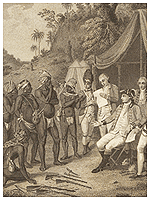
Peace was thus restored; but on the plea that the Maroons had failed to comply with the last-named condition, the Legislature, instead of assigning them lands for a new settlement in some other part of Jamaica, adopted a resolution to transport the late belligerents in a body from the colony. Accordingly in June, 1796, six hundred of them were shipped off to Nova Scotia, where they settled; but after a few years, on the ground that they were found intractable and troublesome, they were deported to the black settlement of Sierra Leone.

The conduct of the Assembly in causing these people to be transported was considered by many at the time a gross breach of faith, and Gen. WALPOLE, who commanded the forces that had been employed in their subjugation, and concluded the treaty of peace with them, declined to receive a sword, for which the Assembly had voted the sum of five hundred guineas, as an acknowledgment of his valuable services. There were three other settlements of the Maroons in Jamaica, but these not having been drawn into hostilities, were allowed to remain; and it is to their descendants, who still live very much as their fathers lived in the last century, that Gov. EYRE issued his proclamation during the late troubles in that island. The services to which the Governor refers, as rendered by the Maroons to the Crown in times past are, we suppose, the share of military duty they bore during a rebellion of the slaves in the parish of St. Mary, Jamaica, in the year 1760, and the assistance they gave to the militia toward the suppression of the negro revolt of 1831-32, when the slaves in the western part of the island rose in insurrection.

Friday, February 25, 2011

Slavery: Turning Humans Beings into Things

St Nicholas Abbey has no church connection. It has always been a sugar plantation house.

Sitting in the grand plantation house, next to the mills that turned sugar into liquid gold...What did you care if you had to go to West Africa to by the slaves. Then ship them back across the Atlantic.

Oh yes, the logistics were difficult, but nothing the greatest seafaring nation in the world couldn't handle. The British were good at commodities. A couple of thousand pounds bought you 200 acres of Barbadian cane fields, a mill and 200 odd slaves. And within a few years, it returned an equal amount every year.--for the rest of your life.


You were now among the richest men anywhere in the British Empire. The slave economy in the Caribbean wasn't just a “sideshow” of Empire--it was the Empire.

Three and a half million slaves were transported in British ships alone. They went to British plantations, to make British profits and build British cities—Bristol, Liverpool, and Glasgow. Where the cult of liberty is still on everyone's lips in smart coffeehouses.

Apart from the occasional visiting Quaker or exiled Puritan, there was a deafening silence in the “land of liberty” about turning fellow men into “work animals.” The scale of profits sealed the conspiracy of silence.


Here's a little thing of devilish prettiness—silver-- it looks like jewelery. Might be a hat pin, or something like that. But, it's not. This is an object that marked the passage of a human being to a thing. This is a branding iron. "Once these initials were burned into your flesh, you were no longer a human...You were an object. You were a commodity. You belonged to someone. You were a beast-of-burden. . ."-- Simon Schama (historian)


The Wrong Empire, chapter 3