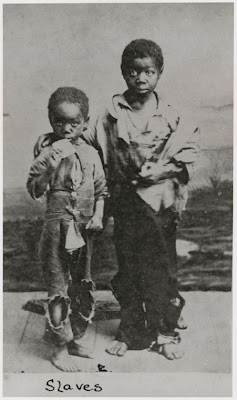
On October 11, 2011 the Community Times reported: The rare tintype of Baltimore slave Martha Ann “Patty” Atavis and Alice Lee Whitridge, the young girl she cared for, was probably taken in 1860.
The Maryland Historical Society acquired at auction recently a rare daguerreotype of Baltimore slave, Martha Ann "Patty" Atavis, and a tintype of the same woman holding Alice Lee Whitridge, the daughter of Dr. John Whitridge of Baltimore.
The items are from circa 1845-1860. The photographs and supporting documents illuminate the realities of urban slavery in Baltimore during the Civil War era.
"This acquisition is incredibly important for the Maryland Historical Society and will further help us understand urban slavery in Baltimore," Mark Letzer, of the Maryland Historical Society, said in a statement.
Letzer acquired the images for the museum at the Crocker Farm Auction House in Sparks.
About 5 percent of slaves lived in urban areas at the eve of the Civil War, according to the historical society. In Baltimore, that totaled about 5,000, with two thirds of them being women. Most of the women were in domestic service like Atavis. She stayed in the service of the same family until her death a decade after the abolition of slavery.
The pictures will be on display in the Maryland Historical Society library starting, Wednesday, Oct. 12, from 10 a.m. to 5 p.m., Wednesday through Saturday. (source: The Community Times)
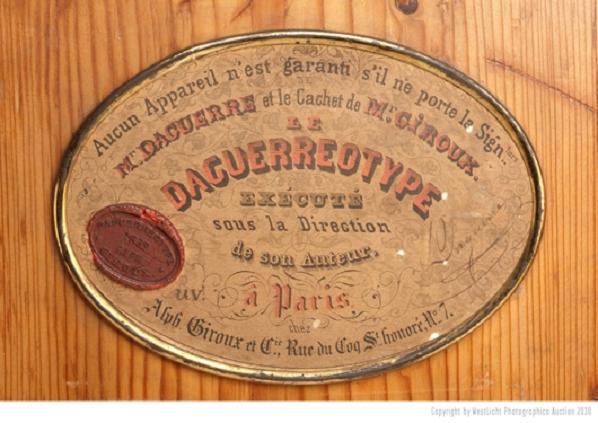
The Daguerreotype
Louis-Jacques-Mandé Daguerre invented the daguerreotype process in France. The invention was announced to the public on August 19, 1839 at a meeting of the French Academy of Sciences in Paris. American photographers quickly capitalized on this new invention, which was capable of capturing a "truthful likeness." Daguerreotypists in major cities invited celebrities and political figures to their studios in the hopes of obtaining a likeness for display in their windows and reception areas. They encouraged the public to visit their galleries, which were like museums, in the hope that they would desire to be photographed as well. By 1850, there were over 70 daguerreotype studios in New York City alone.
Popularity of the daguerreotype declined in the late 1850s when the ambrotype, a faster and less expensive photographic process, became available. A few contemporary photographers have revived the process.
The Cameras
The earliest cameras used in the daguerreotype process were made by opticians and instrument makers, or sometimes even by the photographers themselves. The most popular cameras utilized a sliding-box design. The lens was placed in the front box. A second, slightly smaller box, slid into the back of the larger box. The focus was controlled by sliding the rear box forward or backwards. A laterally reversed image would be obtained unless the camera was fitted with a mirror or prism to correct this effect. When the sensitized plate was placed in the camera, the lens cap would be removed to start the exposure.
Baltimore City Police officer seperates whites and negro students at Southern High School to prevent fighting.October 1, 1954
From Baltimore City Paper, "A Liberalism Education: Howell Baum's exploration of Baltimore city school desegregation overlooks the local politics in its political posturing," by Edward Ericson Jr. 9 June 2010: In 1954, Baltimore became one of first school districts to voluntarily desegregate, and was the first large American city to do so, earning plaudits for its forward thinking.
Baltimore was the only one of the four early school districts to desegregate using only a "free choice" enrollment model, which simply allowed any student to enroll in any school. Other districts drew boundary lines meant to compel blacks and whites to attend the same schools. University of Maryland Urban Studies and Planning professor Howell Baum spins this remarkable fact into a brilliant and, alas, overwrought, theory in his Brown in Baltimore: "Liberalism," he writes, is what kept Baltimore schools racially segregated.
The story of school segregation--in Baltimore and elsewhere--after the historic 1954 Brown vs. Board of Education cases is now well-known. Rapidly shifting--and informally segregated--housing patterns outran and outflanked school desegregation plans from Baltimore to Boston, from Hartford to Houston. The infamous "massive resistance" threatened by Southern whites turned out to be a camera-ready sideshow to the insidious and much broader patterns of white flight and economic disinvestment that followed.
But Baum brings little analytical muscle to these larger trends, focusing instead on the singular decisions made by Baltimore leaders within the context of the city's unique culture and history. This is yeoman's work, competently accomplished. But in trying to tie local history to the larger forces that shaped American society since the 1950s, Baum downplays or overlooks factors that don't fit his thesis.
That thesis--like so much of what passes for scholarship these days--is seductively simple. Baum locates the problem in "liberalism," broadly defined. Liberals of the time believed in free choice and small government (self-described "conservatives" claim that mantel today, but Baum is correct, historically speaking). Because classic liberals believed in free choice and a non-coercive school assignment policy, continuing segregation was all but preordained, Baum argues.
But in the details of Baum's narrative lurk elements of Baltimore's political character that differ from classic liberalism. From the school board chaos of the early 1970s and the credible claim that African-Americans, by then, considered the school system more of a power base than a moral cause, to William Donald Schaefer's Nixonian response to federal desegregation pleas and his close tending of his patrons' contractual needs--and even to the barely discussed white flight and blockbusting activities of the '50s and '60s, which, as Antero Pietila shows in Not in My Neighborhood ("Chopping Blocks," Feature, March 17), were tied firmly not only to key civil rights leaders, but also to career criminals and some of the state's biggest banks--the context of Baltimore's school segregation was at once smaller and more complex than a signal flaw in liberalism.
Baum fails to explore how his subjects' actual motives may have diverged from their stated political philosophy. This failure is remarkable given the detailed evidence he marshals.
Much of Brown consists of a blow-by-blow recounting of Baltimore's struggles with desegregation and its failure to embrace racial integration. The detailed account reads in places like meeting minutes, and the long stretches between bouts of analysis and context can leave a reader weary. It's simply not that interesting, 30 years on, to read about the school system's third response to a demand from the Department of Health, Education and Welfare (which split in 1979 into Health and Human Services and the Department of Education) that it voluntarily desegregate city schools.
What is interesting, though, is the behavior of political icons such as Schaefer (he was a sly race-baiter from the start) and--gasp--Barbara Mikulski, who effectively fought desegregation in the city's Southeast neighborhood in the guise of protecting neighborhood cohesiveness from meddling federal bureaucrats.
These political interventions, which Baum cites as manifestations of liberalism, have alternate explanations that could have further illustrated the city's political culture. Baum couches Baltimore as a border city, attributing its political and social culture to its geography and to the insults it endured during the Civil War. Though not wrong, this feels incomplete. Baltimore's parochialism may be partly attributable to its dashed hopes of civic glory, as Baum argues, but it also might be the result of tactics so ingrained in the city's political families as to be second nature. Setting east against west, neighborhood against neighborhood, keeps the rabble's mind's off more substantive matters, such as who is actually getting paid. Baum does not explore this possibility.
Much of Brown's narrative rests on the proposition that stemming white flight is the most important aspect in keeping (or making) the city viable. Forced busing will exacerbate white flight, one Johns Hopkins professor warns in the early 1970s as the federal government pressured city officials to act. No, counters another professor, only a specific desegregation policy will assure white families that "school will be integrated wherever they move within the city and will not become overwhelmingly black anywhere."
Baum endorses the latter position, though he never provides any supporting evidence. This argument is questionable on its face, and even more so when you examine the claim that Baltimore schools, under a directed desegregation plan, would "not become overwhelmingly black anywhere" in a city with a public-school enrollment that was already 73 percent black. By any logical assessment, the integration battle was already lost. (By 2004, the 50th anniversary of the Brown decision, it was 89 percent.)
What Baum's Brown is missing is a forthright discussion of the benefit to black students of learning with whites. The study Baum cites, 1966's "Equality of Educational Opportunity Study," published in 1966, paired poor blacks with middle class whites, and did not tease out the effects of race versus the effects of class.
Yet class and cultural issues--as opposed to race--may have animated much of the exodus. A November 1975 Sun story Baum cites (but does not discuss at length) quoted black parents who were fleeing the city school system. One mother said of her son, "He's not a big boy and he was getting beat up on all the time."
While acknowledging it, Baum does not address in any substantive way the fear of physical harm experienced by students and parents on both sides of the racial divide. How did those fears influence city officials? How do they square with those officials' alleged fealty to liberalism? Baum doesn't say.
Realities bigger than education and segregation outran the law, and Baum could have explored those realities--from the savage disinvestment to the city's increasing reliance on a drug-fueled shadow economy; from its corrupt and dynastic political system to the fraud-fueled real estate market that herded blacks into and whites out of neighborhoods, enriching a corps of well-connected hustlers in the process. By focusing instead on minutia such as meeting minutes from early 1970s school board meetings, hearing transcripts from administrative proceedings--and by presupposing that Baltimore's government operated within a broadly liberal framework (instead of, to cite just one possible counter-narrative, within a framework of institutionalized corruption)--Baum misses much of what made Baltimore the segregated, violent, and poor city it is today. Liberalism certainly played its part in the city's undoing, but piling Baltimore--or even just its dilapidated, predominantly black schools--at the feet of liberalism looks more than uncharitable and less than scholarly.
From the Baltimore Sun, "Book review: 'Not In My Neighborhood' Ex-Sun author traces bigotry's role in shaping Baltimore," by Diane Scharper, 21 March 2010
Builder James W. Rouse is remembered as a visionary because of his shopping malls and new towns, like Columbia - promoted as free of racial discrimination. But Rouse had another, less egalitarian side, according to Antero Pietila, a former Baltimore Sun reporter and editorial writer. That side had shown itself a few years earlier in 1951 when, as vice president of the Northwood Co., Rouse looked the other way as blacks and Jews were excluded from the Northwood community.
Rouse is just one of the movers and shakers spotlighted in "Not In My Neighborhood," Pietila's eye-opening account of bigotry in Baltimore. The book spans about 100 years but focuses primarily on the years from World War II to the passage of the 1968 Civil Rights Act, the time when race relations reached a boiling point.
With its sensitive subject, this groundbreaking book is a monumental effort. Pietila spent seven years researching the people and stories in this account, which contains nearly 40 pages of notes. With facts, maps and charts, the book seems heavy at times. But Pietila hooks readers with anecdotes and arresting details. His description of Jack Goldenson during the 1968 riots on the roof of his delicatessen with a gray machine gun aimed at a surging mob is riveting.
As Pietila sees it, Baltimore's racial problems were exacerbated in 1910 when an African-American lawyer set up an office on McCulloh Street in a house he had bought from a white woman. Soon afterward, Baltimore enacted the first law in U.S. history to prohibit African-Americans from moving to white residential blocks and vice versa. Segregation existed in many Northern cities, Pietila explains. Baltimore, though, used the force of law to "achieve systemic, citywide separation." Numerous other cities, including Richmond, Va., Birmingham, Ala., and Atlanta, followed suit.
When the U.S. Supreme Court struck down the 1910 segregation law seven years later, Baltimore leaders weren't fazed. Covenants and other private agreements were used to bar blacks and Jews from certain neighborhoods. After the Supreme Court declared those unenforceable in 1948, Baltimore became a pioneer in blockbusting.
A 1937 map from the Federal Home Owners Loan Corporation
Most U.S. cities had separate housing markets for whites and blacks. But Baltimore, Pietila explains, had a three-tiered market: one for gentiles, one for Jews and one for blacks. It worked like a racially charged game of musical chairs. Gentiles moved out when Jews moved in. When Jewish housing demand weakened, houses went to blacks. The migration of Jews and blacks proceeded north and northwest from the harbor to Ashburton, to Windsor Hills, to Gwynn Oak and Woodlawn. Later, Jews moved to Pikesville and the Reisterstown Road corridor up to Owings Mills and Reisterstown. Gentiles moved east toward York Road or north toward Carroll County.
The bottom line is this: Gentiles excluded Jews and blacks from their neighborhoods using both legal and illegal means. Unscrupulous speculators took advantage of home sellers and buyers. Mortgage companies redlined neighborhoods where people could not get a regular mortgage, forcing them to rely on unscrupulous rent-to-buy schemes. With blockbusting techniques, flipping, and subprime mortgages, Baltimore neighborhoods and bank accounts were destroyed - to say nothing of people's souls. Pietilla blames Baltimore's racial troubles on many people, including blockbuster Manuel Bernstein. But some, like Dale Anderson, former Baltimore County executive, deserve more blame than others, Pietilla writes.
Pietila says Anderson tried to push blacks from Towson by building a thoroughfare through the heart of an African-American neighborhood, thereby effectively eliminating it. In Catonsville, Anderson and the Baltimore County Council replaced blacks' homes with snack shacks and gas stations. Throughout the county, they decimated at least 20 old African-American settlements.
Race relations in the city were also troubling. In 1966, the Baltimore City Council considered a bill outlawing racial discrimination in housing. When an interfaith group testified in support of the bill, the members were spat upon, accused of moral blackmail and threatened with death. The bill was defeated, 13-8. After the Rev. Martin Luther King Jr. was assassinated, Baltimore, like other cities, exploded. To prevent an all-out race war, President Lyndon B. Johnson signed the Civil Rights Act of 1968 on April 11, which included provisions for fair housing. But by then, as Pietila vividly describes it, Baltimore - with its ugly racial and ethnic prejudices - had shown itself to be anything but Charm City. (source: Baltimore Sun)
Baltimore City Paper, "Dire Education: Jonathan Kozol’s The Shame of the Nation Fires Off a Crucial Wake-Up Call For Rapidly Resegregating Public School Systems—Such as Baltimore’s," by Michael Corbin:
When you walk into a classroom of almost any Baltimore City public school this fall you immediately face the facts of 21st-century educational apartheid. The white children are absent. They left a while ago and won’t be coming back.
Standing in these classrooms you might think that you stumbled upon some remnant of white supremacy, some exemplar of American democratic, public institutions before 1954. What is striking is not the fact of segregation in America, but rather that we no longer care that segregation in public education matters to our democracy. In Baltimore, for instance, the generations-long struggle to integrate public education no longer has a place in public discourse. We complain mightily about the school system’s many woes, but we no longer remark that going to the city’s dysfunctional schools is almost exclusively a black thing.
“Why Segregation Matters: Poverty and Educational Inequality,” a 2002 report (reaffirmed in 2005) from Harvard University’s Civil Rights Project, ranked Baltimore City schools No. 1 in “black isolation.” That is, it found that students who attend Baltimore City schools have the “lowest exposure to whites” in the 239 school districts in the U.S. with a total enrollment greater than 25,000. The white children who still attend a Baltimore City public school are huddled in a diminishing number of schools and are often isolated within specific classrooms in those particular schools.
This isolation is not just the case for Baltimore. After several decades of incremental desegregation following the 1954 Brown v. Board of Education Supreme Court decision, U.S. public schools are more than a decade into the process of resegregation. According to the Civil Rights Project, that resegregation has increased “to levels not seen in three decades.” Close to three-quarters of America’s black and Latino students attend schools that are predominately minority.
It is this demographic fact of racial segregation and its absence from our political concerns that Jonathan Kozol examines in his important new book Shame of a Nation: The Restoration of Apartheid Schooling in America. After visiting 60 schools in 11 states over a five-year period, Kozol attempts to be both polemical and empirical about this reality of U.S. education. Apartheid has become the norm in many U.S. school districts, and Kozol wants us to name it, to acknowledge that we’ve abandoned the democratic project of integration. His book is at minimum a call for us to at least be honest that we operate in an America with a Plessy v. Ferguson reality while claiming the moral absolution of Brown v. Board of Education and its destruction of the lie of “separate but equal.”
Kozol has spent more than 40 years and written numerous books weighing the democratic promise of public schools in America. In books such as The Night Is Dark and I am Far From Home, Amazing Grace: The Lives of Children and the Conscience of a Nation, and Savage Inequalities, Kozol has produced a body of work that stands as a singular arraignment and censure of what we often do to kids in the name of schooling. Shame of a Nation is a full-frontal jeremiad. There is an almost painful sense of exasperated urgency in the book, an angry sense that the sacrifice and struggle of the civil-rights movement is not only being dismantled but, in an Orwellian perversion, that same sacrifice and struggle is claimed as honorific imprimatur to our racially segregated schools.
For example, Kozol notes, go into any U.S. city and look for the school named after a prominent figure in the struggle for civil rights and racial equality. There you will find “bastions of segregation.” In Baltimore, for instance, we have two schools named for Thurgood Marshall, the native son architect of the Brown decision and first African-American Supreme Court justice. Thurgood Marshall High is 98.2 percent African-American. Last school year there were six white kids enrolled. Thurgood Marshall Middle is 97.7 percent African-American, with 10 white kids on roll. Kozol also points to the Thurgood Marshall Elementary in a Seattle neighborhood “where approximately half the families were Caucasian,” but “95 percent of the students [attending the school] were black, Hispanic, Native American or of Asian origin.”
The strength of Kozol’s work is always the time he spends with kids in their schools and in their neighborhood, listening to them and letting them do the talking. Shame of a Nation is no different. He renders in poignant, detail the stories of children whom he has literally watched grow up in the dysfunctional schools he has analyzed. “I walk into a class of 25 or 30 students and I look around me at the faces of children, some whom in New York City I have known since they were born, and look into their eyes . . . and I cannot discern the slightest hint that any vestige of the legal victory embodied in Brown v. Board of Education or the moral mandate that a generation of activists and young idealists lived and sometimes died for has survived within these schools and neighborhoods.”
Similarly, Baltimore City students in their hypersegregated schools simply have no expectation that they operate in the same world as white kids. Going to such segregated schools, argued the Supreme Court in 1954, “generates a feeling of inferiority as to [black students’] status in the community that may affect their hearts and minds in a way unlikely ever to be undone. . . . Separate educational facilities are inherently unequal.” Today, we wonder at the lure for Baltimore school kids of the corner, of the street and a thug life, but many simply see no value in these separate and unequal institutions of educational apartheid. There is not only the so-called achievement gap that politicians hand-wring over, but there is clearly an opportunity gap as well, and black kids often make a rational calculus about what the real deal is in America. The 2001 study “Labor Market Conditions Among 16-24 Year-Old Young Adults in Maryland and Baltimore,” from the Institute for Policy Studies at Johns Hopkins University, puts the dropout rate for African-American males from Baltimore City schools at a staggering 76 percent.
Most people simply have no idea what goes on in segregated city schools. However, because we go to such great lengths to maintain the pernicious facade of “separate but equal,” we become blind to what school has become for many black kids in Baltimore and in the segregated schools across the United States. Kozol dissects these perversions of education in what he calls the “Ordering Regime”—“an architecture of adaptive strategies that promise incremental gains within the limits inequality allows.” Kozol describes the “new vocabularies of stentorian determination, new systems of incentive, and new modes of castigation. . . . Curriculum materials that are alleged to be aligned with governmentally established goals and standards and particularly suited to what are regarded as ‘the special learning styles’ of low-income urban children . . . relentless emphasis on raising test scores . . . a new empiricism and imposition of unusually detailed lists of named and numbered ‘outcomes’ for each isolated parcel of instruction.”
Simply put, in the name of marginally increasing test scores, the under- and miseducated children of apartheid schools are subjected a kind of Dickensian, quasi-militaristic intellectual indoctrination. If we could just get these kids, we seem to think, to chant every morning, “We Are Somebody,” get them to write formulaic paragraphs and memorize the “Seven Habits of Highly Effective Black Teens,” then we can claim progress. We can claim that it’s not the obvious fact that the schools are different, it’s just those ghetto kids who can’t seem to get with the program.
No parent with options, black or white, would send their kids to such schools, Kozol says. Those without options are constantly told that the failed schools are being “reformed,” and the “ordering regime” is precisely what passes for “reform” of Baltimore City schools. This fall, for instance, Baltimore begins a reform of middle schools where, according to the city school system’s own analysis, “less than 3% of eighth graders can analyze text and extend information.” That reform consists mainly of mandating a uniform class structure and curriculum, hiring a consultant, and disallowing teachers to transfer out because of the hundreds of vacancies at city middle schools. Those same city middle-school students will matriculate to high school, reading on average at the fifth-grade level, and yet this year’s high-school freshmen will be the first required to pass the new Maryland High School Assessment exams to graduate.
One has to read Kozol’s powerful rendering or spend time in city classrooms to see what this “architecture of adaptive strategies” leads to for kids. What young Baltimoreans regularly get are classrooms and, indeed, whole schools where curiosity, relevance, beauty, and meaningful inquiry into their lives exist only at the margins of what passes for education, if they are there at all. It’s no wonder so many drop out.
Shame of a Nation is no manifesto. Kozol provides no systematic political program in response. He does provide an interesting review of the few and little publicized successes of interdistrict school desegregation in the U.S., and he invokes the success of many black people who, because of Brown, had access to institutions they otherwise wouldn’t have. He makes some vague gestures at saying a new movement is necessary. But Kozol’s brief against apartheid is a moral one. He wants us to be ashamed. This vocabulary of moral outrage is more associated with the conservative right these days in the struggle over things such as abortion, gay marriage, and the proverbial “family values.” In some measure, because of such rhetorical infidelity, Kozol’s moral vocabulary falls a bit flat.
Also importantly absent from Kozol’s analysis are any of the voices of intellectuals, activists, or even the kids from the so-called hip-hop generation. Like the kids in our segregated classrooms, analysts such as Michael Eric Dyson, Adolph Reed, bell hooks, and Bakari Kitwana, among others, challenge the invocation of the great civil-rights struggle and its moral vocabulary when it doesn’t acknowledge much less ameliorate the current crisis and lived experience of contemporary educational apartheid in places such as Baltimore City.
Nevertheless, Shame of the Nation is a moving and necessary testimony. It is both documentary evidence of the unredeemed promise of Brown and an indictment of the rhetorical bombast about equal educational opportunities in this country. Today, in Baltimore and in cities across America, kids sit in classrooms in deeply separate and unequal schools. And we don’t appear to give a damn about it anymore. If we take seriously the role of public education in our democracy, then we should be ashamed.
--Michael Corbin teaches English and literacy at the Academy for College and Career Exploration, an “innovative” public high school in Baltimore City. (source: Baltimore City Paper)
From the Baltimore Sun, "A bitter Inner Harbor legacy: the slave trade," on 12 July 2000, by Ralph Clayton:
THOUSANDS of NAACP members descended on Baltimore for their convention this week, prompting visits to the major tourist attractions that line the Pratt Street corridor.
What most of the hundreds of thousands of tourists who visit the Inner Harbor each year don't realize is that they are walking on sacred ground, where countless thousands of men, women, and children suffered during Baltimore's darkest hour.
Between 1815 and 1860, traders in Baltimore made the port one of the leading disembarkation points for ships carrying slaves to New Orleans and other ports in the deep South. Interstate traders in the domestic coast slave trade found Baltimore's excellent harbor, central location and position in the midst of a developing "selling market" attractive incentives in which to build their slave pens and base their operations near the bustling port.
The major slave dealers, who came from Kentucky, Georgia, Virginia and Tennessee built their slave pens near Pratt Street, the major east-west connection to the wharves in the Inner Harbor and Fells Point.
One of the first major pens was built behind a white frame house near the corner of Cove and Pratt streets, near the intersection of what is today Martin Luther King Jr. Boulevard. The pen belonged to Tennessee native Austin Woolfolk, whose reign in Baltimore ran from 1818 to 1841.
Georgia native Hope Hull Slatter constructed his pen in 1838, several doors east of Howard and Pratt streets. During his 14-year stay, Slatter was ably assisted by his male slave, a jail steward.
By the late 1850s, Joseph Donovan, who had used pens on Pratt Street and Camden Street near Light Street, had a new pen constructed on the southwest corner of Camden and Eutaw streets, near where the Babe Ruth statue now stands at Oriole Park at Camden Yards.
Babe Ruth statue at Oriole Park in Camden Yards
Many other traders made their mark in Baltimore during the height of the slave trade: James Franklin Purvis, whose pen was on Harford Road near Aisquith; Bernard M. and Walter L. Campbell, whose pen was on the south side of Conway Street, near Hanover Street. (He would later buy Slatter's pen after Slatter's departure for Mobile, Ala., in 1848); William Harker, several doors south of Baltimore Street, on the west side of Calvert Street; and John Denning, on Frederick Street, several hundred feet behind the current site of the Holocaust memorial.
Baltimore Holocaust Memorial
The "travelling traders" like George Kephart of Maryland, David Anderson of Kentucky, and Barthalomew Accinelly of Virginia came to town, gathered purchased slaves, and shipped them on packets that regularly made the run from Baltimore to New Orleans.
Although numerous wharves at Fells Point were used by the packet ships, so were the Pratt Street wharves that lined the north side of the Inner Harbor. The site of the current Pratt Street Pavilion, once underwater, was the home to numerous such packets as well as the docks that housed their agents' offices.
The methods for moving the slaves down Pratt Street differed, depending on the trader. Woolfolk preferred to march his slaves in the middle of the night, chained together and on foot. Slatter often used carriages and omnibuses to convey his slaves to the packet ships.
Ships with names like Agent, Architect, Hyperion, General Pinckney, Intelligence, Kirkwood, Tippecanoe and Victorine made their runs from wharves along the Inner Harbor as well as Fells Point.
Greed made for strange bedfellows. Many of Baltimore's slave dealers shipped together on the same brigs, barks, ships and schooners making their cyclical runs to New Orleans. In October 1845, Campbell, Donovan and Slatter shipped 117 souls aboard the Kirkwood from the Frederick Street dock. The Tippecanoe sailed from Chase's wharf in January 1842 with 114 souls shipped by Purvis, Slatter and others.
For 45 years, thousands of families and individuals were sent south on their final passage. For most on board, this meant a death that came when families and loved ones were separated and "sold South" -- a separation from which few returned. It also signified almost certain separation from one another in New Orleans; large families were rarely sold to the same buyer.
Baltimore Inner Harbor
Tourists who go to the attractions of the harbor area this summer should take time to remember the price that so many paid in blood and broken hearts on Pratt Street.
Remember the young woman who took her and her child's life in Woolfolk's pen in the spring of 1826, rather than go south; the man who, in 1821, upon learning that he had been sold to a trader, slit his own throat at one of Baltimore's wharves; or the unsuccessful attempt in1846 of a female slave to drown herself at the Light Street dock rather than live another day in slavery.
Blacks and whites alike of modern-day Baltimore have ignored the story of the jails that played a key role in the U.S. slave trade of the 1800s. The Baltimore Sun reported on 20 June 1999, by SCOTT SHANE:
ON JULY 24, 1863, three weeks after the Battle of Gettysburg, Union officers freed the inmates of a slave trader's jail on Pratt Street near the Baltimore harbor. They found a grisly scene.
"In this place I found 26 men, 1 boy, 29 women and 3 infants," Col. William Birney of the U.S. Colored Troops wrote to his commanding officer. "Sixteen of the men were shackled and one had his legs chained together by ingeniously contrived locks connected by chains suspended to his waist."
The slaves were confined in sweltering cells or in the bricked-in yard of "Cam- liu's slave-pen," where "no tree or shrub grows" and "the mid-day sun pours down its scorching rays," Birney wrote. Among those imprisoned was a 4-month-old born in the jail and a 24-month-old who had spent all but the first month of his life behind bars.
The liberation of the slave jails marked the end of a brutal Baltimore institution whose story remains unknown except to a handful of local historians.
For a half-century before the Civil War, more than a dozen slave traders operated from harborside storefronts along Pratt and adjacent streets. Some advertised regularly in The Sun and other papers, declaring "5,000 Negroes Wanted" or "Negroes! Negroes! Negroes!" In an 1845 city directory, "Slave Dealers" are listed between "Silversmiths" and "Soap."
Out-of-town dealers would routinely stop for a week at Barnum's or another downtown hotel and place newspaper advertisements declaring their desire to buy slaves.
A routine spectacle was the dreary procession of black men, women and children in chains along Pratt Street to Fells Point, where ships waited to carry them south to New Orleans for auction. Weeping family members would follow their loved ones along the route; they knew their parting might be forever, as there would be no way to know where slaves shipped south would end up.
The grim drama in Baltimore was part of a major industry. Though the United States banned the import of slaves in 1808, the domestic slave trade thrived, as the need for labor shrank in the Chesapeake area and boomed in the Deep South, where the cotton gin had revolutionized agriculture. Between 1790 and 1859, according to one scholar's estimate, more than 1 million slaves were "sold south," most of them from Virginia and Maryland.
The broken families and severed relationships resulting from this commerce were a human catastrophe that can be compared in scale, if not in violence or death toll, to the original tragedy of the Middle Passage. Scholars estimate that perhaps 11 million captured Africans survived the journey to the Americas, but most went to Brazil and the Caribbean; only about 650,000 came to the colonies that would become the United States.
Yet the story of the domestic slave trade has been swallowed in America's long amnesia about slavery in general.
"A dream of mine would be to have a little Baltimore tour -- not showing where Frederick Douglass worked in Fells Point or where Thurgood Marshall lived, but where the slave traders were, where the slaves were whipped," says Ralph Clayton, a librarian at the central Pratt library and a historian who has authored most of the few works on the city's slave trade. "But I've run into many people of both races who say, 'Why are you digging this up? Leave it alone.'"
Slave pen'
Agnes Kane Callum, dean of Maryland's African-American genealogists, remembers seeing a still-standing slave jail as a girl in the 1930s. Her father would take the family on Sunday drives and point out a hulking brick building with barred windows at Pratt and Howard streets.
"He called it a slave pen," recalls Callum, 74, a North Baltimore grandmother who has researched slavery for 30 years. "He'd say, 'That was where my grandmother was held.'" The slave dealer sold Callum's great-grandmother, who had been snatched as a girl from a beach in the Cape Verde Islands off West Africa, to a plantation in St. Mary's County.
Camliu's and all the other physical evidence of Baltimore's once-thriving slave trade has been erased by demolition and redevelopment. But its history can be pieced together from surviving documents.
The slave jails served several purposes. Slave owners leaving for a trip could check their slaves into a jail to ensure they would not flee. Travelers stopping in Baltimore could lock up their slaves overnight while they slept at a nearby inn. Unwanted slaves or those considered unreliable because of runaway attempts could be sold and housed at the jail until a ship was ready to take them south, usually to New Orleans.
The slave ships anchored off Fells Point, which the traders' generally preferred because of fear of interference from the large number of free blacks working at the Inner Harbor, says Clayton. He has researched the story of an Amistad-style rebellion by slaves on one ship, the Decatur, southbound from Baltimore. The Sun carried ads for the ships' regular runs from Baltimore to New Orleans.
By the Civil War, while slaves outnumbered free blacks in Maryland, in Baltimore there were 10 free people of color for every slave. Yet the slave trade posed a constant threat to free African-Americans, who were in danger of being kidnapped and sold into slavery.
In fact, the warden of the Baltimore County jail ran regular newspaper notices listing black men and women he had arrested on suspicion of being runaways but who claimed to be free. Each notice would include a detailed description and the admonition, "The owner of the above described negro man is requested to come forward, prove property, pay charges and take him away, otherwise he will be discharged according to law."
In The Sun in 1838, Hope H. Slatter, a Georgia-born trader who succeeded Woolfolk as Baltimore's leading trafficker in human beings, announced under the heading "Cash for Negroes" the opening of a private jail at Pratt and Howard, "not surpassed by any establishment of the kind in the United States." Slatter offered to house and feed slaves there for 25 cents a day, declaring: "I hold myself bound to make good all jail breaking or escapes from my establishment."
To keep the supply flowing, Slatter added: "Cash and the highest prices will at all times be given for likely slaves of both sexes. ... Persons having such property to dispose of, would do well to see me before they sell, as I am always purchasing for the New Orleans market."
Facing complaints about the grim procession of chained human beings along Pratt Street, Slatter found a solution of sorts: He hired newfangled, horse-drawn "omnibuses" to move the slaves to the Fells Point docks. He would follow on horseback.
"The trader's heart was callous to the wailings of the anguished mother for her child. He heeded not the sobs of the young wife for her husband," wrote one abolitionist eyewitness whose account was discovered by Clayton.
"I saw a mother whose very frame was convulsed with anguish for her first born, a girl of 18, who had been sold to this dealer and was among the number then shipped. I saw a young man who kept pace with the carriages, that he might catch one more glimpse of a dear friend, before she was torn forever from his sight. As she saw him, she burst into a flood of tears, sorrowing most of all that they should see each other's faces no more," the abolitionist wrote.
Rogers' mother was particularly distraught, the flier said, because she had lost another daughter in the same manner four years earlier, "of whom she has never since heard." Rogers' stepfather, a free man, had offered to bind himself to service to work off the $850 necessary to buy her freedom. But the slave trader was unwilling to wait, so the preacher, identified as S. Guiteau, was trying to raise the necessary sum.
"Let mothers and daughters imagine the case their own," Guiteau wrote, "and they cannot but act with promptness."
Reopening old wounds
Why have such spellbinding stories so rarely been told? Callum, the Baltimore genealogist, attributes it to the reluctance of both races to reopen the wound left by slavery.
"White people naturally don't want anyone to know their ancestors owned slaves," Callum says. But black people, too, have kept silent, she says. Callum's maternal grandfather was born into slavery, but when the subject arose, the old man would declare, "No man owned me!"
"His voice was so full of emotion, a hush would fall over the room," Callum recalls, sitting in her North Baltimore rowhouse surrounded by the tools of the genealogical trade.
"Some black people still feel that way today, six generations later," she says. "But we cannot let people forget our holocaust, the black holocaust of slavery."