THE 1950's The 1950's was a time of accelerated political change. At the end of the Second World War there were only three independent countries in Africa:
Liberia, which had been founded by freed slaves and declared itself independent in 1847.
Ethiopia, which was an ancient territory, had never been colonized by a European power despite the attempts of the Italians in the 1880's and 1930's
and Egypt, which had achieved independence in 1922.In 1951
Libya was granted independence from Hitler's former ally, war-weary Italy. Egypt renounced its historic control over Sudan. Britain had little choice then but to grant full independence to Sudan in 1956. In the same year, Morocco and Tunisia became independent of France.
Leaders of Indian Nationalism, Ghandi and Nehru, 1948.
INFLUENCES: INDIA: The country which made the biggest impact on African nationalists was India which was led to independence by Mahatma Gandhi in 1947. His confident doctrine of nonviolence, and his track record battling racial prejudice in South Africa made him a hugely influential model among African nationalists. He was assassinated in January 1948.
1945 Pan-African Congress , Chorlton Town Hall in Manchester England.
PAN-AFRICANS: Already in 1945 at the 5th Pan African Congress in Manchester, UK, there were a number of delegates who were later to bring their countries to independence. These included Hastings Banda (later President of Malawi), Kwame Nkrumah (later President of Ghana), Obafemi Awolowo (later Premier of the South West Region Nigeria) and Jomo Kenyatta (later President of Kenya).
But nobody could have predicted that within fifteen years of the meeting in Manchester, the vast majority of African countries would be independent. In the early 1950's, Julius Nyerere estimated that complete independence would not happen until the 1980's.
AFRICA & USA & SOVIET UNION: On the world stage America wanted an end to colonialism for reasons of free trade (easy access to African markets which had previously bought from Europe) and political influence. The Soviet Union wanted an end to colonialism and capitalism for reasons of ideology and to increase its sphere of influence.
While African nationalists took a pragmatic view of soviet style communism, the British government was concerned about the Soviet influence on Africa. And where African nationalists met with resistance or persecution from Europe, many welcomed the support and interest of the Soviet Union.
AFRICA & USA & SOVIET UNION: "…generally speaking, it is the detribalised native who responds best to communism, as he misses the narrow confines of tribal life and a leader on whom to bestow loyalty. This gives the Rand, with its inflow of immigrant labour, its special importance in the diffusion of communism in Africa…
Communism has made the least progress where the influence of Islam is strongest. Though in the past year the communist picture has been one of retrogression on some fronts, there are signs of increased interest in anti-colonialism from Moscow." --British Foreign and Colonial Office, Notes on the Aims, Strategy and Procedure of the Communists in Africa, 1 May 1950.
"The Black Christ of Portobelo is a powerful influence in Panama,"
Nobody knows exactly how or when the Black Christ (El Cristo Negro) arrived in the tiny community of Portobelo on Panama’s Caribbean coast. Some put the date at around 1658. But the stories of miracles surrounding the eight-foot wooden statue of the Black Christ are enough to overwhelm the village with tens of thousands of pilgrims every October 21.
Cristo Negro de Portobelo
Some walk the 53 miles from Panama City, thousands walk the last 22 miles from Sabanitas, and many crawl the last mile on hands and knees to worship before El Nazareno, one of the names given to the Black Christ by locals. Many wear ornate purple robes that are discarded at midnight on the steps of the church in which the statue is now housed, Iglesia San Felipe. The robes announce that the wearer is responding to a divine command, doing penance for wrongdoing, or simply making an expression of faith.
Many stories surround the Black Christ statue’s arrival in this unlikely place. All agree that it was carved in Spain, arrived on a ship and was washed ashore at Portobelo. The rest is shrouded in the mists of time and myth.
One story holds that the ship carrying the heavy statue in a wooden crate met a terrible storm that drove it back into the harbor. The ship attempted to leave five times, but every time a sudden and unexpected storm endangered the ship and everyone aboard. On the final attempt, the crew jettisoned the crated Black Christ to lessen the weight and save their lives.
Fishermen, amazed by the lack of respect shown by the sailors, carried the Black Christ to their church and gave it a place of honor.
Another myth is that the figure Jesus of Nazareth was destined for the island of Taboga, off the Panamanian coast, but the Spanish shipper incorrectly labeled the shipment. Many attempts were made to send the statue to Taboga, but all attempts to remove it from Portobelo failed. The people of Portobelo, who suspected the figure had magical powers, said it wished to remain with them.
The sick, the troubled and the needy pray before the ornately robed statue of the Black Christ for the miracles they hope to receive, but it is said that if a promise is made and not kept there will be severe retribution. One story is of a man who prayed he would win the country’s top weekly lottery prize ($2,000) and promised that if he did he would paint the outside of the church.
Sure enough, he won the lottery, but he did not paint the church. He even told friends he did not intend to carry out his promise. Unable to resist what he saw as a good thing, he was back to visit the Black Christ the next year with the same request and promise. Lottery tickets are sold everywhere in Panama where people are, and many sellers are outside the church. He bought his ticket before setting off for home. On the way, he was killed in a traffic accident. In his pocket was the winning ticket.
The foot weary take a break after walk for Black Christ.
“¡El Cristo Negro cobra!” believers warn. The Black Christ calls in the markers!
The popular name, The Black Christ, is attributed to U.S. servicemen shortly after the Second World War. Some 500 arrived in a ship to celebrate the October festival. One witness of that particular day says that many of the U.S. visitors were so caught up in the emotional fervor that they began to shout “viva El Cristo Negro!” The name stuck everywhere except in Portobelo. A more familiar name is simply The Saint.
Mass is called at 6 p.m. on October 21. (Be there before 4 p.m. if you hope to get inside the church.) At exactly 8 p.m., 80 able-bodied men carry the statue from the church to begin a four-hour parade around the community. There is a carnival atmosphere.
The bearers take three steps forward, two back, in a similar manner to that of Spanish religious processions. But, unlike those of Spain, this procession has a special Latin American twist: a quick step to lively music. The bearers have freshly shaved heads, wear purple robes and have bare feet. It is a distinct honor to be chosen to bear the Black Christ, an honor paid for by sore shoulders and aching muscles the next day.
At exactly midnight, The Saint is returned to the church.One story holds that it is impossible to return the Black Christ before midnight. “It just gets too heavy to move.”
African slaves in the fierce struggle for freedom against the Spanish Empire (the 'runaways') were also land in the jungle magic Portobelo. And after escaping deep into its dense forests and hills, the Maroons built fortified villages, known as Palenque, from which declared war against their former slavers. So successful were these courageous battle in the Spanish fugitives were forced to declare several truces, and finally to recognize their freedom and independence.
The traditions of the Congos consist of unwritten traditional performances, with characters from mythology, rituals, costumes, architecture, music, food and dance. Its impromptu street performances recall was metaphorically describe their ancestry and the victory of good over evil.
Congo culture survived thanks to the use of 'double effect' that enslaved Africans used as a weapon of resistance, which allowed them to communicate with one another while confusing the Spanish. By distorting the meaning, the reality becomes ambiguous making the African teachers in the exchange of information. The ability to communicate with each other without being discovered, they made it possible to plan escapes and riots, as well as operate an elaborate system of espionage. The result is a story full of symbolism and idiosyncratic culture, paradigms and metaphors that arouse fascination among visitors to Portobelo ready to be wrapped in mists of light.
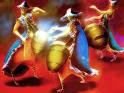
One of the traditions of the people is the drummer of "Congos" during Carnaval this tradition dates from the time of slavery in colonial times.
One of the main traditions of the people is the drum of "Congos". It usually occurs during the carnival in February. This tradition dates back to slavery in the colony. It is a mockery of the Spanish kings and during the dance, which lasts several days, the participants assume the role of runaway slaves fleeing the Spanish. They hide in different parts of the village and take captive.
The dance has a story in which characters representing the Congolese fight against the devil, who is on the loose in those days. At the end are saving the "Queen Conga" with the help of "bird" and "John of God" in these traditions is easy to see the syncretism between Catholicism and African rituals Antilles.
Congo, Evocation of complaints from black ancestors and now facts and incidents of everyday life.
The Congo is the one that has persisted and is alternated with salsa dancing or popular. As for the special clothing is congo: change of chintz, striking large flowered skirt, head, crown fitted with colored ribbons, mirrors, flowers typical of the season (Caracucho, jasmine, papos, Havana), pinned at Trez in circle on the sides of the head.
Men use ketones, pants backwards subjects with rope, tape crowns interspersed with mirrors, a motet or quirky bag that serves to put few things picked up.
The Congos are the descendants of the Maroons, who have preserved the stories of their ancestors in a living tradition which is essentially a work of art. You travel back in time achieving power and strength as they approach their African ancestors of the seventeenth century. (source: Webscolar)
In her article, "Uruguay Spirit of Afro Resistance Alive in Candombe" from Upside Down World, Marie Trigona (a writer, radio producer and filmmaker based in Buenos Aires) reports: In the streets of Montevideo, Uruguay, Afro-Uruguayans celebrate an often-ignored part of their history - Candombe and resistance. For more than 200 years Afro descendants have maintained the tradition of Candombe, a rhythm that traveled from Africa to Uruguay with African slaves. The music carries centuries of resistance and liberation.
The word Candombe literally means "place and dance of Africans." The musical tradition evolved during the colonial era. Africans brought to Uruguay for slave labor used the rhythm of the tambores, or drums, to communicate with each other and defy colonialists.
Today the music thrives in Montevideo's working class neighborhoods, where African descendants have kept alive the tradition of the Llamadas, parades where Candombe is played. Candombe drummer Mitchel Navos says that Candombe didn't originate in Africa, but with Afro-descendants in Montevideo. "Candombe is specifically from Montevideo. Candombe like Montevideo's Candombe doesn't exist in any other part of the world." He also asserts that Candombe's spirit has been passed down for generations despite a historical void surrounding the music's origins.
Origins of Candombe Montevideo's colonial district is the birthplace of Uruguay's Candombe music. Africans from the Southern and Western regions (Bantú regions which include Congo, Angola and Mozambique) were brought to Uruguay and Argentina through the slave trade beginning in 1750. "Africans arriving from the Bantú region brought with them the Candombe rhythm," explains Navos. "Being from different nations and regions, they didn't have the possibility of communicating through language."
In whatever time their white masters allowed, slaves communicated through drums and dance. The first Llamadas took place at this time. Some historians assert that the word Llamadas - "parade of calls," refers to the drums Africans played to call out to each other in their homes. Each tribe had a particular rhythm that could be identified from afar.
Within these living quarters, African musicians gave birth to a rhythm and tradition which has been passed on for generations. Martin Silva is a young musician from Montevideo's Barrio Sur. His grandparents taught him the Candombe rhythm and the origins of Candombe. "Before the llamadas were held in Ansinas, which was a conventillo or a housing complex here on Isla de Flores and nearby streets. It was a huge housing complex where hundreds of families lived. The llamadas were held there, they paraded inside. It was a different kind of festivity. It's not the same as today."
Upper class whites tried to ban Candombe gatherings in the 19th century. One of the earliest historical documents tracing Candombe music is an 1808 police record, when citizens of Montevideo requested that these dances be severely repressed and completely prohibited. Afro descendants took their music underground, to defy the oppressive conditions of slavery.
"We can't refer to anything before 1900 with historical certainty," explains Navos. There exists an extensive historical void regarding Candombe practices between 1800 and 1900. "What exists today is what we could hide and preserve, which has led to the transformation of Candombe in what it is today, from generation to generation," he continues.
"Barrio Sur and Palermo were where the meat curing plants were located. Many of the black slaves had to work in the meat curing plants, but also many lived in the curing plants. That's where music from Africa mixed with Catholicism." Many historians assert that the first Llamadas took place in clandestine music halls, until they went public with the abolishment of slavery in the late 19th century. "The first Llamadas held was a procession from the Meat curing plants toward Montevideo's main cathedral, in the Old part of the city. In commemoration of Day of the Kings, they made a procession to give a tribute to the Catholic Saints of the Masters. That's when Western Traditions got mixed in. That's when the term Llamadas, or walking procession, came to be. Before it wasn't about walking in the streets, it was held in a hall or like a band performance."
Symbols of Afro descendants' painful past The dance and music are filled with symbols of African descendants' painful past. The troupes the perform the Llamadas are called comparsas, and are made up of cuerdas (drummers) and dancers. The drummers walk very slowly, barely separating their feet as they walk. This rhythm and style of procession is meant to symbolize Afro-descendants' past and historical roots when their ancestors were made to walk with chains and shackles. Three main characters lead the llamadas: the Mama Vieja (Grandmother), Gramillero (Old Doctor), and Escobero (Wizard). The Gramillero walks with a cane as if he's about to fall over. The Mama Vieja carries an umbrella attending to the Grammillero. The Escobero sweeps the ground with a great baton.
Navos describes the significance of these three characters. "The Escobero, I don't know if he's a magician or wizard, he's the person in charge of taking charge of the spirit of the comparsa. The Escobero walks in front of the flags to clean the bad spirits opening the way for the comparsa."
The Gramillero and Mama Vieja symbolize two key figures in Afro-Uruguayan history: the old doctor who uses medicinal herbs to cure and the grandmother, the matriarchal figure. Navos explains the significance of those characters. "Those characters are as important to us as our grandparents. In a family they are the roots. They are the oldest people in the comparsa. Their dance is about that. Simulating the pain in their slow dance, there's an expression of fatigue in their dance."
Candombe as a cultural tool
Some of the city's Candombe troops feature more than 50 drummers and dozens of dancers. Each neighborhood has its own rhythm and style. In Barrio Sur, where slaves took the music underground in the 19th century, new Candombe troops are emerging today.
According to Mario Suarez a young musician playing a traditional African drum in the Isla de Flores comparsa, the Llamadas is more than a performance. "The Llamadas and Candombe for the Afro descendants are a passion and a tradition. We have to maintain the tradition. The identity of the comparsa of Isla de Flores is strong, because it's part of the identity barrio Ansinas and Barrio Sur. The first Llamadas took place here in the barrio Ansinas and the barrio Sur."
Today Afro-Uruguayans number around 100,000, or about 6 percent of the population. For many Uruguayans of Afro descent, Candombe is part of everyday life and resistance in a continually discriminating society. The Llamadas ispracticed all year long, not just during Carnival. Uruguayans have also adopted the increasingly popular Candombe music as part of their national identity. Especially in the past 30 years, the music has influenced White musicians. The music was used to express resistance to the repressive regime during Uruguay's bloody military junta from 1973-1984. Today, Candombe isn't just heard in Montevideo but has spread to Uruguay's interior and echoes in Argentina.
"Candombe is not only a question of skin color, it's a way of thinking and being," says Diego Bonga Martinez from the Afro-cultural movement in Buenos Aires. In Buenos Aires, the Llamadas have been continually repressed by police and government officials. Martinez adds, "Candombe is a cultural weapon we have used to defend ourselves with, for our culture to live on." From the size and sound of the growing number of comparsas participating in the Llamadas in Montevideo, this tradition will be passed on for generations to come.
The Smithsonian Magazine: An imposing sculpture by Senegalese artist Ousmane Sow—the centerpiece of a new exhibition, “African Mosaic,” which highlights recent acquisitions at the Smithsonian National Museum of African Art—depicts the 18th-century Haitian revolutionary Toussaint Louverture. The figure, more than seven feet tall, portrays Toussaint reaching out to a seated female slave. “The ‘Great Man’ theory of history is no longer popular,” says curator Bryna Freyer. “But it’s still a way of looking at Toussaint. He really was larger than life.”
The sculpture, which museum director Johnnetta Cole describes as “our Mona Lisa,” evokes two men—the celebrated rebel of Haitian history and the artist who pays homage to him.
Senegalese artist Ousmane Sow
In 1743, Toussaint Louverture was born into bondage in Haiti, the French island colony then known as Saint-Domingue, possibly the grandson of a king from what is now the West African nation of Benin. He is thought to have been educated by his French godfather and Jesuit missionaries. Toussaint read widely, immersing himself in writings from the Greek philosophers to Julius Caesar and Guillaume Raynal, a French Enlightenment thinker who inveighed against slavery. In 1776, at the age of 33, Toussaint was granted his freedom from the place he was born, Breda Plantation, but remained on, rising to positions in which he assisted the overseer. He also began to acquire property and achieved a level of prosperity.
In 1791, while France was distracted by the turmoil of the revolution, a slave rebellion began in Haiti. Toussaint quickly got involved; perhaps as repayment for his education and freedom, he helped Breda’s white overseers and their families flee the island. Toussaint (who added Louverture to his name, a reference either to his military ability to create tactical openings or to a gap in his teeth, caused when he was hit by a spent musket ball) quickly rose to the rank of general—and eventually the leader of the independence movement. His forces were sometimes allied with the Spanish against the French, and sometimes with the French against the Spanish and English. In 1799, he signed a trade pact with the administration of President John Adams.
Ultimately, Toussaint considered himself to be French and wrote to Napoleon declaring his loyalty. Bonaparte was neither impressed nor forgiving. In late 1801, he dispatched 20,000 French troops to reclaim the island. Although Toussaint negotiated an amnesty and retired to the countryside, he was seized and sent to a prison in France. There, he died of pneumonia in 1803. In death, as in life, Toussaint was lionized. Wordsworth, no friend of the French, wrote a memorial sonnet, “To L’Ouverture,” attesting to the fallen leader’s enduring fame: “There’s not a breathing of the common wind / That will forget thee.”
Sculptor Ousmane Sow (rhymes with “go”) created the Toussaint figure in 1989 in Dakar, Senegal. The museum acquired the piece in 2009. Born in 1935 in Dakar, Sow left for Paris as a young man. “He worked as a physical therapist, which gave him a good knowledge of human anatomy,” says curator Freyer. “And he spent hours at Parisian museums, looking at the works of sculptors such as Rodin and Matisse.”
Sow has often chosen historic themes and heroic characters—he has completed a 35-piece work about the Battle of Little Big Horn, a series on Zulu warriors and a bronze statue of Victor Hugo. A large man himself—Sow stands well over six feet tall—the artist seems to favor large-scale pieces. Karen Milbourne, a curator at the museum who has visited Sow’s studio in Senegal, describes an outsize depiction he did of his father. “Because it’s so large and imposing,” she recalls, “it’s as if you’re seeing it [from the perspective of] a child.”
Ordinarily, when discussing sculpture, there is mention of what it’s made of—stone or bronze, wood or terra cotta. Sow works in his own unique medium, creating pieces from a farrago of ingredients that may include soil, straw, cement, herbs and other things, according to an ever-changing recipe. “It’s his secret sauce,” says curator Christine Kreamer. The mixture is allowed to age for weeks or months, and then is applied to a metal framework. According to Freyer, Sow has also used the mysterious substance to waterproof his house.
For his part, Sow doesn’t attempt to define his work’s effect: “I don’t have much to say; my sculptures say it all,” he says.
After King Leopold's Belgium exploitation of the Congo. The Chinese are rapidly replacing the Europeans overexploitation of African land, labor, and natural resources.
The Financial Times writes: The Beijing Consensus: How China’s Authoritarian Model will Dominate the Twenty-First Century, by Stefan Halper, Basic Books £16.99, 312 pages
On his first visit to China late last year, Barack Obama stuck closely to the script mapped out by his predecessors George W Bush and Bill Clinton. He asserted that America welcomed China’s growing wealth and power. Relations between the US and China were not, he insisted, a “zero-sum game”. America was comfortable with a rising China.
Stefan Halper, a senior research fellow at Magdalene College, Cambridge and a former official in the Nixon, Ford and Reagan administrations, is having none of it. He believes that the coming decades will see an increasingly overt competition between the two nations. China, he asserts, “poses the most serious challenge to the United States since the half-century cold war struggle with the Soviets”. What is more, Halper is not particularly optimistic about America’s chances in this new struggle. His book is subtitled “How China’s Authoritarian Model will Dominate the Twenty-First Century”.
Halper says he has been on a voyage of intellectual discovery. His initial intention was to “produce a book on the rise of the new consumer class [in China] and how the process was eating away at the power of the ruling party”. The notion that capitalism will eventually bring democracy to China has been a crucial part of the west’s approach to the country, ever since the opening of the Chinese economy in 1978. The collapse of communism in eastern Europe in 1989 strengthened the mainstream American belief in the onward march of economic and political liberalism, otherwise known as the “end of history”. (source: The UK Financial Times)
Watch the youtube video below as Serge Michel and Michel Beuret, tell the dramatic -- and largely unknown-- story of the rise of China's economic empire in Africa and how it stands to transform geopolitics.
Over the course of nearly two years, Michel and Beuret traveled thousands of miles between China and Africa to report the story of this collaboration. Supplemented by the work of award-winning photojournalist Paolo Woods, China Safari establishes why the world is coming to realize Africa's potential and what role China is playing in the transformation.


 One of the traditions of the people is the drummer of "Congos" during Carnaval this tradition dates from the time of slavery in colonial times.


 Montevideo's colonial district is the birthplace of Uruguay's Candombe music. Africans from the Southern and Western regions (Bantú regions which include Congo, Angola and Mozambique) were brought to Uruguay and Argentina through the slave trade beginning in 1750. "Africans arriving from the Bantú region brought with them the Candombe rhythm," explains Navos. "Being from different nations and regions, they didn't have the possibility of communicating through language."