Showing posts with label Mississippi slavery. Show all posts

Sunday, October 9, 2011

Mississippi's Roesnwald Schools

“Separate free schools shall be established for the education of children of African descent; and it shall be unlawful for any colored child to attend any white school, or any white child to attend a colored school,”--Mississippi.
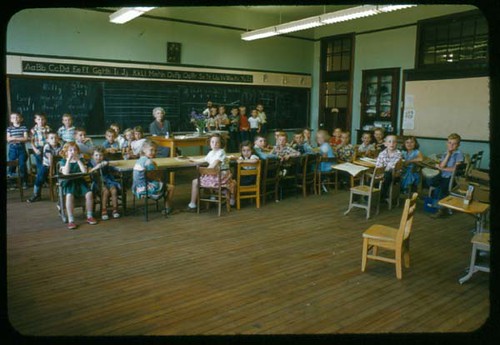
Panola County - Batesville School District - 1st Grade Classroom - 1955. University of Mississippi Visual Collections, John Elon Phay Collection


From the Mississippi History, "Rosenwald Schools in Mississippi," written by Jennifer Baughn: Public schooling in Mississippi did not become commonplace until after the American Civil War. After the United States Supreme Court decided in its 1896 Plessy v. Ferguson ruling that states could require separate public facilities for blacks and whites as long as they were equal (the so-called “separate but equal” doctrine), white-dominated school boards began concentrating more of their efforts and funding on schools for white children, rather than for black. By the early 1900s, while many white children studied their textbooks in new functional buildings, black students were often left to make do in churches, lodges, and poorly constructed buildings that barely kept out the wind and the rain.
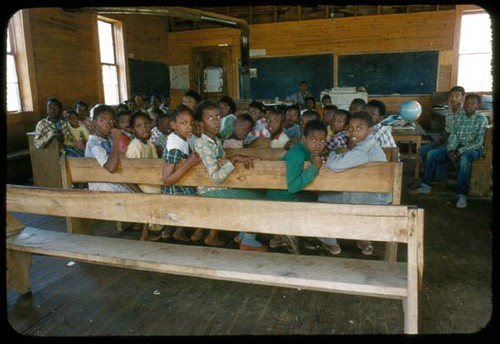
Panola County - Eureka Springs School - All Grades- 1955, University of Mississippi Visual Collections, John Elon Phay Collection

Beginning in the 1910s, however, new school buildings for African Americans began to spring up on the Mississippi landscape. The schools, constructed as a partnership between the Julius Rosenwald Fund and local citizens, represented a leap forward for black southerners who wanted to ensure an education for their children. When the philanthropic program ended in 1932, a victim of the Great Depression, more than 5,000 school buildings had been constructed under its auspices in fourteen southern states. Mississippi’s Rosenwald program constructed six hundred and thirty-three schools and ancillary buildings and was the South’s second-largest state program.


The Rosenwald Fund — the product of an alliance between Booker T. Washington, president and founder of Tuskegee Institute in Alabama, and Julius Rosenwald, president and chief executive officer of Sears, Roebuck & Co. in Chicago — was the only philanthropic effort in the early 20th century to concentrate on improving the learning environment of black students in the South. The fund accomplished this by giving grants to black communities to cover about a third of the cost of a building. The communities were expected to match the Rosenwald money with either cash or in-kind contributions of labor and materials and to gain financial support from the public school system. While the communities gained a quality building, they also lost a measure of control over their children’s education when the school, which had usually been run by its own board of trustees, came under the control of the county superintendent of education.
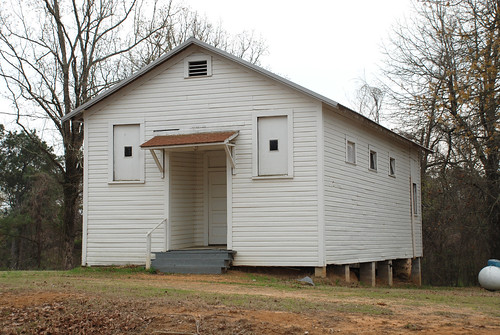
Bynum School in Panola County, Mississippi

Begun at Tuskegee in 1912 and initially focused on the few counties surrounding that campus, the Rosenwald Fund’s fame grew through the extensive personal networks of southern blacks. By the end of the 1910s, several states surrounding Alabama had a few Rosenwald schools. But after Washington’s death in 1915, Rosenwald lost confidence in the fund’s new leaders at Tuskegee Institute. He moved the fund’s management away from Tuskegee and set up a new office run by foundation professionals in Nashville. During the 1920s, the Rosenwald Fund became increasingly standardized and efficient, approving thousands of grants in all of the southern states.

Julius Rosenwald founder of the Roesnwald schools.

In Mississippi, only a dozen or so schools obtained help in the early years under Tuskegee’s management. The early buildings were not built to standard plans and often were not much better planned than non-Rosenwald schools. A major shift occurred after the Rosenwald Fund’s reorganization in 1919-1920. By 1922, the Rosenwald Fund reported that one hundred and forty-one Rosenwald schools had been built in Mississippi, including fifty-eight three-teacher schools and five houses for teachers.
Built in 1926, the Bynum School in Panola County is the only surviving one-classroom Rosenwald school in Mississippi. Photograph by Jennifer Baughn. Courtesy Mississippi Department of Archives and History.
A NEW SCHOOL BUILDING: A primary focus of the newly reorganized Rosenwald Fund was the quality of the construction of school buildings that would be built with its funds. The fund wanted to build the most schools it could, but it also wanted them to meet current building standards and to be solidly constructed of good materials. Rosenwald also wanted to incorporate knowledge gained during a decade of careful study into lighting levels and ventilation. At the time, rural schools, and even some town schools, did not have electricity to provide lighting or heat. Thus, lighting needed to come into the building through windows, and studies had shown that schools needed many more windows than had previously been thought in order to give students sufficient light. In addition, new research showed that good ventilation prevented the spread of germs and diseases.


Using the findings from a survey of the existing Rosenwald schools by consultant Fletcher B. Dresslar, a recognized authority on the topic of school hygiene and good school planning, the fund, led by its new director Samuel L. Smith, drew a new set of standard plans that would be used to construct almost all Rosenwald schools in the 1920s. From 1920 onward, the Rosenwald Fund’s emphasis moved from funding “better schools” to encouraging “model schools” that could be standards for both black and white schools in the South.

Rosenwald plan, one-teacher school
Rosenwald plan for a one-teacher school. Courtesy Julius Rosenwald Fund, Community School Plans, Bulletin No. 3, Nashville, Tennessee, 1924.

The new plans allowed for a broad variety of schools, based on the number of teachers per school. Ranging from one-classroom structures with a gable front — a common school form in all areas of the country — to large twelve-classroom buildings with auditoriums, the plans relied on simple forms and construction techniques that would be accessible to the many volunteer laborers who built these schools. Several new features of the schools did in fact become models for school architecture in the 1920s, such as:


Prentiss Institute Rosenwald School, Prentiss, Jefferson Davis County

• One-story construction, which required slightly more land but was easier to build and was considered a safety improvement following several deadly school fires in two-story buildings.

• Large groupings of windows, concentrated on the east and west elevations of buildings, became the hallmark of schools for both black and white students in the 1920s. Previously, rural school buildings would have a few scattered windows, with windows on several walls of each classroom. Studies showed, however, that light from many directions caused a glare that could damage a student’s eyesight.


• Two school forms, the H-plan and the T-plan, became standard for rural and town schools alike in the 1920s. The Rosenwald standardized plans used these two forms almost exclusively for schools of four classrooms or more. Both plans contained an auditorium for school and community gatherings, but the H-plan was designed to face north or south, with its windows on the sides facing east and west, while the T-plan was designed to face east or west with its windows on the front and back. These simple but effective plans show the ingenuity and flexibility of the Rosenwald Fund’s program and the emphasis on quality even in difficult circumstances.


Prentiss Institute Rosenwald School, Prentiss, Jefferson Davis County

Only fifteen of the original five hundred and fifty-seven schools aided by the Rosenwald Fund are known to still stand in Mississippi. Of these, about half are either greatly altered or in a deteriorated state. The sole surviving one-classroom school is the Bynum School, built in 1926, in Panola County. Two good examples of the H-plan form are the concrete-block building (1926) at the Prentiss Institute in Jefferson Davis County, a six-classroom building constructed according to Rosenwald Plan #6-A, and the Brushy Creek School (circa 1930) in Copiah County, a clapboard Rosenwald Plan #4-A. The Drew Rosenwald school in Sunflower County began as a substantial T-plan Rosenwald, and grew over the years into a sprawling building with a large student population. The T-plan especially was popular because it could easily handle any needed expansion.
Brushy Creek School, 1930, in Copiah County, Mississippi

In addition to the known Rosenwald schools, Mississippi has some “ghost schools,” a group of schools that were supposed to have received Rosenwald Funds but the money was fraudulently diverted for personal use between 1923-1928. The Rosenwald agent at the Mississippi Department of Education, Bura Hilbun, who was responsible for overseeing the Rosenwald Fund in Mississippi and sending in final reports to the Nashville office, was later found to have falsified records and pocketed the money meant for certain schools. Hilbun’s fraud was found after he left the education department. He was convicted of embezzlement in 1931 in the Hinds County Circuit Court, after two hung juries. Hilbun appealed to the Mississippi Supreme Court but it upheld the lower court’s decision.

Poplar Hill School, Fayette vicinity, Jefferson County – (c. 1923) (National Register). Poplar Hill School in Jefferson County is a rare example of a rural school built in the early 20th century to serve the surrounding African American community. The one-story wood frame building with a side-gable metal roof was built c. 1923 and housed two classrooms. Two teachers were responsible for educating students from grades 1 through 8.
As a result of Hilbun’s falsified records, the historical records of the Rosenwald Fund at Fisk University Archives in Nashville list some schools that were not actually built, thus the “ghost schools.” One of those ghost schools has survived. Poplar Hill School is a rare two-classroom black school in rural Jefferson County, and while the school appears in the Rosenwald Fund database on the Fisk website, it is not, in fact, a Rosenwald plan and did not receive any Rosenwald funding. This was distressing news to a group of interested alumni who in 2009 pursued a National Register of Historic Places listing for the building as a Rosenwald school. Nonetheless, the building is still significant as a rare surviving rural African-American school, once one of thousands that dotted the Mississippi landscape.

Sherman Line School in Amite County, Mississippi, built in 1928. Photograph by Jennifer Baughn. Courtesy Mississippi Department of Archives and History.

BUILDING SCHOOL COMMUNITIES: The Rosenwald Fund did not stop with just building new classroom buildings for students. Located in rural areas with poor road systems, the schools came to be somewhat self-sufficient campuses, eventually including not only houses for teachers but also separate buildings for vocational and home economics education.

John White School teacher’s house (1925) in Forrest County

The Rosenwald Fund understood well the challenges of rural schools, and the first and most important one was attracting qualified teachers. School trustees often found it necessary to build a teacher’s house on the campus as a way to entice a principal who could oversee the school’s functioning. Not only did a teacher’s house keep principals and teachers longer at the school, but it provided security for the campus and an on-site alarm in case of fire. As it did with school plans, the fund offered several different house plans for teachers to accommodate families of various sizes. The Rosenwald Fund helped build fifty-eight teacher houses in the state, and many school boards built houses for teachers as well. At least two of the Rosenwald houses still stand in the state, the John White School teacher’s house (1925) in Forrest County and the former president’s house (circa 1930) at Coahoma Community College north of Clarksdale, a campus that began as one of only two agricultural high schools for African Americans. The other school was Hinds County Agricultural High School in Utica (1946).

Pope Chapel Elementary School, Panola County, 1955.

Vocational buildings or shops were also seen as a way to improve both the campus and the school’s educational program. The Rosenwald Fund emphasized vocational education not only because of its origins at Washington’s Tuskegee Institute but because training in agricultural and mechanical skills was thought to be the best way to educate rural children of both races for much of the first half of the 20th century. Indeed, backed by sufficient funding, white consolidated schools of the same period far outstripped black schools in providing buildings and teachers for vocational and home economics education and were considered better schools because of it. Only eighteen vocational buildings for black schools were constructed in Mississippi under the Rosenwald program, primarily because of lack of matching funds and because building a vocational building also meant hiring an extra teacher to teach the classes. This was often out of reach for the Rosenwald schools struggling to survive on limited funding from the public school boards.

Rose Hill School in Sharkey County, Mississippi, is a Rosenwald school.

By 1932, two years after Rosenwald’s death and three years after the stock market crash slashed the value of its endowment, the Rosenwald Fund ceased its building program, leaving southern blacks and southern progressives to find another solution for black education. (source: Mississippi History)

Sunday, September 25, 2011

Sons of Mississippi, Paul Hendrickson

"This photograph was taken in late September 1962, seven years after the killing of Emmett Till. The photograph, which isn't an icon image of the sixties—but should be—was recorded a few days before an all-night riot in Mississippi in which two died and hundreds were injured. It was made by an uncommonly brave and gifted white freelance photographer from Alabama named Charles Moore, on a Thursday afternoon, in a grove of elms and oaks and fine old catalpa trees, at Oxford, Mississippi, on the campus of a place known lovingly as Ole Miss. A week later this document was published in a double-truck spread in Life magazine with this small headline down in the left-hand corner: 'Local lawmen, getting ready to block the law.' There were a lot of other pictures in the story, but this was the one that stole your eyes...

Paul Hendrickson

"...Even now, after years of looking at it, examining it, carrying it, I can't precisely say what it was about the image that so took hold of me. It had an overwhelming storytelling clarity—and simultaneous confusion. It was only much later, with the research and reporting and interviews unfolding before me, that I found a certain corroboration for all I must have been imagining the first time I came across it."

—from Sons of Mississippi by Paul Hendrickson

From the April 2003 Washington Monthly, "Rising Sons: A review of Paul Hendrickson's Sons of Mississippi," by Wen Stephenson: On Sept. 27, 1962, in Oxford, Miss., among the elms and oaks and catalpa trees on the campus of Ole Miss, a gifted young freelancer snapped a photograph for Life magazine of seven Mississippi sheriffs having too good a time. It's not an icon of the 1960s, but it should be, says Paul Hendrickson. They're standing, "these seven faces of Deep South apartheid," around the hood of a squad car, and the handsome one in the middle--head of the state sheriffs' association, cigarette between his grinning teeth--is taking a practice swing with a billy club to the amusement and grim appreciation of his colleagues. It was three days before James Meredith would become the first African American to enroll at the University of Mississippi (accompanied by more than 500 federal marshals and several thousand U.S. troops), and these sheriffs, in their white shirts and dark ties, had come from all over the state to help keep their fellow Mississippian from setting foot on the sacred campus.
Paul Hendrickson

For Hendrickson, a former Washington Post reporter who was born in California but raised partly in the Deep South, that photograph contains an essential underlying story of the Battle of Oxford and the larger civil rights struggle, a story of race and its legacy that holds the key to much of the past 40 years. In Sons of Mississippi, Hendrickson takes a rare approach to this subject, focusing on the white supremacists themselves, rather than the familiar, and safer, heroic narrative of the people who rose up to defeat them. His driving impulse is to get beneath the surface and beyond the frame of that photograph in order to see these seven Southerners, and their children and grandchildren after them, as complex individuals rather than two-dimensional caricatures. He knows that racism--even in a time and place as benighted as Mississippi in 1962--is never monolithic, and is careful to highlight the nuances of racial feeling along a spectrum that runs from virulent bigotry to complacent (and complicit) passivity. He knows that the only way to understand the inhumanity in that photograph is to make the men who populate it human.
1962 Ole Miss University campus riot.

Two of those men were still alive when Hendrickson started the project; all of them are well remembered by family, friends, and colleagues. One of the deceased, the former sheriff of Pascagoula--alcoholic, viciously bigoted, and beloved of his men--has an FBI file on him big enough, yet maddeningly inconclusive enough (full of "redactions" pointing all the way to J. Edgar Hoover) to be the stuff of legend. For more than one of them, Hendrickson unearths evidence of Klan and Klan-related activities, though he's unable to prove anything, and none can be linked directly to any civil-rights crime.

The University of Mississippi, Oxford 1962.

But as Hendrickson states at the outset, his book isn't really about the men in the photograph. "Instead," he writes, "it's about what's deeply connected but is off the page, out of sight, past the borders. It's about what has come down from this photograph." And so the portraits of those men are followed by longer, more intimate profiles of some of the descendants, those he calls "the inheritors," in whose stories he finds "some modest surprises and small redemptions and blades of latter-day racial hope."

U.S. Border Control

There's Sheriff Tommy Ferrell, who succeeded his father as sheriff of Natchez (Adams County), keeps a portrait of Nathan Bedford Forrest--co-founder of the KKK--on his office wall, and has nonetheless risen to national prominence in his determination to modernize the image of Mississippi law enforcement. (And whose proud political demeanor conceals an edge of defensiveness about his father's role in the 1960s.) There's Tommy's son Ty Ferrell, a U.S. Border Patrol agent in Santa Teresa, N.M.--compassionate, painfully self-conscious, prone to tears--who seems to carry around with him the entire burden of the family's racial past. And there's John Cothran--grandson and namesake of Sheriff John Ed Cothran of infamous Greenwood (Leflore County) in the Delta--a "working stiff" whose good heart and bad temper have left him with four broken marriages, who works as a floor manager at Home Depot and a second job stocking shelves at the Kroger supermarket to pay child support for the kids he loves, and whose ambition is a double-wide trailer in an all-white development outside Senatobia. (And yet whose humanity toward, and willingness to stand up for, his black co-workers and friends give him a shot at redemption that is neither simple nor sentimental.)

Ole Miss was the scene of rioting that spilled over into the streets of Oxford, Mississippi (1962)
Hendrickson succeeds, movingly and compellingly, in these portraits of contemporary Southerners. But his feel for the deeper Southern past, and for the broader context of Southern politics, is less sophisticated and less satisfying. That is to say, Hendrickson gives us vivid pictures of who the men in that photograph were in 1962, and of what they passed on to their descendants, but he makes almost no effort to explain how they got that way--almost forgetting, it seems, that these men themselves were descendants, inheritors of the forces that shaped their South. Despite a central chapter in which he weaves a kind of historical essay on the events surrounding the Battle of Oxford and its aftermath, I found myself searching for some analysis of the social and political dynamics of race and class that run as an inescapable current through Southern history.
Ole Miss 1962

How, for example, did the poor and working-class backgrounds of these men, their lack of education, and their place within the stratified society of white Mississippi, affect their racial fear? How did white supremacism, and the populist politics of racial solidarity, offer them a kind of perverse security within that world? How did the tangled history of race and class in the Jim Crow South set the social boundaries and norms of behavior in their time and place? Hendrickson hints elusively at such questions, but fails to confront them. (source: Wen Stephenson, Washington Monthly)


click here to watch Paul Hendrickson on C-Span's Book TV

Thursday, September 8, 2011

Enslavement After Emancipation

On the local level, most southern towns and municipalities passed strict vagrancy laws to control the influx of black migrants and homeless people who poured into these urban communities in the years after the Civil War. In Mississippi, for example, whites passed the notorious "Pig Law" of 1876, designed to control vagrant blacks at loose in the community. This law made stealing a pig an act of grand larceny subject to punishment of up to five years in prison. Within two years, the number of convicts in the state penitentiary increased from under three hundred people to over one thousand.
It was this law in Mississippi that turned the convict lease system into a profitable business, whereby convicts were leased to contractors who sub-leased them to planters, railroads, levee contractors, and timber jobbers.
Almost all of the convicts in this situation were blacks, including women, and the conditions in the camps were horrible in the extreme. It was not uncommon to have a death rate of blacks in the camps at between 8 to 18 percent. In a rare piece of journalism, the Jackson Weekly Clarion, printed in 1887 the inspection report of the state prison in Mississippi:
"We found [in the hospital section] twenty-six inmates, all of whom have been lately brought there off the farms and railroads, many of them with consumption and other incurable diseases, and all bearing on their persons marks of the most inhuman and brutal treatment. Most of them have their backs cut in great wales, scars and blisters, some with the skin pealing off in pieces as the result of severe beatings.
Their feet and hands in some instances show signs of frostbite, and all of them with the stamp of manhood almost blotted out of their faces.... They are lying there dying, some of them on bare boards, so poor and emaciated that their bones almost come through their skin, many complaining for the want of food.... We actually saw live vermin crawling over their faces, and the little bedding and clothing they have is in tatters and stiff with filth.

As a fair sample of this system, on January 6, 1887, 204 convicts were leased to McDonald up to June 6, 1887, and during this six months 20 died, and 19 were discharged and escaped and 23 were returned to the walls disabled and sick, many of whom have since died."

(Creating Jim Crow: In-Depth Essay, by Ronald L. F. Davis, Ph. D.)

Tuesday, August 16, 2011

Mississippi Circumvents the US Constitution

From the University of Richmond's History Engine, "Jim Crows to the Senate-a White Mississippians' Defense of Supremacy": On December 31, 1890, Senator James Z. George (D. Miss), a man Dunbar Rowland calls a life-long resident of Carroll County, began his overwhelmingly convincing speech on the Senate Floor defending the newly written Mississippi Constitution. The new constitution, according to Rowland's 1902 reflections, was drafted in order to eliminate ignorance at the ballot box, and Senator George's defense was apparently very insightful; he displayed a more intimate knowledge of the constitutions of Massachusetts, Vermont and Connecticut than did the Senators who represented those states, and the speech itself has been called one of the great constitutional law speeches of the Senate. Indeed, the principles that the man from Carroll laid out in his speech were subsequently validated by the United States Supreme Court in Williams v. Mississippi, 1898.
Two of the 1890 Mississippi Constitution's 285 main sections which George defended, however, have now earned historical renown: Sec. 243 establishing a uniform poll tax of two dollars, to be used in aid of the common schools, and for no other purpose, and Sec. 244 establishing a literacy test consisting of being able to read, understand, and interpret any section of the new Constitution. Although these two sections do not explicitly disenfranchise blacks and the provisions of the constitution of the State of Mississippi and the laws enacted to enforce them [were found in Williams v. Mississippi not to be] repugnant to the Fourteenth [and Fifteenth] Amendment of the Constitution of the United States, the result was undoubtedly lopsided. According to William Alexander Mabry, the educational test if administered honestly [disenfranchised] about 123,334 Negroes and only 11,889 whites, leaving a white voting majority of more than 40,000 in the state instead of the existing 70,000 potential Negro majority, not to mention the fact that the Negro majority was already being repressed by bloodshed, bribery, [and] ballot stuffing.


Unfortunately, contrary to some of the official defenses of the 1890 constitution, including Senator George's, the result of disenfranchising a great number of blacks was intentional. As Rowland stated, the 1875 White Revolution in Mississippi and the subsequent years of intimidation of blacks leading up to the 1890 convention were carried out under the belief that the negro has proven himself unworthy of suffrage, and it should be taken from him. Even future early twentieth century Mississippi Governor James Kimble Vardaman noted, according to an online PBS history of Jim Crow, that there is no use to equivocate or lie about the matter.


Mississippi's constitutional convention was held for no other purpose than to eliminate the nigger from politics; not the ignorant -- but the nigger. James George had fought since 1875 for this very purpose, and, despite claims of eliminating ignorance, it was in fact racial discrimination he defended before the U.S. Senate.


Although the man from Carroll County's humble beginnings had earned him the nickname the Great Commoner, and his work in the United States Senate was valuable in aiding education and civil service reform as well as being instrumental in shaping the Sherman Antitrust Law, his staunch defense of the Mississippi Constitution of 1890 left a darker legacy to the South. While he was very likely only a product of his time and environment, as well as a much larger underlying racial problem in the South and indeed the entire country, Senator James Z. George's rousing speech left what would become a permanent stain not only on the man from Carroll, but also on the entire South and United Sates as a whole, as it justified before Congress the Jim Crow system of de jure racial segregation and subjugation.

Mississippi Negro Education

The fraudulent state elections of 1875 removed many black and Republican lawmakers who had supported public school funding. Conservative white Democrats regained control of state government and gradually began to reduce the taxes that had funded public education. The Republican governor was forced to resign and the lieutenant governor and the state superintendent of education were impeached and removed from office.
During the early 1870s the education of black children was further endangered as a campaign of intimidation and violence was waged against black schools and their officials. The Ku Klux Klan made the public schools and their teachers targets for their acts of destruction and mayhem. By 1885 the state had cut education funding to the point that the effectiveness of the schools was being called into question.
In 1886 State Superintendent J. R. Preston implemented a revised education code that raised educational standards for both teachers and schools. The new law adjusted teacher salaries to school size and required teachers to take and pass a licensing examination. With white Democrats firmly in control of the state government, it was only a matter of time before laws pertaining to education would be either changed or nullified by those who opposed the education of the Negro.


Public Education Under the Constitution of 1890
The consolidation of political power in the Democratic Party led to a call for a new state constitution. The Constitution of 1890 was for the most part very similar to the previous state constitution with regard to education. There were however two notable differences. The first difference was found in Article VIII, Section 207 which read, “Separate schools shall be maintained for children of the white and colored races.” This provision established legal segregation in the common schools. A similar law passed in 1888 had legalized segregation of public accommodations such as trains and railway stations. The education of the Negro was considered a necessary evil by white southerners who resented paying taxes to support black schools. Methods of circumventing the constitutional education provisions soon emerged. Funds earmarked for black schools were blatantly designated to white schools. This early misappropriation of education funds contributed to inequalities in black school facilities and in the salaries of black teachers. One other significant difference between the two constitutions was the provision for the establishment and support of institutions for the education of the deaf, dumb, and blind. Changes in the school laws came rapidly during this period, but by 1890 most Mississippians had accepted public schools as a cost-effective alternative to expensive private academies.
With state government once again in control of an all white Democratic Party, the public began to invest in the education of its white children to the neglect of the majority black children. As white leadership in predominantly black counties shifted funds to build and maintain white schools, black communities worked hard to offset the funding imbalances. To make up the difference black communities often were “double taxed,” having to pay the state poll tax and then to collect donations within their communities to sustain the education of their own children. Black schools were also assisted by northern philanthropy through such organizations as the Peabody Fund, the Slater Fund and the Julius Rosenwald Fund.

Saturday, July 2, 2011

EMMETT TILL: MORE THAN A MURDER


The Clarion-Ledger/ Jackson Daily News on August 25, 1985 article, "Emmett Till: More Than A Murder: Bryant wants the past to ‘stay dead’," by Joe Atkins a Jackson Daily News Staff Writer and Tom Brennan a Clarion-Ledger Staff Writer"

Roy Bryant seems to be two men.

On one hand, the 54-year-old white Delta storeowner is sick of questions about the 14-year-old black youth he and his half-brother, J. W. Milam, were accused and acquitted of killing 30 years ago.
This Roy Bryant’s voice becomes a growl at the mention of Emmett Till. “He’s been dead 30 years and I can’t see why it can’t stay dead,” he says.

The other Roy Bryant is an agreeable sort whose face brightens with pride when he talks about the flowers he has grown in front of his store. He says he gets along fine with blacks.

“I don’t mistreat a man because he’s black any more than I do a white man,” he says. “I treat a man like I want to be treated.”

The second side of Roy Bryant wants his privacy and worries that some young black might seek belated vengeance. He possesses such loyalty from friends that one of them nearly slugged a television reporter who recently tried to interview him.


“I don’t know what happened to Emmett Till,” this Roy Bryant says.

Yet, the other Roy Bryant grumbles darkly that he isn’t making a dime out of renewed publicity about Emmett Till’s slaying. He says his memory could be jogged “for a bunch of money.”

This Roy Bryant even thinks enough of his notoriety to keep in his modest brick home a video cassette of the Today show’s recent televised report on the Till case, a show in which host Bryant Gumbel innocently asks, “Whatever happened to Roy Bryant?”

“Hell no, I didn’t do it!” Bryant said during one of two recent interviews at his store and home. “I didn’t admit to it then. You don’t expect me to admit to do it now. Of course they couldn’t do anything to me if I did.”

But, he adds, “I feel this way: If Emmett Till hadn’t got out of line, it probably wouldn’t have happened to him.”

The man who, with Milam, gained international attention in the Emmett Till slaying today lives an obscure life not unlike that of 30 years ago.
Map of Money, Mississippi

He lives in a Mississippi Delta town. He runs a store. He vigorously maintains his innocence in Till’s death.

Bryant mostly refuses to discuss the events of that Sunday morning in August 1955, when Till was dragged from his great-uncle’s home. He and Milam told authorities at the time they’d taken the youth off to punish him but later released him unharmed.

Bryant was described by news reports in 1955 as the handsome ex-paratrooper with the beautiful wife. Now, the good looks and the woman, both, are gone.

Bryant has gained a thick paunch, lost much of his jet black hair and says he is legally blind. He uses a thick magnifying glass to read price tags when he rings up purchases at his store.

He has been divorced for six years from Carolyn Holloway Bryant, the dark-eyed brunette beauty whose honor Bryant and Milam are said to have defended 30 years ago. Bryant says both have remarried, but their three children and eight grandchildren keep them in touch.

“She was a good-looking woman,” he said as he watched an old film of her on the Today report.

Despite the support shown them by white Delta residents during their trial, Bryant and Milam were ostracized afterward by both the white and black communities.


Their isolation worsened after January 1956, when a shattering article by author William Bradford Huie appeared in Look magazine. The article quoted Milam, who described in detail how he and Bryant brutally beat the boy and finally dumped him in the river after Milam shot him.
“J. W. Milam was from Glendora. He was acquitted in the trial, but he was not acquitted by the people of this area,” recalls unsuccessful 1983 gubernatorial candidate Mike Sturdivant, a large landowner in the tiny Tallahatchie County town of Glendora. Sturdivant knew Milam and Bryant.
“J. W. left Glendora because the people in the area convicted him in their relationship with him.”

Bryant bitterly maintains he was driven from the state by the same community that rallied to his and his half-brother’s defense during the September 1955 trial.

“I had to leave to make a living; there was nothing here for me,” he said.

After the trial, he and his first wife tried to reopen the store in Money, the scene of the infamous wolf-whistle, but a boycott by black customers forced its closing.

“We had it open for three weeks and didn’t clear $100,” he said. “I saw the handwriting on the wall.”

Bryant says he did odd jobs for 75 cents a day before learning welding at the Bell Machine Shop in Inverness. The family moved to Orange, Texas, in 1957, where he spent 15 years as a boilermaker – the job he says cost him his eyesight. In 1972, the Bryants returned to Mississippi to take over a grocery owned by one of Bryant’s brothers.

Roy Bryant's Store in Money, Mississippi

“Mississippi was my home. Once you are raised up in a state, it’s home,” he says.

I wouldn’t have come back to Mississippi for a job.”

For 13 years , Bryant has been satisfied with his hew life. His sister helps him out at the store.
“It may not be much, but it’s a honest living and that’s all a man can ask,” he says.

His domain how is a converted gas station with a wooden floor. The store is cluttered with the mainstays of small-town living: canned goods, snacks, cigarettes and one beer cooler.


As in 1955, Bryant today relies on credit purchases and a black clientele. “I have a good black business, more black customers than whites.”

Chain smoking behind the counter while a spotted cat sleeps nearby on a pile of grocery sacks, Bryant talks not of the past, but of what he has done with the store.

He points with a dedicated gardener’s pride to the rose moss flowers growing by a shoeshine stand outside the store. He welcomes visitors to the café he built in the back, with its three red-vinyl booths, pool table and three-stool bar.

“It is a family type of place,” he said. “We serve plate lunches and sandwiches and that type of stuff (publicity about the Till slaying) just wouldn’t help.”

He speaks fondly of Milam, his half-brother, who was 36 at the time of the Till trial. Milam died of cancer of the backbone on Dec. 31, 1981.

“He was a hell of a fine fellow and brother. He was gentle as a lamb and helped a lot of people that never paid him back.”

Like Bryant, Milam spent many years in Texas after the trial. Like Bryant, he eventually returned to his home state. He lived in Greenville and worked in construction until his illness made it impossible.

“My father never said much to me about it and I never asked,” says Milam’s son, Bill, a 34 year-old Greenville truck driver who attended his father’s trial along with his brother, Harvey, who was 2 years old at the time.


“I don’t have any memories of it at all,” Bill Milam says of the trial in Sumner. “I was so little, didn’t none of it affect me. I never wanted to get involved in it. Most folks I know had never said anything about it.”

Bill Milam is single. Harvey is married and has three children, but Bill wouldn’t say where his brother lives.

Bryant’s son, Frank, shields his mother from publicity. “She doesn’t want to make any comment on anything and she doesn’t want anyone to try to contact her,” he said.

Bryant still fears economic and physical retaliation for the 30-year-old incident and refuses to have his picture taken or to have the location of his store revealed.

“This new generation is different and I don’t want to worry about a bullet some dark night,” he said. “This store is all I have now, that and my disability check.”

Does he have any personal regrets about what happened in 1955?

“You mean do I wish I might wouldn’t have done it? I’m just sorry that it happened,” Bryant said.

The.Untold.Story.Of.Emmett.Louis.Till.1of2


The.Untold.Story.Of.Emmett.Louis.Till.2of2