Showing posts with label American Studies. Show all posts

Tuesday, October 11, 2011

Public Pools' Contentious Past: "Just Don't Touch the Water"

Excerpt: Contested Waters, "Just Don't Touch the Water"

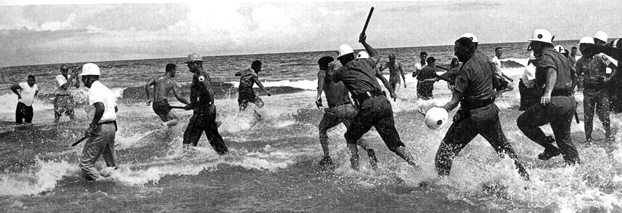
FORT LAUDERDALE July 4, 1961 a small group of other civil rights activists waded into the whites-only beach off Las Olas Boulevard. The "wade-ins" that started that day were a turning point in Fort Lauderdale history. A year later, a judge refused the city's request to stop the protests and the city decided to open the beaches to everyone.

INTRODUCTION--In 1898 Boston's mayor Josiah Quincy sent Daniel Kearns, secretary of the city's bath commission, to study Philadelphia's bathing pools. Philadelphia was the most prolific early builder of municipal pools, operating nine at the time. All but three were located in residential slums and, according to Kearns, attracted only "the lower classes or street gamins." City officials had built the austere pools during the 1880s and early 1890s—before the germ theory of disease transmission was popularly accepted—and intended them to provide baths for working-class men and women, who used them on alternating days. The facilities lacked showers, because the pools themselves were the instruments of cleaning. Armed with the relatively new knowledge of the microbe, Kearns was disturbed to see unclean boys plunging into the water: "I must say that some of the street gamins, both white and colored, that I saw, were quite as dirty as it is possible for one to conceive." While the unclean boys shocked Kearns, blacks and whites swimming together elicited no surprise. He commented extensively on the shared class status of the "street gamins" and their dirtiness but mentioned their racial diversity only in passing. Nor did racial difference seem to matter much to the swimmers, at least not in this social context. The pools were wildly popular. Each one recorded an average of 144,000 swims per summer, or about 1,500 swimmers per day.


Fifty-three years later, the scene at a municipal pool in Youngstown, Ohio, was quite different. A Little League baseball team had won the 1951 city championship and decided to celebrate at the local pool. The large facility was situated within the sylvan beauty of the city's Southside Park, not in a residential slum. The pool itself was surrounded by a broad deck and grassy lawn, both of which provided swimmers ample space to play games or lie in the sun. The pool was clearly intended to promote leisure, not cleanliness. To celebrate their baseball victory, coaches, players, parents, and siblings showed up at the pool, but not all were admitted. One player, Al Bright, was denied entrance because he was black. The lifeguards forced him to sit on the lawn outside the fence as everyone else played in the pool. The unwritten rule was clear, one guard told the coach, "Negroes are not permitted in the pool area." After an hour had passed, several parents pleaded with the guards to let Al into the pool for at least a couple of minutes. Finally, the supervisor relented; Al could "enter" the pool as long as everyone else got out and he sat inside a rubber raft. As his teammates and other bystanders looked on, a lifeguard pushed him once around the pool. "Just don't touch the water," the guard constantly reminded him, "whatever you do, don't touch the water."
Cairo, Illinois

How is it that so much had changed in those fifty years? At its heart, this book answers that question. It explains how and why municipal swimming pools in the northern United States were transformed from austere public baths—where blacks, immigrants, and native-born white laborers swam together, but men and women, rich and poor, and young and old did not—to leisure resorts, where practically everyone in the community except black Americans swam together. As the opening vignettes suggest, this social, cultural, and institutional transformation occurred during the first half of the twentieth century and involved the central developments of the period: urbanization, the erosion of Victorian culture, Progressive reform, the emergence of popular recreation, the gender integration and racial segregation of public space, and the sexualization of public culture. In short, the history of swimming pools dramatizes America's contested transition from an industrial to a modern society.

[Photographer unknown]
June, 1964. Black children integrate the swimming pool of the Monson Motel. To force them out, the owner pours acid into the water.
But the story does not end there. A second social transformation occurred at municipal swimming pools after midcentury. Black Americans challenged segregation by repeatedly seeking admission to whites-only pools and by filing lawsuits against their cities. Eventually, these social and legal protests desegregated municipal pools throughout the North, but desegregation rarely led to meaningful interracial swimming. When black Americans gained equal access to municipal pools, white swimmers generally abandoned them for private pools. Desegregation was a primary cause of the proliferation of private swimming pools that occurred after the mid-1950s. By the 1970s and 1980s, tens of millions of mostly white middle-class Americans swam in their backyards or at suburban club pools, while mostly African and Latino Americans swam at inner-city municipal pools. America's history of socially segregated swimming pools thus became its legacy.


Throughout their history, municipal pools served as stages for social conflict. Latent social tensions often erupted into violence at swimming pools because they were community meeting places, where Americans came into intimate and prolonged contact with one another. People who might otherwise come in no closer contact than passing on the street, now waited in line together, undressed next to one another, and shared the same water. The visual and physical intimacy that accompanied swimming made municipal pools intensely contested civic spaces. Americans fought over where pools should be built, who should be allowed to use them, and how they should be used.
Integrating St. Augustine's "white only" beaches. "I remember the wade-ins because the bump hasn't gone off my jaw yet. They started yelling obscenities at us, but we went on — myself and a group of teen-age girls. We were afraid but we felt we just had to go on." — Dorothy Cotton, SCLC.
This is a very different view of urban space than presented by historians John Kasson, Kathy Peiss, and David Nasaw. They characterize commercial amusements at the turn of the twentieth century—such as Coney Island, dance halls, and movie houses—as social melting pots that rather painlessly dissolved earlier class and gender divisions but reinforced racial distinctions. According to Nasaw, "'going out' meant laughing, dancing, cheering, and weeping with strangers with whom one might—or might not—have anything in common. . . . Only persons of color were excluded or segregated from the audience." Kasson makes essentially the same point when he concludes that commercial amusements "help[ed] to knit a heterogeneous audience into a cohesive whole."
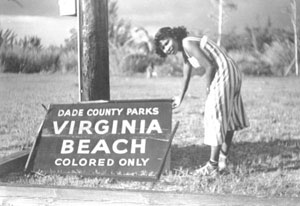
Woman by sign blown down during hurricane: Virginia Beach, Florida (1950)
Woman by sign blown down during hurricane: Virginia Beach, Florida (1950). Virginia Beach is off the coast of Miami in Dade County.

Just the opposite was true at swimming pools early in the twentieth century. Northerners' use of municipal pools throughout the Progressive Era reinforced class and gender divisions but not racial distinctions. Cities strictly segregated pools along gender lines, and people from different social classes almost never swam together. In many cases, middle-class northerners fought vigorously to ensure that working-class swimmers did not intrude upon their recreation spaces. By contrast, blacks and working-class whites commonly swam together, often without conflict.
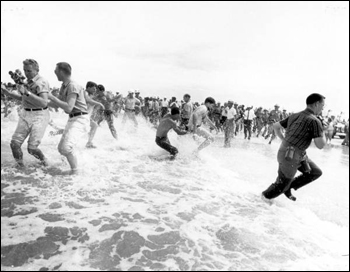
Segregationists trying to prevent blacks from swimming at a "White only" beach (June 25, 1964)

All this changed during the 1920s, when northerners redrew the lines of social division at municipal pools. Different social classes of whites and both sexes plunged into the same pools and simultaneously excluded black Americans. This social reconstruction had many causes. The Great Black Migration contributed to the onset of racial segregation at pools by intensifying residential segregation in northern cities and heightening perceptions of black- white racial difference. Conversely, economic prosperity and the decline in European immigration mitigated perceptions of class and ethnic difference. Middle-class northerners generally became willing to swim in the same pools with working-class whites because they did not seem as poor, foreign, or unhealthy as before. Also, municipal pools became more appealing to the middle class during the 1920s because cities redesigned them as leisure resorts and typically located them in open and accessible parks rather than residential slums. At the same time, municipal officials began permitting males and females to swim together because they intended the new resort pools to promote family and community sociability. The concerns about intimacy and sexuality that had necessitated gender segregation previously did not disappear during the 1920s; rather, they were redirected at black Americans in particular. Whites in many cases quite literally beat blacks out of the water at gender-integrated pools because they would not permit black men to interact with white women at such intimate public spaces. Thus, municipal pools in the North continued to be intensely contested after 1920, but the lines of social division shifted from class and gender to race.

Historians have largely ignored this racial contest over public space in northern cities after 1920, focusing instead on housing, work discrimination, and schools. John McGreevy, for example, recently concluded that "racial violence in the North centered on housing and not, for the most part, on access to public space." This book tells a different story. The imposition of racial segregation at municipal pools was a violent and contested process in the North. Blacks and whites battled one another with their fists as well as with bats, rocks, and knives. Racial segregation succeeded not because black Americans acquiesced, but because white swimmers steadfastly attacked black swimmers who entered pools earmarked for whites and because public institutions—namely the police and courts—enforced the prejudice of the majority rather than the rights of minority.
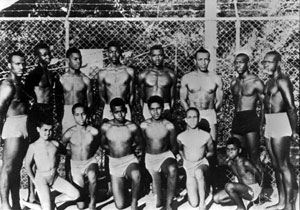
Tallahassee, Florida: Swim team at Robinson Trueblood Swimming Pool on Dade Street was built by the city in response to wade-ins by blacks at all white pools. It was the only pool where blacks could swim and train as lifeguards.
The social reconstruction of municipal pools between 1920 and 1940 marked a fundamental shift in northern social values and patterns of social interaction. During the Gilded Age and Progressive Era, the difference between people with "black" skin and those with "white" skin was a less significant social distinction than class. Furthermore, what we now think of as "race" was a less significant public social division than gender, class, and even generation. That changed during the 1920s, when race emerged as the most salient and divisive social distinction. Northern cities became fundamentally more integrated along class, gender, and generational lines, yet more segregated along racial lines. This racial division persisted throughout the rest of the twentieth century, despite court-ordered desegregation and the civil rights movement.

Savannah, Georgia Beach July 15, 1963: Two Negroes were arrested by local police and jeered and cursed by white people on the beach for swimming in the whites only water.

Northerners also contested public culture at municipal pools. During the late nineteenth century, working-class boys battled with Victorian public officials to determine the use and function of these new institutions. Public officials intended municipal pools to be used "seriously" as baths and fitness facilities. They were supposed to instill the working classes with middle-class values and habits of life. In defiance of these expectations, working-class boys transplanted their boisterous and pleasure-centered swimming culture from natural waters and defined municipal pools as public amusements. In doing so, they undermined Victorian public culture and helped popularize the pleasure-centered ethos that came to define modern American culture. During the 1920s and 1930s, swimmers refashioned attitudes about the body and cultural standards of public decency by what they wore and how they presented themselves at municipal pools. City officials attempted to dampen the sexual charge sparked by mixed-gender use and to limit exhibitionism and voyeurism by mandating conservative swimsuits. They could not, however, control popular demand. The acceptable size of swimsuits shrank during the interwar years and pools became eroticized public spaces. As a result, public objectification of the body became implicitly acceptable, and public decency came to mean exhibiting an attractive appearance rather than protecting one's modesty. The female nakedness and overt sexuality that pervade contemporary American culture originated, in part, at swimming pools. In these ways, ordinary Americans reshaped public culture by what they did and what they wore at municipal pools.
Civil Rights Series, Demonstrations at an "all-white" swimming pool in Cairo, Illinois, 1962
Municipal swimming pools were extraordinarily popular during the 1920s, 1930s, and 1940s. Cities throughout the country built thousands of pools—many of them larger than football fields—and adorned them with sand beaches, concrete decks, and grassy lawns. Tens of millions of Americans flocked to these public resorts to swim, sunbathe, and socialize. In 1933 an extensive survey of Americans' leisure-time activities conducted by the National Recreation Association found that as many people swam frequently as went to the movies frequently. In other words, swimming was as much a part of Americans' lives as was going to the movies. Furthermore, Americans attached considerable cultural significance to swimming pools during this period. Pools became emblems of a new, distinctly modern version of the good life that valued leisure, pleasure, and beauty. They were, in short, an integral part of the kind of life Americans wanted to live.

This story of tens of millions of Americans flocking to municipal pools, reshaping cultural standards, and redefining the meaning of the good life presents a very different view of modern American culture than offered by most historians. William Leach, Gary Cross, and Richard Fox and T. J. Jackson Lears are unanimous in arguing that consumption and commercialism became the dominant cultural ethos in twentieth-century America, effectively wiping out all competing public cultures. In their introduction to The Culture of Consumption, Fox and Lears claim that "consumption became a cultural ideal, a hegemonic 'way of seeing' in twentieth-century America." Additionally, many cultural historians characterize Americans as passive receivers of this consumer culture supposedly created and popularized by marketers, movie producers, merchants, and entrepreneurs. As William Leach argues in Land of Desire, "the culture of consumer capitalism may have been among the most non-consensual public cultures ever created . . . it was not produced by 'the people' but by commercial groups in association with other elites." This was not the case at municipal swimming pools, where ordinary Americans helped create a vibrant public culture not primarily focused on spending money and consuming goods.
1964 Racial Confrontation on St. Augustine Beach. A confrontation of black demonstrators and white segregationists at a white-only beach in St. Augustine. (Photo: Florida State Archives)
Finally, the history of swimming pools reveals changes in the quality of community life and the extent of civic engagement in modern America. From the 1920s to the 1950s, municipal pools served as centers of community life and arenas for public discourse. Hundreds and sometimes thousands of people gathered at these public spaces where the contact was sustained and interactive. Neighbors played, chatted, and flirted with one another, but they also fought with one another over who should and should not be allowed to swim and what sorts of activities and clothing were appropriate for this intimate public space. In short, community life was fostered, monitored, and disputed at municipal pools. The proliferation of private swimming pools after the mid-1950s, however, represented a retreat from public life. Millions of Americans abandoned public pools precisely because they preferred to pursue their recreational activities within smaller and more socially selective communities. Instead of swimming, socializing, and fighting with a diverse group of people at municipal pools, private-pool owners fenced themselves into their own backyards. The consequences have been, to a certain extent, atomized recreation and diminished public discourse.
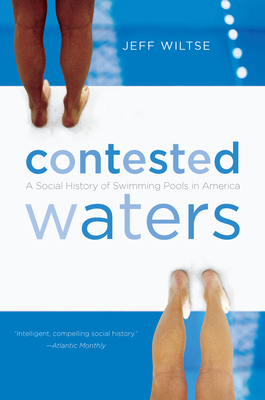
This study focuses on the history of municipal swimming pools in the northern United States. I chose to focus on municipal pools because they enabled me to study the public lives of Americans from many different — and often overlapping—social groups: working-class whites, women, African Americans, immigrants, children, and the middle class. At one time or another, Americans from all these social groups frequented municipal pools and contested their use. This book also examines and interprets the history of private swimming pools, but mostly when that history is necessary for understanding what occurred at municipal pools. I chose to focus on the northern United States in order to make the research more manageable, and because I wanted to tell a coherent story rather than interpret regional variation. I have, however, defined the northern United States broadly, including cities such as Baltimore, Washington, D.C., and St. Louis. These cities certainly have a southern heritage, but the history of their municipal pools followed a very similar pattern to that of cities further north. Likewise, the pattern occurred not only in large cities but in smaller municipalities as well. It turns out that what happened at municipal pools, whether in St. Louis and Chicago or in Newton, Kansas, and Elizabeth, New Jersey, was all quite similar.

[From Contested Waters: A Social History of Swimming Pools in America by Jeff Wiltse. Copyright (c) 2007 by the University of North Carolina Press.]

Thursday, June 23, 2011

This Land Is Your Land: Woodie Guthrie

"Woody Guthrie: Natural born anti-fascist," by Stetson Kennedy
“Do you have any evidence of Woody having ever committed any disloyal act?” my lawyer/friend/neighbour asked the two FBI agents who had dropped into his office to ask if it were true that “one Woodrow Wilson Guthrie” was staying at my home on the outskirts of Jacksonville, Florida.

“Well, there’s this,” one of them replied, fishing from his briefcase an 8x10 photograph of Woody holding his guitar with the inscription writ large across its face, THIS MACHINE KILLS FASCISTS!

It did, too. From the very first moment that fascism reared its head on the world scene - first in Mussolini’s Italy, then aped in Hitler’s Nazi Germany, and then imposed by the two of them in Franco’s Falangist Spain - Woody was singing his heart out against it. And long after the Axis defeat in 1945, Woody remained a militant anti-fascist until he drew his last breath on 3 October 1967.
That figures, because fascism was the mortal enemy of everything Woody believed in - people, unions, democracy, human rights, justice, peace, world brotherhood, you name it.

So Woody didn’t have to wait until Mussolini gloated, “We fascists have ridden roughshod over the putrid corpse of parliamentary democracy, and will do so again if need be!” or for Il Duce’s son-in-law Count Ciano to report how “troops of Ethiopian horsemen blossomed like roses when bombed from the air”. Or for Hitler to spell out in Mein Kampf his master plan for 1,000 years of world dominion, and a “final solution for European Jewry”. Or the Axis-backed fascist overthrow of the republican government of Spain. Much less the tardy US declaration of war against the Axis.

Fact is, a lot of us cut our political wisdom teeth on the works of those British socialists, Sidney and Beatrice Webb, who ended one of their 1930s books with the question, “What are we to do?” and answered “Build the Popular Front against fascism!”

Like the book Hard-Hitting Songs for Hard-Hit People, which Woody put together with folk musicologist Alan Lomax in 1941, Woody’s life work consisted of making up and singing songs to strengthen the arm of the poor, and especially their unions, in their struggle to shake off the shackles of the rich. Since the function of fascism was the exact opposite, Woody was what you might call a natural-born anti-fascist.

But he said it - and sang it - best. During World War II the US Office of War Information hired him to write some “morale-building songs”, but his were so explicitly anti-fascist not one was ever released. (The War Department did put out a four-page booklet to tell servicemen what fascism was all about, but Congress made them recall it. Hasn’t been seen since.)

“There ain’t but two sides, the working people’s side and the big bosses’ side,” Woody wrote. “The union side and the Hitler side. The first thing that Hitler cracked down on when he took the Nazi Chamber was the Trade Unions. And it will be the Trade Unions that beat Hitler. The best job you can do for your country, next to being a good soldier for the working people.

“You don’t have to go to Europe to find plenty to do to beat Hitler, stick up for what’s right, freedom of speech, press, radio, meetings, collective bargaining, the right to get together for decent pay, hours, rent, prices … The biggest thing that’s happening right now in the United States is us.”

That was the stuff Woody’s songs were made of. He didn’t mind others singing about love and such, but as far as he was concerned, “A song that don’t say somethin ain’t worth nothin”. Of course, what his were worth, and what they fetched, were two very different things. I remember getting many a mimeographed, self-illustrated copy in the mail, scrawled over in Woody’s hand, “Here is my latest song. Hope you like it. If so, please send 25c.”

It was much the same when it came to collecting even the $25 honorarium Woody generally got for singing on stage.

“But it’s for a Good Cause!” protested one sponsor who wanted him to sing for free.

“I don’t sing for bad causes,” was Woody’s rejoinder.

Woody was never the armchair anti-fascist, mind you. When he received a wartime telegram saying “Got a dish-washing job on a Liberty Ship,” he jotted in his Notebook:

Woman a-cryin
and me a-flyin
out the door
and down the line!

According to his sidekick Cisco Houston, when one of those ships carrying material to Britain and the Soviets was torpedoed (despite Woody’s prayers against “tin-fish”) he grabbed his guitar and kept playing, in the heroic tradition of dance bands when fire breaks out in the ballroom.

And when a sister ship went down with all hands on board, Woody sang (as if in anticipation of all the names engraved on the Vietnam Memorial wall in Washington):

Tell me, what were their names, boys,
what wurrr their names?
Did you have a friend
On that good Reuben James?

Woody was rightfully proud of his membership in the National Maritime Union and kept paing his dues long after he came ashore.
Like all true folk philosophers he could say a lot in a few words, for example, “If we would just take the profit out of war, there wouldn’t be any”.

In a 4 March 1942 entry in his Notebook for a letter to his unborn son, Woody had this to say:

“Maybe I should talk to you about fascism. It is a big word and it hides in some pretty little places. It is nothing in the world but greed for profit and greed for the power to hurt and make slaves out of the people… But fascism can no more control the world than a bunch of pool hall gamblers and thugs can control America. Because all of the laws of man working in nature and history and evolution say for all human beings to come always closer and closer together…

“How come me launching into a talk about fascism to you - only 4 months on the way - not even here yet? Because in the whole big world… fascism and freedom are the only two sides battling… every other shades into the fight somewhere, I’m not worried about where you’ll be standing - but - how could I ever get this book wrote full unless some of it was cussing out facism?

Like Tom Joad said to his dying mother in Steinbeck’s Grapes of Wrath, “wherever working people are fighting for their rights, I’ll be there”. That was Woody, all the way…

We were all very confident back then - as Pete Seeger has never tired of singing - that there was “a better way on the way”. Woody often put it in terms of a great day coming in which we (the human race) would all be members of “One Big Union”.

One of the most everlasting of Woody’s countless contributions is his song, This Land Is Your Land, which has virtually replaced America (that rewrite of God Save the King) as the US national anthem. Its refrain:

This Land is your land,
This land is my land,
This land belongs to you and me…

This song has taken root in the heart of Americans of all ages - all the title deeds to the contrary not withstanding. That Woody was not unaware of this complication was evidenced by his gentle yet firm revolutionary admonition for us to “take it easy, but take it!”

That Woody’s prenatal exhortations against fascism did not fall on deaf ears is attested by Arlo Guthrie’s singing career. That word fascism may still be understood on the eastern side of the Atlantic, where it wreaked the most havoc, but it is still almost unheard of in the USA today. (Recently when a student-made transcript of an interview with me came back from the oral history archive at the University of Florida, it read, “Following the faddist invasion of Spain…”)

During the 1950s, when McCarthyite witch-hunting was at its peak, Alan Lomax was in London and I was in Budapest, and we both begged Woody to pack up his guitar and songbag and come to Europe. He never made it in the flesh, but as a legendary folk hero Woody Guthrie lives on in people’s struggles around the world.

Just for fun, before concluding let me speak to two apolitical components of the Legend of Woody Guthrie: that he slept with his boots on, and ate standing up. The former was often true, and I have concluded that the habit was acquired during his hoboing years, when one needed to be ready to run when aroused by a railroad cop. And he did on occasion rise from a dining table and take his plate to a shelf or mantlepiece. His own explanation: there were no tables in a hobo jungle, nor around the chuck wagons of the Dust Bowl refugees.


But the Legacy of Woody Guthrie, which will always stand mankind in good stead, is the necessity for solidarity in throwing off the yoke of oppressors, and building a better world of peace and justice.

One of my fondest memories of Woody is May Day 1947, when we marched together in the writers’ contingent of the parade of progressives in New York City. When we reached Union Square, Woody climbed up on a ledge protruding from a bank, the better to hear the speakers. A cop spotting him from the other side of the square came charging with his billystick and bellowing, “Get offa that bank!”

Woody climbed down with the utmost dignity, saying, “Very well officer, but a little courtesy please. Don’t forget I help pay your salary.”

Afterwards when the two of us were driving to upstate New York for some meeting, when Woody’s time came at the mike he plucked at his scalp (as he often did, as if for lice) and told the audience:

“On the way up here listening to the car radio we heard the announcer talking about what a fine May Day parade the Mayor and all the Big Shots and American Legion had down Fifth Avenue, and how all of us Lefties ‘got lost in the shuffle over on Eighth Avenue’ … The way I see it, that’s what we’ve gotta do - keep shufflin’ …” (source: Searchlight)

Wednesday, June 22, 2011

The African Banjo and American Music

First introduced to the United States by African Americans in southern slave communities, the early banjo was construed with a gourd head and four gut or vine strings. Early, relatively primitive designs of the instrument are African in origin and modern (designs) vaguely resemble these early versions. The banjo was introduced to Anglo-American culture in the early nineteenth century.

It quickly underwent important changes in structure and construction. The gourd head used in the African and early forms of the instrument was replaced by a wooden rim design. By 1850, some forty years after the date believed to signify the initial crossover into Anglo-American culture, the gourd sound chamber design had almost entirely disappeared. 1 In the mid-nineteenth century, the addition of a fifth “drone” string proved to be the most significant adaptation. It is not clear whether this development occurred in African American or Anglo-American playing circles.

Fretless 19th century banjo

Regardless of who made this modification, the impact on the playing style of the instrument cannot be understated. The fifth string fundamentally altered the way the banjo was played and the sound that it produced. It was this alteration that brought the banjo from an African instrument to what John and Alan Lomax described as “America’s only original folk instrument.” (source: North Carolina Craft Revival)

THE FIFTH STRING
Joel Walker Sweeney of The Sweeney Minstrels, born 1810, was often credited with the invention of the short fifth string. Scholars know that this is not the case. A painting entitled The Old Plantation painted between 1777 and 1800 shows a black gourd banjo player with a banjo having the fifth string peg half-way up the neck. If Sweeney did add a fifth string to the banjo it was probably the lowest string, or fourth string by today's reckoning. This would parallel the development of the banjo elsewhere for example in England, where the tendency was to add more of the long strings with seven and ten strings being common. Sweeney was responsible for the spread of the banjo and probably contracted with a drum maker in Baltimore, William Boucher, to start producing banjos for public sales.

These banjos are basically drums with necks attached. A number have survived and a couple of them are in the collections of the Smithsonian Institute in Washington. Other makers like Jacobs of New York or Morrell who moved his shop to San Francisco during the Gold Rush, helped to supply the growing demand for the instrument in the mid 1840s as the minstrel shows traveled Westward to entertain the gold diggers. (source: Bluegrass Banjo)

Perhaps no other instrument has been more deeply associated with the mountains of the southeast than the banjo. Through Hollywood portrayals, media stereotyping, and the recent rise in popularity of Bluegrass music, the banjo has become became inextricably linked to the people of the southern Appalachians.


EARLY STAGES

Banjos belong to a family of instruments that are very old. Drums with strings stretched over them can be traced throughout the Far East, the Middle East and Africa almost from the beginning. They can be played like the banjo, bowed or plucked like a harp depending on their development. These instruments were spread, in "modern" times, to Europe through the Arab conquest of Spain, and the Ottoman conquest of the Balkans. The banjo, as we can begin to recognize it, was made by African slaves based on instruments that were indigenous to their parts of Africa. These early "banjos" were spread to the colonies of those countries engaged in the slave trade.
Scholars have found that many of these instruments have names that are related to the modern word "banjo", such as "banjar", "banjil", "banza", "bangoe", "bangie", "banshaw". Some historians mention the diaries of Richard Jobson as the first record of the instrument.. While exploring the Gambra River in Africa in 1620 he recorded an instrument "...made of a great gourd and a neck, thereunto was fastened strings." The first mention of the name for these instruments in the Western Hemisphere is from Martinique in a document dated 1678.

It mentions slave gatherings where an instrument called the "banza" is used. Further mentions are fairly frequent and documented. One such is quoted in Grove's Dictionary of Music and Musicians from a poem by an Englishman in the British West Indies in 1763: "Permit thy slaves to lead the choral dance/To the wild banshaw's melancholy sound/". The best known is probably that of Thomas Jefferson in 1781: "The instrument proper to them (i.e. the slaves) is the Banjar, which they brought hither from Africa." (source: Bluegrass Banjo)

Folk America ep01 Birth Of A Nation

About the Banjo by Tony Thomas

From Black Banjo Gathering this article "About the Banjo," written by Tony Thomas discusses the banjo and American folk music. Tony Tomas writes: The banjo is a product of Africa. Africans transported to the Caribbean and Latin America were reported playing banjos in the 17th and 18th centuries, before any banjo was reported in the Americas. Africans in the US were the predominant players of this instrument until the 1840s. Originally the banjos were made out of gourds and skins. The strings numbered between three and nine, with four- and five-string banjos being popular. A distinguishing feature was one or more short drone strings sounded with the thumb.

Banjo playing became an object of popular white culture in the US and later in Britain as a result of the Blackface Minstrel shows that became a popular form of entertainment in the 1830s and 1840s. Minstrels from the South who had actually learned real African-American music like Joel Sweeney popularized the banjo by introducing the clawhammer or frailing style that Blacks had brought from Africa. Commercial banjo makers later claimed that Sweeney invented the banjo in order to cover up its African origin. Sweeney did work with luthiers and drum makers to help perfect drum head banjos, the most common type, and is thought to have popularized the five-string banjo as opposed to the four-string banjo. Banjo playing became widely popular among working class and poor people both urban and rural. While African Americans continued their tradition with the instrument, whites also became fans, makers and manufacturers of the banjo.
Banjos began to be built by fine instrument makers, factory scaled manufacturers, as well as working people and farmers who worked with home-made materials. Gradually, the sturdier drum head style of banjo began to replace the gourd banjos.

Banjo playing expanded in the late 19th Century when classic banjo playing finger-picking styles made the banjo a popular instrument among the upper classes and social elites of the US and Britain. While efforts were made to distance the banjo from its African origins and its continued popularity as the instrument of the poor and the Black, nevertheless the outstanding player of period was Horace Weston, an African-American who excelled at the classic, minstrel, and traditional African-American banjo styles.

In the last 30 years of the 19th Century, manufacturers added frets to banjos to make them easier to play for beginners; these became a standard part for most manufactured banjos while people continued to make their own fretless and gourd banjos. In the same years banjo-based instruments aimed at taking the place of various orchestra instruments such as the banjo cello, banjo-bass, mandolin banjo, and banjo mandolin flourished as banjo orchestras became popular particularly among college students.
The twentieth century saw the emergence of steel strings on the banjos. This meant banjos could be played with a plectrum or pick. This led to the plectrum banjo and the more popular tenor banjo, which were both four-string banjos with the fifth drone string removed. These instruments proved popular for pop, dance, tango, and Jazz bands until they started to be replaced by the guitar in the late 1920s and 1930s.

While five-string banjo playing retained a support among African-Americans and whites in the Piedmont and Appalachian South, five string banjo playing declined until the explosion of Bluegrass in the post war years, powered by Earl Scruggs’ dynamic style of finger picking, Bluegrass led to the repopularization of the banjo among Southern whites. The “Folk Revival” that began in the late 1950s popularized the banjo among college youth. A crucial part of that folk revival was the struggle by some young folk players to learn and reproduce traditional Southern white and Black banjo styles played before Bluegrass. This led to a revival among some players of old-time clawhammer and finger picking styles.

The once ignored music of traditional African-American five-string banjoists from Piedmont areas of Virginia, the Carolinas, and Georgia began to be heard again in the collection and performance of banjoists like Dink Roberts, John Snipes, and Odell Thompson. The publication of Dr. Cece Conway’s African Banjo Echoes in Appalachia: A Study of Folk Traditions linked these players to the African origins of the banjo as well as to the African origins of clawhammer and other traditional banjo styles among white old-time players. The issue by Dr. Conway and Scott Odell of Black Banjo Songsters of North Carolina & Virginia, a CD of these Black banjoists’ music, brought the original Black voice of the five-string banjo back to the banjo world. These events helped encourage a layer of African-Americans to take up the banjo and continue and expand the traditions of their elders.

Today Black banjoists are exploring the original Black traditions of clawhammer and finger style five-string banjo, as well as reviving the traditions of Horace Weston in classic banjo, and continuing the great music of the great Black tenor, plectrum, and six-string banjoists of the 20th Century.
For more history of the banjo, please visit www.dhyatt.com/history.html, by George Gibson.

The Historical Context of "Lift Every Voice and Sing"

From CNN, Professor Rudolph P. Byrd responds to an unenlightened article posted by Timothy Askew discussing James Weldon Johnson's masterpiece, "Lift Every Voice and Sing." Professor Byrd's article "Song reflects racial pride, never intended as anthem," on 30 July 2010:

In a recent article on CNN.com, Timothy Askew, author of "Cultural Hegemony and African American Patriotism: An Analysis of the Song 'Lift Every Voice and Sing,' " makes certain claims regarding James Weldon Johnson's hymn that are not only historically inaccurate, but also are potentially harmful to Johnson's legacy as a pioneering figure in the modern civil rights movement.

"Askew decided the song was intentionally written with no specific reference to any race or ethnicity," the article stated. Nothing could be further from the truth.

James Weldon Johnson

The agnostic Johnson carefully reconstructs the genesis and context for the composition of his hymn in his autobiography "Along This Way." There he writes: "A group of young men decided to hold on February 12 [1900] a celebration of Lincoln's birthday. I was put down for an address, which I began preparing; but I wanted something else also."

Along with his address, Johnson initially was interested in writing a commemorative poem in honor of Abraham Lincoln but abandoned that idea for lack of time, and instead composed with his younger brother J. Rosamond Johnson "Lift Ev'ry Voice and Sing."

"Lift Every Voice and Sing Sheet Music"

As Johnson composed his loving tribute to his race and nation, he wept: "I could not keep back the tears, and made no effort to do so." On the occasion of its debut, the hymn was sung by 500 African-American children, many of whom were students at Stanton School, Johnson's alma mater and where, at the time, he was principal.

The context then for the composition of "Lift Ev'ry Voice and Sing" was an early Black History Month celebration organized by the black leadership of Jacksonville, Florida, decades before this tradition was institutionalized by the African-American historian and Harvard Ph.D Carter G. Woodson.
Musical Composer J. Rosamond Johnson, (James Weldon Johnson's Younger Brother)

Not only does Askew mistakenly claim that Johnson composed his hymn without any "specific reference to any race or ethnicity," but he applies this erroneous, ahistorical and decontexualized reading to the lyrics themselves.

"Some people argue lines like 'We have come, treading our path through the blood of the/slaughtered,' signify a tie to slavery and the black power struggle. But in all essence," asserts Askew, "there is no specific reference to black people in this song."


While there is no specific reference to African-Americans in the hymn, the genesis and context make it impossible to ignore the centrality of the history of African-Americans and their heroic movement from slavery to freedom in a democratic republic that for centuries countenanced the contradiction of slavery, and later, segregation, to the hymn's inspiration and composition.

Without this context, which Askew surely must know, such a phrase as "the blood of the/slaughtered" cannot be fully understood. In his commentary on the hymn, Johnson observed that "the American Negro was, historically and spiritually, immanent. ..."

Timothy Askew

By ignoring the context and Johnson's own commentary, Askew is able to advance his wrongheaded interpretation of this hymn, which the National Association for the Advancement of Colored People adopted as its official song in 1920.

Askew is correct in stating that "Lift Ev'ry Voice and Sing" "lends itself to any people who have struggled." Of course, this is true of all great works of art that emerge from the specific experience of a people and that rise to the level of universalism. Johnson understood and appreciated this dimension of the hymn.

"Recently I spoke for the summer labor school at Bryn Mawr College," he wrote in his autobiography, "and was surprised to hear it ["Lift Ev'ry Voice and Sing"] fervently sung by the white students there and to see it in their mimeographed folio of songs."

As this story reveals, Johnson's hymn is not only part of the rich cultural background of African-Americans, but it is also part of the cultural background of all Americans.


In his eagerness to enter the debate regarding whether or not "Lift Ev'ry Voice and Sing" should be sung as the black national anthem, Askew fails to offer an important clarification, which is that Johnson always regarded the song he composed with his younger brother Rosamond as a hymn, not an anthem. The Johnson brothers understood that there was only one national anthem: Francis Scott Key's "The Star-Spangled Banner."

While "Lift Ev'ry Voice and Sing" was widely sung, even during Johnson's lifetime, as the "Negro National Anthem" he never encouraged this practice, but recognized it for what it was -- the spontaneous response of African-Americans who found in this hymn a source of racial pride.

And the fact that many African-Americans continue to sing this hymn as an expression of racial pride today represents a desire to remain connected to the history of slavery and the struggle for freedom while also affirming their national identity as Americans.

Let us be clear, Johnson was not a racial separatist. In his role as executive secretary of the NAACP, he was at the head of a national interracial coalition committed to the full realization of the promise of American democracy.

James Weldon Johnson

Askew's failure to provide this clarification leaves Johnson vulnerable to the charge of racial separatism, a stance that he steadfastly rejected throughout his life. This is a disservice to Johnson's legacy as both race man and patriot, not to mention to the truth.

There is the text and the context. A knowledge of the complex interplay between both is needed to appreciate the origins and continuing significance of Johnson's "Lift Ev'ry Voice and Sing." As reported in the earlier article, Askew fails to meet this widely accepted standard in scholarship, and in the process performs a certain violence upon a hymn cherished by many as well as Johnson's legacy.
Professor Rudolph P. Byrd

Rudolph P. Byrd is the Goodrich C. White Professor of American Studies and the founding director of the James Weldon Johnson Institute at Emory University.