Sunday, March 14, 2010

The Parliament Buildings

parliament building
The towers, arches, sculptures and stained glass of the Parliament Buildings embody the French, English and Aboriginal traditions and the Gothic Revival architecture popular in the time of Queen Victoria. The buildings were completed in the 1860s. The Centre Block was destroyed by an accidental fire in 1916 and rebuilt in 1922. The Library is the only part of the original building remaining. The Peace Tower was completed in 1927 in memory of the First World War. The Memorial Chamber within the Tower contains the Books of Remembrance, in which are written the names of soldiers, sailors and airmen who died serving Canada in wars or while on duty.

The provincial legislatures are architectural treasures. The Quebec National Assembly is built in the French Second Empire style, while the legislatures of the other provinces are Baroque, Romanesque and neoclassical, reflecting the Greco-Roman heritage of Western civilization in which democracy originated.

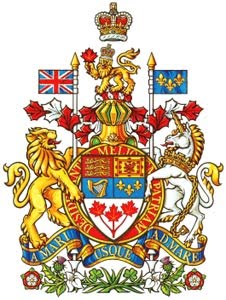
The Coat of Arms

coat of arms
As an expression of national pride after the First World War, Canada adopted an official coat of arms and a national motto, A Mari Usque Ad Mare, which in Latin means "from sea to sea." The arms contain symbols of England, France, Scotland and Ireland as well as red maple leaves. Today the arms can be seen on dollar bills, government documents and public buildings.

The National Flag

national flag
The National Flag was first raised on February 15, 1965. The red-white-red pattern comes from the flag of the Royal Military College, Kingston, founded in 1876. National Flag of Canada Day is February 15. The provinces and territories also have flags that embody their distinct traditions.

The Maple Leaf

maple leaves
The maple leaf is Canada's most known and respected symbol. Maple leaves were adopted as a symbol by French Canadians in the 1700s, have

appeared on Canadian uniforms and insignia since the 1850s, and are carved into the headstones of our fallen soldiers buried overseas and in Canada.

Symbol: The Crown

the crown
The Crown has been a symbol of the state in Canada for 400 years. Canada has been a constitutional monarchy in its own right since Confederation in 1867 during Queen Victoria's reign. Queen Elizabeth II has been Queen of Canada since 1952, marked her Golden Jubilee (50 years as Sovereign) in 2002 and celebrates her Diamond Jubilee (60 years as Sovereign) in 2012. The Crown is a symbol of government, including Parliament, the legislatures, courts, police services and the armed forces.

The Justice System

canadian justice system

The Canadian justice system guarantees everyone due process under the law. Our judicial system is founded on the presumption of innocence in criminal matters, meaning everyone is innocent until proven guilty.

Canada's legal system is based on a heritage that includes the rule of law, freedom under the law, democratic principles and due process. Due process is the principle that the government must respect all of the legal rights a person is entitled to under the law.

Canada is governed by an organized system of laws. These laws are the written rules intended to guide people in our society. They are made by elected representatives. The courts settle disputes and the police enforce the laws. The law in Canada applies to everyone, including judges, politicians and the police. Our laws are intended to provide order in society, to provide a peaceful way to settle disputes, and to express the values and beliefs of Canadians.

COURTS

The Supreme Court of Canada is our country's highest court. The Federal Court of Canada deals with matters concerning the federal government. In most provinces there is an appeal court and a trial court, sometimes called the Court of Queen's Bench or the Supreme Court. There are also provincial courts for lesser offences, family courts, traffic courts and small claims courts for civil cases involving small sums of money.

POLICE

The police are there to keep people safe and to enforce the law. You can ask the police for help in all kinds of situations -- if there's been an accident, if someone has stolen something from you, if you are a victim of assault, if you see a crime taking place, or if someone you know has gone missing.

There are different types of police in Canada. There are provincial police forces in Ontario and Quebec and municipal police departments in all provinces. The Royal Canadian Mounted Police (RCMP) enforce federal laws and serve as the provincial police in all provinces and territories except Ontario and Quebec, as well as in some municipalities. Remember, the police are there to help you.

You can also question the police about their service or conduct if you feel you need to. Almost all police forces in Canada have a process by which you can bring your concerns to the police and seek action.

GETTING LEGAL HELP

Lawyers can help you with legal problems and act for you in court. If you cannot pay for a lawyer, in most communities there are legal aid services available free of charge or at a low cost.

Levels of Government and Responsiblities

local government
Local or municipal government plays an important role in the lives of our citizens. Municipal governments usually have a council that passes laws called "by-laws" that affect only the local community. The council usually includes a mayor (or a reeve) and councillors or aldermen. Municipalities are normally responsible for urban or regional planning, streets and roads, sanitation (such as garbage removal), snow-removal, firefighting, ambulance and other emergency services, recreation facilities, urban transit, and some local health and social services. Most major urban centres have municipal police forces.

Provincial, territorial and municipal elections are held by secret ballot, but the rules are not the same as those for federal elections. It is important to find out the rules for voting in provincial, territorial and local elections so that you can exercise your right to vote.

The First Nations have band chiefs and councillors regional and national Aboriginal organizations who have major responsibilities on First Nations that are a voice for First Nations, Métis and Inuit reserves, including housing, schools and other people in their relationships with the federal, services.

There are a number of provincial, provincial and territorial governments.

  • Members of Parliament
    * National Defence
    * International Trade (MPs)
    * Foreign Policy
    * Aboriginal Affairs
    * Citizenship
    * Immigration (shared)
    * Policing
    * Agriculture (shared)
    * Criminal Justice
    * Environment (shared)
  • Members of the Legislative Assembly (MLA)
    * Education
    * Health Care
  • Members of the National Assembly (MNA)
    * Natural Resources
    * Highways
  • Members of the Provincial Parliament (MPP)
    * Policing
    * Property and Civil Rights
  • Members of the House Assembly (MHA)
    * Immigration (shared)
    * Agriculture (shared)
    * Environment (shared)
  • Mayor or Reeve
    * Social and Community Health
    * Policing
  • Councillors or Aldermen
    * Recycling Programs
    * Firefighting
    * Transportation and Utilities
    * Emergency Services
    * Snow Removal