Showing posts with label slave pen. Show all posts

Wednesday, September 21, 2011

The Antebellum Domestic Slave Trade

The Antebellum Slave Trade in Regional and Historical Perspective


From HNet Calvin Schermerhor writes: Robert Gudmestad has made at least two important contributions in A Troublesome Commerce. The first is to account for regional differences in perceptions of the antebellum interstate slave trade, and the second is to account for why southerners accepted the trade while simultaneously maintaining ambivalence toward traders. Gudmestad argues that by the mid-1830s, white southerners came to view the long-distance domestic slave trade as necessary to southern society rather than as an embarrassing practice that tore apart enslaved families, corrupted the morals of slaveholders, and flooded the Lower South with potentially seditious slaves. Gudmestad orients his reader to think of the interstate slave trade in terms of regional capitalist-economic development and explores its social ramifications.

Robert H. Gudmestad. A Troublesome Commerce: The Transformation of the Interstate Slave Trade. Baton Rouge: Louisiana State University Press, 2004

A Troublesome Commerce therefore adds to an historiography that includes Steven Deyle's Carry Me Back: The Domestic Slave Trade in American Life (2005), Walter Johnson's Soul By Soul: Life Inside the Antebellum Slave Market (1999), and Michael Tadman's Speculators and Slaves: Masters, Traders, and Slaves in the Old South (1989).


Gudmestad investigates the perceptions and practices of the speculator or trader as a way to connect slavery's economic expansion with its social significance. In contrast to a slaveholder who may have bought or sold slaves locally and for a variety of reasons, traders earned a living primarily by purchasing enslaved people from slaveholders in the Upper South and selling them to buyers in the Lower South. In the popular imagination, according to Gudmestad, "The trader broke up families, emphasized profit above piety, manipulated reality, and ruined paternalism. The stereotype had all the qualities that slaveowners were supposed to control" (p. 190). Gudmestad argues that "when [the slaveholder] could not meet this idea, the speculator was one way to explain their failure.... [slaveholders] blamed all others--banks, debt, abolitionists, the slaves themselves--for the slave trade because to admit their own culpability would have undermined the whole basis of their society" (p. 190). The idea that slaves represented cash above any supposed membership in a slaveholder's extended family upset southerners and inspired reactions, from moral outrage to regulatory legislation. In response, traders joined southern politicians and other proslavery apologists to sanitize the image of the slave trade so that by the mid-1830s, southerners could defend slavery and slave trading in the same breath. Gudmestad argues compellingly that southerners ended up agreeing to ignore the realities of speculation in the interstate slave trade in order to preserve the social order it supported.
Issac Franklin watching slave caravans moving from the upper south to the lower south.

By the early nineteenth century the interstate slave trade developed in reaction to regional settlement in the southwest. Gudmestad contends that speculation "was sporadic and uncertain at a time before there was a crush of labor in the Old Southwest" (p. 17). Profits from the production of cotton and other commodities attracted settlers. Planters in the Lower South states of Alabama, Arkansas, Florida, Georgia, Mississippi, and Louisiana increased demand for enslaved laborers, whom Gudmestad refers to most often as "bondservants" (p. 48, passim). Initially, planters moving to the cotton frontier forcibly transported slaves with them, but as white migration fell and established slaveholders sought to expand their holdings, more and more enslaved people were marched or shipped south in the interstate trade. "Rather than being relatively stable in the nineteenth century," Gudmestad argues, "the interstate slave trade increased in volume and proportion during the 1820s and 1830s as white migration declined and the demand for labor increased in the Lower South" (p. 20). Southern economic development and consequent demographic changes stand in the background in Gudmestad's narrative of what white southerners made of speculators' activities.

Slave auction.

Traders like Isaac Franklin and John Armfield, who had been in the transportation business before getting into the interstate slave trade, found a niche to exploit, transporting enslaved people on the Ohio and Mississippi rivers to Natchez before investing in ships for the coastwise trade to New Orleans. By the late 1820s, Gudmestad argues, traders published newspaper advertisements offering to pay cash for large numbers of slaves for the first time. The scale of the interstate trade is difficult to calculate with precision, but traders' activities began to account for the majority of forced migration by the 1830s. Significantly, that development was a catalyst for the slave trade's social transformation.
-
Slave Auction.

According to Gudmestad, the activities of speculators inspired resistance among potential victims of the trade and initially alarmed legislators in the nation's capital. In 1816, after a slave named Anna jumped from a third story window to avoid being sold away from her husband and children--shattering her arms and breaking her back--an outraged John Randolph of Virginia moved to regulate the slave trade in the District of Columbia. The measure failed, but his efforts represented the problems slave traders posed to white southerners' perceptions of slavery: the cash traders so prominently featured in advertisements belied an organic relationship between master and slave. "The irony," according to Gudmestad, "is that a business that labored mightily to reduce slaves to just another commodity accidentally promoted the fact of bondservants' humanity" (p. 48). In the 1810s and 1820s, men like Randolph anguished over what the slave trade did to the humanity of slaves and masters.
Separation of families at slave auctions.

Gudmestad explains regional differences regarding views of the slave trade by the 1820s: whites in the Upper South who were troubled by the effects of slave sales on the morals of masters, and whites in the Lower South who feared that their part of the country was becoming a dumping ground for rebellious slaves. "When southerners looked at the white image in the white mind," he contends, "they did not like what they saw" (p. 63). The dilemma confronting slaveholders in the Upper South concerned how to rationalize selling enslaved people away from their families to traders likely to transport them out of state. While many slaveholders tried to keep families together--or at least proffered that aim--the interstate trade tore families apart. Buyers in the Lower South, by and large, wanted individual laborers and not families. Observers in the Upper South who worried about the potential threats posed by a surplus slave population began to see the trade as a practical alternative to colonization. Evangelical Protestants, meanwhile, turned churches into the "'bulwark'" of slavery, at least in the minds of many abolitionists (p. 143). Gudmestad contends that churches solved the moral dilemma regarding the slave trade by shifting from opposition to noninterference in individual slaveholders' affairs. "By 1840 then," according to Gudmestad, "most southern evangelicals accepted the slave trade as a regular and necessary part of southern society" (p. 146). Ironically, the moral dilemmas slaveholders faced ended up strengthening slavery since slaveholders convinced themselves that they had no option but to sell slaves to traders. Perceived economic necessity became a solvent for moral guilt, as the interstate trade became an increasingly common and seemingly inescapable part of Upper South slavery by the mid-1830s.
The slave sale.

Citizens in the Lower South were not concerned about the moral health of masters and did not wait for religious leaders to come around to their position. Gudmestad contends, "residents there generally accepted the interstate slave trade--even with all its flaws--because of its importance in replenishing and augmenting the labor supply" (p. 95). Especially following the Turner Rebellion of 1831, Mississippi and Louisiana attempted to regulate traders' activities lest slaves become infected with the "contagion of rebellion" (pp. 104-105). Interstate slave traders found creative ways to evade restrictions on slave imports. If observers in the Upper South worried about moral decay among the slaveholding classes, whites in the Lower South worried about rebellion sweeping the country.

Interior of a slave jail.

Attitudes toward the trade in the Upper South caught up to those in the Lower South, and by the 1830s, "slave traders became a species of social workers who redeemed the dregs of society" (p. 171). Slave traders, who had been implicated in kidnappings, sexual abuse, and clandestinely dumping the bodies of dead slaves, used a variety of techniques to improve their image, including moving slave jails and auctions out of public view, keeping secret the details of their activities, and marching coffles of slaves out of cities under the cover of darkness. While abolitionists worked to publicize the terrors of family separation and the horrors of transportation at the hands of traders, traders represented themselves as respectable businessmen, which in Gudmestad's view "helped effect a change in opinions towards speculation from initial skepticism to grudging acceptance" (p. 164). Southern whites reacted to abolitionist criticisms by blaming the messenger and excusing slave traders for breaking up slave families. When southerners defended slavery, therefore, they had to defend traders' activities as well. At the issue's core, however, was the realization that there was little anyone could do to stem the interstate slave trade. Gudmestad concludes that "moralizing proved ineffective in blunting the force of economic and social considerations" (p. 177).
Slave traders Isaac Franklin and John Armfield office in Alexandria, Virginia.

A Troublesome Commerce contributes to an historiography in which the domestic slave trade stands at the center of antebellum southern politics and society rather than at the peripheries. Gudmestad's fresh perspective is interrupted by a section on "profits and piety," which revisits much familiar ground, and the reader may be seduced into ignoring broader historical and international contexts, such as the international slave trade (p. 118). Gudmestad is at his best narrating the values and business practices of traders and their observers, beginning and ending with the notorious trader Isaac Franklin, which makes this an interesting read, to lay readers and undergraduates, as well as to specialists. (source: H-Net, 2006)

Virginia Slave Sale 1812

AN ADVERTISEMENT FOR THE SALE OF ELEVEN SLAVES, FEBRUARY 17, 1812

This advertisement announced the sale of four men, two women, and five children that would take place on February 24, 1812, at the Eagle Tavern in Richmond. This broadside foreshadows Richmond's rise as a major market in the domestic, or interstate, slave trade by the middle of the nineteenth century. The woodcut depicting laborers suggests that the printer produced advertisements of slaves often enough to justify the expense of commissioning the artwork. Much of the slave-trading activity in Richmond took place in hotels located in the area of Shockoe Bottom. Venues like the Eagle Tavern, built in 1787 and located on the south side of Main Street between Twelfth and Thirteenth streets, the Exchange Hotel, and many others had special holding pens and showrooms where sales took place. In order to make the best impression with potential buyers, there were even businesses that specialized in dressing slaves for sale.

Notable in this broadside is the mention of the skills practiced by these enslaved African Americans. A carpenter, a “Brick Moulder,” a tanner, and “a good Crop Hand” or agricultural worker, are listed, providing evidence that many slaves were trained as artisans and craftsmen. This widespread practice was intended to save slave owners money, but it also had the effect of reducing the need for free white laborers. To avoid competition with enslaved laborers who were the mainstay of the southern workforce, many European immigrants to the United States during the antebellum period settled in the North. Between 1810 and 1820, a “prime field hand” sold for about $400. By the 1830s, that increased to $600 in Virginia, and $1,100 in Louisiana. Between 1810 and 1820, scholars estimate that 45,000 enslaved people were sold away from Virginia. As many as 300,000 enslaved African Americans were sold through Richmond to points in the lower South by the 1860s.


Being sold at an auction was an embarrassing and frightening experience for enslaved African Americans. Men and women were forced before a roomful of spectators to strip so their bodies could be inspected for defects. This included showing teeth and an inspection of mouths, eyes, and other extremities. Sales were especially frightening because slaves did not know who their new owners would be, or if they would be sold away from their loved ones. These conditions sometimes spurred some enslaved African Americans to run away from the South, and there were rumors that slave rebellions were inspired because of such forced separations. Outside of the South, the horrors of the auction block featured prominently in antislavery speeches and literature. (Virginia Memory)

Friday, September 16, 2011

Slave Route in Nigeria


From Africa Travel Magazine, "Discover the Slave Route in Nigeria," by Dr. Beryl Dorsett: A darker historical era saw many people of West Africa leave their shores for plantations in Europe, North and South America and the Caribbean. The infamous slave trade in Nigeria is not known to many people like the slave trade in Ghana, Senegal, Togo and Benin. Nigeria and Ghana were former British colonies. Senegal, Togo and Benin were former French colonies.


In December 2000, I attended the Fourth Eco-tourism Symposium in Nigeria as a delegate of the Africa Travel Association. The Lagos State Waterfront and Tourism Development Corporation invited conference delegates to a two-day pre-symposium tour of Lagos States. On the first day, we toured the city of Lagos. On the second day, we toured the town of Badagry and learned that Badagry was an important slave route in West Africa. Badagry is one of five divisions created in Lagos State in l968.


This ancient town of Badagry was founded around l425 A.D. Before its existence, people lived along the Coast of Gberefu and this area later gave birth to the town of Badagry. It is the second largest commercial town in Lagos State, located an hour from Lagos and half hour from the Republic du Benin. The Town of Badgry is bordered on the south by the Gulf of Guinea and surrounded by creeks, islands and a lake. The ancient town served mainly the Oyo Empire which was comprised of Yoruba and Ogu people. Today, the Aworis and Egun are mainly the people who reside in the town of Badagry as well as in Ogun State in Nigeria and in the neighboring Republic du Benin.
Slave Trade Route

In the early 1500's, slaves were transported from West Africa to America through Badagry. It is reported that Badagry exported no fewer than 550,000 African slaves to America during the period of the American Independence in l787. In addition, slaves were transported to Europe, South America and the Caribbean. The slaves came mainly from West Africa and the neighboring countries of Benin and Togo as well as others parts of Nigeria. The slave trade became the major source of income for the Europeans in Badagry.


Today, Badagry is an historic site because of the significant role it played as a major slave port in Nigeria. The town of Badagry is promoting an African Heritage Festival in May, 2001 to enlighten the world to its historic sites, landscapes, cultural artifacts and relics of human slavery. Badagry wants to share this world heritage site with others. They are preserving buildings, sites and memories of this iniquitous period so those tourists can unearth the dark impact of this era. Places of interest include the Palace of the Akran of Badagry and its mini ethnographic museum, the early missionaries cemetery, the District Officer's Office and Residence, the First Storey Building in Nigeria constructed by the Anglican missionaries, relics of slave chains in the mini museum of slave trade, cannons of war, the Vlekte slave Market, and the Slave Port established for the shipment of slaves before the l6th century.


The Lagos State Waterfront and Tourism Development Corporation is sponsoring the African Heritage Festival, May 2001, in collaboration with Nigerian Tourist Development Corporation, Badagry Local Government and some NGOs. Chief Moses Hungbo Owolabani is the Executive Chairman of Badagry Local Government Council. The tentative program of events encompasses initiation into Nigerian tribes, boat regatta, educational and economic forums, music and dance festivals, and numerous recreational activities and picnicking on miles of beach front property. (source: Africa Travel Magazine)

Thursday, September 1, 2011

Baltimore's Inner Harbor Slave Trade Legacy

From the Baltimore Sun, "A bitter Inner Harbor legacy: the slave trade," on 12 July 2000, by Ralph Clayton:

THOUSANDS of NAACP members descended on Baltimore for their convention this week, prompting visits to the major tourist attractions that line the Pratt Street corridor.


What most of the hundreds of thousands of tourists who visit the Inner Harbor each year don't realize is that they are walking on sacred ground, where countless thousands of men, women, and children suffered during Baltimore's darkest hour.


Between 1815 and 1860, traders in Baltimore made the port one of the leading disembarkation points for ships carrying slaves to New Orleans and other ports in the deep South. Interstate traders in the domestic coast slave trade found Baltimore's excellent harbor, central location and position in the midst of a developing "selling market" attractive incentives in which to build their slave pens and base their operations near the bustling port.


The major slave dealers, who came from Kentucky, Georgia, Virginia and Tennessee built their slave pens near Pratt Street, the major east-west connection to the wharves in the Inner Harbor and Fells Point.


One of the first major pens was built behind a white frame house near the corner of Cove and Pratt streets, near the intersection of what is today Martin Luther King Jr. Boulevard. The pen belonged to Tennessee native Austin Woolfolk, whose reign in Baltimore ran from 1818 to 1841.


Georgia native Hope Hull Slatter constructed his pen in 1838, several doors east of Howard and Pratt streets. During his 14-year stay, Slatter was ably assisted by his male slave, a jail steward.


By the late 1850s, Joseph Donovan, who had used pens on Pratt Street and Camden Street near Light Street, had a new pen constructed on the southwest corner of Camden and Eutaw streets, near where the Babe Ruth statue now stands at Oriole Park at Camden Yards.


Babe Ruth statue at Oriole Park in Camden Yards


Many other traders made their mark in Baltimore during the height of the slave trade: James Franklin Purvis, whose pen was on Harford Road near Aisquith; Bernard M. and Walter L. Campbell, whose pen was on the south side of Conway Street, near Hanover Street. (He would later buy Slatter's pen after Slatter's departure for Mobile, Ala., in 1848); William Harker, several doors south of Baltimore Street, on the west side of Calvert Street; and John Denning, on Frederick Street, several hundred feet behind the current site of the Holocaust memorial.


Baltimore Holocaust Memorial


The "travelling traders" like George Kephart of Maryland, David Anderson of Kentucky, and Barthalomew Accinelly of Virginia came to town, gathered purchased slaves, and shipped them on packets that regularly made the run from Baltimore to New Orleans.


Although numerous wharves at Fells Point were used by the packet ships, so were the Pratt Street wharves that lined the north side of the Inner Harbor. The site of the current Pratt Street Pavilion, once underwater, was the home to numerous such packets as well as the docks that housed their agents' offices.

The methods for moving the slaves down Pratt Street differed, depending on the trader. Woolfolk preferred to march his slaves in the middle of the night, chained together and on foot. Slatter often used carriages and omnibuses to convey his slaves to the packet ships.


Ships with names like Agent, Architect, Hyperion, General Pinckney, Intelligence, Kirkwood, Tippecanoe and Victorine made their runs from wharves along the Inner Harbor as well as Fells Point.


Greed made for strange bedfellows. Many of Baltimore's slave dealers shipped together on the same brigs, barks, ships and schooners making their cyclical runs to New Orleans. In October 1845, Campbell, Donovan and Slatter shipped 117 souls aboard the Kirkwood from the Frederick Street dock. The Tippecanoe sailed from Chase's wharf in January 1842 with 114 souls shipped by Purvis, Slatter and others.


For 45 years, thousands of families and individuals were sent south on their final passage. For most on board, this meant a death that came when families and loved ones were separated and "sold South" -- a separation from which few returned. It also signified almost certain separation from one another in New Orleans; large families were rarely sold to the same buyer.


Baltimore Inner Harbor


Tourists who go to the attractions of the harbor area this summer should take time to remember the price that so many paid in blood and broken hearts on Pratt Street.


Remember the young woman who took her and her child's life in Woolfolk's pen in the spring of 1826, rather than go south; the man who, in 1821, upon learning that he had been sold to a trader, slit his own throat at one of Baltimore's wharves; or the unsuccessful attempt in1846 of a female slave to drown herself at the Light Street dock rather than live another day in slavery.


Remember.


(source: Baltimore Sun, by Ralph Clayton)

Saturday, August 27, 2011

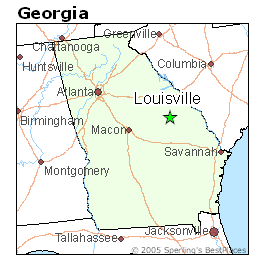
Slave Market House: Louisville, Georgia

Journey to Louisville (pronounced Lewis-ville), Georgia and you are in for a history lesson. Site of the Georgia state capital during the Yazoo Land Fraud the city was near the center of the antebellum cotton industry. Completely rebuilt in the center of downtown Louisville is a market house where people would sell just about anything, including slaves. It is the only remaining slave-trading site in the state of Georgia, and was the largest slave market in the state for many years.


Originally built between 1795 and 1798, the market used by sheriffs and other officials as well as local folk to sell land and goods. But the dark side of this market is the African-American slave trade that fueled the local economy. When importation of slaves became illegal in 1808 the market in Savannah closed. Smugglers had to move their goods inland for sale, and the market at Louisville was very active in the illegal trade.


The market survived General Sherman's March to the Sea. A bell inside the market was cast for a New Orleans Convent, but never made it there. A pirate ship took it as booty and through an unknown series of events the bell ended up at Louisville. (source: Roadside Georgia)


Map of Louisville--First Planned Capital and Capitol


The commission appointed to choose the location of a new permanent capital city directed that it be built within 20 miles of the trading post called "Galphin’s Old Town" (or "Galphinton"), which was located in present day Jefferson County. The site finally selected was by a slave market located at the intersection of three roads leading to Augusta, Savannah, and Georgetown respectively. The slave market, built in 1758, is still standing. The Legislature directed that the name of the new capital be Louisville in honor of King Louis XVI of France as an expression of thanks for French aid during the Revolutionary War.
Louisville was Georgia’s first planned capital, and the city was to contain the state’s first capitol building built expressly for that purpose. The new state house was completed in 1796. Although there are no known paintings or drawings of this building, it is known that it was a two-story structure of 18th century Georgian architecture, and was made of red brick. Even before moving to the new capital, the Legislature designated Louisville the "permanent seat" of Georgia government. But by the early 1800s, further western expansion caused the Legislature to convene in yet another new "permanent" state capital. (source: Georgia Government State Archives)

William Wells Brown: The St. Louis Slave Market

William Wells Brown a former slave


William Wells Brown a former slave wrote: "I shall never forget a scene which took place in the city of St. Louis, while I was in slavery. A man and his wife, both slaves, were brought from the country to the city, for sale. They were taken to the rooms of Austin and Savage auctioneers."

St. Louis Courthouse Where Slaves Were Auctioned


"Several slave-speculators, who are always to be found at auctions where slaves are to be sold, were present. The man was first put up, and sold to the highest bidder. The wife was next ordered to ascend the platform. I was present. She slowly obeyed the order. The auctioneer commenced, and soon several hundred dollars were bid. My eyes were intensely fixed on the face of the woman, whose cheeks were wet with tears. But a conversation between the slave and his new master attracted my attention.


I drew near them to listen. The slave was begging his new master to purchase his wife. Said he, "Master, if you will only buy Fanny, I know you will get the worth of your money. She is a good cook, a good washer, and her last mistress liked her very much. If you will only buy her how happy I shall be." The new master replied that he did not want her but if she sold cheap he would purchase her. I watched the countenance of the man while the different persons were bidding on his wife. When his new master bid on his wife you could see the smile upon his countenance, and the tears stop; but as soon as another would bid, you could see the countenance change and the tears start afresh."


Reenactment of a Slave Auction in St. Louis, MO


"From this change of countenance one could see the workings of the inmost soul. But this suspense did not last long; the wife was struck off to the highest bidder, who proved not to be the owner of her husband. As soon as they became aware that they were to be separated, they both burst into tears; and as she descended from the auction-stand, the husband, walking up to her and taking her by the hand, said, "Well, Fanny, we are to part forever, on earth; you have been a good wife to me. I did all that I could to get my new master to buy you; but he did not want you, and all I have to say is, I hope you will try to meet me in heaven. I shall try to meet you there." The wife made no reply, but her sobs and cries told, too well, her own feelings. I saw the countenances of a number of whites who were present, and whose eyes were dim with tears at hearing the man bid his wife farewell."


"Such are but common occurrences in the slave states. At these auction-stands, bones, muscles, sinews, blood and nerves, of human beings, are sold with as much indifference as a farmer in the north sells a horse or sheep." --William Wells Brown

Old St. Louis Hotel and Slave Market in New Orleans

On the corner of St. Louis and Chartres streets in 1838, the St. Louis hotel opened. It was also called the City Exchange Hotel. Two years later it burned down but was quickly rebuilt. The main entrance to the hotel led into the exchange, a beautiful domed rotunda where every afternoon between noon and 3 p.m. the auctions were held. In this elegant hotel, the center of Creole society before the Civil War, was located perhaps the most infamous of the slave auction blocks. There was more than one.

Auction Block: Saint Louis Hotel, New Orleans, Louisiana


In 1842, George Buckingham reported walking through the rotunda. The auctioneers, he said, were "endeavouring to drown every voice but his own. ... One was selling pictures and dwelling on their merits; another was disposing of some slaves. These consisted of an unhappy family who were all exposed to the hammer at the same time. Their good qualities were enumerated in English and in French, and their persons were carefully examined by intending purchasers, among whom they were ultimately disposed of, chiefly to Creole buyers; the husband at 750 dollars, the wife at 550, and the children at 220 each."


Slaves were sold on this spot at the old St. Louis hotel, which had also served as the state Capitol and the site of Carnival balls. The hotel was on St. Louis between Chartres and Royal streets. Damaged in a 1915 storm, it was demolished two years later.
Indeed, in her 1852 novel Uncle Tom's Cabin, Harriet Beecher Stowe imagined a New Orleans hotel rotunda as the place where Uncle Tom and his fellow slaves from the St. Clare plantation were sold.


In the antebellum years, Creole gentlemen drank in the hotel's bar and attended with their wives and daughters fabulous balls and concerts. One of the most spectacular events held in the hotel was in honor of the visiting Henry Clay. During the winter of 1842-43, the great statesman paid an official visit to New Orleans, and a dinner and ball was held. Six hundred people sat down to dinner at $100 dollars each. While they dined, they were entertained by the French Opera orchestra.
Rotunda, Old St. Louis Hotel, New Orleans, Louisiana


During Reconstruction, the hotel was used for a few years by the state Legislature. Then the hotel was renovated and given a new name: the Royal Hotel, but it soon became neglected and very run-down because visitors preferred the St. Charles Hotel. Writer John Galsworthy paid a visit to New Orleans in 1912. He and his friends were taken into the old hotel on a tour to view the rotunda and the slave auction block. Their guide was an old woman who reminisced: "Yes, suh. Here they all came -- 'twas the finest hotel -- before the war-time; old Southern families -- buyin' an' sellin' their property."
In 1915, the old closed-up building was a veritable haven for rats and a bubonic plague scare made way for the demolition of the hotel. In its place stands the Omni Royal Orleans hotel.


The luxurious Omni Royal Orleans hotel at the corner of St. Louis and Chartres streets stands on a site once home to a hotel rotunda that was the site of the city's most infamous slave-auction block.
The Constitution of the United States included a provision that abolished the international slave trade after 1808. This boosted domestic slave trafficking. Since there was a large demand for slaves in Louisiana, Alabama and Georgia for the cultivation of sugar and cotton, slave traders went throughout the upper South to purchase slaves to be sold at auction in the lower South. Slaves from Virginia were especially desired for their training and intelligence and brought the highest prices.


Slaves in the upper South feared being sold into the lower South because of the harsh conditions and the hot climate. But hundreds of thousands of African Americans were forced to migrate South, tearing apart families. New Orleans became the center of the slave trade, especially after 1840, and the slave auction was one of the most cruel and inhumane practices of slavery.


Slave-trading firms kept "slave pens," where they held the people waiting to be sold or auctioned off. The rooms usually held fifty to 100 slaves, crowded together in unspeakable conditions before they were taken to one of the markets: the St. Louis Hotel, the St. Charles Hotel or the exchange on Esplanade Avenue.
Old St. Louis Hotel, New Orleans


Frederika Bremer, a Danish writer who visited one of the slave markets in the 1850s, described the black men and women, "silent and serious" standing against the walls. "I saw nothing especially repulsive in these places," wrote Bremer, "excepting the whole thing." (source: Best of New Orleans)

St. Augustine, Florida Slave Market

St. Augustine Record, on 2 December 2001, "St. Augustine once a hub of slave trade," by Margo Pope: ST. AUGUSTINE -- Four and a half centuries ago, St. Augustine was the hub of the slave trade in Spanish colonial Florida, a distinction that continued through the early 1800s. The slave trade was part of the city's economy from its founding in 1565, when Spanish explorer and founder Pedro Menendez de Aviles included black slaves among the New World's first Spanish settlers.


In fact, said St. Augustine historian Susan Parker, the Spanish Crown was one of the largest slaveholders, putting slaves to work on the city's defenses.


And, though many of the records from that period are lost, documents from the Catholic Church reveal slavery's deep roots in North Florida's history. In 1606, one year before the founding of Jamestown, Va., the first documented slave birth was recorded in St. Augustine. Agustin was baptized in the Catholic faith. He was the son of Agustin and Francisca, both listed as slaves in church baptismal records.


Church documents from what is called the First Spanish Period, 1565 to 1763, were taken from St. Augustine to Cuba in 1763 when the British occupied Florida. Some records were lost. But St. Augustine's main church, now called the Cathedral Basilica, has records dating to 1594.


Parker said church documents show how the royal government worked through slave owners to record slaves' marriages and births. "The Church is so prominent in this role," Parker said.

Parker said there are misconceptions regarding what early slavery was like in St. Augustine. Many people today have an image of slavery from movies about the pre-Civil War American plantations, she said. Though a plantation society did exist around St. Augustine in the 18th century, the first slaves, primarily from Africa, worked in Spanish households in town.


"In a lot of the homes, they did the hard tasks," Parker said."You would have a female domestic slave, a male slave for hard work but you wouldn't have slave quarters [as on plantations]."


And not all remained slaves. Fort Mose became the first town for free blacks in Spanish Florida, in 1738. Mose was then the northern defense outpost for St. Augustine. Those slaves who converted to Catholicism and worked at the fort were given their freedom.


Under British rule


From 1763 to 1783, when the British ruled Florida, more of a plantation society-style developed in St. Augustine. Historian Daniel Schafer said St. Augustine maintained its dominant position in the slave trade under British rule, but it did so with more of an economic and less of a domestic slant. Schafer is a professor of history at the University of North Florida and has studied the roots of slavery in Florida from its African origins.


In the 20-year occupation of St. Augustine by the British, slave ships regularly arrived, either after stopping in the American colonies or coming directly in from Africa.


As the British settled in East Florida, agricultural plantations were built apart from the center of town. British residents coming to Florida from the Carolinas and Georgia brought slaves with them to work in the fields. Florida's British Gov. James Grant had African slaves, but Lt. Gov. John Moultrie, Schafer said, had third-, fourth- and fifth-generation slaves born in America.

Principal slave suppliers to east Florida were South Carolinian Henry Laurens, who provided mostly African-born slaves, as well as John Graham of Savannah, Ga., and Richard Oswald of Scotland. Oswald, said Schafer, had a slave "factory" on Bance Island in what is now part of Sierra Leone, Africa. Oswald brought hundreds of slaves for his plantation near St. Augustine, as well as to sell to others.


Ships coming into the Port of St. Augustine would carry about 100 Africans at a time, Schafer said. The slave population of this period also included West Indies natives.


Slave buildings at the Kingsley Plantation, St. Augustine, FL
The building on the right is made of crushed shells. It's also where the slaves undertook the dangerous and back-breaking task of processing the sugar cane.


Spanish rule returns


Spanish rule returned in 1784 and St. Augustine's slave center image remained. In fact, more than a quarter of the recorded population were slaves. According to a 1784 report by the Spanish governor back to Spain, St. Augustine recorded 574 black residents and 1,418 white residents, without distinction of free or slave. In 1797, the census recorded 1,007 white residents, 483 slaves and 102 free black residents.


By 1802, St. Augustine had been back under Spanish rule for almost 20 years. The slave trading business was changing worldwide as European countries, and the American colonies started banning the importation of African slaves. Spain did not.


"You have Liverpool, a center for the slave trade and all these ships from Africa there and suddenly, there is a ban," Schafer said. "So they pack up and head for [ports in] Fernandina and St. Augustine," he said.


The second Spanish occupation continued until 1821, when Spain transferred Florida to the United States. Parker said the slave culture in St. Augustine expanded because it not only included the slaves who returned with Spanish owners in 1784, but it still had some from the British period, African born and American born.


In this second Spanish period, she said, the slaves were also holding "jobs" when they are not working for their owners. This was an attempt to buy their freedom. They worked as butchers, seamstresses, rowers for boats. They held parties to sell products.


"Whatever they did, it took a long time," she said. "Most would have been paid only 1 1/2 to 2 pesos a day and the minimum to buy their freedom would have been about 400 pesos."


Parker said public slave sales likely were held on the steps of Government House at the opposite end of the town market on the Plaza de la Constitucion. But private sales also took place in town.


"They were private sales between owners and they may have been at the market to do other business when they did this," she said. (source: Florida Times Union)

Friday, August 26, 2011

Selling "Fancy Girls"

Slave Market, ca. 1850-1860.


New Orleans and Lexington, Kentucky, had active markets in "fancy girls," beautiful young girls and women, often mulatto or quadroon, who were sold not as domestics but as concubines. They were presented at auction well dressed and coiffed, sometimes with jewelry. In the 1850s, beautiful teenage girls were valued at more than $1,500 (close to $30,000 in today's dollars), which made them as "expensive" as prime male field hands. Buying a "fancy girl" was a status symbol for traders, gamblers, and saloonkeepers. Because New Orleans attracted a large population of gamblers, debauchees and revelers for Carnival, it was the largest market for those girls and young women who were sent there from the Upper South.