Showing posts with label South Carolina Slave Code. Show all posts

Wednesday, September 28, 2011

Black History In America: Boone Hall Plantation & Gardens in Mt. Pleasant, SC

Boone Plantation Slave Cabin

Boone Hall Plantation & Gardens in Mt. Pleasant, SC is proud to introduce a new groundbreaking addition to the Boone Hall experience. Visitors can now take a journey through our exciting new exhibit, "Black History In America."

Boone Plantation Slave Cabin

What really makes this exhibit unique is that this story will be told using eight of the original slave cabins located on Boone Hall Plantation. Each of the cabins on Slave Street present different themes in telling the black history story. Visitors are able to see the different aspects of daily life, how they worked and lived, struggles that were faced, as well as follow different periods of historical progression from the beginning all the way up to present day.

Boone Plantation Slave Cabin

Life size figures, pre-recorded narratives, audiovisual presentations, photos, pictures, biographical information, and actual historical relics, are interwoven and meshed together in displays throughout the cabins presenting this new exhibit.

Boone Plantation Slave Cabins

Themes for each cabin are as follows:
Boone Hall Plantation & Gardens in Mt. Pleasant, SC

Cabin 1 – Praise House
Cabin 2 – Slave Crafts
Cabin 3 – Their Life & Family
Cabin 4 – Archaeological Discoveries
Cabin 5 – Their Work and Life
Cabin 6 – Emancipation & Freedom
Cabin 7 – Struggle For Civil Rights
Cabin 8 – Heroes and Leaders
(http://boonehallplantation.com/beyond.php)

Boone Plantation Slave Cabin

The next part of our journey will take us past the original slave cabins along “the row of oaks,” as the driveway is referred to. For some people this part of the Boone Hall Plantation is their least favorite.
Boone Hall Plantation & Gardens in Mt. Pleasant, SC

As you approach the slave cabins you start to feel a sense of remorse that is, of course, unfounded. Nonetheless, you realize at this point that slavery was real in all its profound evil. As you peer into the blank windows of the cabins you see the meager living endured by thousands of slaves throughout time until abolishment.

Boone Plantation Slave Cabin

From the front door, to the right is usually the bed area, straight ahead is where food was often prepared and eaten, and finally off to the left is a small play or study area for the children. Along the way you come to some people that artistically recreate a craft originally brought over from Africa. That craft is basket weaving, which is very popular with the locals.

Boone Hall Plantation & Gardens in Mt. Pleasant, South Carolina

From the beginning all the way to the end of your tour, you will feel like you stepped into the past. You see what you might have done back then, in your mind. How life might have been, whether you would have liked to have been alive then, how the food would taste, all these things course through your mind like the Ashley River runs through the property. Sadness creeps up on you as you prepare to leave. As you turn back on the road leading away from the house, you know beyond a shadow of a doubt that you will return. (source: Hubpages)

Boone Hall Plantation & Gardens in Mt. Pleasant, SC

Boone Hall Plantation: Gullah Story About the Adam's Apple


Boone Hall Plantation in Mount Pleasant (boonehallplantation.com) has a walking tour of its slave cabin lane featuring different stories told in each of eight cabins – from the praise house churches, to the variety of jobs done by slaves, to the changed roles after emancipation, to the more recent struggle for civil rights. Boone Hall also puts on a live Gullah Theater presentation, celebrating the unique culture created by the slaves and their descendants along the sea islands.

Read more: The State

Boone Hall Plantation: Gullah Story About the Adam's Apple

Low Country Chapel Of Ease at St. Helena, South Carolina

During the Colonial period, chapels of ease were constructed by rice and cotton planters as houses of worship because their plantations were located so far from the churches in Beaufort. This tabby walled church was constructed between 1742 and 1747 for the planters of St. Helena Island. A forest fire destroyed most of it in 1886.

All that remain today are its tabby ruins and an adjacent cemetery. Tabby is a mixture of shell (an aggregate), lime (often made from burnt shells which serve as a cement), and water. It is put up in forms and allowed to harden. During the eighteenth and early nineteenth century, lowcountry planters used tabby to build not only their own dwellings, but also slave houses, dairies, barns, fences, and even some grave monuments. Tabby was used not because it was easy or particularly convenient, but because brick was in such short supply. Tabby tended to hold up very well, as long as its outer stucco "skin" was kept in good shape and as long as the building was "tied" together by internal timbers.

Chapel Of Ease at St. Helena, South Carolina

A quiet sea island in Beaufort County, St. Helena Island is perhaps best known for its historic connection to Gullah culture and language, still evident on the island today. The island is nestled between downtown Beaufort and the resort communities of Harbor Island and Fripp Island, so it enjoys the benefits of both rural and suburban life. The population of St. Helena (pronounced HEL-uh-nuh) hovers around 10,000. St. Helena is home to the Penn Center, a National Historic Landmark located on the site of one of the nation's first schools for freed slaves, which opened in 1862.

Chapel Of Ease's adjacent cemetery

Beaufort (pronounced "BU-fort") is the seat of Beaufort County, where Jean Ribault and his fellow Huguenots established Charlesfort in 1562. In French, "beau" means beautiful, handsome, lovely, or fine ... and after even the shortest of visits, you'll know both the city and county are aptly named. (Ironically, both are actually named for an Englishman, Henry Somerset, the Second Duke of Beaufort, who pronounced his name "BOW-fert," as in bow and arrow and Beaufort, North Carolina.)

Chapel of Ease


Monday, September 26, 2011

The State of South Carolina's Disdain Of The Value of Education

The State, South Carolina Homepage article "Nine ways the Civil War changed and continues to affect S.C.,"Sep. 25, 2011: 6. Disdain of the value of education

Before the Civil War, education in South Carolina was seen primarily as a private or religious affair. What value was there in educating a white farmhand or a black slave, which was, in fact, forbidden by law? On the eve of the war, only half the state’s white children had gone to school.
The state Constitution of 1868, written by African-Americans and Republicans during Reconstruction, established the right to a free public education for all for the first time. But, in impoverished post-war South Carolina, schools were poorly funded.

The post-war shift in the state’s limited wealth – from agricultural rural areas to industrial cities – accentuated the disparity between poor, inferior rural schools and better urban ones. South Carolina’s embrace of education also was slow and grudging. The state did not establish high schools until 1907, compulsory education until 1919 and a 12th grade until World War II, a move made after the military complained it had to reject too many S.C. draftees as uneducated or sickly.
South Carolina education lottery

In 1948, the state had 1,680 school districts. Funding ranged wildly from rural to urban schools, and black to white schools.

Then, black Clarendon County parents went to court, launching what would become the 1954 U.S. Supreme Court case that ended segregation. While education bills in the 1970s and 1980s sought to address school funding inequities, those issues remain unresolved, the subject of a more-than-decade-old court case, stuck in judicial limbo.

South Carolina education lottery

The passage of a lottery in 2000 was intended to help parents pay higher education costs. However, state funding of public colleges and universities – already among the lowest in the South – has dwindled. (source: The State, South Carolina Homepage)

Friday, August 26, 2011

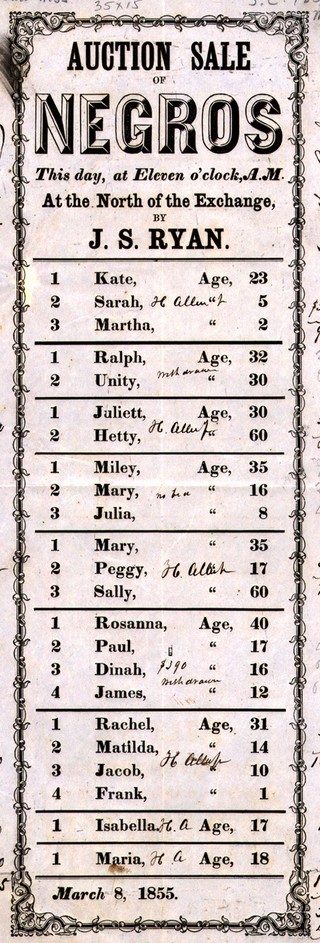
South Carolina Slave Auction Advertisement: March 5, 1855


Among the enslaved people who were sold at this particular auction in 1855, were 23 individuals that ranged from infants to 60 years old. Enslaved women represented an overwhelming majority of this sale (78%); Seventy percent (70%) were between the ages of 1-30 years old, 21% were between 31-40 years old and two 60 years old. This is a repeating pattern of the youthful skew of slaves who were sold at auction.


J.S. Ryan is the Old Slave Mart located in Charleston, South Carolina.

Monday, August 22, 2011

The Liquidated Slaves Of The William Barnwell Plantation House, Beaufort, South Carolina

The William Barnwell House is a historic Building in Beaufort, South Carolina and is a part of the Beaufort Historic District. It was built in 1816 by the critically acclaimed Gibbes Brothers for their sister, Sarah Reeve Gibbes. The property got its name from her husband, though, William Wigg Barnwell, who came from the prominent Beaufort family connected to Major William Hazzard Wigg, a Revolutionary War hero.


The William Barnwell House stayed with the Barnwells until 1895. It was then when the property was given to the city. The local government then used it as a schoolhouse, and then transformed it to an apartment building before shutting it down for disrepair. It was then rescued by the Historic Beaufort Foundation in 1973 from threats of demolition.

Estate Sale! By Order Of Executor. By Louis D. DeSaussure


On Wednesday, 19th Inst. at 11 o'clock a.m. will be sold in Charleston, South Carolina at the Ryan and Son's Mart in Chalmers Street, by the order of the Executor of the late Mr. and Mr. and Mrs. William Barnwell. A Prime Gang of 67 Negroes. Accustomed to the culture of Sea Island Cotton and Provisions, in Beaufort District. Amongst whom are several House Servants.


Conditions--One-third Cash; balance by Bond, bearing interest from day of sale payable in two equal Annual Instaments, to be secured by a Mortgage of the Negroes, and approved Personal Security. Purchasers to pay for papers.


The liquidation of the enslaved population of the William Barnwell Estate in Beaufort, South Carolina. According to the "List of Negroes," 70.1% 26 years old and under.


0-12 years old 18 26.8%
13-26 years old 29 43.8%
27-54 years old 18 26.8%
55- 70 years old 2 2%


Among the 18 children to be orphaned by this sale that are between the ages of 0-12 years old are: "Hector age 7, Affy age 5, Infant #1 nameless, Venus age 2, Young Patty age 3, Infant #2 without a name, Annie age 5, Ellen age 3, Isaiah a little 5 year old boy with one eye, Cimon age 3, Infant Mariah, Adam age 12, Infant Rose, an unsound Infant, Young Tannah 3 years old, and Jim age 10.


There were 29 teenagers and young adults between the ages of 13-26 years old. Children and teenagers represented the bulk of the enslaved population of the William Barnwell Plantation.


There were 18 adults between the ages of 27-55 years old, and only two people that were 70 years old.

Wednesday, July 13, 2011

Slavery at the South Carolina College in Columbia

Urban Slavery in Columbia, sc
DeSaussure College (1809) is the second-oldest building on campus, formerly the North Building and later Old North Building. Named for Carolina chancellor Henry William DeSaussure, it survived an earthquake in 1811 and a fire in 1851.
In the early 1800s, South Carolina College was a significant institution in the growing city of Columbia. In order to understand slavery on campus, it is necessary to examine the role of slaves in Columbia during this era. Contrary to popular belief, not all slaves lived on plantations. In some ways, urban slaves, such as those in Columbia, inhabited a very different world than their rural counterparts.
One major difference between urban and rural slavery was the high concentration of slaves in cities. Whereas great distances often separated small communities of rural slaves, urban slaves typically lived and worked in close proximity with one another. In 1830, approximately 1,500 slaves lived and worked in Columbia; this population grew to 3,300 by 1860. Some members of this large enslaved population worked in their masters’ households. Masters also frequently hired out slaves to Columbia residents and institutions, including South Carolina College. Hired-out slaves sometimes returned to their owner’s home daily; others boarded with their temporary masters.

The movement of slaves throughout Columbia fostered ample opportunities for interaction among blacks in public and private spaces. These relationships permitted communication among slaves and the city’s small community of free blacks. Legislators developed state and local statues to restrict the movement of urban slaves in hopes of preventing rebellion. Although various decrees established curfews and prohibited slaves from meeting and from learning to read and write, such rulings were difficult to enforce. Several prewar accounts note that many Columbia slaves were literate; some slaves even conducted classes to teach others to read and write. In spite of white efforts to prevent blacks from congregating, slaves and free blacks persevered to build a strong community of their own in Columbia.

Urban slaves also participated in white organizations throughout the city, though in limited roles. Many slaves attended services at local Baptist, Presbyterian, and Methodist churches, yet some struggled to obtain membership in these institutions. Jack, a college slave, applied for membership in the First Presbyterian Church in April 1820. Church leaders postponed this decision for nearly two years and consulted the college’s board of trustees regarding Jack’s character. Jack did not obtain membership before his death in 1822. Jack’s story reveals the close ties between campus slaves and their urban environment. It also provides evidence of whites’ utter disregard for the contributions of slaves throughout this period.

(source: http://slaveryatusc.weebly.com/urban-slavery-in-columbia.html)

Friday, June 24, 2011

South Carolina Slave Cabin Rescued and Restored

The Washington Times reported: CHARLESTON, S.C. | When Joe McGill spreads his sleeping bag on the floor of a slave cabin, he knows that spending the night there will conjure the specter of slavery.

Slave cabin before: "The two-room cabin "was in pretty bad shape. We managed to [salvage] maybe 50 percent of the original fabric," says Thomas Riddle, secondary social studies consultant at Greenville County Schools, who helped rescue the cabin. "We used many original wall studs, which were really cool because they were recycled from an earlier cabin. We used literally every scrap that we could." (source: National Trust for Historic Preservation)
"If I were a firm believer in ghosts and spirits and things of that nature, I don't think I could do this," said Mr. McGill, who is working to preserve buildings that are part of a past that many prefer to forget.

One night he heard dogs in the distance — a sound that recalled the search for runaways during slavery. He awoke on Mother's Day morning in a cabin thinking of children being sold from their mothers. Then he walked to the black graveyard on a plantation near Charleston.

"I thought, 'This is why I'm doing this — for those people in those graves to give them a voice for what they endured,'" said Mr. McGill, 48.

Mr. McGill, a program officer with the National Trust for Historic Preservation, spent Saturday night in a cabin at Hobcaw Barony near the coastal community of Georgetown.

The slave cabin after, with a new foundation, shingles, and framing, the cabin is scheduled to be dedicated Feb. 12, 2010. "The 23-by-16-foot structure was built before the Civil War by people enslaved by Dr. Thomas Blackburn Williams, and later became a home for families who worked on a nearby farm. The last occupants moved out in the early 1930s."(source: National Trust for Historic Preservation)
It was the fifth night this year that he has slept on a cabin floor, trying to attract attention to the need to preserve the structures and the history they hold.

Mr. McGill, who is black, is also a re-enactor with the 54th Massachusetts, the black Union regiment that fought at Battery Wagner on Charleston Harbor during the Civil War. He said that spending the night in the cabins helps him connect with his ancestors.

He first slept in a cabin at Boone Hall Plantation near Charleston a decade ago as part of a program for the History Channel titled "The Unfinished Civil War," which focused on the dispute over the Confederate flag flying over the South Carolina Statehouse.

During the past year, Joe McGill has slept in 22 former slave dwellings in six states. He does it to draw attention to the need to preserve the structures that are part of the heritage of blacks in America.
He has returned to the cabin project this year and meets with reporters wherever he goes to draw attention to the buildings. He said that preserving the cabins requires local efforts and his goal is to encourage people to save the ones that are left.

The cabins where Mr. McGill has stayed — such as those at Magnolia Plantation and Gardens near Charleston — have been restored, but many others have been neglected.

Mr. McGill started in May with a list from the State Historic Preservation Office showing cabins at about 30 sites. He thinks his effort is already helping because since he started the sleep-ins, three more cabins have been identified.

Magnolia Plantation Slave Quarters

He plans to sleep later this summer in a cabin in Anderson, in upstate South Carolina, and this fall in cabins in Alabama.

South Carolina once had thousands of slave cabins. Many did not survive because they were modestly constructed of wood or because people didn't want a connection with a dark chapter of history, Mr. McGill said.

Andy Chandler, who helps administer the National Register of Historic Places for the State Historic Preservation Office, said no firm figures are available on how many cabins are still standing in the state.

About 1,300 listings are on the register for South Carolina, and some may include sites with cabins. But, he said, since some sites have been on the register for decades, some of the cabins may not be there anymore. People who recommend sites for inclusion on the register don't always consider slave cabins worth mentioning. (source: The Washington Times)

Tours of the former slave cabin are available at the Rober Mountain Science Center's Living History Farm. The cabin was restored and moved from a site on Grove Road in Greenville. (GEORGE GARDNER/Staffer)

Slave cabin sleepovers

Wednesday, June 15, 2011

Cast in Bondage: Charleston Slave Tags and Slave Badges

From the February 2003 edition of the Smithsonian Magazine, "Cast in Bondage Copper neck tags evoke the experience of American slaves hired out as part-time laborers," by Victoria Dawson:

It seems, at first glance, an innocuous if enigmatic artifact, a copper medallion 1.5 inches square, rough-edged and engraved with the words "Charleston. 571. Porter. 1856."

But the inscription—a city, a number, an occupation and a year—is stamped on a rare fragment of the past, known to scholars of the period as a slave hire badge, one of three in the cultural collection of the Smithsonian’s National Museum of American History. The tag likely hung from the neck of a slave for a calendar year, representing all that we will ever know of one man: a porter in Charleston, South Carolina, in 1856, industrious and trusted enough to be leased out by his master for short-term hire but required by law to be licensed and to wear or carry a metal identification tag at all times.
"Looking at a slave badge evokes an emotional reaction," says James O. Horton, Benjamin Banneker Professor of American Studies and History at George Washington University. "There is the realization that one person actually owned another."


Urban slavery just prior to the Civil War accounted for less than 5 percent of the slave population in the United States. "One reason a collectible like this is so compelling is that, given our dearth of knowledge about the badge system, there is room for speculation," says Michael Hodder, a numismatic consultant who researched the subject in 1993 when the New York coin-dealing firm Stacks offered 14 badges—the first large private collection ever sold. They commanded $60,000.

The badges, Hodder says, "evoke a personal history which is almost unfathomable: beatings, hardships, tears, pain, separation, loss, a terrible sense of abandonment." At the same time, he adds, "one can read into them a sense of hope and planning for the future—the slave working to earn as much money as possible, perhaps to purchase his freedom or the freedom of a family member."

Badge laws existed in several Southern cities, urban centers such as Mobile and New Orleans, Savannah and Norfolk; the practice of hiring out slaves was common in both the rural and urban South. But the only city known to have implemented a rigid and formal regulatory system is Charleston. Perhaps the statutes in other cities were never enforced; perhaps paper badges, inherently impermanent, were issued instead. All of today’s extant badges can be traced exclusively to Charleston. There, from the mid-18th century to the end of the Civil War, ordinances dealt with the matter of owners marketing the labor and skills of their slaves by arranging for them to work outside the home or plantation.

Perhaps a quarter to a third of white Southern families were slaveholders. The rest of the population, according to Horton, likely contracted to purchase slave labor on a part-time basis. "This was especially true if you needed a skilled craftsman," says Horton. "The process proved quite profitable for the master. The slave might accrue some portion of the fee—he might get it all or he might get nothing."

Such practices were inevitably fraught with tension. White laborers objected to what they saw as unfair competition. "There was a great deal of resentment," observes Harlan Greene, a Charleston scholar and coauthor, along with Harry Hutchins, of the forthcoming book Slavery’s Badge: A History of the Slave Hiring System of Charleston, SC, 1783-1865. "White artisans complained vehemently."
The system also created a category of slaves whose privileges threatened the status quo. "[Urban] slaves had more access to education, opportunities for self-hire and self-purchase, and the privilege of ‘live-out’ in separate sections of town, away from all the watchful eyes of masters," writes historian Theresa Singleton of Syracuse University in "The Slave Tag: An Artifact of Urban Slavery," a 1984 journal article. "All of these conditions tended to undermine masters’ control over slaves."

In the seaport of Charleston, one of the wealthiest and most important cities in the South, the city treasurer’s office issued all badges, with fees set according to the category and skill of the laborer. The most common occupations were servants and porters, though Charleston slaves also worked as skilled artisans (such as furniture makers and silversmiths), fishermen and fruit vendors.

Badges were made of copper alloy, cut or pressed from a mold, or occasionally fashioned by hand into various sizes and shapes, most typically squares or diamonds, ranging in size from about 1.5 square inches to 3 square inches. Each was punctured with a hole and was probably worn around the neck on a string or chain.

In addition to the three slave hire badges owned by the Smithsonian, another 100 or so, dating from 1800 to 1864, are in various museums around the country, and another few hundred are believed to be in the hands of private collectors. Prices for badges have soared in recent years, in part because of a burgeoning interest in African-American memorabilia. Recently, a huckster’s (fruit vendor’s) badge, dated 1803, fetched $26,450 at auction in Baltimore, Maryland.


Their power far transcends monetary value. "Imagine," Michael Hodder says, "this badge as it hung around the neck of a man. Imagine how it felt against his chest, how it felt to present it whenever someone demanded. At the end of the day, did the slave hang up the badge in his hut or did the master keep it? What happened if a slave lost his badge? What happened at the end of the year? Was the badge returned to the city marshal’s office, turned in, taken to a local mill, melted and then reused?" The only certainty is the profound inhumanity—and likely brutality—evoked by such an artifact.

http://www.smithsonianmag.com/history-archaeology/Cast_in_Bondage.html?c=y&story=fullstory

Monday, May 23, 2011

Senator Ben “Pitchfork” Tillman Justifies Violence Against Southern Blacks

“Their Own Hotheadedness”: Senator Benjamin R.“Pitchfork Ben” Tillman Justifies Violence Against Southern Blacks

In this March 23, 1900, speech before the U.S. Senate, Senator Benjamin R. “Pitchfork Ben” Tillman of South Carolina defended the actions of his white constituents who had murdered several black citizens of his home state. Tillman blamed the violence on the “hot-headedness” of Southern blacks and on the misguided efforts of Republicans during the Reconstruction era after the Civil War to “put white necks under black heels.” He also defended violence against black men, claiming that southern whites “will not submit to [the black man] gratifying his lust on our wives and daughters without lynching him”—an evocation of the deeply sexualized racist fantasies of many Southern whites.

. . . And he [Senator John C. Spooner, of Wisconsin] said we had taken their rights away from them. He asked me was it right to murder them in order to carry the elections. I never saw one murdered. I never saw one shot at an election. It was the riots before the elections precipitated by their own hot-headedness in attempting to hold the government, that brought on conflicts between the races and caused the shotgun to be used. That is what I meant by saying we used the shotgun.

I want to call the Senator’s attention to one fact. He said that the Republican party gave the negroes the ballot in order to protect themselves against the indignities and wrongs that were attempted to be heaped upon them by the enactment of the black code. I say it was because the Republicans of that day, led by Thad Stevens, wanted to put white necks under black heels and to get revenge. There is a difference of opinion. You have your opinion about it, and I have mine, and we can never agree.

Demonstrators carry Confederate flags as they leave the South Carolina Statehouse after the removal of flag in Columbia, S.C., July 1, 2000. Photograph: Eric Draper/Associated Press
I want to ask the Senator this proposition in arithmetic: In my State there were 135,000 negro voters, or negroes of voting age, and some 90,000 or 95,000 white voters. General Canby set up a carpetbag government there and turned our State over to this majority. Now, I want to ask you, with a free vote and a fair count, how are you going to beat 135,000 by 95,000? How are you going to do it? You had set us an impossible task. You had handcuffed us and thrown away the key, and you propped your carpetbag negro government with bayonets. Whenever it was necessary to sustain the government you held it up by the Army.

Mr. President, I have not the facts and figures here, but I want the country to get the full view of the Southern side of this question and the justification for anything we did. We were sorry we had the necessity forced upon us, but we could not help it, and as white men we are not sorry for it, and we do not propose to apologize for anything we have done in connection with it. We took the government away from them in 1876. We did take it. If no other Senator has come here previous to this time who would acknowledge it, more is the pity. We have had no fraud in our elections in South Carolina since 1884. There has been no organized Republican party in the State.

We did not disfranchise the negroes until 1895. Then we had a constitutional convention convened which took the matter up calmly, deliberately, and avowedly with the purpose of disfranchising as many of them as we could under the fourteenth and fifteenth amendments. We adopted the educational qualification as the only means left to us, and the negro is as contented and as prosperous and as well protected in South Carolina to-day as in any State of the Union south of the Potomac. He is not meddling with politics, for he found that the more he meddled with them the worse off he got. As to his “rights”—I will not discuss them now. We of the South have never recognized the right of the negro to govern white men, and we never will. We have never believed him to be equal to the white man, and we will not submit to his gratifying his lust on our wives and daughters without lynching him. I would to God the last one of them was in Africa and that none of them had ever been brought to our shores. But I will not pursue the subject further.

I want to ask permission in this connection to print a speech which I made in the constitutional convention of South Carolina when it convened in 1895, in which the whole carpetbag regime and the indignities and wrongs heaped upon our people, the robberies which we suffered, and all the facts and figures there brought out are incorporated, and let the whole of the facts go to the country. I am not ashamed to have those facts go to the country. They are our justification for the present situation in our State. If I can get it, I should like that permission; otherwise I shall be forced to bring that speech here and read it when I can put my hand on it. I will then leave this matter and let the dead past bury its dead.

Source: "Speech of Senator Benjamin R. Tillman, March 23, 1900," Congressional Record, 56th Congress, 1st Session, 3223–3224. Reprinted in Richard Purday, ed.,Document Sets for the South in U. S. History (Lexington, MA.: D.C. Heath and Company, 1991), 147.