Showing posts with label india basketball. Show all posts

Tuesday, April 13, 2010

An NBA preseason game in India? Dream on...


The NBA is a very rich league, a league much richer than other sporting leagues in North America, and a huge reason for this is that the NBA is a lot more famous internationally. There are three major reasons for this:
1) Basketball is the one sport that both North Americans and the majority of the rest of the world understand and enjoy.
2) There once lived a man named Michael Jordan who was the biggest thing since basketball itself.
3) NBA commissioner David Stern is a shrewd man - and ever since he took the role of commissioner in 1984, the one thing that the NBA has done best is spread the game to other parts of the world while at the same time feature more and more international players in their own league.
Let's focus on point number 3: there are countless examples of the NBA's efforts to promote itself to a far greater international audience than just those in North America. Outside the US and Canada, NBA games are regularly broadcasted live in at least 31 more countries around the world. The recent All-Star game was broadcasted in 215 countries in 41 languages! The NBA has set up a dedicated 'Global' page to showcase its efforts around the world, and it has global websites in Brazil, France, India, Taiwan, Canada, Germany, China, Japan, Spain, Italy, Hong Kong, and the UK. There were 83 international players from 36 different countries on NBA rosters to start the 2009-10 NBA season.

And then its the NBA's outreach and grassroots events in other countries that continue to make them the ubiquitous name in basketball. The Basketball Without Borders (BWB) programme has served as "has served as a summer camp for young people designed to promote friendship, goodwill and education through sport." BWB have been to India, too, and as you may know, the NBA has teamed up with Mahindra to start a recreational league in three Indian cities this summer. Programmes such as BWB have also encouraged current and former NBA players to visit other countries, including India.
So where do we go from here? In most countries, usually the NBA's next step has been the most interesting one - organizing preaseason games featuring NBA teams on foreign soil. The NBA has been holding games exhibition games in Europe for several years already, and recently announced that the Lakers, Knicks, and T'Wolves will be playing again in Europe this October.
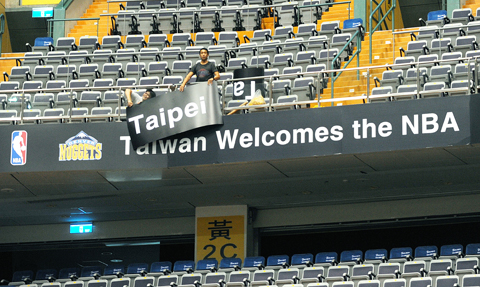
Even Asia has had its share of NBA action: The NBA has played six games in Japan since the 1990s, and has held preseason games in China since 2004, after Chinese star Yao Ming joined the Houston Rockets in 2002: the first game obviously featured the Yao-powered rockets against the Sacramento Kings. In 2009, when the Nuggets met the Pacers in Taipei, it became the eight Asian city to host either an NBA regular season or preseason game, along with Tokyo, Yokohama, and Saitama in Japan; Beijing, Shanghai and Guangzhou in China; and Macau.
You know where this train of thought of heading... an NBA game in India? FUGGEDABOUDIT! What is the one thing in common amongst all the other countries that we lack back home in India? We have the money if someone chooses to spend it (for proof, see IPL). Our extra large population ensures that even a small percentage of NBA fans make up for enough to provide enough audience for any game. And the IPL has proven that we have the technological, energy and security infrastructure to host large sporting events.

No, what we really lack back here are good, ol-fashioned arenas! Not the kind of sharp-shooting, gun-toting Arenas that plays for the former Washington Bullets; no, I mean actual, international quality indoor basketball courts, made of good quality, polished hardwood (or similar surface), with fiberglass boards, and the capability to hold a large-capacity audience. Yes, there are some new courts around the country now which come close, but we're talking NBA-quality here, people! Yes, the NBA has brought in everyone from AC Green to Dikembe Mutombo opened several courts in India over the past few years, but we're far, far hehind.
Hell, even the Indian national team has to practice on shoddy surfaces most of the time. One of the biggest complains is that the best players in India play most of their basketball on concrete courts with rubber balls, and so when they move on to play on a hardwood court with a leather basketball they are constantly struggling to adjust. Even the men's national team members that have been training with JD Walsh, Craig Esherick, and Dr. Bob Baker in Bangalore have had to work in embarassing facilities.
I'm sorry, but there's no way that David Stern is going to allow his preciously talented millionaire NBA stars to break a sweat in any of our Indian courts.
Who knows, maybe the Reliance-IMG alliance to develop sports facilities in India will change things in the future. The extremely distant future. Otherwise, no, no chance in hell.
Go ahead, David Stern, NBA, Reliance... prove me wrong.

Sunday, March 28, 2010

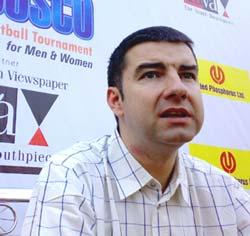
Alexsander Bucan: Bringing in a foreign coach doesn't guarantee that the quality will improve

Krishnakumar KH from Express Buzz interviewed Alexsander Bucan, the head coach of the Indian Men's basketball team, during Coaches Coaching Clinic in Kochi a few weeks ago. Bucan, an experienced Serbian coach, has been in-charge of the Young Cagers for around two years. Here are some excerpts from that interview:

India, says Bucan, has the potential to bloom in the ‘simple’ business of getting through a maze of giant bodies to ram a huge ball through a basket raised high on a pole. Easier said than done, he accepts. But if China, Russia and Iran can do it, so can India, feels the affable Bu­can...

“The Russians and the Chinese are not the biggest of people,” he points out. “But they have tall players in their basketball and volleyball teams. That means they identified talent at an early age and put them through scientific training to produce world-class athletes. The same is possible in India.” But Bucan contends that producing world-class athletes requires an overhaul of the “amateurish system” in India. “It is professionalism that gets you results,” he says. “You need to begin early and find young talent with the right build. Then they need systematic training that includes fitness training, nutritional care and psychology sessions.” The Serb has no doubt India has the talent. “I ha­ve seen many talented players at the school and college levels in India. Some are more gifted th­an the national players. Sadly, most of them drop off the game to further their studies or go looki­ng for jobs. No one is rea­lly interested in leaving everything else behind and concentrating solely on the game.”

“There is no way the team can impro­ve without playing stro­ng opposition regularly,” he says. Further, Bucan is not one to boast without a blueprint — infrastructure, academies, age-gr­oup tournaments, camps, a professional national league at the senior level and cheering crowds.

“Just because you bring in a fo­reign coach, for any ga­me, there is no guarantee the quality will improve,” he says.

However, the national coach is quick to point out the improvement made by the cagers in the past few years. “There has been a big difference in standards in the past two years,” he says. “But the real difference can be made only with long-term strategies. Stress should be laid on the under-16 level to unearth players with potential.”
The most significant achievement during the past two years is the triumph of the Indian under-17 team at the 2008 Asian FIBA 33 championship — which allows just three players per team. It was the first time an Indian basketball team at any level had achieved such a feat. “We beat the Philippines, where basketball is as big as cricket in India,” says Bucan.
Regarding coaching, he feels it is tactical play that requires greater attention once the basics are in place. “We are far behind world-class standards in terms of contact play,” he says. “Also, there has to be more set play than what the players are used to here.”


Read the full article here.

What I found particularly interesting about this interview was Bucan's admittance that bringing in a foreign coach doesn't neccessarily guarantee an improvement. We Indians have historically had a niggling inferiority complex to foreigners, and this is true in sports, too: Gary Kirsten has managed to steadily improve the cricket team, but the credit for that should go to the captain MS Dhoni as much as the coach. Sure, it is neccessary for our coaches to learn new skills and techniques from around the world, but it is also important for the coach to know about local knowledge, playing styles, and conditions, to offer a holistic improvement of the team.

I also hate to say this, but in more cases than not, a positive fact about bringing in a foreign coach is that he or she is free from the political pressures and the corruption at every rung of the ladder that Indian coaches have to suffer through. This freedom tends to insinuate misunderstanding or jealousy amongst their local counterparts who are already used to a certain system, but in the end, the priority is to worry about a degree of professionalism in team selection and play.


Bookmark and Share

Monday, March 8, 2010

BFI's Harish Sharma: "India could have a professional basketball league in three years!"


Sitting courtside at the NBA All Star Game at the Dallas Cowboys stadium in Arlington, Harish Sharma, the secretary general of the Basketball Federation of India (BFI), was more awestruck by the scenes off the court than the superstars on it. Off the court sat the biggest crowd to ever attend a basketball game – a mind-boggling, Guinness-Book-of-Records shattering 108,713 people.

That is more than 1 lakh, 8 thousand in Indian terms.

“I have never seen a crowd this big at a basketball game,” Sharma said, “It was amazing. I was happy and excited to see that basketball can draw such a huge number.”

The All Star Weekend in Dallas was just one of the many basketball-related activities that Sharma took part in during his eight-day tour of the US last month. Sharma represented Indian basketball as he traveled from city to city, watching players, meeting NBA officials, and plotting a future for basketball in India.

No, there is no chance that a crowd of over 1 lakh will show up for a basketball game in India anytime soon. Hell – that kind of crowd doesn’t even show up for NBA games – the All Star was only an exception. Nevertheless, Sharma was left moved and motivated – basketball has a future, in the USA, in India, and all around the world.


One of his most ambitious projects is, with the co-operation of the NBA, to begin a two or three city school and college league in India later this year, which would eventually lead to a full-scale professional basketball league in around three years time.

I finally caught up with Sharma yesterday for a brief interview. Basketball may still be a fringe sport in terms of national consciousness in India, but Sharma and the efforts of others in BFI ooze in confidence, promising a bright future for the game here.


Hoopistani: I know you attended the recently concluded Ramu Memorial Basketball Tournament in Mumbai – what were your thoughts on the level of basketball there?

Sharma: The level at Ramu was good, but a lot of other good teams and players were not able to participate. It was the offseason and the tournament was being held immediately after the National Basketball Championship. Still, I was satisfied by the improving talent of our basketball players.

Hoopistani: Let’s talk about your visit to the US. How long were you there for? What was on your agenda?

Sharma: I spent 8 days in the USA, from the 11th-18th of February. It was a busy trip, as I met several top-level officials of the NBA, including NBA commissioner David Stern. I attended the All Star Game in Dallas. I also got to meet [basketball coach and entrepreneur] JD Walsh, and discussed the George Mason University programme with the help of which we hope to send Indian coaches to get trained in America. I was in Tampa, Florida to observe other basketball systems, and even kept my eye on non-resident-Indians, the Bhullar brothers, play a game in Philadelphia.

Hoopistani: Speaking of JD, what do you think of his efforts and work with basketball in India?

Sharma: We totally support his work here. We open our arms to anyone who can come here and help Indian basketball.

Hoopistani: Now, the NBA has been increasing interest in India over the last few years, with programmes such as Basketball Without Borders that was held a few years ago and the launch of the new NBA-India website at the end of last year. What is the future of the NBA with India?

Sharma: The NBA have started a partnership with BFI, and we are looking to share a vision of basketball in India with them. We are seeking their help from them in developing basketball in the country in various ways. There will probably be a follow-up Basketball Without Borders programme very soon. One of our main agendas is to launch a pilot school and college city basketball league.

Hoopistani: Can you please tell me more about this project? When will it be launched?

Sharma: This school/college basketball league will be launched later this year in two or three cities in India. We are definitely looking for a school league in New Delhi and a college league in Chennai. We may increase the number of cities if the response to our request to the sponsors/marketing people requires it.
Hopefully we can come up with some good basketball in these leagues. The NBA is helping us to run this and make sure that we follow it in the correct way.

Hoopistani: What about professional leagues? Do you think we should have a basketball league in India that mirrors the NBA or the Indian Premier League (IPL) of Twenty-20 cricket?

Sharma: Absolutely! A professional basketball league in India is definitely our goal. That is why the school/college league will play the part of a nursery to develop more future basketball players. My trip to the USA was one of our efforts to learn about how to develop such a league in India. Give it maybe three years, and such a league could become a reality.

Hoopistani: One problem in India with basketball is getting enough sponsors to support the project. Do you think these proposed leagues would have the necessary support?

Sharma: Yes, sponsorship is always a hindrance for such projects – but we have the NBA’s support, and are working hard to get sponsors to help launch this league.

Hoopistani: How has basketball evolved in India over the last few decades, ever since you were a player? (Sharma was part of the Indian national team in the 70s, representing the country in tournaments such as the Youth Asian Championships and the Indo-German series).

Sharma: A lot has changed. Basketball is a lot more popular in India now. There is more basketball on TV, more players, more tournaments, and more schools are involved.
There will always be arguments between the old-school and new-school, and which is better, but there is no denying that the facilities are better now, the courts are better. There are more manufacturers producing basketball goods – I remember that as a player, we had to get our shorts get custom made by the tailors because we couldn’t find the right gear in the market!

Hoopistani: What do you see for the future in Indian basketball?

Sharma: India has progressed – we must dedicate a lot of effort into the game. India will very soon come into a big space in basketball. One of our main aims is to make sure our players are better rewarded. They deserve more for playing the game, and I’m sure that in the near future, there will be much better incentive and reward for Indian basketball players.
But players have to also understand their responsibility. The federation and sponsors may do all they can, but in the end, it all comes down to the performance of the players. Only their performance can really shape the future of Indian basketball – and I’m confident that they can do it!


Bookmark and Share

Thursday, March 4, 2010

Video: TJ Sahi vs. Yi Jianlian

You may have already heard of Talwainderjit Singh "TJ" Sahi. The 6'2" Punjab point guard is one of the finest players in the country and even took his game to a division II team in California.

Here is a famous video of TJ Sahi leading the Indian team in an international game last year against Asian powerhouses China. China played without injured superstar Yao Ming. Sahi faced off against Yi Jianlian, who plays for the New Jersey Nets in the NBA. Predictably, China whooped our asses, but TJ showed flashes of brilliance, usually being one step ahead of everyone else on the court.


Find out more about Sahi on his official website, TJSahi.net


Bookmark and Share

Tuesday, March 2, 2010

Hoopistani on Facebook


Hoopistani is now on Facebook Join in to catch updates on NBA and basketball stories, only in the true Hoopistani flavour!

I'll be regularly updating followers of the page with basketball stories and events in India, as well as holding discussions about NBA and other related topics from around the world.

P.S.: Thanks for the logo, Tulika...


Bookmark and Share

Monday, March 1, 2010

IOB and SEC Railway lift Ramu Memorial trophies

Another edition of the Ramu Memorial Basketball Tournament (RMBT) concluded on Sunday night, with Indian Overseas Bank (IOB) and South East Central (SEC) Railway lifting the Men's and Women's trophies respectively.


Held at the Indian Gymkhana in Mumbai, the RMBT is an annual, prestigious All-India basketball tournament, now in it's 26th edition. The tournament has historically featured the best team's in India competing for the coveted trophy.

From the tournament's press release:


Indian Overseas Bank, improving in every match since their first league match loss to Indian Army, gained sweet revenge right at the end, when they outplayed the Indian Army team 71-54 in the men’s final to lift the glittering 26th UPL Ramu Memorial Trophy, sponsored by United Phorphorous Ltd. and earn a purse of Rs 1 lakh at the Indian Gymkhana, here, on Sunday.
Earlier, in the women’s final, South East Central Railway ended the four-year domination of Southern Railway, handing them a 67-57 defeat to lay their hands on the Kapila Khandvala Shield, along with a purse of Rs 50,000.

Indian Army were done in by the ‘Triple Towers’ of Indian Army, S Robinson, Vineeth Mathew and Mihir Pander... Robinson was easily the standout among both teams... He ended up with the day’s high of 24 points, while Mathew got 18 and Pandey 13. In fact, such was the dominance of IOB that they had scored 12 points before Army opened their account. With Sambhaji Kadam a pale shadow of himself and Nixon failing to find his scoring touch, Army were always playing catch up.
The women’s final saw SECR score over Southern thanks to their entire team pulling their weight. On the other hand, Southern’s reliance on Geethu Anna Jose to deliver the goods proved their undoing with the other players failing to rise to the occasion.


S. Robinson was named player of the tournament. By the way, the 'S' stands for 'Sozhasingarayer' - no wonder the media chooses to stick to the initial! This has been sweet redemption for the basketball sensation, who spent three years in basketball exile after being banned from representing his state Tamil Nadu and the national team.

Pushpa of SEC-Railway, for her consistent play throughout the competition, won the Women's player of the tournament.


Earlier, the Men's semi-finals as well as the slam dunk and three point competitions took place on Saturday evening at the Gymkhana. In the semis, IOB, led by Robinson's 29 points, defeated the rather lukewarm challenge of ONGC 74-57. Indian Army defeated last year's winners Western Railway 71-57.

Nixon from the Indian Army won the 12-man field of the three point shootout. TJ Sahi of Punjab faced a tough competition from last year's finalist Vishesh Bhriguvanshi in the slam dunk competition - TJ eventually won, dunking over two motor bikes and a carrom board in the final round (!), after which he did his signature reverse slam.

A carrom board... ha!

Anyways, this was all in all an exciting tournament, garnering a lot of attention for Indian basketball teams and stars. Granted, for the sport to really capture the imaginations of the audiences, we need to have a consistent league system instead of irregular prized/sponsored competitions. The signs are good though - with the NBA's involvement with BFI as well as their interest in the promoting the game to an Indian audience, I have no doubt that basketball, the country's second fastest growing sport, has nowhere to go but up...

Happy Holi, everybody.


Bookmark and Share

Wednesday, February 17, 2010

Ramu Memorial Tournament ready to take-off


The Ramu Memorial Basketball Tournament, a prestigious all India basketball competition now in its 26th edition, is ready to tip off from Feb 21. The tournament is held at the Indian Gymkhana in Mumbai and will last a whole week. It features some of the top (men and women) teams in the country fighting for the coveted trophy.

From the official website:

The hallmark and annual feature of [the Gymkhana's] activities is the Ramu Memorial Basketball Tournament, which was first started in the year 1966. Besides, the various tournaments and events that gymkhana organizes, Ramu Memorial has become an Household name in the basketball and sporting circles, not only in the western part of the country, but all over.
In 2009, the Silver Jubilee of All-India Ramu Memorial Basketball Tournament was conducted in a very grand and befitting manner. The most significant aspect and highlight of the tournament was honoring of all former greats of Basketball, who had played an important part in popularizing the tournament, since early 1970s / 1980s.


This tournament is played in a specially erected stadium, having a seating capacity of 5000 spectators and the matches are held under floodlights.


This year's tournament will feature the following teams:

Men:

Western Railway
ONGC
Chennai Customs
Vijaya Bank
Indian Overseas Bank
Services
Punjab
RCF - Kapurtala

Women

Southern Railway
SEC Railway
Karnataka
Aamchi Mumbai

Superstar players such as Talwinderjeet Singh "TJ" Sahi, S. Robinson, Vishesh Bhriguvanshi, and many others will be taking part in the tournament.


Held to much fanfare, last year was the Silver jubilee of the tournament, won by Western Railways and Southern Railways in the Men's and Women's competitions respectively.

Indian basketball fans - this is your chance to support and watch some of the best of our country's talent. The tournament will be an entertaining event and be a big push towards promoting basketball in India. DD Sports and All India Radio FM 101.7 have already been partnered for live coverage of the tournament's semi-finals and finals.

See more about the tournament on its official website. I will be posting updates/news regularly.


Bookmark and Share

Tuesday, February 16, 2010

Farceketball - Indian Basketball's Rotten Core

This feature is following up the story I had written earlier, titled Guns, Fraud, and Basketball, and it was published in the third edition of the Sports Keeda e-magazine.

When basketball players step on to the court, something in their nature changes. They are no longer the desk clerk, the IT technician, the law-student, the father of two, the Hindu the Muslim, the Marxist, or the Shiv-Sainik. They become basketball players.

Before taking their first step on the revered basketball court, it is common practice for the player to bend down and touch the ground, taking its blessings, just like he would do before entering a temple. That is the reverence a basketball court has – so much so that it is worshipped and respected in the same manner as a God would. It blurs every other thing in the player’s life, and basketball becomes the only focus in his or her mind.

But what is the point of reverence when it is nothing but a farce? When games are played not to win but to pave way for the ‘natural order’ of sport in the country; when results are determined not by the team with the more talent but the team with the stronger voice?


Earlier this month, the All India Inter University Basketball tournament concluded in my hometown of Varanasi. Hosted by the Banaras Hindu University (BHU), this tournament featured the best four teams from each of the four zones in the country. The press release of this tournament would probably tell you that the best 16 university teams in the country took part in an exciting competition, leading up to the final which featured two of the local teams, the hosts BHU and the Mahatma Gandhi Kashi Vidyapeeth (MGKV). BHU beat MGKV 63-56 in a close-fought final game to lift the trophy in front of their home fans, and thus became the best university basketball team in the country, providing a memorable finale to the career of retiring BHU coach KN Rai.

But the result is far from the entire truth. Players from visiting Delhi and Rajasthan universities claimed that they had to forfeit or lose their games over threats at gunpoint. In the final, the MGKV played without their starting five, including star player Vikram ‘Dicky’ Parmar, and their rallying reserves threw away a one-point lead in the final minutes to pave way for a BHU victory.

The most shocking fact about this farce isn’t that the above mentioned incidents took place; it is that everyone involved with the tournament and the teams taking part in the finals silently let it happen. The crowd, although uncomfortable with the happenings on court, simply sat back and watched. The media made a soft whimper about it on the following days, but the organizing associations turned a blind eye. Even the coaches and players of the MGKV could only respond with a sigh, agreeing that “these things just happen.”

They just happen. When I spoke to former UP player and Varanasi-based basketball coach Jitendar Kumar about this incident, his only response was that these things are “natural” in such tournaments – everyone from the referees, gun-toting bullies, and even opposing coaches and players get involved in making sure that the home squads take the trophy. The teams agree to the result: that is what is “supposed to happen”, because it always does.


So it is compulsory for the best four teams from each zone to participate, even though participation is truly absurd when the winners have already been decided. Even former BHU player and Indian national Women’s team star Divya Singh wrote, “I know these University championships are like this… whoever hosts the championship does whatever they want... referees are corrupt in these championships.”

But the players who participate in these championships are the same players who will become our countries best basketball players in the future – if the biggest university-level championship is treated under such conditions, we are doing nothing but corrupting the very core of what will shape our national basketball in the future. What is the point of being true to the game that won’t be true to you? If Indian authorities are really serious about promoting basketball as a major sport in India, it should first clean out such practices in all levels.

When basketball players step on the court, something in their nature changes, to beautifully make them one with the game they respect and with nothing else besides it. Let’s not convince our players to corrupt the one thing they love the most: basketball.


This story was first published in the February edition of the Sports Keeda e-magazine. Click here to download the magazine.


Bookmark and Share

Monday, February 15, 2010

BFI: It wasn't me

Following basketball star Geethu Anna Jose's "ban" from being able to in a professional league in Australia (as reported on TimesNow.tv), I wrote an article on my blog protesting against Geethu's plight, called How to suppress your superstars - 101. This article was also published on SportsKeeda.com.

The TimesNow.tv article mentioned this: "... the Indian Olympic Association has denied permission since Geethu is also the captain of the Indian women's Basketball team. According to the explanation given by the IOA, the Basketball Federation of India is supposed to organise a National camp during the same time."


It didn't take long for a response to my article: the Basketball Federation of India (BFI) made a press release just three days later refuting the blame for denying Geethu from playing in Australia.

The release, posted by former women's national team captain Divya Singh reads something like this:

Basketball federation of India refutes the blame of denying their National player for playing in Australia.
One of the recently published articles stated that Geethu Anna Jose, an outstanding and highly reputed International Basketball Player of the country was denied the opportunity to train and play in the Big V Women’s program in Australia from 15th February to mid August, 2010 by the Ringwood Basketball Association, Victoria, Australia by the Basketball Federation of India.
BFI clarifies that Jose sent her E-mail to the Federation at 8:42 PM on 25th January, 2010. The 26th January, 2010 being a National Holiday the office was closed. Her permission to participate in the above program in Australia was given on 27th January, 2010 addressed to Head Women’s Coach Ringwood Basketball Association Inc, Australia by Email and a copy of the letter was also forwarded to Geethu by Email.

“We never deny any player, until unless it comes to our commitment towards the nation” says, Harish Sharma, Genl secy BFI.
In few months Geethu, a member of the Indian team, will be representing at the reputed Asian Games. Basketball Federation of India is planning the National Coaching Camp and Foreign Exposure for the Men & Women teams in order to prepare Indian teams for the Asian Games this year where it is mandatory for the selected players to participate in the Coaching Camps & Foreign Exposure prior to their respective International participation and the Asian Games.
In such cases, BFI always considers National interest, and it is expected of every player selected, to attend the National Coaching Camps for the preparation of International events. Basketball is a team game and the whole team needs to practice together for the work-outs on offensive as well as defensive strategies & team coordination.


I applaud the BFI if they really did give permission to Geethu to join the team in Australia. But if the BFI isn't stopping her, then why is she still here?

I wholeheartedly agree that national interest should stand above all, but it shouldn't come in the way of player progress if possible. Geethu had been quoted saying that her league season in Australia would end three months before the Asian Games, giving her ample time to practice with the team. In situations like these, doesn't she deserve to go and improve her skills abroad?

I was finally able to contact Geethu and get her side of the story.

This is what Geethu said about the issue: "... About the Australian league: What really happened was, finally [the BFI] gave me the permission to go, but also they said i have to be back for this Asian games camp going to be held at next month."

What she means is this: the BFI did allow Geethu to go, but expected her back much too early, and for her to return in a month would mean that she misses a large part of her professional season with the Ringwood Hawks in Australia.

Geethu was, after all, the top scorer in all of Asia (!!) during the FIBA Women's Asian Basketball Championships in Chennai in November. Pardon me for thinking that she deserves a lot more respect and recognition for her efforts.

These questions remain to be answered for the conflict to be fully resolved. But this is just a start of such conflicts - if we are hoping that Indian players improve their quality of play, then they will eventually be wooed by better basketball leagues in other countries - Australia, Europe, and hopefully in my lifetime, the NBA. Will this be a reoccuring situation every time our players want to head out of India?

Indian federations / associations need to learn from incidents such as those of Geethu and, of course, from the problems faced by our only Olympic individual gold medalist Abhinav Bindra, who was involved in a tussle with the NRAI.

Based on the opinion of most of the players and coaches I have spoken to, the BFI's General Secretary Harish Sharma seems to be determined in helping promote basketball in India the right way. He should be thanked for his swift response to this issue, but I feel that there is a long way to go before we have a smooth system of dealing with these complicated issues.


Bookmark and Share

Friday, February 5, 2010

India lose to Afghanistan in SAG final

Despite an inspired second-half comeback, India lost to Afghanistan 65-64 in the final of the South Asian Games basketball tournament, at Dhaka (Bangladesh) last night.

India's national basketball team, The Young Cagers, had lost to Afghanistan once in the group stages of the tournament.

Afghanistan.

Seriously, Afghanistan.

Here's an excerpt of the final's recap from The Hindu:

India tasted its first setback of the 11th South Asian Games here on Friday. First the Indian football team bowed out in the semifinals losing to host Bangladesh 0-1 and later the men’s basketball team was beaten by Afghanistan in a rousing final 65-64.

Trailing 35-44 at half-time, the Indians made a remarkable recovery in the next two quarters to tie the score at 58-all. The Indians, 49th in the FIBA ranking, kept the pressure on and took the vital lead with four minutes to go.
Jagdeep Singh, who was the Indian playmaker, missed a couple of lay-up shots at the crucial minutes and this allowed the Afghanistan to sink in a two-pointer to regain the lead by one point.


Apart from the Afghanistan losses, the Vishesh Bhriguvanshi led squad actually performed well in the rest of the tournament. India was in a group with Sri Lanka, Pakistan, and Afghanistan. They won their other two group games, highlighted by a 52-point drubbing of Sri Lanka (led by Vishesh's 31-point explosion).

In the semi-final, India defeated the hosts Bangladesh 96-54 before losing to Afghanistan for the second time in the close final on Friday night.


Bookmark and Share

Sunday, December 13, 2009

Trideep Rai: A discourse in disillusion

For a former captain of the Indian Basketball Team with nearly a decade of international experience, Trideep Rai (26) comes of as humble and brashly honest. But perhaps the humbleness shouldn’t surprise me – Indian basketball ‘stars’ have always seemed down to earth, since most of these stars get their shine dimmed early and often in their professional careers. They have no choice but to be ‘down to earth’, because a career in basketball in India has never given them an opportunity to aim too much higher.

But it is his honesty that does surprise – disillusioned by what they believe to be incomprehensible decision-making by the higher authorities, most pro players silently accept the system for the fear of banishment from the national camps. On a self-imposed exile from the Young Cagers, Trideep spoke to me about his career, the pros and cons of the Indian professional system, and the potentially troubled future of the national team.


I have a personal connection with him, too – Trideep happens to be one of the many great players to have grown out of my hometown, Varanasi. He first played the game at the UP College in the city, and my older brother has played pick-up games with him on several occasions.

Trideep started playing basketball at age 13 at the UP College basketball court, but only at age 17 when he was called up for India’s Under-19 camp did he begin to consider the sport as a possible career option. At age 19, he began to play for the Western Railways, where he was for three years. He then moved on to play for the Indian Overseas Bank for a years, and for the past three years, he has been a part of the Oil and Natural Gas Corporation (ONGC).

He has been involved with the Young Cagers from 2000 onwards, last playing in a tournament in Indonesia earlier this year. The highlights of his national career have included captaining the team during the 2006 Commonwealth Games in Melbourne, and in the same year, winning the distinction of Most Valuable Player and leading scorer in the Prince Crown Invitational Cup in Thailand, where India finished a respectable third place.

He is a high-scoring ‘forward’ (or more specifically, shooting guard, for the NBA-oriented reader). He is a good long-distance shooter and is known to regularly attack the lane.

On his career… “I consider myself to be luckier than most other players,” Trideep says, “In all of my postings (Railways, Indian Overseas Bank, ONGC) I’ve never had to do any actual work – I was recruited as a basketball player and was only expected to play basketball.”

“There are many other players I know – legends of the game in India whom I look up to – who have had to toil through years of a schedule of basketball practice in the morning, working at a railway platform in the afternoon, and then practice again in the evening.”

The system, Trideep admits, has its pros and cons: Indian “professionals” are actually only semi-pro players who are given a post in a government service. The post, as in Trideep’s case, can often be nothing more than a formality – at the Indian Overseas Bank, where he was a probationary officer, Trideep says that he only had to check in his name every morning and his job was done. At the ONGC he has been ceremoniously named an ‘Assistant HR Executive’; he admits that he isn’t expected to actually report to work, and instead, only focus on basketball practice and games come tournament time.

The lack of a league system definitely hinders the players’ exposure and being tied up by other jobs means that they can’t fully dedicate their lives to the game like professionals in other countries. “But it has its advantages,” says Trideep, “A league system in Indian basketball will never be very rich, and even the best players will only earn a contract of around 1-2 lakh (100,000-200,000) rupees per year. With a government job we have a guaranteed salary and job post-basketball – if I get injured or decide to retire from the game, I can at least be sure that there will be something for me to fall back on.”

“It’s the same reason why most players don’t accept offers to go into leagues in other countries,” he says, “The potential for growth and exposure is exciting, but we don’t want to give up the job security we have here.”


It is a very different system to that from the United States, and had indubitably affected the state of international level talent produced in India today – but I’ll leave that debate for a future story.

On improving the standard of basketball in India… Trideep’s suggests that first and foremost, it is the infrastructure in India that needs an overhaul. “We play on outdoor courts and with rubber balls most of the time, and are expected to get used to indoor wooden courts and leather balls in a short period before any international tournament,” he says, “Every city in India needs at least a good indoor court.”

He speaks about the tension between the Basketball Federation of India (BFI) and its players, too. “The players blame the federation, and the federation blames the players, but the fault needs to be shared: the players don’t work as hard as they should at the most competitive level, and the federation doesn’t provide us with the right facilities.”

“There needs to be more transparency in the system,” he adds, “The federation often makes perplexing personnel decisions which leave a lot of its players angry and dissatisfied.”

Trideep speaks of several talented basketball players who’ve quit a career in the game or have been seriously hindered by the federation or the service that employs them. There is widespread depression amongst many professionals who just don’t believe that they’ll have the support that they will need, even as pro athletes.

Another major push is needed in the early development of youngsters. “We don’t usually learn the basics here in India till we’re a bit older,” feels Trideep, and this feeds into a later comment he makes on “pro players getting disillusioned and disinterested in the game after a certain level.” Basketball, even for those who are in love with the game, remains just that – a game. If a love and the basics for the game are instilled at an earlier age, the older players would go out and enjoy it without losing their focus, no matter the level or the competition.

And picking up from that point, Trideep adds that there is definitely need for more incentive for the players to continue playing. “After a certain point, when players make it to the highest service/semi-pro level (which many believe to be at the ONGC), players run out of further ambition. They need to think higher…”

On Transparency… “The international team’s successes need to be advertised more, but it isn’t done so because then our failures, which are much more frequent, would be advertised, too. This is okay – as long as we can build an interest amongst the media.”

On Physical Competency… “It is true that the physical level of Indian players isn’t naturally at par with those in America or Europe, but this is no excuse. Countries like Kazakhstan, who we used to thrash, have brought in the right facilities to improve physically, and now they are able to beat us. We have all the right skills but are just missing out on the physical standard.”

“We need to prepare a lot to get to the level of other Asian teams,” he adds, “We have no physical trainer, no dietician – it is no surprise that we keep lagging behind!”

On the future… “The future isn’t looking too good,” he says frankly, “Our position has fallen down amongst Asian nations over the last few years. I must commend the Federation for trying to give us more exposure, but the team performance hasn’t improved and morale is low.”

Trideep has voluntarily pulled out of the team in recent competitions, and low on confidence, he ponders if he will return to the squad in time for the Commonwealth Games next year, which will be held in New Delhi. There are many others like him, disenchanted by the sport and disinterested in ambition after the never-ending whispers of corruption, short-cuts, and unfair advantages in the entire system.

At 26, he may not even have hit his prime yet, and is already been slowed down and dogged by the same things he warns others to beware of.

Low on confidence and ambition, his story is a cautionary tale for youngsters hoping to make it into the game here: it is very possible to lose faith in the system, but the love for basketball should rise above the external crises.


Bookmark and Share