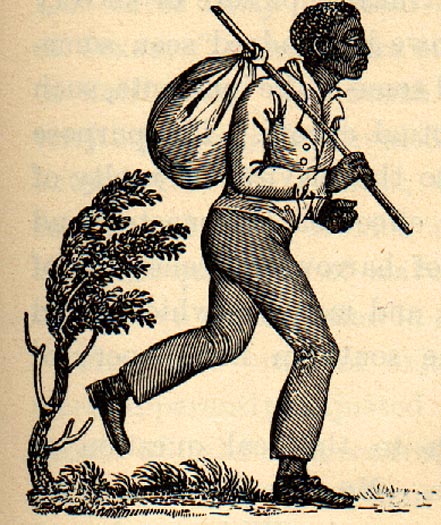
On the Underground Railroad
The notion of an underground railroad sets up ideas of precision and organization. And, indeed, the Underground Railroad did have conductors, it did have safe houses, it did have a vigilance committee. But for the most part it was a loosely knit network of black, mostly black men and women, some white abolitionists who appeared when somebody was in big trouble, kind of ad hoc. Somebody had escaped a slave trader, a slave trader or a slave catcher was following them, they needed big help. The Underground Railroad provided big help and by that process thousands of black people gained their freedom. And, of course, they then joined the struggle against slavery. The Underground Railroad, besides freeing these individuals had an enormous effect on American society at mid century.
Number one, it demonstrated to northerners, white northerners, who were not committed to the end of slavery, how horrendous an institution slavery was. How much black people desired freedom. What they would do, the extent they would do to gain that freedom. This against the slave holders' propaganda that slavery was a benevolent institution and that black people were happy as slaves.

Professor Ira Berlin
Number two, the underground railroad demonstrated to northerners their own complicity in the institution of slavery. This in particular, after passage of the second Fugitive Slave Act in 1850, an Act which operated against certain treasured rights of the American people, particularly the right of habeas corpus. And which demanded that all Americans participate in the recapture of runaway slaves and if they did not participate they were liable to fine or perhaps even jail.
Thirdly, the Underground Railroad demonstrated to southerners, to slave holders, the extent to which slaves opposed slavery. To the extent to which some radical abolitionists, black and white, were willing to go to help slaves escape. And demonstrated the slow leaching of slavery from the border states which over time would leave them isolated in a slave-holding republic in the deep south. A slave-holding republic which slavery might be liquidated by constitutional means. They, therefore, struck a preemptive strike to create an independent confederacy. That independent confederacy cession led to a war and war, of course, led to emancipation and ironically the end of slavery itself.
On African Americans in the North

On the eve of the Civil War about a quarter of a million black people lived in the North in freedom. Some of them, of course, were descended from people who never were slaves, who slipped through the net of slavery. The vast majority of them gained their freedom as a result of the American Revolution and the emancipations that followed the American Revolution and hence were free for generations, perhaps two, perhaps three generations. Some of them were newly freed, were runaways from the South. These free people of color for the most part resided in cities, by dynamic hub of northern society and although this was the dynamic part of the northern economy, free blacks did not get to participate in this. They were prescribed from the best jobs. Most black people, women worked as domestics, men worked as day laborers. They shouldered a shovel, they pushed a broom, they were not allowed into other kinds of occupations.
They were also limited legally. They were not allowed in most places to run for office, to vote, to sit on juries, to testify against whites, to participate in the militia. Nonetheless, they enjoyed certain critical civil rights, the right to organize, the right to meet, the right to publish. They take these few rights which were allowed them, they form them into a great organizational and political tradition which creates a network of churches and schools and associations which creates a cadre of political leaders, of conventions. Everyone from Sojourner Truth to Frederick Douglass who batter against the institution of slavery, who batter against the institution of inequality, who demand full participation in American society, it is that which is the legacy of free people of color in the northern states.
On African Americans in the South

On the eve of the Civil War slightly more than four million people of African descent lived in the slave states. About a quarter of a million of those were free people of color. That is more free blacks in the South than they are in the North. They lived on the very margins of southern society because slave holders, planters, feared them as harbingers of the Revolution, beginning of slave insurrections, examples to slaves that a black person could be free. So that free people of color were prescribed legally, culturally, socially in a variety of ways. They not only had their legal rights limited, but they were forced to carry passes, denied free travel, a whole variety of prescriptions. Nonetheless, perhaps because they were black and perhaps because blackness was identified with labor, free people of color in the South had certain economic niches which allowed them to participate in the economy, participate perhaps to a far greater degree than free blacks in the North. And free blacks in the South enjoyed a greater economic prosperity than they did in the North which is perhaps one of the reasons why they stay in the South.

The vast majority of African Americans in the South were slaves. And as slaves they suffered from the condition that slaves everywhere did. That is slavery was an institution which rested upon violence, imposition, psychological and physical. A dehumanization as slave holders squeezed the labor and creativity out of black people for their own profit, for their own wealth, for their own political power. Nonetheless, slaves refused to give in to this dehumanization. That is on the narrowest of grounds they created a culture, they created life, they created families, they created churches, they created educational institutions, they created cuisine, language, theology, all of the trappings of culture. So here we have the two facts about slavery: the great tension in slave life between the dehumanization, the violence of slavery and the creativity of black people within slavery.
A second thing should be said about slavery and should be understood, that slavery was not one thing, it was many different things. It was different in cities than in the countryside. It was different on plantations than in farms. And in the 19th century slavery was changing rapidly. At the beginning of the 19th century most slaves grew rice or tobacco. At the end of slavery in 1863 most slaves were growing cotton. In 1800 most slaves lived in the seaboard states by emancipation, most slaves were living in the black belt. That is an enormous migration, forced migration of slaves from the upper to the lower south. We call that the slave trade. And perhaps the most important change that goes on in the 19th century, the embrace of Christianity for the first time by people of African descent and the creation of the Afro Christian Church. All of these things speak to the kinds of changes within slave life. The one thing, of course, that does not change is the desire of black people, of slaves for freedom. That, of course, is a standard throughout the history of slavery.
Interview with Historian Ira Berlin
Watch the full episode. See more American Experience.