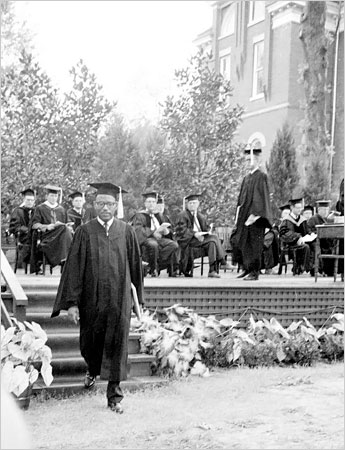
Showing posts with label James Meredith. Show all posts

Tuesday, May 31, 2011

Barack Obama in the Footsteps of James Meredith

History News Network article, "Barack Obama in the Footsteps of James Meredith," by Frank Lambert (Mr. Lambert is Professor of History at Purdue University.)

On September 26, 2008, Democratic presidential nominee Senator Barack Obama arrived on the Ole Miss campus in Oxford, Mississippi for his first debate with the Republican candidate Senator John McCain. Many of the university students and guests from around the state of Mississippi who comprised the audience were mindful of the occasion’s historic significance. Obama, the first African-American presidential nominee in American history, was welcomed on a campus that on a September evening 46 years earlier had erupted into violence over the mere presence of an African-American who sought admission to the all-white university. James Meredith was met with a starkly different reception from the cordial welcome extended Obama.

Hoisting a Confederate flag, hundreds of Ole Miss students protested integration of the school in front of the registrar's office on Sept. 20, 1963. Mr. Khayat, a former Ole Miss football player, banned Confederate flags at football games, sparkling controversy that earned him death threats.
Thousands of rioters hurled bricks and stones and fired bullets in a storm of protest against Meredith’s assault on white supremacy and racial segregation, which white Mississippians defended in the name of states’ rights. Meredith prevailed in his courageous battle for civil rights, and it is impossible to conceive of presidential candidate Barack Obama at an integrated Ole Miss without first considering James Meredith’s path-breaking effort to open the university to all qualified students regardless of race.


In his campaign, Obama asked Americans to consider his candidacy on the basis of his character and ideas, not on that of his race. Similarly, in his application to the University of Mississippi, Meredith asked Ole Miss to consider him as a qualified transfer student, not as an African-American. Fully aware of the state’s history, Meredith knew that the university would in fact make his race an insurmountable hurdle. So, when he received the expected rejection letter he filed suit and began the long campaign for his civil rights against the equally determined governor, Ross Barnett, who pledged to uphold Mississippi’s states’ rights.
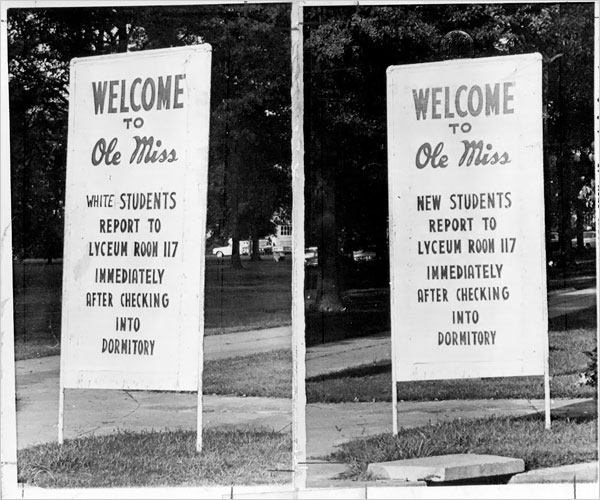

Since he was 14 years old, Meredith had dreamed of attending Ole Miss and then becoming a lawyer in the state, but when he graduated from high school in 1950, four years before Brown v. Board of Education, he joined the Air Force because he had no chance of enrolling at segregated Ole Miss. He was stationed at the Strategic Air Command base near Topeka, Kansas when the Brown decision was handed down, and that decision rekindled his desire to attend Ole Miss. In 1957, when President Eisenhower sent troops to Little Rock to protect nine African-American students seeking admission to Central High School, Meredith began to hatch a strategy for entering Ole Miss. As a military man, he conceived of the challenge as a battle and thus he devised a plan of attack similar to that of a military mission.
An unidentified soldier gets first aid from his buddy following a clash in the Oxford town square where he was hit by flying glass. September 30 - October 1 - Oxford, MS - James Meredith, former Staff Sergeant of the Air Force, along with his legal team from the NAACP, ended an 18-month court battle to be allowed to enroll at the University of Mississippi over the objections of Governor Ross Barnett and white segregationists. Although President Kennedy addressed the nation asking Mississippians to obey the law and "live up to their honor," violence erupted on the campus and continued for fifteen hours.

His was a two-part strategy. First, he needed to secure the support of the federal government to counter what he knew would be massive and determined state resistance. Second, he needed to ensure that his enrollment efforts would take place under the bright lights of national publicity, not under the cloak of night as preferred by those who fought to maintain racial segregation in Mississippi.
Army trucks, carrying marshals in steel helmets, rolled across the University of Mississippi in September 1962. They were called in to enforce a federal court order to enroll Mr. Meredith at the previously segregated school. Chancellor Robert C. Khayat sees the presidential debate as an opportunity to supplant the image of the university that is most closely linked to civil rights-era violence.

With unflinching courage and iron resolve, Meredith followed his battle plan and prevailed. He enrolled at Ole Miss with the reluctant, though resolute, backing of the Kennedy Administration, which provided federal troops to ensure his safety. While he had anticipated stiff resistance, Meredith was unprepared for the ferocity and persistence of the opposition. The campus turned into a battlefield on the evening of September 30 with perhaps two thousand rioters attacking the 500 federal marshals sent to protect Meredith. In the end, hundreds were wounded, two were killed, and millions of dollars of property was destroyed. Within a week more than 10,000 federal troops had arrived to restore order on the campus.


When CBS’s Schieffer went to Ole Miss to cover the presidential debate in 2008, he recalled his visit there in 1962 covering the Meredith case. He was struck by the contrast between the tranquility of the campus in 2008 and the violence of 1962. He called the riots “the most terrifying experience I ever had,” quite a statement from a correspondent who had covered the Vietnam War. Meredith has a different interpretation. He objects to the characterization of the violence surrounding his admission as “riots.” Legitimate governments do not riot, he points out, adding that “everything at Ole Miss was a consequence of state action.” Meredith prefers the term “battle.”

Meredith graduated in 1963 and thus inspired thousands of African-Americans to follow him as students at Ole Miss. In the first years after 1962, they came as lone individuals, and then by the end of the decade they began enrolling in significant numbers. When Obama visited the campus, about 13 percent of the student body was African-American, and a sizeable number were among those assembled on September 26, 2008 to witness the presidential debate.

Conspicuously absent was James Meredith. University and state officials had hoped he would attend to underscore the historic significance of the occasion and to demonstrate the great strides that the state had made in race relations. But the 75-year-old Meredith stayed at his home in Jackson, Mississippi, and the reasons that he gave say much about the man. First, he said that he was babysitting his granddaughters. When I heard that, I recalled my meeting with him in Jackson for an interview for my book, The Battle of Ole Miss. He arrived at the restaurant with one of his granddaughters in tow, explaining that he had forgotten that it was his day to pick her up from daycare. Clearly family is important to James Meredith, as it had been in 1962 when he insisted that his actions were inspired by his father’s dreams that his son take his rightful place in a state that afforded all its citizens equal opportunity and by Meredith’s own goal to secure a good education not only for himself but for his son and future generations. Second, Meredith stayed home because he did not assign as much significance to the Ole Miss debate as did white officials. To him, what he had done was to win a battle, not the war against white supremacy. In his mind 1962 represented an opening campaign not a decisive victory. While he applauded the strides that had been made, he was not ready to celebrate.

Six weeks after the debate at Ole Miss, Barack Obama was elected President of the United States. Many factors explain his victory: an unpopular war, a financial and economic meltdown, a faltering Republican administration, etc. But, to those across the country who remembered watching the televised reports of the battle of Ole Miss in 1962, his election seemed to be nothing short of the winning of a war. It was the culmination of a long and painful struggle for equal opportunity fought by pathfinders like James Meredith whose courage made Obama’s election possible and gave Meredith a moment to celebrate.

(source: History News Network)

U.S. Marshals and the Integration of the University of Mississippi

The U.S. Marshals Service writes the History of The U.S. Marshals and the Integration of the University of Mississippi:

40 years ago, deputy marshals safeguarded a man’s education goals and carried out a president’s orders
Mr. Meredith being escorted on the first day of class by James McShane, chief United States marshal.
History is often made when one person stands his ground and demands his dream. But history needs its enforcers. And when James Meredith sought to legally become the first black person to attend the University of Mississippi 40 years ago, the duty of upholding the federal law allowing him to do so fell upon the shoulders of 127 deputy marshals from all over the country who risked their lives to make his dream a reality.

"Negro James Meredith prepares to attend his first class at the University of Mississippi here 10/1 morning, escorted by U.S. Marshal James McShane (L) and John Doar (R) of the Justice Department..."
A bold challenge Race relations in the United States were plenty tumultuous in 1962. While the landmark case of Brown v. Board of Education of 1954 made public school segregation illegal, some states resisted the change, and the federal government did little to interfere.


That changed when Meredith set his sights on becoming the first black person to attend Ole Miss. According to one biographer, Meredith was dissatisfied with race relations in the South, and in a calculated move he applied for admission.

However, the university, citing administrative technicalities, refused his application numerous times over the course of the next several months. This prompted the would-be student to write a letter to Thurgood Marshall, then head of the National Association for the Advancement of Colored People’s Legal Defense Fund.

In the letter, Meredith wrote that he knew the “probable difficulties involved in such a move as I am undertaking and I am fully prepared to pursue it all the way.” Marshall and his organization backed Meredith wholeheartedly. In his book, “An American Insurrection: The Battle of Oxford, Mississippi,” author William Doyle stated that the NAACP’s backing was a key component in Meredith’s eventual success. Doyle also noted that two other factors were equally important: John F. Kennedy, seen as the first president to support civil rights, took office in January 1961; and the Brown ruling was still the official law of the land.

Mississippi Governor Ross Barnett

Kennedy, who scored a narrow election victory with the help of many black voters, would indeed turn out to be sympathetic to Meredith’s cause, but the same could not be said of Mississippi’s governor, Ross Barnett. In a statewide television broadcast, Barnett stated, “[Mississippi] will not surrender to the evil and illegal forces of tyranny ... [and] no school will be integrated in Mississippi while I am your governor.” Later, the Supreme Court ruled in favor of Meredith attending classes. But Barnett was still defiant. He went on to call Meredith’s attempt to enter Ole Miss “our greatest crisis since the War Between the States.” Photo above right: Chief Marshal J.P. McShane (right), Assistant Attorney General John Doar (left) and Deputy Cecil Miller (in Background) escort James Meredith to classes at the University of Mississippi .

The job of seeing to it that Meredith was safely admitted to the school clearly fell upon the federal government, and soon enough, President Kennedy sent deputy marshals into the fray.

Mississippi's Lieutenant Governor Paul Johnson confronts Chief Marshal James McShane as he escorts Meredith to the registrar's office where he was admitted to the school. For the next year, until Meredith graduated in August 1963, Marshals protected him on the campus.
Three times, Chief U.S. Marshal J.P. McShane led a small contingent of deputies — without loaded guns — to register Meredith. But in each instance, they were stopped by state politicians and state troopers who were taking orders from Barnett. Finally, President Kennedy escalated matters by ordering a much larger group of deputies — 127 — to get the job done. To increase the numbers even more, McShane swore in over 300 U.S. Border Patrol agents and close to making them special deputy marshals and bringing the total number of federal law enforcement officers for this assignment to 538. The stage was set.

On Aug. 19, 1963, Mr. Meredith became the first black student to graduate from the university. In 2006, a monument dedicated to Mr. Meredith and integration was erected on campus.

Meredith was the first black student to attend 'Ole Miss' and was registered at the school after a violent confrontation between students and Deputies. One hundred and sixty Deputies were injured - 28 by gunfire. For the next year, Deputy Marshals provided Meredith with 24 hour protection, going everywhere he went on campus, enduring the same taunts and jibes, the same heckling, the same bombardment of cherry bombs, water balloons, and trash, as Meredith did. They made sure that Meredith could attend the school of his choice.
(source: US Marshal)

Monday, May 30, 2011

James Meredith: History of the Black-White Race Issue

In 1966 the BBC reported: "1966: Black civil rights activist shot." James Meredith, the first black man to brave the colour bar at the University of Mississippi, has been shot and wounded after entering Mississippi on a civil rights march.

James Meredith, center, is escorted by federal marshals as he enters the University of Mississippi, in Oxford, in September 1962. Mr. Meredith was the first black student to attend Ole Miss, and his enrollment sparked riots by white students and residents that led to two deaths. The campus was the site of the first presidential debate between Democratic Candidate, Senator Barak Obama and Republican Candidate Senator John McCain in 2008.

Police have arrested a 41-year-old white man named Aubrey James Norvell from Memphis on suspicion of carrying out the shooting.


The 32-year-old civil rights activist began his solo 220-mile March against Fear yesterday in Memphis and was heading for Jackson to show his fellow black citizens how to stand up to white authority and also to encourage them to register to vote.

James Meredith, center, was the first African American student accepted by the University of Mississippi. His attendance provoked riots. Here he is escorted to class by U.S. marshals and troops. Oct. 2, 1962.

At Hernando, Mississippi - 30 miles from his starting point - he saw an armed man aim at him and dived to the ground, but he was shot three times. Bleeding from the head, shoulder and leg he shouted: "Oh my God."

FBI agents and reporters who were following the march witnessed the ambush.

An ambulance took him to hospital where doctors later said his wounds were not serious.

Fight to enter university In 1961 Mr Meredith became an icon for the civil rights movement when he applied to the University of Mississippi and was rejected on racial grounds.

The NAACP (National Association for the Advancement of Colored People) then brought a suit in a federal court which granted him the right to enroll.

When he arrived to do so he was turned away by the university authorities and by the governor of Mississippi.

A court injunction for contempt removed this barrier but a white mob stopped him entering the university.
After a riot in which two people were killed and 375 were wounded, President Kennedy sent 3,000 troops to restore order and allow Mr Meredith to register as a student.

He graduated in 1963 and recently published his experiences in a book called Three Years in Mississippi.


In Context

LinkMartin Luther King visited Mr Meredith in hospital the following day and then took up the March Against Fear - renamed the Meredith March - which attracted thousands of black men and women along the way.

Mr Meredith's injuries turned out to be superficial and he recovered enough to complete the march.

Aubrey James Norvell confessed to the shooting and was sentenced to five years in prison.

Soon after the march Mr Meredith dropped out of the civil rights movement to work as a stockbroker, and then in real estate. In 1967 he became an investor and entered Columbia University Law School in 1968.

That year he also became president of Meredith Enterprises and began to lecture on racial problems. In 1972 he stood unsuccessfully as a Republican candidate for the US House of Representatives. (source: BBC)


History of the Black-White Race Issue