Showing posts with label Indian Railways. Show all posts

Monday, October 3, 2011

62nd National Basketball Championship for Men & Women will be in Chennai from December 16-24, 2011


The 62nd National Basketball Championship for Men & Women will be organised by the Basketball Federation of India (BFI) in association with the Tamil Nadu Basketball Association (TNBA) from December 16th-24th at the Jawaharlal Nehru Stadium in Chennai (Tamil Nadu).

The 'Senior Nationals' are the biggest event in the domestic basketball calender in India: India's top teams and players will be participating in this event in both the Men's and Women's sections, showcasing the finest talent of hoops in the country.

Chennai last hosted the 23rd FIBA Asia Championship for Women in 2009. One of the most basketball-loving cities in the country, Chennai will feature strong host teams and local-based stars.

All participating member units are requested to confirm the participation of their Men/Women team(s) to the Chairman, Technical Commission latest by 15th November, 2011.

The last National Championship was held in New Delhi, and was won once again by Indian Railways in both the Men's and Women's divisions.

Thursday, April 14, 2011

Shooting For Success share high-flying exciting hoops in India


David “DJ” Jones was born in California and now spends his time working in San Antonio, Texas with his basketball camp/foundation, Shooting For Success (SFS). Funny then, that the city where he hears the crowds offering him the most home support these days is thousands of miles away from home... Mumbai.

With four years of participation in Mumbai’s Savio Cup, and this year, for the first time playing in the 2011 Ramu Memorial Basketball Tournament (RMBT), SFS have certainly made a name for themselves in Mumbai. The club has been the only consistent foreign side visiting India for basketball competitions in recent years, and their fan following has now reached near-cult status.

SFS’ connection with India began when their team manager, Tushar Patel, first the team over here. “We always have a great experience here, and that is why we keep coming back,” said DJ, who is the captain and coach of the side, as well as the coach back home for the SFS camp in Texas. “It is the great experience that makes us keep coming back – teams that don’t come here are missing out!”

SFS are a crowd-favourite in Mumbai, as they exhibit amazing above the rim athleticism, swarming defense, and some hot shooting rarely seen on courts in India. DJ, who has played at the professional level in the States for over a decade, says that Mumbai has been one of the places that has shown him the most love. They chant his name ‘DJ! DJ! DJ!’ every time he gets on court; they scream in delight whenever he beats a man off his quick dribble or drains one of his many reliable three-pointers. “The fans treat us well here, so we keep coming back!” he says.

Apart from their captain, the current SFS side playing at the RMBT in the Indian Gymkhana in Matunga feature the tall and athletic forward Terry Fields, who is one of the most exciting dunkers in the team and won the Savio Cup’s Slam Dunk Competition. DJ also mention point guard Limar, who is a fantastic point guard and tough defender.

Still, it’s not all ‘showtime’ from SFS – At the Savio Cup a few months ago, the Indian Railways side, led by Vishesh Bhriguvanshi, shocked SFS in an exciting finale. SFS have returned for Ramu Memorial with another strong squad, hoping to prove themselves again. “We want to get better each time and keep the fans on the edge of their seat with excitement,” said DJ, “The Savio Cup loss left a bad taste in our mouth but we are back here to win.”

With two wins in their first two games, it seems that Shooting For Success certainly mean business!

Sunday, April 3, 2011

Basketball Federation of India, 2010-11 Season – National Basketball Championship Winners


With the arrival of support from the IMG-Reliance, the 2010-11 season was an extremely fruitful one for basketball in India. The Basketball Federation of India (BFI) held five official National Championships around the country. These are the final results from each:

27th Youth National Championship for Boys and Girls: June 1-8, 2010, Trichy (Tamil Nadu)

Boys

1. Punjab
2. Chhattisgarh
3. Madhya Pradesh

Girls

1. Kerala
2. Uttar Pradesh
3. Tamil Nadu

37th IMG-Reliance Sub-Junior National Championship for Boys & Girls: Sep 24-30, 2010, Kangra (Himachal Pradesh)

Boys

1. Rajasthan
2. Chhattisgarh
3. Delhi

Girls

1. Chhattisgarh
2. Karnataka
3. Madhya Pradesh

61st IMG-Reliance Junior National Championship for Boys & Girls: Oct 24-31, 2010, Vashi (Maharashtra)

Boys

1. Punjab
2. Tamil Nadu
3. Madhya Pradesh

Girls

1. Kerala
2. Maharashtra
3. Tamil Nadu

61st IMG-Reliance National Championship for Men & Women: Dec 28, 2010–Jan 1, 2011, Delhi

Men

1. Indian Railways
2. Services
3. Punjab

Girls

1. Indian Railways
2. Delhi
3. Tamil Nadu

25th IMG-Reliance Federation Cup National Championship for Men & Women: Feb 10-15, 2011, Raipur (Chhattisgarh)

Boys

1. Western Railway
2. IOB (Chennai)
3. Indian Army

Girls

1. Chhattisgarh
2. Southern Railway
3. Delhi

Thursday, March 10, 2011

Jayasankar Menon: A Hoops Odyssey


Imagine you’re in the theatre. The drama on stage is the tale of a legend. You have heard about him before, maybe even seen him, but what you know is only a rumour or story. But now, you’re going to see the action for yourself. Like every good character-based drama, this one starts with a life-changing moment for our hero, then sees the hero cement his legend, and then he meets his perfect heroine. But no story is complete without the conflict, which leads to the moment of climax, and then to a resolution that leaves demands a thunderous applause from the happy audience.

This is the story of Jayasankar Menon.

ACT – 1: The Auto-Rickshaw Accident

Our saga begins in the Wadakanchery, in Thrissur district, in Kerala around 1980. Young Jai, the son of a revenue officer in the Thrissur Municipal Office, grows up with what he calls a “free pass” to a local basketball tournament. His first major exposure to the world of basketball comes when Jai participates, not on-court, but just beside it, as he manages the scoreboard for the games.

But his own sublime basketball skills continue to grow as he grows older and taller. Learning under a coach at the local sports council, CP Michel, Jai improves to qualify for the Kerala Youth (U16) side, playing in his first National tournament at Bhilwara in Rajasthan. Soon after, in the year 1984, he gets selected to the Sports Hostel in Kerala, a move that injects a boost into his hoops development.

But basketball wasn’t the only sport that Jai participated in. He was also a very able Handball player, and was selected to represent Kerala’s Senior Handball side. Unfortunately, before he could explore his potential on the Handball court, his destiny would be changed forever.

“I should say, fortunately, I got into an accident,” Menon says, “While I was in Trivandrum for the Senior State coaching camp, an Auto-Rickshaw ran over my leg and I injured myself. That, luckily, put an end to my Handball career!”

When he recovered, he was fully back to basketball, as he began to play regularly and developed into good shape. “Of course I’m happy now that I had that accident!” Menon added, “Basketball got me so much more than Handball could have – I’m obligated to this game.”

ACT – 2: A rookie in the Starting 5

Jai climbed the ranks quickly, from Youth to Junior to the Senior side, before he joined Railways in 1987 and moved to Chennai, where he played for Southern Railways. That was the same year that Indian Railways took part in the World Railway Games in Delhi, where Indian Railways obtained a silver medal. Later that year, Jai was picked to his first Senior National, when India participated in the Asian Basketball Championship in Bangkok.

Later that year, the 19-year-old was part of the Railways squad that won the first Senior National in 19 years, at Mysore. He was part of the team that started a golden era for the Railways side, who are now favourites to win every major competition they participate in.

Jai played his first senior international game for India against Jordan, a 89-72 victory for India. But he got a bigger confidence boost as, in a rare move, the coach made him part of the starting five. “I completely didn’t expect that – usually youngsters have to move up the ranks before they get a starting slot. It was a rare opportunity for me, in my first international game, to start for India.”

Act 3 – Dominating Big Man

The dominance continued: over Six foot five inches tall, Jai played the Power Forward or the Center position, depending on the situation. He was also a strong player, who wasn’t afraid to use this strength to dominate the post play. One of the country’s best ever rebounders, Jai went on to represent India in four Asian Basketball Championships (ABCs). He won two gold medals for India in the South Asian Games, in Colombo and Chennai. His international basketball travels took him to the USA, Syria, Malaysia, Indonesia, Japan, and more.

During the 1995 ABC in Seoul, Jai led India as captain, and it was during this tournament where the full range of his abilities were put on display. “I played both the inside and outside game,” he said, “In some of the games, the opponents started to put full-court press on us, so I even began to bring the ball up the court and play the point guard position.”

Back home, there was no stopping Jai either. In his tenure with Southern Railways and Indian Bank, he participated in 15 Senior Nationals, winning the gold medal five times, and silver and bronze one time each. He won a further three golds and two silvers in Federation Cup Championships.

One of the biggest games of Jai’s domestic career came in the 1991 Senior Nationals – he had now moved to Chennai for good, and while representing a Tamil Nadu side, he was back in his home state of Kerala, where, in the Quarter-Finals, his team played against Kerala!

“It was a great game,” Menon remembers, “I really wanted to get this victory – I scored 49 points, and the game went into three overtime periods, but we still lost!”
In the very next Nationals, Jai’s redemption would be complete, as he helped lead TN to the gold.

The other game he remembers is the final of the 1995 Nationals in Calcutta, where, now as Tamil Nadu captain, he helped his team to another National win. “I remember playing the whole second half with four fouls,” Menon said.

Act 4 – The Heroine and the Co-Stars

Every hero needs a heroine, and the female lead role in the story of our main character is played by someone who is a legend herself, someone who deserves her own headline story. In 1994, Jai married Prasannakumari, who was the captain of the Indian Sr. Women’s side. A few years later, Jai became captain himself, taking the helm of the Indian Sr. Men’s team.

“We were probably the first marriage of captains,” Menon said, “Not only in basketball, but in any sport!”

Just like his illustrious lead partner, Jai was blessed with co-stars who helped him through his career. He speaks in high regard of the greats he has played with, included Ajmer Singh, Ram Kumar, Sunny CV, Shahid Quereshi, Unwin J. Anthony, Rajesh Srivastava, and Parminder Singh – each of whom could have a saga of their own now.

“The basketball players today are far more athletic, far more stronger than the players in our time,” he says, “But what we had, and what the current crop has to work on, is perfecting the team game. We had good fitness, and knew how to move well without the ball. This is something that the generation today has to work on.”

He adds: “There is also not much good height in the players today – maybe some in the Juniors – we need good big players, 7 footers in India.”

Act 5 – The High Point – The All Star and the Arjuna nominee

In 1997, Jai did the extraordinary – after leading India as captain to the ABC in Seoul (South Korea) two years earlier, Jai became the first basketball player from the South Asian region, and certainly the first from India, to be chosen to the Asian All Star side. He was the sixth-man in the All Star Team that played against the South Korea team in Seoul.

A year later, he was nominated for the Arjuna Award, recommended by the BFI, and although he never received the honour, in the eyes of the true fans, our protagonist had reached his high point.

Act 6 – The Suspension

As his international career ended, Jai still found it impossible to stay off the court in domestic competitions, continuing to be a dominating force for Indian Bank well into his late 30s. But for our lead character, the conflict was never against age – it was against an unfortunate circumstance.

In 2005, Jai stepped on court for Indian Bank against Southern Railway. When a little rough play from both sides got out of control, Jai found himself in an altercation. Three players from each side, including Jai were banned from the game. Five out of the six had their bans rescinded afterwards – but not Jai. He suffered a suspension from the game of basketball, the game he loved, the game that made him, and the game he had given his life to. Having lost his ‘current player’ status, he was transferred to Mumbai, forced to stay away from his wife and his daughters.

It took three more years, when a change in the association came about, and finally, Jai’s ban was lifted. But by then our protagonist was no longer the dominating force of his younger years. Between a knee surgery and weight-gain due to inactivity, he was never in shape to be a star again.

Act 7 – The glass half full

But that is not the end of our drama. The end is still in process, still in play, as we, the rest of the audience, watch and, and as we listen. Because although Jayasankar Menon may have waved goodbye to a legendary playing career, he has started to contribute to the game in other ways.

“I’m an optimistic person,” he says, “I always like to see the positive side of things and I believe that good things are bound to happen. As basketball grows bigger, I’m continuing to look for more opportunities to contribute to the growth of the game in India.”

And indeed, he has already made a name for himself off the court. He is an honorary Sports Advisor for Hindustan Group of Institutions and Sports Committee member of Federation of Indian Chamber of Commerce and Industry (FICCI). Menon and Prasanna, Indian basketball’s power couple, started the Professional Basketball Academy (PBA) in Chennai, where he is Director. He has organised inter-school basketball tournaments for several years, and has been involved in coaching. “I have learnt a lot from a lot of different coaches, in India and abroad,” says Menon, “I like to use all their influences but I have my own style!”

Of course, it is perhaps likely that you may have heard Jai before you ever got a chance to see him, despite the fact that he stands at a giant’s height. Jai is a regular colour commentator for DD Sports during India’s televised basketball tournaments. His game may have slowed down, but his voice never does!

And as he watches the game of basketball in India enter an exciting new phase, Menon keeps his outlook positive, but at the same time, offers some sound advice. “There are good things happening to the game in India. The current General-Secretary of the Basketball Federation of India, Mr. Harish Sharma, has helped guide this new way, this new beginning for Indian basketball. I’m happy to see the involvement of IMG-Reliance. Now that our players have begun to receive an honorarium, they will be encouraged to perform better.”

“But we still have a long way to go,” he adds. “We have to make sure our players are promoted the right way. They have to have more exposure against better foreign talents. Our best players now might be dominating the domestic scene, but they get exposed overseas because they do not play enough against better players. We should get more and more foreign teams to come play in India against us so our own level can improve.”

Closing Act

And this is where, for now, the curtains close, and Menon’s story so far comes to an end. Because this is the part that our lead character leaves the stage and he joins the audience to witness a bigger show. A show that his story is a small part of, and a show that we all have a stake in: The Story of Basketball in India.

“The presence of these giants – IMG, Reliance, and NBA in India will take basketball to the next level,” says Menon, “It will take three or four years for things to smooth out, but once a professional league starts in India, things will start to work out.”

We all certainly hope so. But before we welcome our exciting future, let’s celebrate a legend from the past. Who knows? There might well be a young child somewhere in the country, manning the scoreboard at a basketball tournament, and have his eyes set on becoming the next Jayasanker Menon.

Tuesday, February 15, 2011

Yadwinder Singh: Indian Basketball's Energy Bar


As the opposing team's best player dribbles towards his basket, Yadwinder Singh claps his hands together, almost violently, psyching himself up on defense. With an agile and quick 6 foot 6 inch frame, he is capable of guarding almost anyone, from speedy point guards to powerful, back to the basket post players. Yadwinder stays in front of the attacking player, blocking his vision at the basket. As the player drives in, he is forced to change his shot, which clanks off the side of the rim.

Yadwinder grunts loudly as he grabs the rebounds - it's his and his alone. He passes the ball to one of the guards on hid team and races ahead, beating everyone else on court to get to the opposition's basket. Before anyone else can react, he is in perfect position to receive the ball under the basket and lay it up. A few milliseconds later, he's back at the defensive end, turning passes into turnovers, and defense into offense, as he shows his range by nailing a smooth outside jumper.

There are few players in Indian basketball like Yadwinder Singh, or ‘Yadu', as we know him. A monster at both ends of the floor, Yadu seems to be on a constant energy rush, as if Red Bull has given him the wings to fly and keep flying. Defense to offense to defense and back and over and over again… There seems to be no full stops to his energy, just commas. Even when the game pauses for a free throw, Yadu will be talking, joking, shouting, instructing. Even when he is substituted out of the game, he doesn't stop, keeping his body warm and ready to go back in, jogging, doing push-ups… Constant movement.

I have seen enough NBA basketball to know of one (and only one) NBA comparison that comes to mind as I see Yadu, a Power Forward/Center, run the floor like a guard, defend and score like a big man, and motivate his teammates with an unbelievable rush of electricity and tenacity: Kevin Garnett.

His own motivations on the basketball court match Garnett's too: "I feel like basketball is a game all about the defensive effort," Yadu says, "For all the effort one puts in offense, you have to do double of that on the defensive end."

Yadu's defensive instincts, coupled with his fast-paced style of play, perfectly complement how his teams play. Whether he is representing Punjab, Railways, or India, Yadu believes that the secret to basketball success lies in his pace. "Basketball is one of the fastest games in the world," he says, "And if you aren't going to keep running, then why play it? If my team plays a perfect fast-paced game, we can be unstoppable."

Easily one of the most exciting players to watch in India, Yadu has become an important piece to the Senior National side, as was a starter for the country at the 2010 Asian Games in Guangzhou (China). Compared to many other early starters, Yadu had a late introduction to basketball, a fact that perhaps makes his quick ascension up the game's ranks that much more remarkable.

Yadu, the son of a farmer, hails from a small Punjabi village called Rasulpur Khurd. He was athletically-aligned from a very young age, but there was another sport that he focused on: Discus.

"I used to be a very serious discus thrower in school," he said, "And I took part in several major athletic competitions on Punjab from my school." He was also part of his school's hockey team.

In 2002, not until he was 16 years old, and at that point, stood at 6 foot 3 inches, did he take admission in a school in Amritsar where his coach encouraged him to try basketball. From that point on, Yadu's career took a dramatic upwards swing: he went from the Amritsar team to the Ludhiana Academy and then to the Punjab U17 team, all within a matter of one and a half years. By late 2003, he had his first senior national experience in Cuttack, had played U20 international for India in Kuwait, and participated in the Champions Cup in Malaysia.

The basketball world in India can be thankful that he abandoned his Discus throwing days behind to start throwing the basketball, but it's evident from some of his full-court bullet heaves that the throwing arm still has a lot of juice left in it. "When I look back now, even when I was younger, I used to watch a lot of basketball on TV," he said, "My Dad encouraged me to stay with athletics and discus, but once I crossed over to basketball, it completely consumed me and I didn't have the time to practice any other sport anymore."

Yadu added: "I started to enjoy basketball game a lot. It was a team sport where there was so much interaction with other people. And everything kept coming naturally to me - I kept on getting what I wanted. It was a great feeling to first play for Punjab, and then it became even more amazing to wear an ‘India' jersey for the first time!"

Yadu credits his early coaches for making him work extremely hard, whether it was his Amritsar coach Fateh Chand or Ludhiana's famed basketball trainer, Dr. Subramanyam. "I wanted to learn everything about basketball," and adding a smile, he added, "I stopped paying attention to everything else - including my studies!"

Constantly upbeat, energetic, and light-hearted, Yadu becomes the heart of the any team he joins. His Railways and India teammate Arjun Singh says, "He has incredible energy - and the best thing about his game is that he doesn't back down to anyone, no matter who the opponent is."

Yadu and the rest of the Indian squad faced the toughest of opponents at the Asian Games in November, and although they returned with an unflattering 1-5 record, Yadu took home a lot of positives: in the coaching and in India's potential in Asia. "We had a really good coach in Bill Harris for this tournament," he says, "With a coach like that, if we keep working hard, we can become top four in Asia."

"The future is good," Yadu says, "My dream is to take India to a medal one of the big championships - the Asian Games or the Asian Basketball Championships." The 26th edition of the FIBA Asia Basketball Championship, or the ‘ABC', are set to be held in Wuhan (China) in September this year.

Yadu's optimism off the court, on the future of the game, is as contagious as his optimism on it, where he focuses hard on each defensive assignment, each offensive rebound, and each jump-shot. And if this contagious optimism continues to grow in the hearts of Indian basketball player, we may very well see the day when the Young Cagers make a name for themselves in Asian basketball's biggest stages.

Monday, February 7, 2011

Basketball’s Federation Cup to tip off in Raipur (Chhattisgarh) from Feb 10th


In a competition where the finest basketball teams in the country are set to be pitted against each other, the 25th IMG-Reliance Federation Cup Basketball Championship for Men and Women will be held Raipur (Chhattisgarh) from 10th-15th February, 2011. The championship will be conducted by the Basketball Federation of India (BFI) in association with the Chhattisgarh Pradesh Basketball Association.

The Federation Cup is a tournament that features the top eight teams in both the men’s and women’s divisions from the previous year’s Sr. National Basketball Championship. Thus, the top ranked teams from the 60th National Basketball Championship (in Ludhiana) will take part in the Federation Cup this year.

The participating squads are:

Men

1. Indian Railways
2. Tamil Nadu
3. Uttarakhand
4. Services
5. Andhra Pradesh
6. Chhattisgarh
7. Karnataka
8. Kerala

Women

1. Indian Railways
2. Delhi
3. Chhattisgarh
4. Karnataka
5. Kerala
6. Tamil Nadu
7. Maharashtra
8. Andhra Pradesh

The host team qualifies automatically – this year, hosts Chhattisgarh already fell in the top-eight of both divisions. The Men and Women’s teams from Punjab will not be participating, and have been replaced by Kerala (Men) and Andhra Pradesh (Women).

The 24th edition of the Federation Cup was held at Alwar (Rajasthan) from October 22nd-26th, 2009. ONGC (Uttrakhand) were champion amongst the Men while SEC (Indian Railways) won the Women’s division.

Sunday, January 30, 2011

Indian Railways and Southern Railway win Savio Cup 6


In an exciting finale to eight days of mesmerising basketball at the Don Bosco–Matunga in Mumbai, Southern Railway (Women) and Indian Railways (Men) pulled off impressive victories to hoist the sixth edition of the United Phosphorous Limited (UPL) All India Savio Cup on Sunday, January 30th. Southern Railway relied on the talents of legendary Geethu Anna Jose to help beat Chhattisgarh in the Women’s final, 76-66. In the Men’s game, National Champions Indian Railways rallied behind an explosive game by Vishesh Bhriguvanshi as they pulled an improbable 91-79 upset over the strong American side, Shooting For Success (SFS).

For his consistent dominance throughout the competition, Bhriguvanshi was named player of the tournament. Anju Lakra, the Chhattisgarh captain, took the honour in the Women’s division.

In a tournament that has been gathering momentum and fan-following over the past few years, the Savio Cup 6 featured six Men’s teams (Indian Railways, SFS, IOB Chennai, Services, Punjab, Maharashtra) and four Women’s teams (Southern Railway, Chhattisgarh, Maharashtra, Karnataka) who played in a league system from January 23-29th, with the final held on January 30th.

Trailing at the end of the first quarter in the Women’s final, Geethu, Anitha P., Renjini Peter, and the rest of the Southern Railway squad began to turn the game around against Chhattisgarh. Geethu led the game with 29 points while Anitha and Peter added 16 each for Railway as they won by 10 points. For Chhattisgarh, star players Pushpa M (27) and Anju Lakra (20) shined in the final.

Undefeated thus far, American side SFS were strong favourites to win the Men’s final as they faced the Indian Railways side who had won the National Championship in New Delhi a few weeks ago. Instead, Railways kept the game close in a face-paced, back-and-forth match-up. Trailing by two at the end of the third quarter, Railways played their strongest basketball behind Vishesh 33), Yadiwinder Singh (20) and Gagandeep Singh (16) to stand as 91-79 winners. Terry Fields (29) was the high man for SFS.

The winning teams in both divisions were rewarded Rs. 50,000 and the runners-up with Rs. 25,000.

A dunk competition was also held on the penultimate day of the Savio Cup, which was won by Terry Fields of SFS. Amjyot Singh (Punjab) and Anwar Ferguson (SFS) finished second and third respectively.

Final Scores

  • Women: Southern Railway 76 (Geethu Anna Jose 29, Renjini Peter 16, Anitha P. 16) bt. Chhattisgarh 66 (Pushpa M. 27, Anju Lakra 20).
  • Men: Indian Railways 91 (Vishesh Bhriguvanshi 33, Yadiwinder Singh 20, Gagandeep Singh 16) bt. Shooting For Success 79 (Terry Fields 29, David Jones 13).

    Best Players Awards

  • Women: Anju Lakra (Chhattisgarh).
  • Men: Vishesh Bhriguvanshi (Indian Railways).
  • Friday, January 21, 2011

    6th UPL All India Savio Cup to tip off in Mumbai


    Mumbai’s basketball lovers are in for a feast of high quality basketball, as India's leading male and female hoopsters - along with a team from the United States of America 'Shooting for Success' - will be vying for top honours in the 6th Edition of the UPL All India Savio Cup-Don Bosco Basketball Tournament, held from 23rd January 2011 to 30th January 2011. The tournament will be held at Don Bosco High School (Matunga) and will be sponsored by United Phosphorous Ltd and Co-sponsored by Indian Oil Corporation Ltd.

    The tournament, which has become one of the leading basketball competitions in the country, will feature six teams in the Men’s and four teams in the Women’s divisions.

    Father Bosco D’Mello, Organizing Secretary of the tournament said, “The Savio Cup is a brilliant effort of teamwork. Diehard fans of the sport of basketball (both young and not so young) coming together to give a boost to the game of basketball, both to popularize it and take it to great heights by bringing together the best players both of Indian origin and overseas. You have got to be there to live the experience."

    Participating Teams

    Men: Services, IOB Chennai, Indian Railways, Punjab, Maharashtra, Shooting for Success (San Antonio, Texas, USA).

    Women: Southern Railway, South East Central Railway, Karnataka, Maharashtra.

    Some of the star players featuring in the tournament will include Shambaji Kadam, Dilip Kumar, Vishesh Bruguvanshi, Talwinder Singh, Mihir Pandey, Jagdeep, Yadwinder Singh, Harish, Geetu Anna Jose, Anita Pauldurai, Bharati Netam, Anju Lakra, Shirin Limaye, Sneha Rajguru, Amrita Baskute, Seema Singh, and others.

    A highlight of this year’s tournament is the special felicitation function planned for the Administrators, Referees, Players and Journalists of yesteryear who had made significant contributions to the game of Basketball.

    The tournament's organisers are doing a vigorous job in promoting the event. Savio Cup updates can be found on its Facebook page, on Twitter, and the organisers will also be sending SMS updates to fans who wish to submit their number for information.

    The men and women will play a round robin league, with the top two teams going on to play the final. The men’s winners stand to gain Rs. 1 lakh, while the runners-up teams will take home Rs. 50,000. The women’s winners will take home Rs. 50,000 with the runner-up teams standing to gain Rs. 25,000. There will be prizes for every match as well as for individual brilliance.

    Also planned are a ‘dunking competition’ and a ‘three-point shooting competition’.

    The matches will be played on the Terra Flex surface with the use of Electronic Scoreboards and 24-second devices, in specially erected stadium to seat approx. 2000 spectators.

    Three matches are expected to be played every day and they will be officiated by International referees, from different states, including three from Maharashtra.

    Wednesday, January 19, 2011

    Arjun Singh: Point Perfect


    As a chubby young child, Arjun Singh got the nickname ‘Golu’, which literally translated, means 'Round One'. As he grew older though, he left the chubbiness and roundness behind him – but it was another round thing that caught his full attention.

    The basketball.

    From the looks of it, this new ‘Golu’ in Arjun’s life is likely to stick with him forever.

    Fulfilling his potential as an explosive youth star, Arjun Singh has become one of the most respected and feared young players in India over the last few years. Still only 20 years of age, Arjun is already becoming a key ingredient of India’s senior national team. He has starred in several national and international tournaments already, and is looking to cement his position as India’s top choice at the point guard position in the future.

    Following the footsteps of his older brother, former Indian international Amit Singh, the Varanasi-boy Arjun started playing basketball when he was just 11 years old. “My brother had a serious knee injury that ended his career early,” Arjun said, “I always liked the game and used to watch my brother playing so well and winning – I knew I had to make this game my future, too.”

    Arjun began playing the game at the UP College basketball court in Varanasi, where his ascension as a basketball star mirrored another young player that started with him – Vishesh Bhriguvanshi. Arjun and Vishesh started off playing together at the same age, making it through to the UP Sub-Jr. team together, and then moving on to the Youth, Junior, and finally the Senior level. Arjun also followed Vishesh to Indian Railways, where the duo combined to make a devastating backcourt for Railways’ two of the last three years of National Championship victories.

    Arjun’s first experience to a national side was when he was called up to play for the Junior FIBA Asian Basketball Championship (ABC) back in 2008. The youngster got his first exposure of playing internationally in Tehran. He followed this with another call-up when the team went to Kuwait for the Stancovic Cup.

    Things started to get better for the youngster: Arjun, along with Vishesh, was part of the squad that won gold for India at the 1st Beach Games in Bali (Indonesia) at the 3-on-3 championship.

    2010 was an up and down year for Golu: After playing for India in the South Asian Games in Dhaka, he went on to have his best performance to date for India as the Junior ABC in Yemen neared. A good ball-handling PG for his tall height, Arjun and the Indian Junior Team dominated opponents at the Middle Asia Zone Qualifying matches held at Bangalore. His performances gained him steady crowd support too, and when India headed to Yemen for the tournament in September, he announced his arrival at the Asian stage, finishing as India’s leading scorer in a tournament that was otherwise a disappointment for the talented young team.

    “The ABC experience was great,” Arjun says, “This was the second time in this tournament for me and many of the other players. I was able to play more confidently this time. Plus our coach was Mr. Ram Kumar, who is also my coach at Indian Railways. With him on our side, I knew that the training for this tournament was going to much better.”

    Unfortunately, Arjun faced a setback at this tournament: despite his good performances, he suffered an injury that kept him out of contention for India’s Sr. Team which went on to make the country’s first appearance in an Asian Games basketball tournament since 1982.

    Arjun watched from home as India, after winning their grudge match against Afghanistan in their first game, went on to lose their next five matches against Qatar, Chinese Taipei, Iran, Philippines, and Japan. “We lost, but India played very well,” Arjun defended his fellow players, “The team lacked experience, but still played much above their level through stretches in many of the matches.”

    Arjun’s injury kept him out of the team for the Super Kung Sheung Cup in Hong Kong too, but he chose the biggest domestic stage – the National Championship – to announce his much-awaited comeback to basketball. In his second year for Indian Railways, for whom he is the starting point guard, Arjun became a fan favourite at the tournament, wowing opponents and supporters alike with his improving abilities. Indian Railways went on to win their third straight National Championship gold, defeating their rivals, Services, in the Final, 74-62.

    Arjun was in scorching-hot form in the final, scoring a game-high 27 points. Boasting an exciting line-up of Arjun, Vishesh, Gagan Deep Singh, Prakash Mishra, Yadivinder Singh, and Kiran Pal Singh, blazed through the tournament in style.

    But there is one problem that plagues Arjun despite the domestic success: many of the successful Indian players continue to get caught up in an unhealthy cycle of winning big in domestic tournaments, and then, unprepared to handle better talent, India’s national team ends up suffering internationally. “We need more exposure against better international teams before major tournaments,” Arjun said, “The Men’s team had little exposure together between the South Asian Games in January and the Asian Games in December. We can’t improve if we just keep playing against each other at home.”

    Still, Arjun remains optimistic about improvement, both for the Indian National team as well for his own game. “It will take time, but I think we are close to figuring things out,” he says, “We need to make a habit of playing and practicing together to become a stronger side. Once we can find the perfect combination of players in the team, we should be able to improve. Of course, all of us have to remain motivated and keep training harder.”

    “I want to keep improving my game, too,” Arjun adds, “Right now, I’m a good passer of the ball and can be quick running the floor. But to hang with international opponents, I have a lot more work to do. I have to add more body weight to take on stronger opponents, as well as try and get faster.”

    With a sunny future in basketball ahead of him, the boy known as Golu has come a long way at a young age. For now, his focus is on the next challenge ahead of him: the upcoming Savio Cup in Mumbai, where he will once again lead Indian Railways as the team’s premier feeder. Following that will be the Federation Cup and the basketball tournament at the National Games later in February. Railways doesn’t play in the National Games, but Arjun will be there: A highly touted player, he is wanted both by Punjab (where his current job posting is) and Jharkhand (who, as hosts, can call upon any player). His decision could well bolster one lucky side at the tournament.

    Though the young star’s ambitions, clearly, lie strongly with the National side. “I want to keep representing my country,” he says, “India’s position is down right now, so I feel that it will be my responsibility in the future to help fulfill the shortcomings we face today.”

    Saturday, January 8, 2011

    Geethu Anna Jose - "Every time I enter the court, I want to play the best game of my life"


    It's the first quarter of the Women's Final of the National Championship, the biggest basketball competition in India. A large crowd has come this cold, January afternoon to watch the hosts Delhi taking on their arch-nemesis, Indian Railways in the Final. Railways has defeated Delhi in the final of the Nationals for eight straight years, and they again boast the tournament's most formidable team, going undefeated and beating their opponents by over 50 points in each game. But this Delhi squad is going to be tricky; backed by strong home support and featuring superstars such as Prashanti Singh, Akanksha Singh, Shiba Maggon, and Raspreet Sidhu, this was going to be no cakewalk.

    But the star of the show as Railways' six-foot-two center, Geethu Anna Jose, attracting attention from fans and opponents alike. India's finest basketball player was aiming for her seventh consecutive national title; her first as team captain.

    But the game wasn't turning out the way Geethu had imagined. "When I had gone out, I wanted to score 50," she admitted, "But I missed three easy shots in the first quarter and started feeling the pressure. People say that ‘Nobody in India can stop Geethu', but I wasn't living up to those expectations in the game. I was letting them down in the Final! I was embarrassed and just wanted to sit on the bench."

    It was Geethu's Railways and India teammate, Anitha P., who finally got the superstar to relax at halftime. "She told me to approach the third quarter like the first, to start all over again. After that, I was able to realise my mistakes, start improving, and played a completely bindaas, cool game."

    Those who don't deal with the heady expectations that Geethu Anna Jose has put on herself may not realise her context through just her words. She reached double digits even in that ‘embarrassing' first half. She finished with her personal tournament-high of 29 points by the end, playing ‘bindaas'. Railways routed Delhi by 40 points in the final, 95-55. The team won each game by an average of 55.9 points each. Their closest game was a 37 point semi-final victory over Chhattisgarh; their biggest win was against Punjab in the quarter-final, by 101 points. It was Railways' eight straight crown; Geethu's seventh.

    "I was surprised that it was such a one-sided game in the end," she says, "I looked at the score-sheet later and was shocked to see that I was the top scorer!"

    Seven straight victories, but somehow, Geethu still manages to stay motivated for the National Championships. "This is the toughest competition in India and the one I enjoy playing the most. Yes, we have been winning a lot, but this is one tournament with so much talent that I believe that anyone can defeat us if we don't play hard. The victory in the final felt sweet because Delhi was a talented team that had been playing very well. I was especially happy to see that all the players in our squad played well in this championship." Apart from Geethu, players like Anitha P., Anju Lakara, and Renjini Peter stepped up big time for the champions.

    "There is no problem with motivation," Geethu adds, "I want to improve myself in every single game. Every time I step on the basketball court, I want it to be the best game of my life. I want to become a better scorer and a better player."

    It is perhaps this hunger for improvement that has Geethu wishful for tougher competition. Standing taller than most other opponents she faces, she believes that better defenses will get the best out her. "I want to test myself against other big players to see if I can face that challenge. In Australia, I face tall girls all the time, but there are not too many other tall opponents in the basketball scene in India. I hope that players with good size can be developed in the next generation of Indian players."

    There has been no bigger basketball player in India - in stature, and in the Women's division case, in size - than Geethu. Born in the city of Kottayam in Kerala, Geethu, still only 25, has already had a legendary career. She started playing basketball at age 11, idolising the former Indian captain Ivy Cherian as a youngster. After representing Kerala in her youth, she was brought in to play for Southern Railways. The high-point of her career came when she became the first Indian to play professional basketball in Australia - Geethu was picked by the Ringwood Hawks, a lower division team in the Australian WNBL (Women's National Basketball League). Her potential realised, Geethu dominated in Australia, even winning the Most Valuable Player award of the league in 2008.

    But her time in Australia was no trade-off for success back home. Geethu led the Indian National Team to new highs in tournament's in Thailand, Vietnam, the 2006 Commonwealth Games in Australia, the 2009 FIBA Asia Women's Championship in Chennai, and the recently concluded Asian Games in China, where the Indian basketball team featured for the first time in 28 years. In a young, steadily improving team, Geethu emerged as undisputed leader, winning top scorer, top rebounder, top blocker, and most valuable player honours in many of the tournaments she took part in. She was named India's captain for the FIBA Asia Championship.

    It was the Commonwealth Games experience in Australia when Geethu first faced her on-court idol, Lauren Jackson. Jackson, an Australian, is one of the best women players on the planet. India faced Australia in their very first game, which resulted in a massive loss for India. "Jackson is the best," Geethu gushes, "She scored 40 points in 20 minutes, and I became a fan ever since!"

    Fast forward four years, and Geethu and the rest of the National squad faced their toughest challenge as they headed to China for the Asian Games in November. Led for the first time by an American coach - former WNBA player Tamika Raymond - India's inexperience proved to be their downfall. India played against Asia's finest, and the tournament's two best teams, in their first two games - China and South Korea - and were blown out by each one. Their confidence shattered, the team went on to lose their final game too, against a relatively easier Thailand squad. India made a big comeback against the Thais, but Geethu noted that their opponents' zone defense in the end exposed India's inconsistent outside shooting.

    "We really have to improve our game in India," Geethu lamented, "Yes, we may not have height, but we must harness our speed and our shooting ability to get the best out of the team. Each time a player puts on an India jersey, they have to find out some way to improve themselves so that they can be responsible for representing India the right way."

    Still, the future is bright for the game in India. The Basketball Federation of India (BFI) has received sponsorship from IMG-Reliance, who have been helping develop leagues and have handed a bonus honorarium payment to India's best players. Geethu and seven others were part of the top category of players handed this honorarium.

    "Now that we're getting paid, there are no more excuses and no one to blame," she jokes, "We just have to perform now. India still has a long way to go - the youngsters need improved coaching and improved knowledge of the game's fundamentals. A foreign coach like Tamika cannot make miracles happen in three to six months, and a good team cannot be formed if the players aren't always playing together. We need consistent good coaching and we need team unity to improve. It's a long-term process."

    From Shiba Maggon, the Singh Sisters, Geethu's Railways' teammate Anitha P., TN's Kokila, and Maharashtra bigs like Shireen, Geethu is optimistic of the talent in India - it is the experience of big games that she feels will bring out the best potential out of these players. "If we have more small international tournaments in India, inviting squads which are closer to us in quality, we will not only learn more from them but also generate a lot of hype amongst fans for basketball in India," she says.

    But her personal ambitions are higher, and further. Currently mulling over another offer to go back to Australia to the Hawks, Geethu is holding back optimistically as she hopes to get a try-out with the WNBA, the world's finest Women's basketball league. "I don't know if I can make it, but I want to try. It will be a big step if an Indian can even get a trial with the WNBA."

    Geethu doesn't mince words about her growing legend. She has been India's best-known name in basketball for the better half of the last decade, and has admitted that although the pressure sometimes gets to her, the fame certainly doesn't. "It was great being recognised in China and elsewhere as a well-known basketball player - that is the feeling that basketball players should receive in India too, because they're superstars in their own right."

    "Like the National Championships, there are great expectations of me from both fans and opponents when I play, and I have to change my attitude to be able to deal with it," she confesses, "On the court, there are no friendships, no Didis - It's my game, I'm the killer on court."

    So, can anyone in India stop Geethu Anna Jose? "Of course!" she laughs, "I can be stopped very easily." After a pause, she adds, "But I won't reveal how!"

    Tuesday, January 4, 2011

    Indian Railways complete a three-peat double of National Basketball Championship


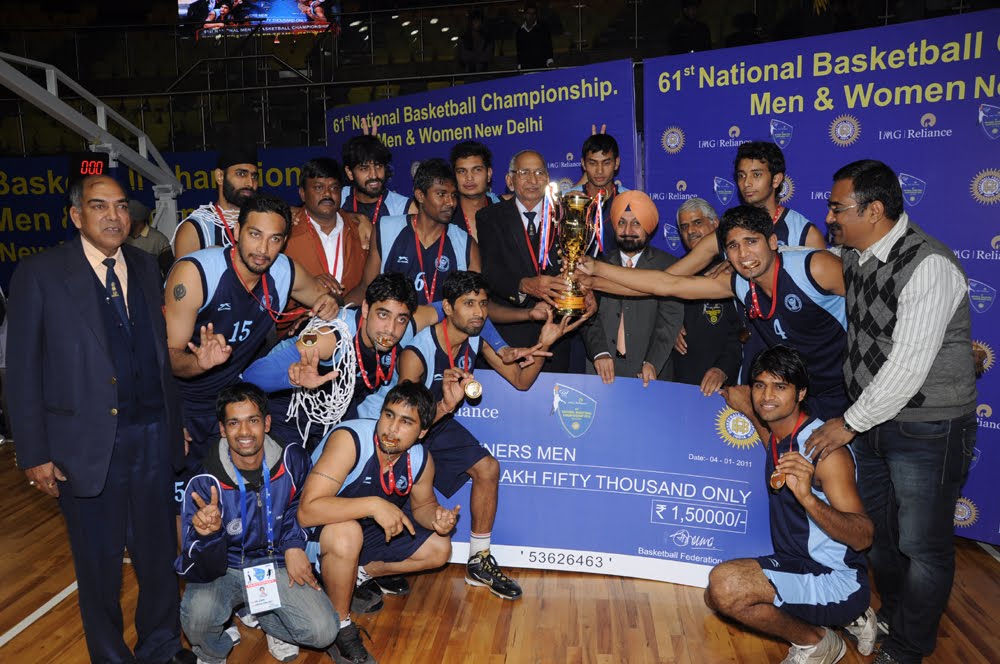
    Indian Railways stamped their mark over Indian Basketball as they completed three-years of double victory of both the Men’s and the Women’s squads at the 61st IMG-Reliance National Basketball Championship for Men and Women at the Talkatora Stadium in New Delhi on Tuesday, January 4, 2011.

    For the ninth straight year, the Women’s final of the National Basketball Championship was held between budding rivals Indian Railways and Delhi. And for the eight straight year, Indian Railways upheld their dominance in the rivalry and over Women’s basketball in India by destroying Delhi 95-55. Indian Railways have won 23 of the last 25 National Championships, and once again, this was their year in the tournament.

    It was more of the same in the Men’s Final, as Indian Railways muscled their way towards a gritty victory against their rivals, Services. This was the third straight National Basketball Championship title for the Railways Men.

    After eight days of excitement, from December 28th – January 4th, at the Talkatora Stadium and the Modern School in Barakhamba, the finals of the championship were a showcase event. In the Women’s game, Delhi were no match for Railways’ devastating duo of Geethu Anna Jose (29 points) and Anju (23), as they were blown out by 40 points. Prashanti Singh and Raspreet Sidhu scored 18 and 16 points respectively for the hosts.

    In the Men’s game, youngster Arjun Singh caught fire to lead Indian Railways a victory over Services, 74-62. Arjun had 27 points, whereas Jay Ram Jat scored 25 points in a losing effort for the Services side.

    In the third place match-ups, Tamil Nadu Women edged out Chhattisgarh in a close encounter, 55-51, behind 18 points apiece by S Kokila and Apoorva Murali Nath. In the Men’s game, Punjab’s superstar Jagdeep Singh found his groove to score 33 points as Punjab beat Kerala 89-67. Amjyot Singh added 16 points for Punjab as they sealed third place. Basil Philip was the top man for Kerala in the match, adding 26 points.

    Harish Sharma, the Secretary-General of the Basketball Federation of India (BFI) expressed his satisfaction towards a successful tournament. “Thanks to the help of our sponsors, IMG-Reliance, this was the biggest national championship to date. The play on the court didn’t disappoint and it’s obvious for us to see that basketball is growing at an acceleration pace in India. Once again, I would like to thank and congratulate all the participating teams, coaches, managers, support staff, and fans who have helped make this a memorable championship.”

    “2010 was a big year for Indian basketball and I’m hoping that 2011 will be even better!” Sharma added.

    BFI’s president RS Gill was the honorable guest to present the awards to the winning teams, along with Arjuna Award winner and Indian Basketball legend Mr. Khushi Ram. Both the winning teams received a cash prize of Rs. 1.5 lakhs each. Runners-up were rewarded Rs. 1 lakh each and third-place winners were rewarded Rs. 50,000 each.

    Scores

    Women’s Final: Indian Railways 95 (Geethu Anna Jose 29, Anju 23) bt. Delhi 55 (Prashanti Singh 18, Raspreet Sidhu 16).

    Men’s Final: Indian Railways 74 (Arjun Singh 27, Gagan Deep Singh 13) bt. Services 62 (Jay Ram Jat 25, Dalip Kumar 14).

    Women’s Third-Place Match: Tamil Nadu 55 (S Kokila 18, Apoorva Murali Nath 16) bt. Chhattisgarh 51.

    Men’s Third-Place Match: Punjab 89 (Jagdeep Singh 33, Amjyot Singh 16) bt. Kerala 67 (Basil Philip 26, Jomon Jose 13).

    Final Standings

    Women

    Indian Railways
    Delhi
    Tamil Nadu
    Chhattisgarh
    Maharashtra
    Kerala
    Andhra Pradesh
    Punjab
    Madhya Pradesh
    Rajasthan

    Men

    Indian Railways
    Services
    Punjab
    Kerala
    Tamil Nadu
    Uttarakhand
    Chhattisgarh
    Andhra Pradesh
    Uttar Pradesh
    Delhi

    Friday, December 31, 2010

    Delhi sets the biggest stage for the biggest games


    National Basketball Championships have been held in India before – 60 times before to be exact – but there is something special about the 61st. Something different. The cheers are louder. The lights are brighter. The passes are so crisp that you can hear them zoom by.

    The best Indian players in the business are displaying their talents at the 61st IMG-Reliance National Basketball Championship in New Delhi with the biggest prize in Indian basketball at stake. There is no bigger stage for the biggest games in the country, and the national capital has stepped up to host this fierce competition. But what will make this championship truly memorable that it is the first year that the Basketball Federation of India (BFI) is receiving full sponsorship for its events by the IMG-Reliance partnership.

    As BFI’s secretary-general Harish Sharma said to reporters to Monday, basketball is indeed ready to take the next step and conquer India.

    An electric atmosphere is greeting players and fans every day at the Talkatora Stadium and the Modern School at Barakhamba, where the games are being held. On Friday afternoon, Andhra Pradesh face a challenge from Chandigarh in a relatively quieter affair, but not lacking in drama and intensity. A trumpeting sound from the crowd screamed over the applause – it was no vuvuzela, but a cheaper and equally effective knock-off! At the Talkatora Indoor Stadium, the players rushed and hustled their sneakers over the squeaky bright wooden floor, looking like one of the best basketball-playing surfaces in the country. An LED screen atop the stands show the live action as it unfolds, and then show highlights from basketball around the world during the breaks, including from the international games and the NBA. Hip-Hop and Punjabi music blares during time-outs and quarter-ends. The AP-Chandigarh game enters crunch time, and the small crowd gets on their feet for the last few minutes. AP hold on to their nerves in their end, stretch out their lead, and pull off an impressive 15 point victory.

    The crowd gets larger and louder as the sun goes down. atmosphere reaches fever pitch by the evenings, when the marquee teams like Indian Railways, Punjab, Tamil Nadu, Services, and of course, the hosts Delhi take centre-stage. Railways, who are the two time champions in both the men’s and women’s divisions, are once again the favourites to find their way to the Indian Basketball’s Promised Land!

    But the best thing about this kind of competition in India is the showcase of India as a cultural phenomenon itself. No matter where in India the players hailed from, they shared a common enthusiasm for basketball. On Friday alone, the Talkatora stadium bore witnesses to players communicating in Telugu, Marathi, Hindi, Punjabi, Kannada, Malayalam, Tamil, and English. It’s a snapshot of the complete picture of Indian on one basketball court, communicated through dribbles, jumpshots, and hustle plays.

    The Talkatora stadium itself has become a temporary temple of sorts to Indian basketball’s finest. Fans walk cardboard cut-outs of their basketball idols, getting am impression of the ones who are making a name for themselves in the sport across the country: players like Shiba Maggon, Sambajhi Kadam, Riyazzudin, Akanskha Singh, Anitha P., and many others.

    On the court itself the action hasn’t disappointed. With quick, on-point passing, awesome athletic ability, and some dead-eye sharp-shooting, the Nationals are serving as the perfect platform for Indian basketball fans to catch a glimpse of their country’s elite.

    The tournament moves on to the Quarter-Final stage from the 2nd of January, and the Finals are scheduled to be held on the 4th. The stage for the biggest teams has been set; now all eyes will be on the biggest teams to step up and claim it!

    Wednesday, December 22, 2010

    27 Men's teams and 23 Woman's teams grouped for the National Basketball Championship


    With less than a week left before the most anticipated basketball event of the year in India tips off at the nation’s capital, New Delhi, the Basketball Federation of India (BFI) has revealed the final pools separating the teams into different groups at the 61st IMG-Reliance National Basketball Championship for Men and Women. In addition, the flexes, graphics, and logos for the competition have also been revealed.

    A total of 27 men’s teams and 23 women’s teams, from different states, services, and railways around India, have registered to take part in the tournament, which will be held at the Talkatora Stadium and Modern School (Barakhambha) in New Delhi from December 28, 2010 till January 4th, 2011. The games will be held from 8:00 AM – 8:00 PM daily.

    Reigning men’s and women’s champions Indian Railways have been grouped in Pool A of the Upper Pool in both the Men’s and Women’s divisions.

    Men

    Upper Pool

    Pool A: Indian Railways, Uttarakhand, Services, Karnataka, Kerala
    Pool B: Punjab, Tamil Nadu, Andhra Pradesh, Chhattisgarh, Chandigarh

    Lower Pool

    Pool C: Uttar Pradesh, Himachal Pradesh, Jharkhand, Tripura, West Bengal
    Pool D: Delhi, Haryana, Madhya Pradesh, Rajasthan
    Pool E: Jammu and Kashmir, Bihar, Maharashtra, Pondicherry
    Pool F: Gujarat, Assam, Mizoram, Orissa

    Women

    Upper Pool

    Pool A: Indian Railways, Karnataka, Kerala, Maharashtra, Andhra Pradesh
    Pool B: Delhi, Chhattisgarh, Tamil Nadu, Punjab, Uttar Pradesh

    Lower Pool

    Pool C: Haryana, Orissa, Pondicherry
    Pool D: Himachal Pradesh, Madhya Pradesh, Rajasthan
    Pool E: Chandigarh, Jharkhand, Bihar
    Pool F: Gujarat, Jammu and Kashmir, Uttarakhand, West Bengal

    Time to gear up for the 'Eight days of Excitement'!

    Thursday, December 16, 2010

    Vishesh Bhriguvanshi: Striving for success


    In Varanasi, one of the oldest living cites in the world, they say that history of the world moves in a cyclical motion. Events repeat themselves one after the other every generation in the city, a cycle of good and evil and life and death, over and over and over for infinity in time. They say that even if the rest of the world stops, in Varanasi life will go on just as usual.

    There is another kind of cyclical history being made at the famous UP College basketball court. Situated in the North-Western corner of the city, time and again, these courts have proven to be the nursery of some of Indian basketball’s finest talents. When taking a closer look, one can see how, every day, day after day, the basketballs continue bouncing without end, every morning and every evening, over and over again. With every year there is the development of a new batch of talented players and every generation gives birth to a select group of superstars.

    On a chilly December evening at the UP College, all is as it has always been: the balls are bouncing, the shots are falling, the sneakers are pacing up and down the court. Except that today, there seems to be a distraction: a familiar face has shown itself again, and the court’s regular players, from the young toddlers with palms barely large enough to control a dribble to the experienced older ones with graying hair, have all stopped to welcome back their hometown hero.

    Fresh out of captaining India to its first appearance at the Asian Games basketball tournament in 28 years, Vishesh Bhriguvanshi returned home to Varanasi for a few days of rest before the next challenge – the Super Kung Sheung Cup in Hong Kong. Still only 19, Vishesh already has several years of senior international appearance under his belt. He was called upon to captain the Indian side at the South Asian Games (SAG) in Dhaka at the beginning of this year, and the young shooting guard hasn’t looked back since.

    Now back at the court where he learned how to master the game, Vishesh goes back to what he does best: showing up every morning and evening to meet his old friends, divide himself and the rest of the participating players into fair teams, and set the ball rolling. In a few years since his national and international exposure, he has earned an aura of awe and respect amongst the youngsters at the court. Refreshingly though, he is still the same old Vishesh with his peers: challenging, taunting, laughing, and competing. A small crowd gathers to watch as he lazily bounces around the court, sometimes wowing the spectators with great plays but mostly just blending in.

    The Asian Games in Guangzhou (China), was a tough competition for the Indian squad. Led by coach Bill Harris, the first ever American hired to coach the Indian basketball team, the Young Cagers defeated Afghanistan in their first game of the tournament, a pre-qualifier that allowed them to enter the main group stage of the competition. India were not only able to exact revenge on an Afghani squad that had beaten them twice at the SAG (including a heart-breaking win at the tournament’s final), but the team also made history by celebrating Indian basketball’s first ever win at the Asian Games.

    India then proceeded to lose all five of their group games, but they did put up some memorable performance in defeat. Against Asian powerhouses Iran, India managed to stay neck-to-neck in the second half after succumbing to a big deficit in first. Against Philippines and Japan, India performed well in the first halves to keep the games competitive before losing focus in certain stretches of the game to lose out.

    A natural wing player, Vishesh (6 foot 4 inches) was forced to play the point guard or ‘feeder’ position at the game due to the team missing several key players. He gracefully took over the role to run the floor, sacrificing some of his scoring numbers to be able to lead the team better.

    “The Asian Games were a great experience,” said Vishesh, “We showed great improvement as a team. Coach Harris was able to instill a defensive philosophy in the team which made us competitive. Throughout the tournament, I think we played some good defense and were better prepared with set plays for our offense, too.”

    Comparing the current feel of the squad to the one that lost to Afghanistan at the SAG, Vishesh said that the players have begun to feel more like a cohesive unit. “Earlier on, it felt like everyone distrusted each other and just wanted to do their one thing,” he said, “This time, we were able to beat Afghanistan even without some great players because of good team unity.”

    Vishesh admits that the Indian team had some glaring faults that were exposed at the Games. “It was hard for us to stay at the top level for the full game,” he said, “We would play well for one half and then not be able to keep up. I think our lack of experience showed. We just have to keep working.”

    For the team to improve, Vishesh believes that they have to keep working harder, especially on the defensive end. Coach Harris has left all of the players he worked with in Chennai and in Guangzhou with specific exercise and training regiments to work on to improve their individual games. “If we keep working hard, I feel that we can improve a lot,” says Vishesh, “I hope that the next time we can get up to the top 8 in the Asian games and at least be able to put up a good challenge against one of the greater teams in Asia.”

    The Indian team that has now headed to Hong Kong has a very different look. For starters, Coach Harris has gone back, and the squad has been playing without some great performers such as Jagdeep Singh, Trideep Singh, Hareesh Koroth, and Eudrick Pereria. They lost their first two games at the Super Kung Sheung Cup to hosts Hong Kong and the Southern California Fukienese Association (SCFA).

    Before heading to Hong Kong, Vishesh acknowledged that the Indian national teams suffered from a lack of consistency – the teams keep changing and the players hardly get an opportunity to gel well together. Players get separated to go and represent their home states or service teams, sometimes become a higher priority for them than the Indian national team. Before leaving, Coach Bill Harris had proposed the idea that the national squads should be chosen yearly only to live, train, and play together as a team all year round to help build better chemistry and understanding.

    “It is a good idea to keep the team together, but we obviously need a good coach to make it work,” Vishesh said, “All of us really liked Coach Harris – he was straight-forward and honest with us.”

    He continues: “Too often, you see good players coming together from different parts of the country, and when they play for India, their performance becomes much worse. You can check the statistics and see this is happening – as Indian players, we need to be together and improve together.”

    Clearly, Vishesh has embraced the role of captain much beyond just the ceremonial position. He seems to understand that in India’s success lies his own success, and he is ambitious about his future with basketball in India.

    His next challenge: the Sr. National Basketball Championship, set to be held at New Delhi on December 28th. Vishesh has been an integral part of the strong Indian Railways squad that has won back to back championships, and he is ready for another win. “We want to make it a three-peat at the Nationals,” says Vishesh, “We will have to show a good performance if we are to have a chance to win. Teams like Tamil Nadu, Uttranchal, Service, and Punjab will definitely put up a tough challenge.”

    Whether it’s his UP College home court in Varanasi, the grand courts in Guangzhou and Hong Kong, or the Talkatora Stadium in Delhi, where the Nationals will be held, Vishesh continues to do what he loves most: the game of basketball. And as long as he the youngster keeps improving, it seems the future of Indian basketball is in good hands, and his own name will be added to the history of Varanasi basketball idols who have been making the city proud, over and over again.

    Thursday, November 4, 2010

    National Championships to be held at New Delhi from Dec 28, 2010 - Jan 4, 2011


    After the great success of the Junior National Championships at Vashi last week, all eyes are now moving on to the Seniors. The Basketball Federation of India (BFI) has announced that the 61st IMG-Reliance National Basketball Championship for Men and Women will be held from December 28th – January 4th at New Delhi.

    As of now, around 26 teams in each division, including states, Railways, and Services, are expected to participate in this prestigious championship for the Senior national-level players.

    Indian Railways Men and Women will be defending the championship they won at Ludhiana last year.

    Thursday, October 28, 2010

    Chhattisgarh: Indian Basketball's best kept secret


    The first quarter has ended. The scoreboard reads: Chhattisgarh 25, Delhi 2. As the Chhattisgarh junior girls team walk back to the bench for a break, their coach Rajesh Patel is still fuming.

    You slowed down in the end,” he says, “This is a 40 minute game, and we have only played 10. We lead by 20 now, I want us to lead by 50 by the time the game's over.”

    The Girls go back at it. They maintain their lead though, and by the time the final buzzer sounds, the score reads 69-48. It wasn’t a 50-point win, but the coach is happy indeed. Another day at the office for India’s most efficient basketball system.

    The blowouts continue, from quarter to quarter, game to game, tournament to tournament, year to year. Here are some heady statistics: The Chhattisgarh state was formed out of Madhya Pradesh ten years ago. Ever since, Chhattisgarh girls have won nine out of the ten Sub-Junior National Championships, give out of nine youth championships (runners up three times), and seven out of nine Junior championships. By the time the talented Chhattisgarh girls reach Senior level, most of them get snagged off to play for Indian Railways (they have already taken 28 girls over the past decade).

    For those who are not involved with the game in India, Chhattisgarh is basketball's best kept secret. In a state struggling to find a positive identity ever since its inception in 2001, Chhattisgarh’s Girls’ basketball programme has given its people more than enough reason for cheer.

    Two words come to my mind when I watch them play, the same two that spring back up when I read about their near-perfect tournament records: ruthless efficiency.

    In Vashi, where the 61st Junior National Championship is taking place, the Chhattisgarh girls, who are the defending champions, are playing up to their reputation. It’s a nightmare for opposing defenses. Wait a second too long and they’ll run down the court for a fast-break. Jump a little too early and they’ll fake and lay it up. Give them a little too much room and they’ll hit a perfect jumpshot. Sag too closely and they’ll beat you off the dribble. Opposing teams need to have a flawless defense to beat Chhattisgarh’s flawless offense. In their first four league games at Vashi, Chhattisgarh has won by 14 points against UP, 21 points against Delhi, 15 points against Karnataka, and 25 points against Andhra Pradesh. Opposing teams don’t really plan to beat them, they plan to not be embarrassed.

    To those engrossed with big city lives of better infrastructure, major tournaments, brand new Nike LeBron sneakers or flashy NBA jerseys, the success of Chhattisgarh may seem like a mystery. To the untrained eye, they are, after all, a great unknown. But their ‘secret’ is as profound as it is simple: 24-7-365, Togetherness. All year round, the team stays together, plays together, studies together, eats together, and holds each other accountable.

    Let this story serve as a microscope at the Chhattisgarh phenomenon. The city of Bhilai, smack in the middle of the Chhattisgarh state is known for two things: 1) the Bhilai Steel Plant, and 2) It happens to be one of the fastest growing cities (in terms of population) in the world. The Bhilai Steel Plant is the financial powerhouse behind providing infrastructure and manpower for Chhattisgarhi basketball, including four well-maintained outdoor courts. The Bhilai Engineering Corporation sponsor the state’s ‘Basketball Hostel’. At this hostel, 20 girls and 10 boys, usually from poor families, are housed all year long, where they eat, pray, and love basketball, practicing 10 hours each day, morning, evening, repeat.

    And then there is their coach, Rajesh Patel. Patel is Honorary Secretary of the Chhattisgarh Basketball Association and Deputy Manager (Sports) at Billai Steel Plant, and has invested over 30 years into the game. Patel has built a well-planned system, where his scouts bring young players (around age 10-11) from deprived conditions and offer them a chance to make a living through basketball. “These are really poor kids from all around the state of Chhattisgarh,” said Patel, “Some are from tribal families. Some can't even afford to buy a pair of slippers for thier feet. Some have father’s who drive auto-rickshaws, or sell paan. We offer them the opportunity that if they are successful in basketball, they will be able to land a government job. By the time they leave, I want them to earn for themselves and be able to stand on their own two feet.”

    And they don’t just stand, they stand tall. In his several decades in coaching, around 120 players that have trained under Patel have received government jobs under the sports quota. 25 players trained under him have represented the Indian Sr. National team. Till date, he has trained around 7,500 basketball players. Recently, Patel was felicitated at the FICCI sports summit for his contributions to developing grassroots basketball in India.

    That is why it should be no surprise that the Chhattisgarh teams, particularly their girls, perform so well in national competitions. It should be no surprise that Patel has collected a total of 41 golds, 11 silvers, and 13 bronze medals in the four levels (Sub-Jr, Youth, Junior, and Senior) over the past decade. It should be no surprise that the Chhattisgarh girls team is dominating proceedings at this year’s Junior Nationals in Vashi. And it should certainly not be a surprise that out of the eight young Indian players chosen for the IMG Academy scholarship programme, four were from Chhattisgarh.

    “These girls are hungry for success,” Patel says, “The potential for a job placement afterwards motivates them to keep trying harder.”

    The Chhattisgarh Basketball Association plans their success in advance: The youngest ones are recruited to start preparing for the championships two years before they first feature in the Sub-Junior Nationals. The Sub-Junior team practices against the Youth, the Youth against the Juniors, and the Juniors against the Seniors.

    Chhattisgarh has a successful boys’ team too, but the high expectations set by the girls almost keeps the boys shadowed a little bit. “See, in Chhattisgarh, we aren’t really blessed with the tallest or the biggest people,” said Patel, “Amongst the girls, you can manage to win by skill, but in the boys’ game, the physical attributes matter a lot more.”

    “Also,” Patel admits, “The boys’ division is so much more competitive than the girls', so it is harder for them to win all the time.”


    Meanwhile, the girls keep on winning and keep on representing the country at the highest level. The current junior girls’ team has three players who have represented India internationally at the Youth or Junior levels: captain Ranjeeta Kaur, Pushpa Nishad, and Sangeeta Mandal. All three ooze with confidence, and have used their international experience to help their squad.

    “The international experience certainly helps a lot,” said Ranjeeta, “I’ve personally learnt a lot of defensive plays when facing tougher opponents, and it shows in my game at this tournament.”

    “Our offense is also much stronger than other teams,” adds Ranjeeta, “We practice it throughout the year.”

    Stack up all the factors above and the haze becomes clearer; the mystery demystifies. Patel admits that whenever the Chhattisgarh team plays in other states, basketball laymen and the local media don’t take them seriously, until they blink and realise a few days later that the team has become a championship contender.

    You can keep away that microscope now: It should be no shock to anyone that Chhattisgarh produce India's most dominating girls' teams.

    "We want to beat each team – we want to win each game in a one-sided fashion,” says Sangeeta Mandal, one of the stars of the Chhattisgarh junior girls squad, “We won’t leave this tournament without playing in the final, and then winning it.”

    The secret is out. And just as ever, Chhattigarh girls' are the top contenders for the crown at Vashi, approaching their destiny just as they always have, with ruthless efficiency.