Showing posts with label Jamaica Slavery. Show all posts

Tuesday, August 9, 2011

Back Pay: Reparations for Slavery

A Jamaican Newspaper, the Gleaner, published an article entitled "Back pay for slavery," on 7 August 2011, by Carolyn Cooper, Contributor to the Gleaner:

THE PRINCIPLE of reparations was established long ago in the 1833 Act for the Abolition of Slavery throughout the British colonies. But there was a catch to the act - not much different in essence from the original sin of catching Africans for enslavement in the Americas. Reparations were to be made to the perpetrators of human trafficking, not to the victims.


This is how the act opens: "Whereas divers persons are holden (held) in slavery within divers of His Majesty's colonies, and it is just and expedient that all such persons should be manumitted and set free, and that a reasonable compensation should be made to the persons hitherto entitled to the services of such slaves for the loss which they will incur by being deprived of their right to such services ... ," etc.


This is a classic example of the diabolical mindset of 'wicked white people'. Slaveholders were legally entitled to the services of their slaves and therefore had a right to 'reasonable compensation' for loss of service. The enslaved had no such rights or entitlements. They were freed with nothing in their two long hands; just like that rather sad-looking couple standing in a basin of water in New Kingston's 'Emancipation Park'.


Statues in Emancipation Park, Kingston, Jamaica


When I talk about 'wicked white people' I don't mean specific individuals who have done me personal wrong. I'm not speaking about singular acts of evil. It's a far bigger issue. What concerns me is the collective crimes against humanity committed by gravalicious people who consider themselves absolutely entitled by God and nature to dominate the world. In many instances, these self-proclaimed rulers just happen to be white.


In the age of colonial conquest, 'wicked white people' as a special interest group committed crimes of unapologetic horror. They ravaged other people's bodies, souls, lands and histories; they vandalised sacred objects and then locked them away in 'museums' - those cemeteries of other people's culture. 'Wicked white people' invading and stealing, stealing, stealing without conscience.


I know I'm going to be accused of racism for exposing 'wicked white people' to public scrutiny in this way. But that's just another ploy of 'wicked white people' and their collaborators to perpetuate mental slavery. It's racism to talk about racist behaviour. But actual racist behaviour is not racism. It's just human nature. What an irony!


Justice versus expediency


So let's say instead that 'nice and decent' white people agreed that it was "just and expedient" to set the enslaved free. But the yoking of justice and expedience in the Act for the Abolition of Slavery reveals the central philosophical and practical dilemma at the heart of the emancipation enterprise.


Justice seemingly puts emancipation on solid moral ground. Expedience erodes all claims to moral authority. It was expedient to emancipate enslaved Africans because plantation slavery had become an expensive proposition. The substitution of beet for cane turned West Indian sugar into a rather sour deal.


After centuries of mostly verbal outrage - incessant talk, talk, talk about 'wicked white people' - we, the collective victims of transatlantic slavery, must finally decide to take legal action in the largest class-action suit in the history of the world. This is a truly wonderful idea. Not the wishy-washy, everyday sense of 'wonderful', meaning simply 'great'; it's the mind-blowing, original meaning of the word: full of wonder.


Five hundred years after the rape of the body and land of the original inhabitants of this part of the world; 500 years after the violent uprooting and enslavement of millions of Africans, we, their descendants, both native and immigrant, must lay claim to rights of reparation.


In the sweet by and by


Enslaved Sugar Plantation Labour


For many Africans in the diaspora, it is in religion that we find hope for reparations. The Christian religion seems to recommend long-term investment in the celestial stock market. The concept of reparations has best been expressed in pious hymns like this: "In the sweet by and by I'll have a mansion so bright and so fair, won't it be glorious when I get there in the sweet by and by?" God will repair the breach. God is the ultimate human rights arbitrator.


Then we have those Africans who want hard cold cash in the here and now. Think of the title song from the movie The Harder They Come: "They tell me bout the pie up in the sky waiting for me when I die. But between the day you born and when you die, they never seem to hear even your cry. So as long as the sun will shine, I'm gonna get my share, what's mine. The harder they come, the harder they fall, one and all."


That's an excellent anthem for the Reparations Movement, the Garveyism of our times. It's the same kind of daring that made Marcus Garvey conceive the Universal Negro Improvement Association and Communities League: a global movement of African peoples who see themselves as having a shared history and a common destiny.


And don't think it's a joke. With derisive laughter cynics like to say, 'when you get the money you can check me.' But the Jews got compensation from the Germans; Japanese-Americans got compensation for the atrocities committed against them. Why not Africans? I'd like to know what, exactly, our National Commission on Reparations is doing about it.


If you think that after 500 years it's now too late for reparations, just remember Psalm 90:4 in which David, himself a Jew, converses with the Supreme Arbitrator: "For a thousand years in thy sight are but as yesterday when it is past." Come to think of it, all we're really talking about is half a day's back pay. (source: The Gleaner)

Monday, June 27, 2011

Slave Food: Breadfruit

Breadfruit

Despite many setbacks, Jamaica continued to grow as an agricultural colony. However, its troubles in war were not yet over. The American Revolution spurred a revolution in France, and the effects of this second revolt were also felt in the Caribbean.

Tough Times
Breadfruit

Jamaica, like many of the Caribbean islands, experienced tough times during the war. Much needed supplies from North America were no longer shipped to the British colonies, so Jamaica was forced to trade with Canada and Britain, getting fewer supplies with less frequency.

Hurricanes also caused a great deal of damage to Jamaica, with these strong storms hitting in 1780, 1781, 1784, 1785, and 1786. The destruction of crops each of these years caused famine, and by 1787 more than 15,000 slaves had died - mainly of starvation. The subsequent search for food to feed the labor force led to the importation of many new plants.

Agricultural Expansion

Ackee

Plants were being imported throughout the years, but an important plant that landed during the American Revolution was ackee. Transplanted from West Africa, the slips were purchased from the captain of a slaver.

Mango was accidentally imported four years later in 1782. Admiral Lord Rodney captured a French government ship bound for French Caribbean islands and carrying mangoes. Rodney saw the value in the mango seeds and sent them to Jamaica for cultivation.
Mango

In 1793, during the French Revolution, British Captain William Bligh returned from a six year journey to Tahiti, where he had sought an alternative form of food for Jamaica's slaves. History had proven a need for better crop production. Despite a mutiny, he returned to the island with breadfruit, among other items. However, the slaves refused to eat breadfruit, and for half a century this food was given to pigs. Breadfruit is now a staple of Jamaican dining.

Bringing Back Trade

The American Revolution gave the new nation new status in regards to trade, as well. This meant that the previously favored position that Jamaica and other British islands had held in trade with the American mainland was no longer so favorable, and Britain was unwilling to negotiate similar trade agreements.

Conditions of trade were harsh. Exports of items including sugar, rum, molasses, coffee, and pimento were treated as though they were going to any other British colony. Imported goods, particularly flour, bread, grain, livestock, and wood could only be carried in on British ships. Meat and fish from the U.S. could not be imported at all.

Higher prices for importation from Canada, Nova Scotia, Newfoundland, and England were harsh on the British West Indies. However, prices eventually dropped on these imported goods. Fortunately, the governors of the West Indian islands, including Jamaica, were allowed to create rules as necessary to preserve their colonies. Jamaica's government made use of these provisions after a series of three hurricanes that devastated the island in the mid 1780s.

These were just a few of the events that took place between the close of the American Revolution in Caribbean waters and the outbreak of the French Revolution. In the Caribbean, the French Revolution found perhaps more support than the American Revolution had. (source: Jamaica Guide)

Sir Joseph Banks, who sailed on HMS Endeavour with Captain Cook to Tahiti in 1769, recognized the potential of breadfruit as a food crop for other tropical areas. He proposed to King George III that a special expedition be commissioned to transport breadfruit plants from Tahiti to the Caribbean. This set the stage for one of the grandest sailing adventures of all time. The ill-fated voyage of HMS Bounty in 1787, under the command of Captain William Bligh, is an extraordinary tale of mutiny, deceit, courage, and sailing skill. Unfortunately, the hundreds of breadfruit plants were all tossed overboard by the mutineers. (source: National Tropical Botanical Gardens)

Captain Bligh was ordered in the 1770s to bring nutritious and valuable breadfruit back to Jamaica from Tahiti, where it grew naturally. Bligh almost accomplished his mission, except for a single snag—The Mutiny on the Bounty, which actually took place in the Tonga Islands.


Origin of Slave Food Breadfruit in the Caribbean

Wednesday, May 11, 2011

Jamaican anger over slave trade

"Jamaican anger over slave trade," By Clive Myrie, BBC News in Kingston, Jamaica, 26 March 2007.

On a plantation just outside the Jamaican capital, Kingston, we watched workers with long machetes slice down towering stalks of sugar cane with industrial precision.

The crop is only harvested by hand on modern plantations when it rains and today there is a steady drizzle. Usually machines do the graft. But for more than 300 years until the early 19th century the machines were African slaves.

Men, women and children were overworked and brutalised. Cruelty and torture meant as many as a third of all slaves died within three years of arriving here.

In the fields, the tears of the living often mixed with the blood of the dead. In all one and half million Africans sailed here. It is their descendents who make up modern Jamaica.

Kingston is the capital of a proud nation, a proud people, but there are painful memories of slavery and racism here. There is also a defiance of spirit that came with the first Africans and today sets this nation apart. It's a defiance that saw slaves endure the worst indignities at the hands of British slave masters.

At the Institute of Jamaica, the staff laid out for me some of the shackles and chains used to keep slaves in line. They are rough-hewn from iron and browned with age. They are also very heavy and would weigh down the slaves forced to wear them.

One artefact is particularly disturbing. It's a tongue restraint, a thin strip of metal and would be fitted around the lower jaw and held in place by a lock at the back of the neck.

At the front is a little plate which would rest on top of the tongue, holding it down. This shackle might be used to force feed slaves. One punishment was the force feeding of human excrement.

There is unease here that British commemorations marking the end of the slave trade are too focused on white abolitionists like William Wilberforce and they do not acknowledge the effect on the morale of the British of numerous slave rebellions.

Many Jamaicans believe Britain wants to play up its role in helping to end the trade and downplay its role in slavery itself.

Descendant's shame

The bicentenary of the Act outlawing the slave trade has raised interesting questions about who owns slave history and what should be done about that history. Nick Hibbert Steele is the descendant of one of the most important slave owning families in Jamaica.

At the height of their wealth and prestige, the Hibberts had interests in 60 plantations and owned 4000 slaves. He's been researching his family history and says he feels it is important to apologise.

"All I can do is say I'm sorry, I come here with clean hands. I don't want my family's history buried any longer."

But Professor Carolyn Cooper of the University of the West Indies says personal apologies mean nothing. "What Britain needs to do as a nation is acknowledge the scale and magnitude of the crimes it committed and then having made that acknowledgement find the appropriate way to right historic wrongs."

The Jamaican parliament is discussing whether or not a formal claim for reparations should be made to the British government. Any final decision is a long way off and a vote for reparations is likely to be greeted with a firm rejection from No 10.

Jamaican Prime Minister Portia Simpson Miller, in a rare interview, told me that in this bicentenary year, there is no statute of limitations on genocide and that Jamaicans will never forget the cruelty done to their ancestors.

"They were packed into ships like sardines in a sardine can. We will never forget what was done to our foreparents. It was a crime against humanity."

Perhaps that's the price Britain must pay, that it will never be allowed to forget what it did. It is a heavy price, the burden of history. Fitting perhaps for a monumental crime. (source: BBC)

Friday, April 8, 2011

AN APPRENTICED LABOURER IN JAMAICA

A Narrative of Events, since the First of August, 1834

By James Williams, an Apprenticed Labourer in Jamaica


I AM about eighteen years old. I was a slave belonging to Mr. Senior and his sister, and was brought up at the place where they live, called Penshurst, in Saint Ann's parish, in Jamaica.

I have been very ill treated by Mr. Senior and the magistrates since the new law come in. Apprentices get a great deal more punishment now than they did when they was slaves; the master take spite, and do all he can to hurt them before the free come;--I have heard my master say, "Those English devils say we to be free, but if we is to free, he will pretty well weaken we, before the six and the four years done; we shall be no use to ourselves afterwards."


Apprentices a great deal worse off for provision than before-time; magistrate take away their day, and give to the property; massa give we no salt allowance, and no allowance at Christmas; since the new law begin, he only give them two mackarel,--that was one time when them going out to job.

When I was a slave, I never flogged,--I sometimes was switched, but not badly; but since the new law begin, I have been flogged seven times, and put in the house of correction four times.

*****

Then they handcuff me to a woman belonging to Little-field, to send to the workhouse; she have little child carrying on her back, and basket on her head, and when she want to give pickaniny suck, she obliged to rest it on one hand to keep it to the breast, and keep walking on; police don't stop to make her suckle the child. When we get to the workhouse, that same evening they give me the fifteen lashes; the flogging
Page 7

was quite severe and cut my back badly; Then they put collar and chain upon my neck, and chain me to another man. Next morning they put me on the tread-mill along with the others: At first, not knowing how to dance it, I cut all my shin with the steps; they did not flog me then--the driver shewed me how to step, and I catch the step by next day; But them flog all the rest that could not step the mill, flogged them most dreadful.
There was one old woman with grey head, belong to Mr. Wallace, of Farm, and she could not dance the mill at all: she hang by the two wrists which was strapped to the bar, and the driver kept on flogging her;--she get more than all the rest, her clothes cut off with the Cat--the shoulder strap cut with it, and her shift hang down over that side-- then they flog upon that shoulder and cut it up very bad; but all the flogging couldn't make she dance the mill, and when she come down all her back covered with blood. They keep on putting her on the mill for a week, and flog her every time, but when they see she could not dance it, they stop putting her on; if they no been stop, they would have kill her.

There was about thirty people in the workhouse that time, mostly men; nearly all have to dance the tread-mill morning and evening; six or eight on the tread-mill one time, and when them done, another spell go on, till them all done; every one strap to the bar over head, by the two wrists, quite tight; and if the people not able to catch the step, them hang by the two wrist, and the mill-steps keep on batter their legs and knees, and the driver with the cat keep on flog them all the time till them catch the step.

The women was obliged to tie up their clothes, to keep them from tread upon them, while they dance the mill; them have to tie them up so as only to reach down to the knee, and half expose themself; and the man have to roll up their trowsers above the knee, then the driver can flog their legs with the cat, if them don't dance good; and when they flog the legs till they all cut up, them turn to the back and flog away; but if the person not able to dance yet, them stop the mill, and make him drop his shirt from one shoulder, so as to get at his bare back with the Cat. The boatswain
Page 8

flog the people as hard as he can lay it on--man and woman all alike. One day while I was in, two young woman was sent in from Moneague side, to dance the mill, and put in dungeon, but not to work in penal gang; them don't know how to dance the mill, and driver flog, them very bad; they didn't tie up their clothes high enough, so their foot catch upon the clothes when them tread the mill and tear them;--And then between the Cat and the Mill--them flog them so severe,--they cut away most of their clothes, and left them in a manner naked; and the driver was bragging afterwards that he see all their nakedness.

Dancing tread-mill is very hard work, it knock the people up-- the sweat run all down from them--the steps all wash up with the sweat that drop from the people, just the same as if you throw water on the steps.

One boatswain have to regulate the pole* of the mill, and make it go fast or slow, as him like; sometimes them make it go very fast, and then the people can't catch the step at all--then the other boatswain flogging away and cutting the people's legs and backs without mercy. The people bawl and cry so dreadful, you could hear them a mile off; the same going on every time the mill is about; driver keep the Cat always going while the people can't step.

When them come off the mill, you see all their foot cut up behind with the Cat, and all the skin bruise off the shin with the mill-steps, and them have to go down to the sea-side to wash away the blood.

After all done dance the mill, them put chain and collar on again, and chain two, three, and sometime four together, and turn we out to work penal gang--send us to different estate to work--to dig cane-hole, make fence, clean pasture, and dig up heavy roots, and sometimes to drag cart to bring big stone from mountain-side, about two or three miles from the bay; have to drag cart up steep hill. About ten o'clock they give we breakfast,--one quart of corn boiled up with a little salt; sometime they give we a shad between two or three of we.

They keep us at work till between four and five o'clock, then take us back to the workhouse--take the chains off we all, and make us go upon the mill again, same fashion as in the morning. After that them put us into the bar-room--put the chain and collar on again, and our foot in the shackle-bar, to sleep so till morning. All the woman put into one room, and all the man in another; them that have any of the breakfast left from morning, them eat it after lock up, but them that eat all the allowance at breakfast, must starve till morning.

We keep on so every day till Sunday. Sunday the women sent to Mr. Drake's yard,* to clean it--and half the man go cut grass for his horses, and the other half carry water for the workhouse. After that they have to grind all the hoes, and the bills, and the axes, ready for Monday. Them work we all with the chains on, on Sunday, but they don't put us on tread-mill that day.


When the nine days done, them send me home; I so weak I hardly able to reach home; when I get there, Mr. Senior put me in the dungeon, and keep me there for four days and nights; he give me four little bananas and a piece of pumpkin with a little dry salt, and a pint of water. Magistrate didn't order me to be locked up in the day, only at night, but massa do it of his own will.

Then I begg'd massa to let me out, and I would do whatever I can to please him, and he do so, and order me to get bundle of wood and keep watch every night, instead of going to the dungeon.

After coming out of workhouse I never feel well, and about three weeks after, I got quite sick with fever and head-ache, and pain in the stomach; almost dead with the sickness. Massa told me one day, another punishment like that, and it will just do for me--it would kill me quite. Dr. Tucker pay good attention to me, and at last I get over it.

After this, it was long time before they punish me again,

* Mr. Drake is supervisor of the house of correction at St. Ann's Bay.


Thursday, March 24, 2011

Report On The Maroons of Jamaica, 1865

A CURIOUS CHAPTER IN NEGRO HISTORY.; The Maroons of Jamaica-- Their Origin and their Present Position.

In the accounts published by the Jamaica newspapers of the late negro insurrection in that island, we find it stated that a people called the Maroons were called upon by the governor of the colony to assist in suppressing the outbreak, and that they rendered prompt and valuable aid to both the civil and military authorities in the disturbed district. The following is the proclamation that was issued to them by His Excellency the Governor at the commencement of the disturbances:

Maroons of Jamaica! We have great trust in you as loyal subjects of the Crown!

In times gone by you did the Crown good service!

Your services are again required! You may earn rewards and honor by your loyalty!

A brutal, murderous, and barbarous insurrection has broken out in St. Thomas in the East! Peaceable, unoffending men (who have ever been your friends) have been killed!

The Governor and the government call upon you to join our forces, and of yourselves separately, to do all that lies in your power to assist to put down this murderous outbreak.

Martial law has been proclaimed!

A reward of $2,000 will be paid to you or to any one, who will take PAUL BOGLE, a principal ringleader, and $500 for any ringleader in these outrages.

Seize and hand over to the nearest military station any of the rebellions people wherever you may find them, and for so doing, and for any information you may give to any of our magistrates, officers, soldiers, or other persons in authority, you will in due time be suitably rewarded.

Issued under the authority of His Excellency the Governor and Executive Committee.

God save the Queen.

It will be seen, from the opening sentences of this address, that the Maroons of Jamaica have a history, and as many people, after reading the recent news from that island, have expressed a curiosity to know who the Maroons are, we propose briefly to relate their history.

As to race, the Maroons are negroes -- pure blacks. As to habitat, several thousands of them are to be found in Jamaica, dwelling in mountain settlements or townships of their own, apart from the other portion of the black population. For a time a number of them found a home in the British Province of Nova Scotia, but were subsequently removed to Sierra Leone, where they have intermingled with the native African population. How these case to be separated from their brethren in Jamaica, first becoming dwellers in the wintry North, and afterward finding their way to "fatherland," will appear in the sequel.

In the year 1655, an English combined naval and military expedition, under the joint command of PENN and VENABLES, was sent out by CROMWELL for the conquest of the Island of St. Domingo; but having failed in that object, those commanders, unwilling to return to England without having something commensurate to the importance of their enterprise, turned their attention to the Island of Jamaica -- at that time belonging to Spain -- and soon made themselves masters of it. The Spanish inhabitants are said to have possessed before the attack of the English about 1,500 enslaved Africans, most of whom, on the surrender of their masters, retreated to the mountain fastnesses of the island, from whence they made frequent excursions to harass the English.

Maj.-Gen. SEDGWICK, one of the British officers, in a letter to Secretary THURLOE, (1656,) predicted that these blacks would prove a thorn in the sides of the English; adding, that they gave no quarter to his men, but destroyed them whenever they found an opportunity, scarcely a week passing without their wounding one or more of them; and as the soldiers became more confident and careless, the negroes grew more enterprising and bloody-minded. The General's prediction was verified by events, and the English soon found it necessary to employ a military force for the subjugation of these dangerous neighbors.
After years of irregular warfare, and of varying successes on both sides, the blacks at length found themselves so hard pressed by the English, that the main body of them, under the command of a negro named JUAN DE BOLAS, whose place of retreat in the Parish of Clarendon (Jamaica) still retains his name, solicited peace, and surrendered to the English on terms of pardon and freedom. A large party, however, remained in their retreats within the mountains, where they not only augmented their numbers by natural increase, but after the island became more thickly sown with plantations, they were frequently reinforced by fugitive slaves. These becoming more confident, made frequent raids on the interior plantations, and intimidated the whites from venturing to any considerable distance from the sea-coast.

This was the origin of the Maroons. According to Mr. LONG, the historian of Jamaica, the word maroon signifies, among the Spanish Americans, hog-hunter, the woods at that time abounding with the wild boar, and the pursuit of them constituting the chief employment of the fugitive negroes. But BRYAN EDWARDS, who wrote a history of the West Indies toward the end of the last century, says that, according to the Encyclopedie -- a French work -- the term is derived from the Spanish word simaram, which signifies a monkey, and was applied to the fugitive negroes because, like that animal, they retreated into the depths of the woods, coming out only to collect the fruits to be found in the immediate neighborhood of their retreats.

The Maroons proved troublesome and indomitrule foes to the English settlers. Forces were repeatedly sent out against them, but every attempt to subjugate them tailed. They continued to distress the island for upwards of forty years, during which time, says LONG, forty-four acts of Assembly were passed, and at least £240,000 expended for their suppression; and in 1730 they were grown so formidable, under a very able General named CUDJOE, that it was found necessary to strengthen the colony against them by two regiments of regular troops, which were afterward formed into independent companies, and employed, with other hired parties, for their reduction. All this failed. Resort was then had to the Mosquito Indians, who, it was thought, would be more than a match for the Maroons in bush-fighting. Two hundred of those people were accordingly imported into Jamaica, and employed against the dreaded enemy. But the Maroons baffled the Indians, and continued to bid defiance to the colonists, who, in their extremity, were compelled to advise Governor TRELAWNEY, in 1738, to propose overtures of peace to the chiefs. These overtures were accepted; articles of pacification were signed; and certain lands in the island, amounting in the whole to several thousand acres, were assigned to the Maroons in perpetuity. The preamble of the articles is curious and is worth transcribing here. It is as follows:
"In the name of God, amen. Whereas Capt. CUDJOE, Capt. ACCOMPONG, Capt. JOHNNY, Capt. CUFFEE, Capt. QUACO, (all African names, except Johnny,) and several other negroes, their dependents and adherents, have been in a state of war and hostility for several years past against our sovereign Lord the King and the inhabitants of this island; and whereas, peace and friendship among mankind, and the preventing the effusion of blood is agreeable to God, consonant to reason and desired by every good man; and whereas, His Majesty King GEORGE H., King of Great Britain, France, and Ireland, of Jamaica Lord, Defender of the Faith, &c., has by his letters patent dated February the 24th, 1738, granted full power and authority to JOHN GUTHRIE and FRANCIS SADLER, Esquires, to negotiate and finally conclude a treaty of peace and friendship with the aforesaid Capt. CUDJOE, and the rest of the captains, adherents, and others his men, they mutually, sincerely, and amicably have agreed to the following articles," &c., &c.

According to this treaty the Maroons were to reside within certain boundaries, apart, from allother negroes.
Jamaican Maroon Map 1794

Peace having been thus established, the Maroons settled upon the lands which had been assigned them, and employed themselves in a sort of rude tillage, which was performed principally by the women, while the young men hunted the wild boar, whose flesh they prepared for market by a peculiar process of their own, in which no salt was used. They were employed also by the plantars in capturing slaves who had run away from the plantations, receiving so much per head for the fugitive negroes they took. For nearly sixty years they gave no further trouble to the colonists; but in 1795 they once more raised the standard of revolt. The cause of this outbreak, known in Jamaica history as the "Maroon war," was a trifling incident; but the conduct of the Maroons on the occasion shows the spirit of that people. It appears that one of their number at Trolawney Town had been convicted before the Magistrate on a charge of having stolen two pigs, and was sentenced to receive thirty-nine lashes. The flogging was given by the black overseer of the prison in which the negro slaves were confined for punishment; and that a Maroon should be treated like a slave -- flogged like a slave by a black overseer -- aroused the indignation of these people, who forthwith flew to arms to avenge their wounded honor.


Negotiation was tried by the whites, and failed. The aged men and the more moderate among the Maroons counseled prudence and forbearance, but the younger and more impetuous spurned this advice, and hostilities were commenced. Troops in considerable numbers were sent against them in their mountain settlements, but for months they succeeded in keeping the military at bay, cutting off several detachments of soldiers, both of the regulars and militia; while they occasionally sallied forth from their fastnesses, burning plantations and killing the white people living on them. At length, as a dernier ressort, the expedient was hit upon of employing Spanish bloodhounds to track them in the woods, and one hundred of these ferocious animals, accompanied by forty chasseurs, or hunters, were imported from the Island of Cuba for that purpose. No sooner did the Maroons hear of the arrival of these dogs than they expressed a willingness to come to terms, and soon after a treaty was concluded, the principal conditions being that the Maroons should ask pardon of the King on their knees -- that the Legislature of the colony should fix their residence in such part of the island as it might think proper -- and that the Maroons should deliver up all the fugitive slaves living among them.
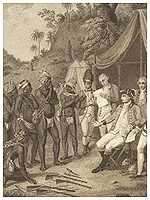
Peace was thus restored; but on the plea that the Maroons had failed to comply with the last-named condition, the Legislature, instead of assigning them lands for a new settlement in some other part of Jamaica, adopted a resolution to transport the late belligerents in a body from the colony. Accordingly in June, 1796, six hundred of them were shipped off to Nova Scotia, where they settled; but after a few years, on the ground that they were found intractable and troublesome, they were deported to the black settlement of Sierra Leone.

The conduct of the Assembly in causing these people to be transported was considered by many at the time a gross breach of faith, and Gen. WALPOLE, who commanded the forces that had been employed in their subjugation, and concluded the treaty of peace with them, declined to receive a sword, for which the Assembly had voted the sum of five hundred guineas, as an acknowledgment of his valuable services. There were three other settlements of the Maroons in Jamaica, but these not having been drawn into hostilities, were allowed to remain; and it is to their descendants, who still live very much as their fathers lived in the last century, that Gov. EYRE issued his proclamation during the late troubles in that island. The services to which the Governor refers, as rendered by the Maroons to the Crown in times past are, we suppose, the share of military duty they bore during a rebellion of the slaves in the parish of St. Mary, Jamaica, in the year 1760, and the assistance they gave to the militia toward the suppression of the negro revolt of 1831-32, when the slaves in the western part of the island rose in insurrection.