Showing posts with label voter registration. Show all posts

Tuesday, September 20, 2011

Judge Albion Tourgee on the KKK

Ku Klux Klan costumes in North Carolina, 1870. (Engraving made from an 1870 photograph by U.S. Marshal J. G. Hester

The following letter was published in the New York Tribune in 1870. In it Judge Albion Tourgee of North Carolina, a carpetbagger, describes the outrages of the Ku Klux Klan to an acquaintance in the U.S. Senate.


Greensboro, May 24,1870.

My Dear General,

It is my mournful duty to inform you that our friend John W. Stephens, State Senator from Caswell, is dead. He was foully murdered by the Ku-Klux in the Grand Jury room of the Court House on Saturday or Saturday night last. The circumstances attending his murder have not yet fully come to light there. So far as I can learn, I judge these to have been the circumstances: He was one of the Justices of the Peace in that township, and was accustomed to hold court in that room on Saturdays. It is evident that he was set upon by some one while holding this court, or immediately after its close, and disabled by a sudden attack, otherwise there would have been a very sharp resistance, as he was a man, and always went armed to the teeth. He was stabbed five or six times, and then hanged on a hook in the Grand Jury room, where he was found on Sunday morning. Another brave, honest Republican citizen has met his fate at the hands of these fiends. Warned of his danger, and fully cognizant of the terrible risk which surrounded him, he still manfully refused to quit the field. Against the advice of his friends, against the entreaties of his family, he constantly refused to leave those who had stood by him in the day of his disgrace and peril. He was accustomed to say that 3,000 poor, ignorant, colored Republican voters in that county had stood by him and elected him, at the risk of persecution and starvation, and that he had no idea of abandoning them to the Ku-Klux. He was determined to stay with them, and either put an end to these outrages, or die with the other victims of Rebel hate and national apathy: Nearly six months ago I declared my belief that before the election in August next the Ku-Klux would have killed more men in the State than there would be members to be elected to the Legislature. A good beginning has been made toward the fulfillment of this prophecy.
Judge Albion Tourgee on the KKK

The following counties have already filled, or nearly so, their respective "quotas:" Jones County, quota full, excess 1; Orange County quota full; excess, 1. Caswell County quota full; excess, 2; Alamance County quota full; excess, 1. Chatham County quota nearly full. Or, to state the matter differently, there have been twelve murders in five counties of the district during the past eighteen months, by bands of disguised villains. In addition to this, from the best information I can derive, I am of the opinion that in this district alone there have been 1,000 outrages of a less serious nature perpetrated by the same masked fiends. Of course this estimate is not made from any absolute record, nor is it possible to ascertain with accuracy the entire number of beatings and other outrages which have been perpetrated. The uselessness, the utter futility of complaint from the lack of ability in the laws to punish is fully known to all. The danger of making such complaint is also well understood. It is therefore not unfrequently by accident that the outrage is found out, and unquestionably it is frequently absolutely concealed. Thus, a respectable, hard working white carpenter was working for a neighbor, when accidentally his shirt was torn, and disclosed his back scarred and beaten. The poor fellow begged for the sake of his wife and children that nothing might be said about it, as the Ku-Klux had threatened to kill him if he disclosed how he had been outraged. Hundreds of cases have come to my notice and that of my solicitor....
Ku Klux Klan Mode of Torture, circa 1870

Men and women come scarred, mangled, and bruised, and say: "The Ku-Klux came to my house last night and beat me almost to death, and my old woman right smart, and shot into the house, 'bust' the door down, and told me they would kill me if I made complaint;" and the bloody mangled forms attest the truth of their declarations. On being asked if any one knew any of the party it will be ascertained that there was no recognition, or only the most uncertain and doubtful one. In such cases as these nothing can be done by the court. We have not been accustomed to enter them on record. A man of the best standing in Chatham told me that he could count up 200 and upward in that county. In Alamance County, a citizen in conversation one evening enumerated upward of 50 cases which had occurred within his own knowledge, and in one section of the county. He gave it as his opinion that there had been 200 cases in that county. I have no idea that he exceeded the proper estimate. That was six months ago, and I am satisfied that another hundred would not cover the work done in that time.


These crimes have been of every character imaginable. Perhaps the most usual has been the dragging of men and women from their beds, and beating their naked bodies with hickory switches, or as witnesses in an examination the other day said, sticks" between a "switch" and a "club." From 50 to 100 blows is the usual allowance, sometimes 200 and 300 blows are administered. Occasionally an instrument of torture is owned. Thus in one case two women, one 74 years old, were taken out, stripped naked, and beaten with a paddle, with several holes bored through it. The paddle was about 30 inches long, 3 or 4 inches wide, and 1/4 of an inch thick, of Oak. Their bodies were so bruised and beaten that they were sickening to behold. They were white women and of good character until the younger was seduced, and swore her child to its father. Previous to that and so far as others were concerned her character was good.

Again, there is sometimes a fiendish malignity and cunning displayed in the form and character of the outrages. For instance, a colored man was placed astride of a log, and an iron staple driven through his person into the log. In another case, after a band of them had in turn violated a young negro girl, she was forced into bed with a colored man, their bodies were bound together face to face, and the fire from the hearth piled upon them. The K.K.K. rode off and left them, with shouts of laughter. Of course the bed was soon in flames, and somehow they managed to crawl out, though terribly burned and scarred. The house was burned.


I could give other incidents of cruelty, such as hanging up a boy of nine years old until he was nearly dead, to make him tell where his father was hidden, and beating an old negress of 103 years old with garden partings because she would not own that she was afraid of the Ku-Klux. But it is unnecessary to go into further detail. In this district I estimate their offenses as follows, in the past ten months: Twelve murders, 9 rapes, 11 arsons, 7 mutilations, ascertained and most of them on record. In some no identification could be made.


Four thousand or 5,000 houses have been broken open, and property or persons taken out. In all cases all arms are taken and destroyed. Seven hundred or 800 persons have been beaten or otherwise maltreated. These of course are partly persons living in the houses which were broken into.

And yet the Government sleeps. The poor disarmed nurses of the Republican party-those men by whose ballots the Republican party holds power-who took their lives in their hands when they cast their ballots for U.S. Grant and other officials-all of us who happen to be beyond the pale of the Governmental regard-must be sacrificed, murdered, scourged, mangled, because some contemptible party scheme might be foiled by doing us justice. I could stand it very well to fight for Uncle Sam, and was never known to refuse an invitation on such an occasion; but this lying down, tied hand and foot with the shackles of the law, to be killed by the very dregs of the rebellion, the scum of the earth, and not allowed either the consolation of fighting or the satisfaction that our "fall" will be noted by the Government, and protection given to others thereby, is somewhat too hard. I am ashamed of the nation that will let its citizens be slain by scores, and scourged by thousands, and offer no remedy or protection. I am ashamed of a State which has not sufficient strength to protect its own officers in the discharge of their duties, nor guarantee the safety of any man's domicile throughout its length and breadth. I am ashamed of a party which, with the reins of power in its hands, has not nerve or decision enough to arm its own adherents, or to protect them from assassinations at the hands of their opponents. A General who in time of war would permit 2,000 or 3,000 of his men to be bushwhacked and destroyed by private treachery even in an enemy's country without any one being punished for it would be worthy of universal execration, and would get it, too. How much more worthy of detestation is a Government which in time of peace will permit such wholesale slaughter of its citizens? It is simple cowardice, inertness, and wholesale demoralization. The wholesale slaughter of the war has dulled our Nation's sense of horror at the shedding of blood, and the habit of regarding the South as simply a laboratory, where every demagogue may carry on his reconstructionary experiments at will, and not as an integral party of the Nation itself, has led our our Government to shut its eyes to the atrocities of these times. Unless these evils are speedily remedied, I tell you, General, the Republican party has signed its death warrant. It is a party of cowards or idiots-I don't care which alternative is chosen. The remedy is in our hands, and we are afraid or too dull to bestir ourselves and use it.

But you will tell me that Congress is ready and wilting to act if it only knew what to do. Like the old Irish woman it wrings its hands and cries, "O Lawk, 0 Lawk; if I only knew which way." And yet this same Congress has the control of the militia and can organize its own force in every county in the United States, and arm more or less of it. This same Congress has the undoubted right to guarantee and provide a republican government, and protect every citizen in "life, liberty, and the pursuit of happiness," as well as the power conferred by the XVth Amendment. And yet we suffer and die in peace and murderers walk abroad with the blood yet fresh upon their garments, unharmed, unquestioned and unchecked. Fifty thousand dollars given to good detectives would secure, if well used, a complete knowledge of all this gigantic organization of murderers. In connection with an organized and armed militia, it would result in the apprehension of any number of these Thugs en masque and with blood on their hands. What then is the remedy?

First: Let Congress give to the U. S. Courts, or to Courts of the States under its own laws, cognizance of this class of crimes, as crimes against the nation, and let it provide that this legislation be enforced. Why not, for instance, make going armed and masked or disguised, or masked or disguised in the night time, an act of insurrection or sedition?

Second: Organize militia, National-State militia is a nuisance-and arm as many as may be necessary in each county to enforce its laws.

Third: Put detectives at work to get hold of this whole organization. Its ultimate aim is unquestionably to revolutionize the Government. If we have not pluck enough for this, why then let us just offer our throats to the knife, emasculate ourselves, and be a nation of self-subjugated slaves at once.
The press photo was taken in Durham, North Carolina. It was dated April 24, 1965. The caption read, "A young negro boy smiles tolerantly at hooded ku klux klansmen as they staged a "mrch" in downtown Durham Saturday afternoon, preliminary to a mass rally tonight.
And now, Abbott, I have but one thing to say to you. I have very little doubt that I shall be one of the next victims. My steps have been dogged for months, and only a good opportunity has been wanting to secure to me the fate which Stephens has just met, and I speak earnestly upon this matter. I feel that I have a right to do so, and a right to be heard as well, and with this conviction I say to you plainly that any member of Congress who, especially if from the South, does not support, advocate, and urge immediate, active, and thorough measures to put an end to these outrages, and make citizenship a privilege, is a coward, a traitor, or a fool. The time for action has come, and the man who has now only speeches to make over some Constitutional scarecrow, deserves to be damned.
(http://www.academicamerican.com/recongildedage/documents/KKK.htm)

Tuesday, August 16, 2011

Mississippi Circumvents the US Constitution

From the University of Richmond's History Engine, "Jim Crows to the Senate-a White Mississippians' Defense of Supremacy": On December 31, 1890, Senator James Z. George (D. Miss), a man Dunbar Rowland calls a life-long resident of Carroll County, began his overwhelmingly convincing speech on the Senate Floor defending the newly written Mississippi Constitution. The new constitution, according to Rowland's 1902 reflections, was drafted in order to eliminate ignorance at the ballot box, and Senator George's defense was apparently very insightful; he displayed a more intimate knowledge of the constitutions of Massachusetts, Vermont and Connecticut than did the Senators who represented those states, and the speech itself has been called one of the great constitutional law speeches of the Senate. Indeed, the principles that the man from Carroll laid out in his speech were subsequently validated by the United States Supreme Court in Williams v. Mississippi, 1898.
Two of the 1890 Mississippi Constitution's 285 main sections which George defended, however, have now earned historical renown: Sec. 243 establishing a uniform poll tax of two dollars, to be used in aid of the common schools, and for no other purpose, and Sec. 244 establishing a literacy test consisting of being able to read, understand, and interpret any section of the new Constitution. Although these two sections do not explicitly disenfranchise blacks and the provisions of the constitution of the State of Mississippi and the laws enacted to enforce them [were found in Williams v. Mississippi not to be] repugnant to the Fourteenth [and Fifteenth] Amendment of the Constitution of the United States, the result was undoubtedly lopsided. According to William Alexander Mabry, the educational test if administered honestly [disenfranchised] about 123,334 Negroes and only 11,889 whites, leaving a white voting majority of more than 40,000 in the state instead of the existing 70,000 potential Negro majority, not to mention the fact that the Negro majority was already being repressed by bloodshed, bribery, [and] ballot stuffing.


Unfortunately, contrary to some of the official defenses of the 1890 constitution, including Senator George's, the result of disenfranchising a great number of blacks was intentional. As Rowland stated, the 1875 White Revolution in Mississippi and the subsequent years of intimidation of blacks leading up to the 1890 convention were carried out under the belief that the negro has proven himself unworthy of suffrage, and it should be taken from him. Even future early twentieth century Mississippi Governor James Kimble Vardaman noted, according to an online PBS history of Jim Crow, that there is no use to equivocate or lie about the matter.


Mississippi's constitutional convention was held for no other purpose than to eliminate the nigger from politics; not the ignorant -- but the nigger. James George had fought since 1875 for this very purpose, and, despite claims of eliminating ignorance, it was in fact racial discrimination he defended before the U.S. Senate.


Although the man from Carroll County's humble beginnings had earned him the nickname the Great Commoner, and his work in the United States Senate was valuable in aiding education and civil service reform as well as being instrumental in shaping the Sherman Antitrust Law, his staunch defense of the Mississippi Constitution of 1890 left a darker legacy to the South. While he was very likely only a product of his time and environment, as well as a much larger underlying racial problem in the South and indeed the entire country, Senator James Z. George's rousing speech left what would become a permanent stain not only on the man from Carroll, but also on the entire South and United Sates as a whole, as it justified before Congress the Jim Crow system of de jure racial segregation and subjugation.

Tuesday, July 5, 2011

Political Independence of the Negro by T. Thomas Fortune , 1884

"Political Independence of the Negro," by T. Thomas Fortune, 1884

In addressing myself to a consideration of the subject: "The colored man as an Independent Force in our Politics," I come at once to one of the vital principles underlying American citizenship and the citizenship of the colored man in a peculiar manner. Upon this question hang all the conditions of man as a free moral agent, as an intelligent reasoning being; as a man thoughtful for the best interests of his country, of his individual interests, and of the interests of those who must take up the work of republican government when the present generation has passed away. When I say that this question is of a most complex and perplexing nature, I only assert what is known of all men.
T. Thomas Fortune, born a slave in Florida

I would not for get that the arguments for and against independent action on our part are based upon two parties of sets of principles. Principles are inherent in government by the people, and parties are engines created by the people through which to voice the principles they espouse. Parties have divided on one line in this country from the beginning of our national existence to the present time. All other issues merge into two distinct ones — the question of a strong Federal Government, as enunciated by Alexander Hamilton, and maintained by the present Republican party, and the question of the rights and powers of the States, as enunciated by Thomas Jefferson, and as maintained by the present Democratic party, — call the "party of the people," but in fact the party of oligarchy, bloodshed, violence and oppression. The Republican party won its first great victory on the inherent weakness of the Democratic party on the question of Human Rights and the right of the Federal Government to protect itself from the assumption, the aggression, the attempted usurpation, of the States and it has maintained its supremacy for so long a time as to lead to the supposition that it will rule until such time as it shall fall to pieces of itself because of internal decay and exterior cancers. There does not appear to exist sufficient vitality outside of the Republican party to keep its members loyal to the people or honest to the government. The loyal legislation which would be occasioned by dread of loss of power, and the administration of the government in the most economical form, are wanting, because of the absence of an honest, healthy opposing party.


But it is not my purpose to dwell upon the mechanism of parties but rather to show why colored Americans should be independent voters, independent citizens, independent men. To this end I am led to lay it down: (1.) That an independent voter must be intelligent, must comprehend the science of government, and be versed in the history of governments and of men; (2.) That an independent voter must be not only a citizen versed in government, but on loyal to his country, and generous and forbearing with his fellow-citizens, not looking always to the word and the act, but looking sometimes to the undercurrent which actuates these — to the presence of immediate interest, which is always strong in human nature, to the love of race, and to the love of section, which comes next to the love of country.

First Vote

Our country is great not only in mineral and cereal resources, in numbers, and in accumulated wealth, but great in extent of territory, and in multiplicity of interests, out-growing from peculiarities of locality, race, and education of the people. Thus the people of the North and East and West are given to farming, manufacturing, and speculation, making politics a subordinate, not a leading interest; they are consequently wealthy, thrifty and contented: while the people of the South, still in the shadow of defeat in the bloodiest and most tremendous conflict since the Napoleonic wars, are divided sharply into two classes, and given almost exclusively to the pursuits of agriculture and hatred of one another. The existence of this state of things is most disastrous in its nature, and deplorable in its results. It is a barrier against the progress of that section and alien to the spirit and subversive of the principles of our free institutions.
African Americans voting before their widespread disenfranchisement
It is in the South that the largest number of our people live; it is there that they encounter the greatest hardships; it is there the problem of their future usefulness as American citizens must have full and satisfactory, or disastrous and disheartening demonstration. Consequently, the colored statesman and the colored editor must turn their attention to the South and make that a field the center of speculation, education and practical application. We all understand the conditions of society in the section and the causes which have produced them, and, while not forgetting the causes, it is a common purpose to alter the existing conditions, so that they may conform to the logic of the great Rebellion and the spirit and letter of the Federal Constitution. It is not surprising, therefore, that, as a humble worker in the interest of my race and the common good, I have decided views as to the course best to be pursued by our people in that section, and the fruits likely to spring from a consistent advocacy of such views.

"Is This a Republican form of government?", Harper's Weekly, September 2, 1876
by Thomas Nast
I may stand alone in the opinion that the best interests of the race and the best interests of the country will be conserved by building up a bond of union between the white people and the Negroes of the South — advocating the doctrine that the interests of the white and the interests of the colored people are one and the same; that the legislation which affects the one will affect the other; that the good which comes to the one should come to the other and, and that, as one people, the evils which blight the hopes of the one blight the hopes of the other; I say, I may stand alone among colored men in the belief that harmony of sentiment between the blacks and whites of the country, in so far forth as it tends to honest division and healthy opposition, is natural and necessary, but I speak that which is a conviction as strong as the Stalwart idea of diversity between Black and White, which has so crystallized the opinion of the race.

It is not safe in a republican form of government that clannishness should exist, either by compulsory or voluntary reason; it is not good for the government, it is not good for the individual. A government like ours some and natural, but upon the fundamental idea incorporated in the Declaration of Independence and re-affirmed in the Federal Constitution the utmost unanimity should prevail. That all men are born equal, so far as the benefits of government extend; that each and every man is justly entitled to the enjoyment of life, liberty, and the pursuit of happiness, so long as these benign benefits be not forfeited by infraction upon the rights of others; that freedom of thought and unmolested expression of honest conviction and the right to make these effective through the sacred medium of a fair vote and an honest count, are God-given and not to be curtailed — these are the foundations of republican government; these are the foundations of our institutions; these are the birthright of every American citizen’ these are the guarantees which make men free and independent and great.


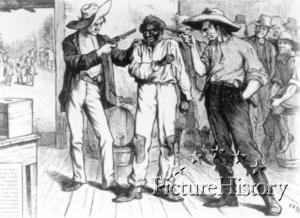
US Voter Intimidation

The colored man must rise to a full conception of his citizenship before he can make his citizenship effective. It is a fatality to create or foster clannishness in a government like ours. Assimilation of sentiment must be the property of the German, the Irish, the English, the Anglo-African, and all other racial elements that contribute to the formation of the American type of citizen. The moment you create a case standard, the moment you recognize the existence of such, that moment republican government stands beneath the sword of Damocles, the vitality of its being becomes vitiated and endangered. If this be true, the American people have grave cause for apprehension.
March 23, 1867: In this commentary on President Andrew Johnson's veto of the military government bill, Nast portrays the scales of justice favoring the South and the Confederate Army
.
The Anglo-African element of our population is classed off by popular sentiment, and kept so. It is for the thoughtful, the honest, the clam but resolute men of the race to mould the sentiment of the masses, lift them up into the broad sunlight of freedom. Ignorance, superstition, prejudice, and intolerance are elements in our nature born of the malign institution of servitude. No fiat of government can eradicate these. As they were the slow growth, the gradual development of long years of inhuman conditions. Let us recognize these facts as facts, and labor honestly to supplant them with more wholesome, more cheering realities. The Independent colored man, like the Independent white man, is an American citizen who does his own thinking. When someone else thinks for him he ceases to be an intelligent citizen and becomes a dangerous dupe — dangerous to himself, dangerous to the State.

"One Less Vote." The Fourteenth Amendment, granting black men the right to vote, was ratified in July 1868. Every black vote became a threat to white Southerners' political power. The stone reads, "Negroe Killed, Seymour Ratification, KKK."
It is not to be expected now that the colored voters will continue to maintain that unanimity of idea and action characteristic of them when the legislative halls of States resounded with the clamor of law-makers of their creation, and when their breath flooded or depleted State treasuries. The conditions are different now. They find themselves citizens without a voice in the shapement of legislation; tax-payers without representation; men without leadership masterful enough to force respect from inferior numbers in some States, or to hold the balance of power in others. They find themselves at the mercy of a relentless public opinion which tolerates but does not respect their existence as a voting force; but which, on the contrary, while recognizing their right to the free exercise of the suffrage, forbids such exercise at the point of the shotgun of the assassin, who it not only nerves but shields in the perpetration of his lawless and infamous crimes.
October 24, 1874: The organized violence of the Ku Klux Klan and the White League made life "worse than slavery" for Southern blacks

And why is this? Why is it that the one hundred and twenty thousand black voters of South Carolina allow the eight thousand white voters of that State to grind the life out of them by laws more odious, more infamous, more tyrannical and subversive of manhood than any which depopulate the governments of the old world? Is it because the white man is the created viceregent of government? The Scriptures affirm that all are sprung affirm that all are sprung from on parental stem. It is because he is the constitutionally invested oligarch of government? The Magna Chart of our liberties affirms that "all men are created equal." Is it because the law of the land reserves unto him the dominance of power? The preamble of the Federal Constitution declares that "We" and not "I," constituted "the people of the United States."

If the law of God and the law of man agree in the equality of right of man, explain to me the cause which keeps a superior force in subjection to a minority. Look to the misgovernment of the Reconstruction period for the answer — misgovernment by white men and black men who were lifted into a "little brief authority" by a might but unwieldy voting force. That black man who connived at and share in the corruption in the South which resulted in the subversion of the majority rule, is a traitor to his race and his country, wherever he may now be eking out a precarious and inglorious existence, and I have nothing to heap upon Arnold he should seek a garret in the desert of population, living unnoticed, and without respect, where he might die without arousing the contempt of his people.

Negrophobic (anti-black) Propaganda
The love of Liberty carries with it the courage to preserve it from encroachments from without and from contempt from within. A people in whom the love of Liberty is in-born cannot be enslaved, though they may be exterminated by superior force and intelligence, as in the case of the poor Indian of our own land — a people who, two hundred years ago, spread their untamed hordes from the icebergs of Main to the balmy sunland of Florida. But today where are they? Their love of freedom and valorous defense of priority of ownership of our domain have caused them to be swept from the face of the earth. Had they possessed intelligence with their more than Spartan courage, the wave of extermination could never have rolled over them forever. As a man I admire the unconquerable heroism and fortitude of the Indian. So brave a race of people were worthy a nobler and a happier destiny. As an American citizen, I feel it born in my nature to share the fullest measure all that is American. I sympathize in all the hopes, aspirations and fruitations of my country.
August 5, 1865: Columbia's sympathetic gesture towards a wounded black soldier is a reply to a previous panel in which Southern landowners ask her forgiveness. Columbia asks, "Shall I Trust These Men, and Not This Man?"

There is no pulsation in the animated frame of my native land which does not thrill my nature. There is no height of glory we may reach as a government in which I should not feel my self individually lifted; and there is no depth of degradation to which we may fall to which I should not fell myself individually dragged. In a word, I am an American citizen. I have a heritage in each and every provision incorporated in the Constitution of my country, and should this heritage be attempted to be filched from me by any man or body of men, I should deem the provocation sufficiently grievous to stake even life in defense of it. I would plant every colored man in this country on a platform of this nature — to think for himself, to speak for himself, to act for himself. This is the ideal citizen of an ideal government such as ours is modeled to become. This is my conception of the colored man as an independent force in our politics. To aid in lifting our people to this standard, is one of the missions which I have mapped out for my life-work. I may be sowing the see that will ripen into disastrous results, but I don’t think so. My conception of republican government does not lead me to a conclusion so inconsistent with my hopes, my love of my country and of my race.


I look upon my race in the South and I see that they are helplessly at the mercy of a popular prejudice outgrowing from a previous condition of servitude; I find them clothed in the garments of citizenship by the Federal Government and opposed in the enjoyment of it by their equals, not their superiors, in the benefits of government; I find that the government which conferred the right of citizenship is powerless, or indisposed, to force respect for its own enactments; I find that these people, left to the mercy of their enemies, alone and defenseless, and without judicious leadership, are urged to preserve themselves loyal to the men and to the party which have shown themselves unable to extend to them substantial protection; I find that these people, alone in their struggles of doubt and of prejudice, are surrounded by a public opinion powerful to create and powerful to destroy; I find them poor in culture and poor in worldly substance, and dependent for the bread they eat upon those they antagonize politically.

1880 Election Map

As a consequence, though having magnificent majorities, they have no voice in shaping the legislation which is too often made an engine to oppress them; though performing the greatest amount of labor, they suffer from overwork and insufficient remuneration; though having the greater number of children, the facilities of education are not as ample or as good as those provide for the whites out of the common fund, no have they means to supply from private avenues the benefits of education denied them by the State. Now, what is the solution of this manifold and grievous state of things? Will it come by standing solidly opposed to the sentiment, the culture, the statesmanship, and the possession of the soil and wealth of the South> Let the history of the past be spread before the eyes of a candid and thoughtful people; let the bulky roll of misgovernment, incompetence, and blind folly be enrolled on the one hand, and then turn to the terrors of the midnight assassin and the lawless deeds which desecrate the sunlight of noontide, walking abroad as a phantom armed with the desperation of the damned!

I maintain the idea that the preservation of our liberties, the consummation of our citizenship, must be conserved and matured, not by standing alone and apart, sullen as the melancholy Dane, but by imbibing all that is American, entering into the life and spirit of our institutions, spreading abroad in sentiment, feeling the full force of the fact that while we are classed as Africans, just as the Germans are classes as Germans, we are in all things American citizens, American freemen. Since we have tried the idea of political unanimity let us now try other ideas, ideas more in consonance with the spirit of our institution. There is no strength in a union that enfeebles. Assimilation, a melting into the corporate body, having no distinction from others, equally the recipients of government— this it is to be the independent man, be his skin tanned by the torrid heat of Africa, or bleached by the eternal snows of the Caucasus. To preach the independence of the colored man is to preach his Americanization. The shackles of slavery have been torn from his limbs by the stern arbitrament of arms; the shackles of political enslavement, of ignorance, and of popular prejudice must be broken on the wheels of ceaseless study and the facility with which he becomes absorbed into the body of the people. To aid himself is his first duty if he believes that he is here to stay, and not a probationer for the land of his forefathers — a land upon which he has no other claim than one of sentiment.

Uncle Sam with a snake in the ballot box

What vital principle affecting our citizenship is championed by the National Republican party of today? Is it fair vote and an honest count? Measure our strength in the South and gaze upon the solitary expression of our citizenship in the alls of the National Legislature. The fair vote which we cast for Rutherford B. Hayes seemed to have incurred the enmity of that chief Executive, and he and his advisers turned the colored voters of the South over to the bloodthirsty minority of that section.
Rutherford B. Hayes

The Republican party has degenerated into an ignoble scramble for place and power. It has forgotten the principles for which Summer contended, and for which Lincoln died. It betrayed the cause for which Douglass, Garrison and others labored, in the blind policy it pursued in the blind policy it pursued in reconstructing the rebellious States. It made slaves freemen and freemen slaves in the same breath by conferring the franchise and withholding the guarantees to insure its exercise; it betrayed its trust in permitting thousands of innocent men to be slaughtered without declaring the South in rebellion, and in pardoning murderers, whom tardy justice had consigned to a felon’s dungeon. It is even now powerless to insure an honest expression of the vote of the colored citizen. For these things, I do not deem it binding upon colored men further to support the Republican party when other more advantageous affiliations can be formed. And what of the Bourbon Democratic party? There has not been, there is not now, nor will there ever be, any good thing in it for the colored man. Bourbon Democracy is a curse to our land. Any party is a curse which arrays itself in opposition to human freedom, to the universal brotherhood of man. No colored man can ever claim truthfully to be a Bourbon Democrat. It is a fundamental impossibility. But he can be an independent, a progressive Democrat.
The hour has arrived when thoughtful colored men should cease to put their faith upon broken straws; when they should cease to be the willing tools of a treacherous and corrupt party; when they should cease to support men and measures which do not benefit them or the race; when they should cease to be duped by one faction and shot by the other. The time has fully arrived when they should have their position in parties more fully defined, and when, by the ballot which they hold, they should force more respect for the rights of life and property.

To do this, they must adjust themselves to the altered condition which surrounds them. They must make for themselves a place to stand. In the politics of the country the colored vote must be made as uncertain a quantity as the German and Irish vote. The color of their skin must cease to be an index to their political creed. They must think less of "the party" and more of themselves; give less heed to a name and more heed to principles.


The black men and white men of the South have a common destiny. Circumstances have brought them together and so interwoven their interests that nothing but a miracle can dissolve the link that binds them. It is, therefore, to their mutual disadvantage that anything but sympathy and good will should prevail. A reign of terror means a stagnation of all the energies of the people and a corruption of the fountains of law and justice.


The colored men of the South must cultivate more cordial relations with the white men of the South. They must, by a wise policy, hasten the day when politics shall cease to be the shibboleth that creates perpetual warfare. The citizen of a State is far more sovereign than the citizen of the United States. The State is real, tangible reality; a think of life and power; while the United States is, purely, an abstraction — a thing that no man has successfully defined, although many, wise in their way and in their own conceit, have philosophized upon it to their own satisfaction. The metaphysical polemics of men learned in the science of republican government, covering volume upon volume of "debates," the legislation of ignoramuses, styled statesmen and the "strict" and "liberal" construction placed upon their work by the judicial magi, together with a long and disastrous rebellion, to the cruel arbitrament of which the question had been, as finally hoped, in the last resort, submitted, have failed, all and each, to define that visionary thing that so-called Federal government, and its just rights and powers. As Alexander Hamilton and Thomas Jefferson left it, so it is today, a bone of contention, a red flag in the hands of the political matadors of one party to infuriate those of the other parties.

T. Thomas Fortune

No: it is time that the colored voter learned to leave his powerless "protectors" and take care of himself. Let every one read, listen, think, reform his own ideas of affairs in his own locality; let him be less interested in the continual wars of national politics than in the interests of his own town and county and state; let him make friends of the mammon of unrighteousness of his own neighborhood, so far as to take an intelligent part among his neighbors, white and black, and vote for the men and for the party that will do the best fro him and his race, and best conserve the interest of his vicinity. Let there be no aim of "solidifying" the colored vote; the missing of black means the massing of white by contrast. Individual colored men — and many of them — have done wonders in self-evaluation; but there can be no general elevation of the colored men of the South until they use their voting power in independent local affairs with some discrimination more reasonable that an obstinate clinging to a party name. When the colored voters differ among themselves and are to be found on both sides of local political contests, they will begin to find themselves of some political importance; their votes will be sought, cast, and counted.

And this is the key to the whole situation; let them make themselves a part of the people. It will take time, patience, intelligence, courage; but it can be done: and until it is done their path will lie in darkness and perhaps in blood.


URL: http://www.TeachingAmericanHistory.org/library/index.asp?documentprint=1166

Monday, May 16, 2011

African Americans Fired and Evicted for trying to Vote in 1960


Camelot was coming. Voters would see to that on Nov. 8, 1960.

Fayette County, Tennessee Tent City in 1960 after Black tenant farmers were forced off their land in retaliation for a voter registration campaign in that then majority African county. (Photo: Ernest C. Withers)

Tent City residents who were ousted from white-owned plantations in Fayette County, Tennessee during 1960

In September 1960, after the crops were gathered, white landowners in Fayette and Haywood counties forced black sharecroppers off their land because they were trying to vote. Here a family prepares to move from their sharecropper home to the Tent City erected for displaced farmers.

But many blacks in Fayette and Haywood counties would not be able to make a choice between eventual President John F. Kennedy or Richard Nixon.

Black sharecroppers in the two counties were being threatened, kicked out of their homes and blacklisted by merchants because they had registered or tried to register to vote.

Presidential Candidates John F. Kennedy and Richard M. Nixon, 1960

They were forced to gather on donated land in Fayette County and live on dirt floors.

"Tent City," as the encampment was called, would become a home to poor black folks who had no homes, no money, no food.

Fayette County 's Tent City was built on land owned by Shephard Towles. A white merchant, whose name is kept secret to this day, donated the tents. Another camp was set up off Tenn. 57 near Moscow on land owned by Gertrude Beasley.

By the time it was over, Tent City would attract the attention of the Kennedy administration, draw national media coverage and result in the first federal lawsuit brought under the 1957 Civil Rights Act.
The end result of Tent City appears in many accounts of the civil rights movement in America. What has not been written is the effect racism in rural West Tennessee had on the black students working for civil rights a few miles away in Jackson.

"We felt the injustice," recalled Ernest Brooks, a stalwart of the Jackson movement. "An injustice there was an injustice here. And we intended to do something about it."

Taking up the cause

In Jackson, sit-ins and picketing occurred downtown every day in the week leading up to the presidential election.

After successfully desegregating buses operated by Jackson City Lines Inc., Lane College students were pressing forward to desegregate lunch counters at Woolworth's and McLellan's.

Blacks in Madison County had little trouble registering to vote. So on election day, their thoughts turned to their neighbors to the west, where some white people were preventing black people from voting by harassing them and forcing them to leave their homes.

Word of the harassment had floated eastward to the Lane campus and to the black community in East Jackson. By Nov. 8, more than 100 people agreed to take a stand for the voting rights of their brethren. Their destination was Madison County's court square. They started marching.

Some carried signs with messages such as "Madison County, Let's Help Fayette County Fight for Free Rights" and "Is the 15th Amendment a Reality in Haywood County?," referring to the portion of the Constitution that prohibits voting restrictions based upon race.

John and Viola McFerren lead protesters to Fayette County Courthouse in 1965. (Photo by Art Shay, Life Magazine)
The students added ranks from nearby Merry High School on their way to Main Street.

Jackson Police Lt. Carl Johnsey spotted the group marching down Royal Street and warned the demonstrators they would be arrested if they continued parading without a permit.

But this wasn't a parade, the students thought. They ignored Johnsey's warning.

Marchers at the front of procession were arrested at the intersection of Cumberland and Main streets, a few blocks from the courthouse. A second group made it to Liberty and Main. A third group reached the courthouse.

Police arrested 144 marchers, all black, including 66 women and several teen-agers. Police charged the marchers with misdemeanors: disorderly conduct, threatened breach of peace and parading without a permit.

"This is in the interest of public safety," Police Chief Raymond Gaba told The Jackson Sun.

The marchers crowded the city jail, forcing police to move some people to the county jail. The result was bureaucratic gridlock inside the police stations, a common tactic used by civil rights demonstrators to frustrate police.

Local black businessmen such as Joe Merry, and Lane administrators such as President C.A. Kirkendoll, would come to the rescue, paying $75 bonds to release each marcher by about midnight.

In the weeks that followed, groups of students - 20, 30, 40 at a time - would be shepherded into city court to face judge Robert Holt and hear their attorney, Emmett Ballard, ask for dismissals and postponements.

Jackson's black community knew their neighbors to the west faced much more grave circumstances. In the 1960 election, several hundred of the thousands of black people in Haywood County were able to cast ballots. It was the first time ever that black people had voted in Haywood, and the white community had not finished its efforts to stop them.

1940 becomes catalyst

Memories are as long-lasting in the South as hot weather on an August afternoon.

Black people in Fayette County had passed down the stories of what happened the night of May 23, 1940. But they never acted on the memory until John McFerren and Harpman Jameson tried to get blacks registered to vote in 1959.

They paid dearly for that attempt: White landowners threw 257 black people off their land - after the cotton had been picked, just as winter was coming on.

What had happened to Burton Dodson more than 19 years ago? How had it galvanized a poverty-stricken black community to revolt? John McFerren and Harpman Jameson, who still live in Fayette County, can tell the story.

Judicial railroading

Burton Dodson and a white man were interested in the same black woman. They had words and came to blows. In the early morning hours of May 23, Sheriff W.H. Cocke and his deputies, plus white men who had been deputized, came to Dodson's home to tell him to surrender. He refused. The officers and their comrades told the children to fall to the ground. Then they shot into his house from the woods, from the corn crib, from all directions.

Dodson's youngest boy was grazed by a bullet and bears the scar on his forehead to this day.

Dodson ran and returned fire. Deputy Olin Burow died. He was behind a tree, down a hill, on the east side of the house.

"I'm still waiting for someone to explain to me how that bullet went over the house, down a hill and came up behind the deputy and got him in the back," Harpman Jameson said. "There was no testing of the gun or the bullets."

Dodson escaped, but in 1958 he was found in St. Louis and brought back to Fayette County to stand trial for murder before an all-white jury. One black juror was called, but he said he was sick.

Although a deputy testified that Dodson's escape path was far from where the deputy was struck, Dodson was convicted of murder and sentenced to 20 years, later reduced to 10.

Still, the judicial railroading of a black man was nothing unusual in that day. In fact, West Tennessee blacks had been lynched without trials in West Tennessee. Why the connection 19 years later to voting rights?

During the trial, J.F. Estes, Dodson's black attorney from Memphis, tied a fair trial for Dodson to voting rights. Estes asked every juror: "Do you believe Negroes should have the right to register and vote?" If they said, "no," he got them dismissed as potential jurors.

When McFerren and Jameson were ready to challenge authority in 1959, they remembered Estes and called him for help.

Wanted something better

McFerren, a black man with sky blue eyes that disconcerted many white people, had come back from World War II wanting something better for black people in Fayette County.

Jameson, McFerren's best friend and a fellow WWII veteran, saw white and black men become friends fighting the war, and then become strangers when they returned.

McFerren had worked in an engineering brigade building bridges during the war. He was near a mine that blew up and nearly lost his legs. Jameson had driven a truck out of a landing barge under fire when the Navy and Marines took Guam and the Philippines, although he was supposed to be a cook. He said the officer in charge wanted country boys who knew how to drive a truck and Jameson was picked for the job.

Both men wanted something better out of life when they returned to Fayette County.

"We had fought for our country," said Jameson, who was 18 when he entered the Navy in 1943.

When Dodson was convicted in 1958, the two decided they would register to vote.

McFerren, then Jameson, went up to the voter registration office. "They said they had no objection to us registering to vote so we could serve on a jury," Jameson said.

Minnie Jameson, Harpman's wife, chuckles as she remembers the moment. "John and Harpman thought they really meant it."

So the two men began trying to get people registered to vote. And Minnie, who wanted more than anything to teach full-time, was never called as a substitute teacher again.

"There are people in this county who still won't speak to us," said Viola McFerren, now divorced from John McFerren, in an interview this year. Viola said she was so scared of what John was doing that she begged him to stop.

The two men wanted to vote for T.L. Redfearn, a liberal white sheriff's candidate. They were allowed to register. But when they went to vote in the August 1960 Democratic primary, "they told us, 'This is an all-white primary and no blacks are permitted to vote,' " Jameson said.

"They didn't let them step in the door," Minnie said. "They were so disappointed."

The white Fayette County Democratic Executive Committee was about to discover that two men who had experienced the horrors of war weren't about to slink back to their small farms and give up.

Time to unite

The men sought Estes for guidance and formed the Fayette County Civic and Welfare League Inc. At the same time, Estes helped people in Haywood County form a league.

The goal was voter registration. One of the first mass meetings was held at Mount Olive Church and the Rev. June Dowdy led off the speaking, followed by McFerren.
Participants in the Fayette County movement were determined to vote.

In January 1960, John had 1,000 black voters lined up to register.

"That's when hell kicked off in Fayette County," Viola McFerren said.

Dowdy asked a white official where he was supposed to register to vote. "He was told Hatchie Bottom. That's where blacks were lynched," McFerren said.

John McFerren, Estes and Jameson drove 22 hours to Washington, D.C., to meet with John Doar, the No. 2 man in the Justice Department's Civil Rights Division. Doar promised a lawsuit.

On Nov. 16, 1959, the federal government filed a lawsuit against the Fayette County Democratic Executive Committee, charging its members with failing to let blacks vote in the Aug. 1 Democratic primary. This was the first lawsuit of its kind to be filed under the Civil Rights Act of 1957.

Members of the Fayette County Election Commission resigned in hopes of shutting down voter registration, but the federal government named new election commissioners in June 1960.

Hundreds of blacks stood in long lines with only one registrar. They were not allowed to sit or stand on the courthouse lawn. Some passed out from the heat.

"People on the roof of the courthouse threw red pepper and spat on them and threw hot coffee on them ... and paint," Jameson said.

In April 1960, the White Citizens' Council drew up a list banning blacks and some whites from shopping in Fayettte County stores. Blacks couldn't get loans at the bank, and their insurance was canceled. Gulf, Esso, Texaco and Amoco oil outlets refused to sell oil and gas.

The oil embargo was broken in August 1960, when the NAACP national office encouraged 350,000 members to boycott the oil companies. But whites tightened the screws in worse ways.

"Black farmers couldn't get crop loans," Jameson said.

In September 1960, eight families were forced off land.

White landowners stepped up their efforts to throw black sharecroppers off the land after blacks voted in November. Fayette County turned Republican for the first time since Reconstruction with 1,200 new black votes. Although Kennedy, a Democrat, was later credited with civil rights advancements, blacks in 1960 were still voting for the party of Abraham Lincoln and against the Southern Democrats who were defending segregation.

Some sharecroppers were told to move immediately, leaving behind all their possessions. Others were given a little time.

"My daddy, Shepard Towles, owned land and he gave them a place to stay on his land," said Levearn Towles, his son. The land, on Tenn. 195, still belongs to the Towles family.

A white merchant gave tents to the displaced blacks. Even today, 40 years after that gesture, the McFerrens and the Jamesons will not name the merchant because of fear that he will be ostracized.

About a dozen tents sheltered families. Wood stoves provided heat, but there were no floors for a long time - not until help came from the American Friends Committee, a national Quaker group. There were 20 adults and 56 children at first.

"Bad as it was, many people said they felt warmer in the tents than they had in the houses they had lived in," Jameson said. None of them had homes with bathrooms.

"We felt responsible for helping these people find some place," Viola McFerren said. "We met several times a week. Most of the members were church leaders. They were strong men. We stood together."

Not long after moving into the tents, Earlie B. Williams was asleep in bed with his wife, Mary, and their baby, Sandra. There was a loud noise.

"I jumped up," Mary Williams said. "Earlie didn't realize he was shot at first. When he moved across the bed, there was a stream of blood on the sheet. He was resting his head on his arm and it went through his arm. Another inch and it could have been his head, or the baby, or me."

"We were there about two years," Earlie Williams said. "It was hard."

Blacks remember law enforcement's response as less than overwhelming, but C.E. Pattat Jr., who was sheriff from 1960-66, said he took some action.

"I talked to them and told them we would have no more of that," Pattat said.

"I talked with both races and told them there would be no violence. There were little things going on all the time. You'd hear about it. Whatever information I had, I gave to the FBI and TBI."

The men in Tent City armed themselves. Not too much later, a group of teen-agers drove by firing in the direction of Tent City. Police did little, so when tents were set up in Moscow on Gertrude Beasley's land, the location was kept a secret.

Reprisals continue

Etta Mason had her baby, Cleo, in February 1961 in a tent when it was about 22 degrees outside and the family's dog froze to death that night.

"There were four tents and about four families when I moved in," said Mason, 67. "We were there over a year on my mother's land. I already had five children and the baby."

Mason said she didn't talk to the children much about the right to vote. "All I was thinking about was getting out of there and doing better."

The reprisals continued. Robert McFerren sold his grocery store to his brother, John, because of the difficulties put on him by the voter registration drive. No food was being sold to him and no fuel.

John rented the store for $50, but to get food, he had to drive in his '55 Ford to Memphis and bring back supplies in the car, outrunning members of the White Citizens Council and the Ku Klux Klan who would lie in wait for him.

Viola was frightened. "White men would drive by so slowly," she said. "The phone rang constantly with the caller using obscene language and threatening to kill us. This happened all the time. One night John came driving into the yard so fast. He was trying to get away from a car that had been chasing him. The car went on by."

"I was threatened every day all day long by people who would drive through and call me names," Levearn Towles said. "We went to the governor (Buford Ellington) several times but they did not respond."

Viola McFerren took it another notch higher.

She met with Robert Kennedy shortly after he became U.S. Attorney General. "He said, 'I've only been here six months. We know what's going on in Fayette County. If you don't believe we're going to do something about it, you come back and see me in six months.' "

Meanwhile, back home, the Williams family received a kind offer of land and a house from white landowner Talmo Johnson of Chester County.

"I saw on TV about these people in Tent City," Johnson said. " All I know is what I understood from TV about them registering to vote. Well, it's a job to get people to pick cotton. I went over and talked to them. They came to work. I built them a house, bought them a refrigerator and cookstove, a washing machine and a deep freezer. I didn't ask no questions. I just wanted somebody to help me work."

Johnson added, "I have no regrets. They are good people."

Mary Williams described the day their benefactor showed up. "We were scared at first when he came to talk with us. He said he was looking for someone to sharecrop. I said we can't just sit here because God didn't intend for us to just sit here. And we've had such a good life. People were so friendly. God opened up a door and we've been here in Chester County ever since."

On June 14, 1961, President Kennedy authorized shipments of surplus food to Fayette and Haywood counties. In March 1961, the National Baptist Convention bought 400 acres in Fayette County and wanted to relocate families there. Leaders of the Fayette Civic and Welfare League squabbled and McFerren's faction formed a group called the "Original Fayette County Civic and Welfare League." The two groups went to court and the money, food, clothing and supplies were divided.

Despite their disagreement over administering aid, blacks in both counties sealed their victories on June 26, 1962, when a consent decree in federal district court in Memphis ended all pending lawsuits against the 74 defendants, landowners and merchants. The agreement permanently enjoined the defendants from engaging in any acts for the purpose of interfering with the right of any person to vote.

Viola McFerren continued her work, receiving accolades from U.S. presidents and appointment to a federal commission. She and others built a community center that is still a vital part of the community and is used by whites and blacks alike.

Like Viola McFerren, several civil rights leaders in Jackson remained in their community and have worked ever since to build it up. One of them - Ernest Brooks - was arrested in the march for Haywood and Fayette voting rights. We tell their story Friday.