Showing posts with label Nova Scotia. Show all posts

Wednesday, June 15, 2011

Slavery in Canada

From Province Quebec, "Slaves in Canada"


In New France many residents kept slaves since the early eighteen century. Reputable people and institutions, such as Governor Vaudreuil, Bishop Saint-Vallier, and General Hospital were slave owners.

When the British took over Canada in 1760 there were 6,604 slaves in New France. Most of them were Panis – representatives of First Nations. The rest were blacks.
British Governor James Murray made it clear that the Canadians would be permitted to retain their slaves. He even hoped to bring more. Thus he asked a friend in New York in 1763 to help him bring to Canada “two Stout Young fellows” and, so that they wouldn’t be lonely, “for each a clean young Wife”.
Governor Vaudreuil

Reading the papers of the late eighteenth century we can see that they contain many advertisements for slaves for sale (for about 50 pounds each). We can find rewards for capturing runaways.
Bishop Saint-Vallier

During the American Revolution, British offered emancipation to the slaves who deserted their rebel masters to serve with British forces. Thus George Washington saw his slaves desert and join the forces against him.

British Governor James Murray

Hundreds of American slaves joined up, and after the United Kingdom had lost the war, many of them settled in Canada, mostly in Nova Scotia, where Guy Carleton arranged for their settlement. But some of theses people fled to Quebec. Many more arrived in the possession of the Loyalists, as slaves belonging to Loyalists were not allowed to leave them.

The majority of slave owners, however, were French Canadians, - more than 85% according to a census of those times. Some notable Anglophones, such as Chief Justice William Smith, Henry Caldwell or George Allsop, owned several slaves.

There was another difference: the French preferred Panis or First Nations slaves, who were cheaper, while the British owned black slaves, who were considered stronger, lived longer and were most skilled.

Prices were dependent as well over slave’s reputation, which was quickly known in a small community like Quebec. A runaway and captured slave was obviously a bad man who didn’t cost much because of his lack of discipline and loyalty. Why does he want to be free if his master feeds him well, anyway? Indeed, something is wrong with this slave.

It wasn’t just notables who bought slaves in Canada. Innkeepers such as Miles Prentice owned slaves who milked his cows, made the butter and waited at tables. Bakers and butchers owned slaves too, including George Hipps, the man who commissioned the statue of General Wolfe in front of the Literary and Historical Society of Quebec. Slaves operated the printing presses of Quebec’s first newspaper Quebec Gazette.

Finally, it was the Loyalists who had fled the United States who ended slavery in Canada. Not because of their moral or Christian convictions, but because they associated it with the new American Republic they hated. Sir James Monk, Chief Justice of Montreal and member of both the Executive and Legislative Councils declared in 1793 that slavery was unsupported by law in the province of Quebec, and warned that his judgements would reflect the fact. The authorities however stopped prosecuting the slaves from deserting.

However, in 1799 Joseph Papineau presented to the Assembly a petition signed by Montreal slave owners for upholding legal recognition of slavery. The bill was defeated, as were several more like it.

Curiously enough, the Quebec Gazette began publishing antislavery poetry and stories in the 1790ies – the same paper which printing presses were operated with the help of the slave labour. But the last time the news-paper advertised a slave for sale was in 1798.

Officially, slavery only ended when Britain abolished it in 1834.

Finally, we must admit than in contrast with their former patriots, Loyalists’ slaves were in somewhat “better situation”. Indeed, they were baptized, given some education, and their families were kept together.

(source: Province Quebec, Outskirt Press)

Thursday, April 14, 2011

Africville, Halifax, Nova Scotia

Africville, Nova Scotia, Canada


Africville was established by Black Refugees of the War of 1812. These veterans had accepted an offer of freedom issued by Vice-Admiral Sir Alexander Cochrane for their support of British interests during this conflict. However, upon arrival in Nova Scotia, little was done to find land for them. Some lived in Preston or Hammonds Plains but found these sites too far removed from potential jobs in Halifax. Just to have shelter in order to survive the weather, they were forced to squat, or take ownership without title, beside the Bedford Basin outside Halifax, over time creating the Africville settlement.
With access to menial work in the Halifax area, some of the homes became much more than the shacks that had been erected hastily in the early days. Eventually, a church was built and people paid taxes. Despite this, a slaughterhouse was built nearby, and a train track and the city dump were located within Africville. The community was cleared in the 1960s, upsetting many residents; the decision to tear it down was made without them and many stood to lose the investment of their home and way of life. Africville was named a national historic site by the Canadian government as part of a process of recognizing its importance to the African-Canadian community and to Black history.

The history of Africville


The town was officially founded in the 1840s, but many of the families who lived there can trace their roots in Africville as far back as the 1700s. Its people were among the first settlers in Nova Scotia, which once was a "slave society." However, the rocky terrain of Nova Scotia limited agricultural potential and prevented slavery from developing on a large scale.

Many American slaves migrated to Nova Scotia after the American Revolution, freed by the British to encourage them to leave their revolutionary masters. They were promised equality, but ended up selling themselves into slavery in order to survive.


In 1792, an agent of the Sierra Leone Company persuaded nearly 2,000 of the Halifax settlers to migrate to Africa. Then, in 1796, more than 550 Maroons, a group of African descent slaves deported from Jamaica, settled on the lands vacated by the black settlers. In 1800, they were shipped off to Sierra Leone where they helped to suppress a rebellion by the former American slaves.
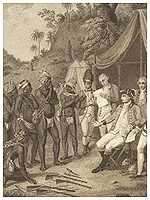
Augustin Brunias (c.1730-1796) 'Pacification with the maroon negroes in the island of Jamaica'

Following the War of 1812, as many as 3,000 blacks streamed into the province and settled within a short distance of Halifax. The British had promised they would be given basic necessities to help them settle into a life of freedom. But the British did not follow through on their promise, and left the refugees to fend for themselves, without food, clothing or shelter.

The original Africville settlers were made up of the many blacks who had come to Nova Scotia over several centuries. These settlers moved to Africville in order to escape the economic hardships encountered on the rocky and barren land of their original settlements.

The first land purchase in Africville is believed to have been in 1848.According to Parks Canada, the population of Africville never exceeded 400 people, who came from up to 80 different families. It was a tight-knit community of law-abiding, tax paying, Baptist citizens who did their best to survive in the conditions they faced. By 1849, the newly formed community had established a Baptist church.

In the 1850s, some Africville residents were relocated due to railway construction. The city began building industrial sites all around and through Africville after Halifax residents rejected the unappealing structures. Africville became the home to Rockhead Prison (1853), the city's night soil disposal pits (1858), an infectious disease hospital (during the 1870s), a trachoma hospital (1905), an open city dump and incinerator (in the early 1950s) and a slaughterhouse.

The Halifax city council, according to its minutes, regarded the "area around Africville as a location for city facilities not tolerated in other neighbourhoods." In addition to the smelly, dirty industries that were relocated to Africville, the city failed to install water service, sewage or lights. Africville also lacked recreational facilities although the Halifax Recreation and Playgrounds Commission did provide facilities to other areas of the city. The residents had no fire or police protection, which led to illegal liquor and entertainment enterprises developing in the small town. By the mid-1940s, Africville was seen as a real problem for the city of Halifax.


Relocation
In 1947, Halifax city council designated Africville as industrial land. However, the residents of Africville expressed a desire to stay and develop the area residentially. City council authorized the borrowing of funds to provide water and sewerage services, but the services were never installed. In the 1950s, discussions in the Halifax city council concerning the industrial potential of the Africville site increased. The city of Halifax owned sizable property to the south, east and west; railway tracks surrounded and intersected the community and the shoreline was valuable for harbour development.


In mid-1954, the city manager submitted to Halifax city council a report that recommended the shifting of Africville residents to city-owned property southwest of the existing community. The report stated: "The area is not suited for residences, but, properly developed, is ideal for industrial purposes. There is water frontage for piers, the railway for sidings, a road to be developed leading directly downtown and in the other direction to the provincial highway."


The city of Halifax claimed that the relocation was for humanitarian reasons as a part of a large urban renewal plan the city had proposed, including the improvement of living conditions, and the racial integration of Africville residents. They proposed welfare planning, co-ordinating employment, educational and rehabilitative programs with the re-housing of residents.

The city council set up an alliance of black and white "caretakers" to be the voice of Africville residents in relocation exchange decisions. The "caretakers" were members of the Halifax Human Rights Advisory, consisting of 10 members, four whites and six blacks. The white caretakers were university graduates or tradesmen with little or no knowledge of Africville's social structure and minimal contact with Africville and its residents. The black caretakers were all middle-class and were concerned about white discrimination against Nova Scotian blacks. Only one of them was from Nova Scotia and all had only little knowledge of Africville's history and social structure.

Africville residents were not consulted in the formation of initial relocation terms, and no attention was given to recommendations from the community. Consequently, the final terms favoured the city.


In the end, many citizens were shipped off to slum housing, their personal belongings transported in city garbage trucks. Bulldozers were sent in during the night to level the community; not only the houses, but the stores, businesses and even the church. One resident recalls,"Those who refused or were slow to leave often found themselves scrambling out of the back door with their belongings as the bulldozers were coming in the front."

Property claims were in chaos: only a handful of families could establish legal title, others claimed squatter rights, and others rented. They were given less than $500 compensation. Most of the residents were relocated to public housing in Mulgrave Park in Halifax. The total cost of the expropriation was $800,000. In 1968, the Africville relocation was proclaimed a success, and the last building was bulldozed in 1970.

The site where Africville was located is now a deserted park. All that remains of the community is a monument in the shape of a sundial inscribed with the names of early black settlers.


Remember Africville


This short film depicts Africville, a small black settlement that lay within the city limits of Halifax, Nova Scotia. In the 1960s, the families there were uprooted and their homes demolished in the name of urban renewal and integration. More than 20 years later, the site of the community of Africville is a stark, under-utilized park. Former residents, their descendants and some of the decision-makers speak out and, with the help of archival photographs and films, tell the story of that painful relocation.

Thursday, March 24, 2011

Report On The Maroons of Jamaica, 1865

A CURIOUS CHAPTER IN NEGRO HISTORY.; The Maroons of Jamaica-- Their Origin and their Present Position.

In the accounts published by the Jamaica newspapers of the late negro insurrection in that island, we find it stated that a people called the Maroons were called upon by the governor of the colony to assist in suppressing the outbreak, and that they rendered prompt and valuable aid to both the civil and military authorities in the disturbed district. The following is the proclamation that was issued to them by His Excellency the Governor at the commencement of the disturbances:

Maroons of Jamaica! We have great trust in you as loyal subjects of the Crown!

In times gone by you did the Crown good service!

Your services are again required! You may earn rewards and honor by your loyalty!

A brutal, murderous, and barbarous insurrection has broken out in St. Thomas in the East! Peaceable, unoffending men (who have ever been your friends) have been killed!

The Governor and the government call upon you to join our forces, and of yourselves separately, to do all that lies in your power to assist to put down this murderous outbreak.

Martial law has been proclaimed!

A reward of $2,000 will be paid to you or to any one, who will take PAUL BOGLE, a principal ringleader, and $500 for any ringleader in these outrages.

Seize and hand over to the nearest military station any of the rebellions people wherever you may find them, and for so doing, and for any information you may give to any of our magistrates, officers, soldiers, or other persons in authority, you will in due time be suitably rewarded.

Issued under the authority of His Excellency the Governor and Executive Committee.

God save the Queen.

It will be seen, from the opening sentences of this address, that the Maroons of Jamaica have a history, and as many people, after reading the recent news from that island, have expressed a curiosity to know who the Maroons are, we propose briefly to relate their history.

As to race, the Maroons are negroes -- pure blacks. As to habitat, several thousands of them are to be found in Jamaica, dwelling in mountain settlements or townships of their own, apart from the other portion of the black population. For a time a number of them found a home in the British Province of Nova Scotia, but were subsequently removed to Sierra Leone, where they have intermingled with the native African population. How these case to be separated from their brethren in Jamaica, first becoming dwellers in the wintry North, and afterward finding their way to "fatherland," will appear in the sequel.

In the year 1655, an English combined naval and military expedition, under the joint command of PENN and VENABLES, was sent out by CROMWELL for the conquest of the Island of St. Domingo; but having failed in that object, those commanders, unwilling to return to England without having something commensurate to the importance of their enterprise, turned their attention to the Island of Jamaica -- at that time belonging to Spain -- and soon made themselves masters of it. The Spanish inhabitants are said to have possessed before the attack of the English about 1,500 enslaved Africans, most of whom, on the surrender of their masters, retreated to the mountain fastnesses of the island, from whence they made frequent excursions to harass the English.

Maj.-Gen. SEDGWICK, one of the British officers, in a letter to Secretary THURLOE, (1656,) predicted that these blacks would prove a thorn in the sides of the English; adding, that they gave no quarter to his men, but destroyed them whenever they found an opportunity, scarcely a week passing without their wounding one or more of them; and as the soldiers became more confident and careless, the negroes grew more enterprising and bloody-minded. The General's prediction was verified by events, and the English soon found it necessary to employ a military force for the subjugation of these dangerous neighbors.
After years of irregular warfare, and of varying successes on both sides, the blacks at length found themselves so hard pressed by the English, that the main body of them, under the command of a negro named JUAN DE BOLAS, whose place of retreat in the Parish of Clarendon (Jamaica) still retains his name, solicited peace, and surrendered to the English on terms of pardon and freedom. A large party, however, remained in their retreats within the mountains, where they not only augmented their numbers by natural increase, but after the island became more thickly sown with plantations, they were frequently reinforced by fugitive slaves. These becoming more confident, made frequent raids on the interior plantations, and intimidated the whites from venturing to any considerable distance from the sea-coast.

This was the origin of the Maroons. According to Mr. LONG, the historian of Jamaica, the word maroon signifies, among the Spanish Americans, hog-hunter, the woods at that time abounding with the wild boar, and the pursuit of them constituting the chief employment of the fugitive negroes. But BRYAN EDWARDS, who wrote a history of the West Indies toward the end of the last century, says that, according to the Encyclopedie -- a French work -- the term is derived from the Spanish word simaram, which signifies a monkey, and was applied to the fugitive negroes because, like that animal, they retreated into the depths of the woods, coming out only to collect the fruits to be found in the immediate neighborhood of their retreats.

The Maroons proved troublesome and indomitrule foes to the English settlers. Forces were repeatedly sent out against them, but every attempt to subjugate them tailed. They continued to distress the island for upwards of forty years, during which time, says LONG, forty-four acts of Assembly were passed, and at least £240,000 expended for their suppression; and in 1730 they were grown so formidable, under a very able General named CUDJOE, that it was found necessary to strengthen the colony against them by two regiments of regular troops, which were afterward formed into independent companies, and employed, with other hired parties, for their reduction. All this failed. Resort was then had to the Mosquito Indians, who, it was thought, would be more than a match for the Maroons in bush-fighting. Two hundred of those people were accordingly imported into Jamaica, and employed against the dreaded enemy. But the Maroons baffled the Indians, and continued to bid defiance to the colonists, who, in their extremity, were compelled to advise Governor TRELAWNEY, in 1738, to propose overtures of peace to the chiefs. These overtures were accepted; articles of pacification were signed; and certain lands in the island, amounting in the whole to several thousand acres, were assigned to the Maroons in perpetuity. The preamble of the articles is curious and is worth transcribing here. It is as follows:
"In the name of God, amen. Whereas Capt. CUDJOE, Capt. ACCOMPONG, Capt. JOHNNY, Capt. CUFFEE, Capt. QUACO, (all African names, except Johnny,) and several other negroes, their dependents and adherents, have been in a state of war and hostility for several years past against our sovereign Lord the King and the inhabitants of this island; and whereas, peace and friendship among mankind, and the preventing the effusion of blood is agreeable to God, consonant to reason and desired by every good man; and whereas, His Majesty King GEORGE H., King of Great Britain, France, and Ireland, of Jamaica Lord, Defender of the Faith, &c., has by his letters patent dated February the 24th, 1738, granted full power and authority to JOHN GUTHRIE and FRANCIS SADLER, Esquires, to negotiate and finally conclude a treaty of peace and friendship with the aforesaid Capt. CUDJOE, and the rest of the captains, adherents, and others his men, they mutually, sincerely, and amicably have agreed to the following articles," &c., &c.

According to this treaty the Maroons were to reside within certain boundaries, apart, from allother negroes.
Jamaican Maroon Map 1794

Peace having been thus established, the Maroons settled upon the lands which had been assigned them, and employed themselves in a sort of rude tillage, which was performed principally by the women, while the young men hunted the wild boar, whose flesh they prepared for market by a peculiar process of their own, in which no salt was used. They were employed also by the plantars in capturing slaves who had run away from the plantations, receiving so much per head for the fugitive negroes they took. For nearly sixty years they gave no further trouble to the colonists; but in 1795 they once more raised the standard of revolt. The cause of this outbreak, known in Jamaica history as the "Maroon war," was a trifling incident; but the conduct of the Maroons on the occasion shows the spirit of that people. It appears that one of their number at Trolawney Town had been convicted before the Magistrate on a charge of having stolen two pigs, and was sentenced to receive thirty-nine lashes. The flogging was given by the black overseer of the prison in which the negro slaves were confined for punishment; and that a Maroon should be treated like a slave -- flogged like a slave by a black overseer -- aroused the indignation of these people, who forthwith flew to arms to avenge their wounded honor.


Negotiation was tried by the whites, and failed. The aged men and the more moderate among the Maroons counseled prudence and forbearance, but the younger and more impetuous spurned this advice, and hostilities were commenced. Troops in considerable numbers were sent against them in their mountain settlements, but for months they succeeded in keeping the military at bay, cutting off several detachments of soldiers, both of the regulars and militia; while they occasionally sallied forth from their fastnesses, burning plantations and killing the white people living on them. At length, as a dernier ressort, the expedient was hit upon of employing Spanish bloodhounds to track them in the woods, and one hundred of these ferocious animals, accompanied by forty chasseurs, or hunters, were imported from the Island of Cuba for that purpose. No sooner did the Maroons hear of the arrival of these dogs than they expressed a willingness to come to terms, and soon after a treaty was concluded, the principal conditions being that the Maroons should ask pardon of the King on their knees -- that the Legislature of the colony should fix their residence in such part of the island as it might think proper -- and that the Maroons should deliver up all the fugitive slaves living among them.
Peace was thus restored; but on the plea that the Maroons had failed to comply with the last-named condition, the Legislature, instead of assigning them lands for a new settlement in some other part of Jamaica, adopted a resolution to transport the late belligerents in a body from the colony. Accordingly in June, 1796, six hundred of them were shipped off to Nova Scotia, where they settled; but after a few years, on the ground that they were found intractable and troublesome, they were deported to the black settlement of Sierra Leone.

The conduct of the Assembly in causing these people to be transported was considered by many at the time a gross breach of faith, and Gen. WALPOLE, who commanded the forces that had been employed in their subjugation, and concluded the treaty of peace with them, declined to receive a sword, for which the Assembly had voted the sum of five hundred guineas, as an acknowledgment of his valuable services. There were three other settlements of the Maroons in Jamaica, but these not having been drawn into hostilities, were allowed to remain; and it is to their descendants, who still live very much as their fathers lived in the last century, that Gov. EYRE issued his proclamation during the late troubles in that island. The services to which the Governor refers, as rendered by the Maroons to the Crown in times past are, we suppose, the share of military duty they bore during a rebellion of the slaves in the parish of St. Mary, Jamaica, in the year 1760, and the assistance they gave to the militia toward the suppression of the negro revolt of 1831-32, when the slaves in the western part of the island rose in insurrection.