Showing posts with label Harish Sharma. Show all posts

Monday, July 25, 2011

BFI to launch second season of the Delhi School League for 10 boys’ & 8 girls’ schools in New Delhi


Delhi’s biggest school basketball competition, the Delhi School Basketball League for Boys & Girls, organised by the Basketball Federation of India (BFI) and IMG-Reliance, will be back in the city for a second season, starting from Wednesday, July 27th, 2011. The league will be held between teams of 10 boys’ and 8 girls’ schools. Each game will be hosted by the home team on a home-and-away basis around the city.

To promote a competitive basketball environment amongst youngsters in the city, the first edition of the Delhi Basketball League was held successfully around the capital last year. The league returns with the same format this season: the boys’ teams have been separated into two groups of five each, while the girls’ teams into two groups of four. Each team will play all of its opponents in the group twice (home and away) before qualifying for the next round, the Super League, the winners of which will then meet in the Final.

The league will tip off at the home of the reigning champions, Montfort School, who will play DPS (RK Puram) in both the boys’ and the girls’ divisions on Wednesday morning. Last year’s runners-up Modern School will host DPS (Mathura Road) in both the boys’ and girls’ divisions on the first day.

League matches will be held from July 27th – August 14th. The Super-League and the Finals will be held between August 16th – August 25th, 2011. The winners of the league will be given cash prizes and bonuses from BFI and IMG-Reliance.

“We will be looking to continue the positive momentum that we build with this league from last season into this year,” said Harish Sharma, the CEO of the BFI, “This is a unique sports league for the school-level, and it will continue to help us identify young talent in the city as well as help promote the exciting game of basketball amongst youngsters here.”

Last season, both the boys’ and the girls’ teams from the Montfort School were crowned as champions, after both of them defeated opponents from Modern School (Barakhamba).

Participating Teams:

Girls

Group A: Montfort School, Delhi Public School (RK Puram), Bal Bharti School (Pitampura), Oxford School.
Group B: Modern School, Delhi Public School (Mathura Road), St. Michael’s School, Carmel Convent School.

Boys

Group A: Montfort School, Delhi Public School (RK Puram), GD Goenka School, Bal Bharti School (Pitampura), Oxford School.
Group B: Modern School, Delhi Public School (Mathura Road), New Green Field School, Air Force Bal Bharti School, St. Michael’s School.

Tuesday, July 12, 2011

Junior Nationals: Tamil Nadu boys beat MP to become Junior Champions; Kerala girls win gold again


In front of Delhi’s large hoop-loving audience that collected together to watch India’s best under-18-year-old basketball players at the Thyagraj Stadium on Tuesday, the eight-day long 62nd Junior National Basketball Championship for Boys & Girls came to an enthralling end as Tamil Nadu boys and Kerala girls clinched the gold medals.

For Kerala, this win stretched their dominance over the younger-level basketball in India: Kerala have now won the last two Junior Championships as well as the last two Youth Championships. For Tamil Nadu, who ended up as runners-up to Punjab in the tournament last year, the gold medal in Delhi on Tuesday was a fitting way to bury the demons of last year’s final loss.

In the boys Final, Tamil Nadu faced another team who matched them in high-flying athleticism – Madhya Pradesh. TN still took the early initiative, starting the game hot and taking a 13-point lead at the end of the first quarter. TN seemed to be on cruise control for most of the game, and before the start of the final quarter, were still leading by 11, 55-44. But it was here that MP put up one last inspired run and chased TN, making it a 4-point game with just seven minutes to go.

But TN regained their composure, made all the clinical plays in the final stretch of the game, and survived to be crowned champions, 77-64. It was TN’s unselfish ball-movement that saw them hoist the winner’s trophy this year. The final belonged to TN’s Sivabalan S, who was able to forget about the disappointment of 2010 to score 34 points and 11 points. Arvind A hadded 18 points for TN. For MP, it was a disappointing finish to a great tournament – their high-scoring dup of Amit Kanarjee and Siddharth Chouhan played well in a losing effort in the final, scoring 21 and 17 points respectively.

In the earlier Final, Kerala continued their dominance over girls’ basketball in the country by rolling to a comfortable victory over Tamil Nadu. Just two months ago, Poojamol KS scored 40 points in the Final of the Youth Championships in Nagpur to help seal the title for her side. On Tuesday, she again started the game with the fire to give her team the win. After a close first quarter, Kerala began to dominate the second period, turning on their defense, and on the other end, scoring at regular intervals, to secure a massive 18-point lead at the end of the first half.

Tamil Nadu could never recover from this second-quarter debacle: the match was an interesting battle between two talented bigs on each side: Rajapriya Darshini for TN and Jeena PS for Kerala. While Darshini more than held her own (19 points, 9 rebounds), Jeena put up a strong performance too, with 17 points and 17 rebounds, continuing to stake her claim as the best rebounder in the Nationals.

TN failed to make up the deficit in the second half, as Kerala’s Surya PR continued her consistent play all championship to put up 28 points. Poojamol ended with a dominant 25 points to go with 15 rebounds. When the final buzzer sounded, Kerala celebrated, having cruised to a 83-67 victory.

Earlier in the day, Punjab Boys beat Chhattisgarh 78-62 to win the third-place playoff, behind Loveneet Singh (23) and Baljeet Singh (16). For Chhattisgarh, B. Dinesh scored 26 points. In the girls’ third-place playoff, Chhattigarh beat Karnataka to claim the bronze medal in a close game, winning by 78-76. Anjana Ekka (24), A. Kavita (17), and Sagarika (16) were the leading scorers for Chhattisgarh. For Karnataka, Navaneetha scored 27 and Simonelle added 20.

RS Gill, the president of the Basketball Federation of India (BFI), Harish Sharma, the CEO of the BFI, Ajay Sud, the BFI’s Secretary General, and Bobby Sharma, the Senior Vice President, Global Business Development, Basketball for IMG Worldwide, were amongst the various dignitaries present at the Finals.

The winning teams in both the boys’ and girls’ divisions were rewarded with a cash prize of Rs. 1,00,000. The runners-up were handed Rs. 50,000, and third-place received Rs. 25,000.

Final Scores

Girls: Kerala (Surya PR 28, Poojamol KS 26, Jeena PS 17, PG Anjana 10) bt. Tamil Nadu (Rajapriya Dharshini 19, Suganya L 11, Ramya R 10) 83-67 (22-20, 27-11, 24-19, 10-17).

Boys: Tamil Nadu (Sivabalan S 34, Arvind A. 18, Kasi Ranjan M. 14) bt. Madhya Pradesh (Amit Kanarjee 21, Siddharth Chouhan 17) 77-64 (24-11, 20-22, 11-11, 22-20).

3rd/4th Place Playoff

Girls: Chhattisgarh (Anjana Ekka 24, A. Kavita 17, Sagarika 16) bt. Karnataka (Navaneetha 27, Simonelle 20, Sagarika 13) 78-76 (20-19, 14-16, 34-19, 10-22).

Boys: Punjab (Loveneet Singh 23, Baljeet Singh 16, Manpreet Singh 12, Gauravdeep Singh 10) bt. Chhattisgarh (B. Dinesh 26, Ajay Pratap Singh 15) 78-62 (20-12, 15-12, 26-16, 17-22).

Tuesday, July 5, 2011

Junior Nationals mark another leap for Basketball in India


Basketball in India made a new type of history when the 62nd Junior National Basketball Championship for Boys & Girls tipped off at the Thyagraj Stadium in New Delhi on July 5th. The Basketball Federation of India (BFI) was already carrying the positive momentum of a successful partnership with IMG-Reliance, the hiring of three world-class coaches for the national teams, and a more organised grassroots development programme: with the inauguration of the Junior Nationals that are taking place in three indoor, air-conditioned, wooden courts at the Thyagraj stadium, the Federation has been able to provide high-quality infrastructure and facilities for the country’s best young players to showcase their talents.

The championship was declared open by Ajay Maken, the Minister for Youth Affairs & Sports (Government of India) who was the Chief Guest of the programme. “Basketball has been close to my heart from the beginning,” Maken said at the opening ceremony, “The Federation has world-class infrastructure to utilise for its National Camps at the Indira Gandhi Stadium and for this championship at Thyagraj – I’m sure that basketball is going to take a giant leap and come up very fast, very soon, on the global level.”

Harish Sharma, the CEO of the BFI, welcomed Maken, and highlighted his support in offering BFI the high-level infrastructure, both at the IG Stadium and the Thyagraj Stadium. “This is the first time in the history of the National Championships in India that we have three indoor, air-conditioned courts for use for the players,” Sharma said, “Basketball is on the rise in India: we want to compete at a high level and show the world that India can be the best!”

The championship certainly started with some high-level hoops action. In a close, back-and-forth afternoon match-up, Karnataka and Rajasthan Boys battled till the end in a thriller, that was finally won by an inspired Karnataka side. Karnataka’s Michael John hit two clutch free-throws at the end of the game to secure a 72-71 win. Karan Joshua led the way with 21 points for Karnataka. For Rajasthan, the duo of Manish Singh (22 points) and Dadhich (17) led a three-point onslaught that almost stole the game from their opponents.

It was a disappointing start for the girls from the hosts Delhi side, who suffered an embarrassing loss at the hands of Tamil Nadu. TN had a blistering start to the game, leading 27-4 at the end of the first quarter, and 41-9 at halftime. A balanced attack from the TN side saw them win by 39 at the end of the game, 74-35.

In another girls’ game, Kerala, the reigning champions of the Junior Championship, began a positive start to their title defense by riding on 40 points by superstar Jeena PS to defeat Punjab, 86-34. Kerala have boasted of great results in the junior levels of basketball in recent years, as they are two-time winners of the Youth title and are hoping to repeat at the U18 level as well. Jeena was assisted by 27 points by Anjana PG. For Punjab, Nagma Mirza scored 26 in a losing effort.

Finally, Chhattisgarh Boys also had a good start to their championship by securing an easier than expected victory against Andhra Pradesh. Chhattisgarh led the whole way, and didn’t take their feet of the accelerator at any point in the game. Sameer Kumar Rai scored 18 points and Bobby Singh added 16 for Chhattisgarh who stood 77-24 winners at the end of the game.

Scores

Boys

  • Chattisgarh (Sameer Kumar Rai 18, Bobby Singh 16) bt. Andhra Pradesh 77-24 (30-8, 14-8, 22-4, 11-4)
  • Karnataka (Karan Joshua 21, Hrishi Keshu .B. Naidu 15, Yashas. R 10) bt. Rajasthan (Manish Singh 22, Sharad Dadhich 17, M.P.Singh 13) 72-71 (23-24, 13-15, 11-11, 25-21)

    Girls

  • Karnataka (S. D'Souza 17, Navaneetha P.U 14, S. Goutham 12, Madhuvri. K 12) bt. Chhattisgarh (A.Kavita 18, S.Mandal 14), 67-54 (12-16, 9-16, 18-15, 15-20)
  • Madhya Pradesh (Deepika David 16, Jhilik Roy 12) bt. Chandigarh 64-17 (12-5, 22-2, 9-8, 21-2)
  • Andhra Pradesh (Shaheen Rebello 11) bt. Goa (P. Yamun 20, F. Jyothi 12) 59-23 (16-4, 20-3, 11-8, 12-8)
  • Kerala (Jeena P.S 40, Anjana P.G 27, Surya P.R 13) bt. Punjab (Nagma Mirza 16) 86-34 (22-5, 11-16, 32-5, 21-8)
  • Uttar Pradesh (Barkha Sonkar 24, Ohriti Aroda 10) bt. Orrisa (Sitamani Tudu 23, Minarshi 15) 56-48 (17-8, 20-16, 12-8, 7-16)
    Tamil Nadu (Kiruthika.V 15, Raja Priya 14, Ramaya. R 12) bt. Delhi 74-35 (27-04, 14-05, 16-07, 17-17)
  • Thursday, June 2, 2011

    Delhi Boys; Kerala Girls become 2011 Youth Champions


    On an evening where India’s best young basketball talent competed against each other to win the top prize, the real winner was the spectacle basketball. The Finals of the 28th Youth National Basketball Championship for Boys & Girls were held at Divisional Sports Complex at Nagpur (Maharashtra) on Thursday – in both the boys’ and girls’ Finals, each team saved its best defense for last. The boys from the capital side Delhi used their length to snuff out a strong Madhya Pradesh side to lift the title. In the girls’ section, last year’s youth winners Kerala continued their hot streak, going undefeated in this year’s edition and beating a strong Chhattisgarh side in the final to become repeat champions.

    The Boys Final was a defensive juggernaut, as both teams played their toughest defense to deny their opponents from getting any shots at the basket. Both teams were quick and athletic, but baskets weren’t coming easy for anyone. Delhi led most of the way though, especially behind the rare combination of skill and size shown by Pradeep Kumar. MP committed too many turnovers as Delhi took a big lead – MP attempted a comeback in the fourth quarter, even making it a three point game with just 5:24 left on the clock, but Delhi regrouped well after a timeout and enjoyed their best offense in the tournament’s last five minutes, cruising to a 58-47 win.

    Neither side was spectacular from the field, as MP shot 26 percent, and the winners, Delhi, just 21 percent. But Delhi’s players, led by Akimjeet Singh, did an incredible job attacking the basket, winning fouls and getting to the free throw line. The 17-5 difference in free throws made was also the difference maker between the two teams.

    “We prepared for this tournament one day at a time,” said jubilant Delhi coach JN Nehra, “We studied the strategy and playing style of each opponent that we faced, and we prepared for each one differently. That helped us get to the top.”

    There was no stopping Kerala as they out-dueled Chhattisgarh in an entertaining Girls’ final. Poojamol KS, who had been Kerala’s best player all tournament, put up her best performance in the Final, putting in 40 points and grabbing 13 rebounds – her opposite number, Anjana Ekka of Chhattisgarh, also gave a tough fight, scoring 37 points to go with 13 rebounds and game-high 6 blocks.

    The Girls’ final started slowly, but Chhattisgarh quickly took control of the game. Kerala boasted of several long and athletic players, but they ran into a big roadblock as Chhattisgarh’s 6 foot 6 inch Centre Poonam Chaturvedi guarded the post. But Poojamal was too swift for even Chhattisgarh’s defense, and she shot a high percentage en-route to her 40 point night. Kerala did a great job in combating Chhattisgarh’s size with speed.

    The game was reminiscent of Chhattisgarh’s semi-final with Maharashtra, where they came back big in the second half for a close win. It was a different story in the Final: Kerala continued to play well in the second, isolating Anjana Ekka who was on a shooting spree for Chhatisgarh. Poojamal and the rest of Kerala went blow for blow with Anjana, and in the end, there would be no comeback as Kerala won 70-61.

    “I was very confident about this game,” Poojamal exclaimed after clinching the title for her side, “Our team had a lot of practice before this tournament to deal with pressure situations such as this final, and I was ready tonight. I am very happy about winning this championship and it is a great achievement for the state of Kerala.”

    Mr. Harish Sharma, CEO of the BFI, congratulated all the players who participated in he championship, and added, "I'm proud of these young stars, they have worked hard for this achievement and I hope that they will have a great future. Basketball in India is at a turning point and it will be these young players who will lead the way in the coming years."

    Earlier in the day, the host Maharashtra side, whose boys’ and girls’ teams had both lost at the Semi-Final stage, played in the third-place playoff matches. Maharashtra Boys faced a motivated Chhattisgarh, who led the game from start to end for a comfortable 73-56 win. Akash Bhasin, one of the tournament’s best scorers, had 32 points for Chhattisgarh, while T. Shantanu paced Maharashtra with 26.

    In the Girls’ playoff, the highly-touted Maharashtra team shrugged off the disappointing semi-final loss to Chhattisgarh from a day earlier and won a highly-competitive game against the speedy girls from Haryana. Haryana Girls, one of the stories of the tournament, stayed neck to neck with Maharashtra throughout the game. In the third, Maharashtra finally opened up a big lead as their stars Shireen Limaye (17 points) and Shruti Menon (16) began to click. Haryana’s fourth quarter comeback wasn’t enough as they lost 70-63. Rimpy Hooda had 21 points for Haryana and Bharti Sihag added 18.

    Final Scores

  • Boys: Delhi (Akimjeet Singh 16, Pradeep Kumar 15, Pankaj Rathi 15) bt. Madhya Pradesh (Shivam Mishra 23) 58-47 (14-9, 13-9, 7-13, 24-16).
  • Girls: Kerala (Poojamol KS 40, Arthy Vimal 12) bt. Chhattisgarh (Anjana Ekka 37) 70-61 (16-21, 9-15, 20-16, 16-18).

    3rd/4th Place Playoffs

  • Boys: Chhattisgarh (Akash Basin 32, Saif Hashmi 10, M. David Boon 10) bt. Maharashtra (T. Shantanu 26, Rohan Ramesh 11) 73-56 (21-16, 19-15, 16-12, 17-13).
  • Girls: Maharashtra (Shireen Limaye 17, Sruthi Menon 16, Ishwari Pingle 11, Kritika Divadkar 11) bt. Haryana (Rimpy Hooda 21, Bharti Sihag 18, Monika Vats 11) 70-63 (23-21, 14-12, 22-12, 11-18).
  • Monday, May 23, 2011

    Nagpur welcomes 24 boys’ and 23 girls’ teams for Basketball’s Youth Nationals


    The future of basketball in India will assemble together to compete for the ultimate prize – the Youth Nationals Championship. The 28th National Basketball Championship for Youth (U16) Boys and Girls will be organised by the Basketball Federation of India (BFI) at Nagpur (Maharashtra) from May 26, 2011 – June 2, 2011. The Indoor Stadium in Mankapur in Nagpur will be hosting this championship.

    Only players born on or after 1st January 1995 are eligible to participate.
    24 boys teams and 23 girls teams from across the country have confirmed their entry into this tournament. The participating squads are:

    Boys: Andhra Pradesh, Bihar, Chandigarh, Chhattisgarh, Delhi, Goa, Gujarat, Haryana, Himachal Pradesh, Jammu & Kashmir, Jharkhand, Karnataka, Kerala, Madhya Pradesh, Maharashtra, Manipur, Orissa, Punjab, Pondicherry, Rajasthan, Tamil Nadu, Uttar Pradesh, Uttarakhand, West Bengal.

    Girls: Andhra Pradesh, Bihar, Chandigarh, Chhattisgarh, Delhi, Goa, Gujarat, Haryana, Himachal Pradesh, Jammu & Kashmir, Jharkhand, Karnataka, Kerala, Madhya Pradesh, Maharashtra, Orissa, Punjab, Pondicherry, Rajasthan, Tamil Nadu, Uttar Pradesh, Uttarakhand, West Bengal.

    “The Youth Nationals will be a great exhibition of the young and upcoming players in the country,” said Mr. Harish Sharma, the CEO of the BFI, said, “These youngsters will become the future superstars of Indian basketball.”

    The 27th Youth Nationals, held in Trichy (Tamil Nadu) from June 1-8, 2010, were won by Punjab (Boys) and Kerala (Girls).

    Tuesday, May 17, 2011

    Basketball Federation of India Signs World-Class Coaches to Lead Indian National Basketball Teams


    BFI Appoints experienced former NBA and elite U.S. college coaches to take training and development efforts to the next level for both players and coaches

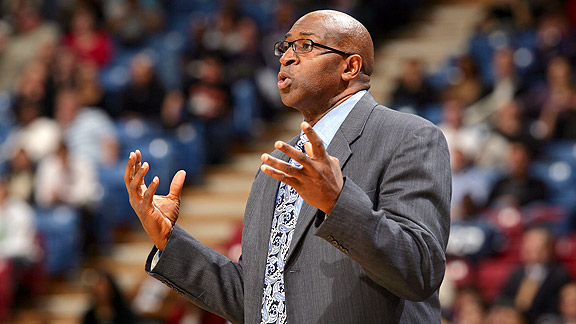
    New Delhi, May 17, 2011: The Basketball Federation of India (BFI) has announced the appointment of three preeminent American coaches to lead India’s men’s and women’s national basketball teams, and further the BFI’s grassroots growth of the game in India. Kenny Natt, with 3 years playing and 13 years coaching experience in the National Basketball Association (NBA), was named as the Head Coach of the Indian Men’s Senior Team, and esteemed U.S. college men’s and women’s coaching veteran Pete Gaudet as the Head Coach of the Indian Women’s Senior Team. Natt and Gaudet will be taking over the reins from Bill Harris and Tamika Raymond, respectively, who led such efforts in 2010. Additionally, Zak Penwell, a highly trained, experienced, and regarded strength & conditioning coach will serve in that capacity to support all men’s and women’s national basketball team efforts. All the three coaches will be based at the Basketball Federation of India in New Delhi.

    IMG Reliance, which recently partnered with BFI to develop the sport of basketball in the country, was instrumental in identifying and forging the relationships with this top coaching talent.

    For 13 seasons, Kenny Natt was an assistant coach for the NBA’s Utah Jazz, Cleveland Cavaliers, and Sacramento Kings, including as the head coach of the Kings during the 2008-09 NBA season. The Players coached by Natt include NBA legends John Stockton and Karl Malone, as well as current NBA superstar LeBron James. Natt also had a 3-year NBA playing career with the Indiana Pacers and the Jazz, having been the 7th pick in the 2nd round of the 1980 NBA Draft.

    The epitome of an accomplished basketball coaching veteran, Pete Gaudet has been in basketball for more than 40 years and brings a wealth of knowledge and experience to the position. He has coached both men and women at the highest levels of American college basketball, including positions at West Point, Duke University, Vanderbilt, and The Ohio State University, and has extensive technical and international basketball experience. While at Duke, Gaudet won 2 NCAA men’s championships and made 7 Final Fours, coaching 8 All-Americans, 3 national players of the year, and 12 NBA draft picks.

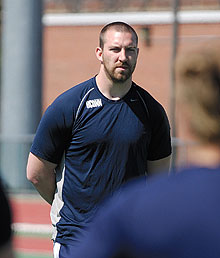
    As the BFI’s Strength & Conditioning Coach, Zak Penwell will be responsible for developing and implementing specialized nutritional, strength training, and conditioning programs for all Indian national men’s and women’s teams. He will also advise Indian coaches throughout the BFI system to enhance and nurture the development of top basketball talent throughout the country. Penwell comes most recently from Scotland’s Sportscotland Institute of Sport, where he worked with athletes from a range of national teams including swimming, basketball, sprint canoe, judo, rugby, golf, curling, triathlon, and field hockey. Since 2006 he has spent over 40,000 athlete contact hours in the weight room, with over 550 elite collegiate and international-level athletes. Penwell is a graduate of the U.S. men’s and women’s college basketball power the University of Connecticut, where he earned two degrees from the top Kinesiology program in America.

    In addition to individual skill development and team coaching of the elite men’s and women’s players in India, Natt, Gaudet, and Penwell will play integral roles in the development of basketball coaching talent in the country, educating and mentoring Indian basketball coaches throughout the BFI system. They will also be deeply involved in construction of the BFI’s and IMGR’s overall basketball development plan for both the Youth and Senior Men’s and Women’s National Team programs.

    “We are excited beyond words to bring on board these three incredible coaches, who will play a critical role in helping us achieve our vision of growing basketball in India by developing and showcasing the best player and coaching talent in the country,” commented Mr. Harish Sharma, BFI Chief Executive Officer. “The introduction of this wealth of basketball knowledge and ability is a watershed moment for Indian basketball.”

    “IMG Reliance played a pivotal role in making this foundation for the future a reality, and is indicative of the tremendous potential that the BFI-IMG Reliance relationship holds to take basketball to greater heights in India."

    Sharma added: “The support given to the BFI and IMGR by the Ministry of Youth Affairs & Sports of the Government of India was instrumental in making the hiring of the coaches possible. The Government of India continues to offer its full backing of our vision for growing the sport of basketball in the country.”

    “IMGR’s relationship with BFI has been an endorsement of the true spirit of partnership,” said Bobby Sharma, IMG Senior Vice President, Global Business Development, Basketball. “The support from management at the BFI for our ideas and the framework for the sport of basketball in India has been wholehearted. The appointment of these world-class coaches marks the beginning of an exciting journey, and we are confident that the elite Indian basketball players and coaches will begin to have their true potential unlocked before our eyes, under the guidance and leadership of Kenny, Pete and Zak. In line with the vision articulated by Mrs. Nita Ambani and the active support from the BFI, IMG Reliance looks forward to encouraging the growth of this talent pool of young Indian men and women, as they compete internationally and successfully represent India on the world stage.”

    Wednesday, April 20, 2011

    Geethu Anna Jose – Q&A: WNBA Dreams


    Two weeks ago, the dreams of lakhs of Indian basketball players and fans came one step closer to realisation, as word got out that India’s superstar Center Geethu Anna Jose is set to be offered tryouts by several professional teams in the Womens’ National Basketball Association (WNBA), the most competitive and prestigious Women’s basketball league in the world. It has been learnt that Geethu (26) will be trying out for the Los Angeles Sparks (two-time WNBA Championship winners), the San Antonio Silver Stars (2008 Finalists), and the Chicago Sky from April 23 – May 8.

    The opportunity couldn’t have come for a more deserving player – Jose has been the biggest Indian basketball star for several years: she has captained the Indian Women’s side at the FIBA Asia Women’s Basketball Championship in 2009, where she was leading scorer in Asia. She has represented India in several major tournaments, including the 2006 Commonwealth Games in Australia and the 2010 Asian Games basketball championship in Guangzhou (China). Jose, who stands at 6 feet and 2 inches, is currently working for Southern Railway in Chennai, and, representing Indian Railways, has won seven consecutive National Basketball Championship titles. She was also the first Indian women to play professionally in Australia, when she represented the Ringwood Hawks, a lower division team in the Women’s National Basketball League (WNBL), and won the league’s Most Valuable Player award in 2008.

    I got a chance to speak to Jose about her historic bid to complete the WNBA dream

    Hoopistani: When did you first hear the news that your WNBA trials have been finalised?

    Geethu Anna Jose [GAJ]: Troy Justice [Director of Basketball Operations, NBA India] emailed me and told me the news. I had handed him CDs of my game tapes, which he had taken with him to the USA, and he had been trying to set up meetings for me for a long time. In the first week of April I heard about my trials finally being confirmed.

    Hoopistani: How does it feel to be given this incredible opportunity?

    GAJ: There are few words left for me to express my happiness. Two years ago, I had gotten a similar offer, but back then, I refused to go: I didn’t feel confident in my own fitness to go for this kind of test. Ever since then, I felt a lot of regret about letting an opportunity like that slip by. I thought I would never get my chance again. But here it is: I’ve been very excited since I heard this news!

    Hoopistani: So this time around, are you ready?

    GAJ: Yes, I think I am.

    Hoopistani: The WNBA is the ultimate dream for basketball players around the world. Was this your ambition too when you first started playing the game?

    GAJ: When I first entered the basketball world, I dreamt of one day becoming the captain of the Indian basketball team. I achieved that dream in 2009 when I captained the Indian side at FIBA Women’s ABC. After that, I thought to myself, “What now?” And I knew that the WNBA should be the next step. In most cases, my age (26) might be a little too late to try for that next step, but my fate has been good because American coaches like Troy Justice and Tamika Raymond have come to India and helped me.

    Hoopistani: Speaking of Raymond [Indian Women coach for the 2010 Asian Games], how has she helped your development?

    GAJ: Coach Raymond encouraged me a lot – she always told me that she liked my game and compared my style of play to her own. In India, I play the Center position, but for the WNBA, I will have to play at Power Forward. Coach Raymond was behind me to help me make that switch when necessary.

    Hoopistani: Talk about the competition that you faced during your time in Australia.

    GAJ: The competition was very rough in Australia, but it also helped my game a lot. In India, I’m used to being double or tripled team in every offensive possession. In Australia, where there are more girls my size, I was usually defended one-on-one, which added a different perspective to my game.

    Hoopistani: At this point, how much do you know about the process of your tryouts with the three teams?

    GAJ: I know that, in Chicago, I will be joining the Sky for a training and tryout session. I will also be helped by Bill Harris [Indian Men’s coach for the 2010 Asian Games] over there. Troy Justice has told me not to worry too much about the process – I know that it’s not going to be about the number of baskets I score, but more about my basketball IQ.

    Hoopistani: How much do you know about the teams that you will be trying out for?

    GAJ: I haven’t followed the WNBA too much in recent years – I do know that the LA Sparks are very talented and have some of the best players in the league. But I’m not concerned about where I go because I think I can fit in with any of the teams.

    Hoopistani: Where do you see yourself in the near future?

    GAJ: I see myself as a WNBA player. But also, I want to see that my tryout is able to be a great opening for other young players in India to make the leap to the highest level.

    Hoopistani: Do you think, then, that more Indian players will follow in your footsteps?

    GAJ: Yes. We have a lot of talent here in India, but unfortunately, the exposure is less for them. There are currently very few club teams for women in India – once this number is increased, or if we see a pro league launched in the country, we will see many more talented youngsters come up the ranks.

    Jose thanked the efforts of everyone who helped make her tryouts and her trip to the USA possible, including Troy Justice, Jayasankar Menon, the BFI’s Harish Sharma, the Basketball Federation of India (BFI), and the Hindustan Group.

    Wednesday, April 6, 2011

    Indian Basketball star Geethu Anna Jose invited for tryouts with two WNBA teams


    Geethu Anna Jose, the legendary Indian Center, has finally been given a shot at her WNBA dream. The superstar who captained Indian Women’s team at the FIBA Women’s Asia Basketball Championship (ABC) in Chennai (2009), has been given the rare honour as she was invited to a tryouts with two WNBA teams in the USA – the Chicago Sky and the Los Angeles Sparks.

    Jose (25), who was the leading scorer at the Chennai ABC, become the first Indian player to get the top scorer honour at any ABC. She has represented India in several major tournaments, including the 2006 Commonwealth Games in Australia and the 2010 Asian Games basketball championship in Guangzhou (China).

    Jose is currently working for Southern Railway in Chennai, and, representing Indian Railways, has won seven consecutive National Basketball Championship titles. She was also the first Indian women to play professionally in Australia, when she represented the Ringwood Hawks, a lower division team in the Women’s National Basketball League (WNBL), and won the league’s Most Valuable Player award in 2008.

    “I have waited a long time for this opportunity – I can’t believe that it’s finally here.” said Jose, “It has been my dream to play at the highest level – the WNBA. It does not matter which team gives me the opportunity there – I just want to compete.”

    The six-foot tall Jose has admitted that she will have to adapt to the power forward position when trying out with taller women in the US. She will travel to Chicago and Los Angeles to try out with the Sky and the Sparks – the Sparks have been one of the most successful teams in the WNBA, winning two championships and three conference titles in the last 10 years.

    Jose has conveyed her sincere thanks to her employer Southern Railway, Mr. Harish Sharma of the BFI, and Troy Justice, the Director, NBA India Operations, for all their whole hearted support. She also thanked the Hindustan Group of Institutions, who have come forward to sponsor the tour for Jose to USA. “I will try my best to give a good performance in the tryouts,” she added.

    The BFI's Harish Sharma said, “This is an incredible opportunity for Geethu Anna Jose. We are delighted for her and everyone who supports basketball in India will hope and pray for her success with the tryouts. She was offered the same opportunity last year, but due to complications she couldn’t make it – we are glad that this time, her dream is one step closer to realisation.”

    “This has been one major step for us at BFI at promoting Indian players throughout the world,” Sharma added, “We will be looking to support such opportunities for other basketball players in India as well – the more players that proper outside of India, the more prosperity they will be bringing to the game of basketball in India.”

    Anand Jacob Verghese, the CEO of Hindustan Group and Pro Chancellor, Hindustan University expressed his happiness in supporting Geethu. "The Indian cricket team has made all of us proud by winning the World Cup," said Verghese, "Now it is the turn of Geethu: she will be a role model for students. I wish that she gets the ultimate honour: a WNBA selection."

    Jose will leave for the USA in about two weeks. She will participate in the Ramu Memorial Basketball Tournament in Mumbai before that.

    UPDATE: Along with tryouts scheduled with the WNBA teams Chicago Sky and LA Sparks which were announced over a week ago, Indian Basketball star has now been invited to tryout and practice with a third WNBA (Women’s National Basketball Association) team during her USA trip: the San Antonio Silver Stars. Jose will be in America from April 23 – May 8, during which time she will be the first ever Indian basketball player to get an opportunity to try out for the WNBA.

    Thursday, March 10, 2011

    Jayasankar Menon: A Hoops Odyssey


    Imagine you’re in the theatre. The drama on stage is the tale of a legend. You have heard about him before, maybe even seen him, but what you know is only a rumour or story. But now, you’re going to see the action for yourself. Like every good character-based drama, this one starts with a life-changing moment for our hero, then sees the hero cement his legend, and then he meets his perfect heroine. But no story is complete without the conflict, which leads to the moment of climax, and then to a resolution that leaves demands a thunderous applause from the happy audience.

    This is the story of Jayasankar Menon.

    ACT – 1: The Auto-Rickshaw Accident

    Our saga begins in the Wadakanchery, in Thrissur district, in Kerala around 1980. Young Jai, the son of a revenue officer in the Thrissur Municipal Office, grows up with what he calls a “free pass” to a local basketball tournament. His first major exposure to the world of basketball comes when Jai participates, not on-court, but just beside it, as he manages the scoreboard for the games.

    But his own sublime basketball skills continue to grow as he grows older and taller. Learning under a coach at the local sports council, CP Michel, Jai improves to qualify for the Kerala Youth (U16) side, playing in his first National tournament at Bhilwara in Rajasthan. Soon after, in the year 1984, he gets selected to the Sports Hostel in Kerala, a move that injects a boost into his hoops development.

    But basketball wasn’t the only sport that Jai participated in. He was also a very able Handball player, and was selected to represent Kerala’s Senior Handball side. Unfortunately, before he could explore his potential on the Handball court, his destiny would be changed forever.

    “I should say, fortunately, I got into an accident,” Menon says, “While I was in Trivandrum for the Senior State coaching camp, an Auto-Rickshaw ran over my leg and I injured myself. That, luckily, put an end to my Handball career!”

    When he recovered, he was fully back to basketball, as he began to play regularly and developed into good shape. “Of course I’m happy now that I had that accident!” Menon added, “Basketball got me so much more than Handball could have – I’m obligated to this game.”

    ACT – 2: A rookie in the Starting 5

    Jai climbed the ranks quickly, from Youth to Junior to the Senior side, before he joined Railways in 1987 and moved to Chennai, where he played for Southern Railways. That was the same year that Indian Railways took part in the World Railway Games in Delhi, where Indian Railways obtained a silver medal. Later that year, Jai was picked to his first Senior National, when India participated in the Asian Basketball Championship in Bangkok.

    Later that year, the 19-year-old was part of the Railways squad that won the first Senior National in 19 years, at Mysore. He was part of the team that started a golden era for the Railways side, who are now favourites to win every major competition they participate in.

    Jai played his first senior international game for India against Jordan, a 89-72 victory for India. But he got a bigger confidence boost as, in a rare move, the coach made him part of the starting five. “I completely didn’t expect that – usually youngsters have to move up the ranks before they get a starting slot. It was a rare opportunity for me, in my first international game, to start for India.”

    Act 3 – Dominating Big Man

    The dominance continued: over Six foot five inches tall, Jai played the Power Forward or the Center position, depending on the situation. He was also a strong player, who wasn’t afraid to use this strength to dominate the post play. One of the country’s best ever rebounders, Jai went on to represent India in four Asian Basketball Championships (ABCs). He won two gold medals for India in the South Asian Games, in Colombo and Chennai. His international basketball travels took him to the USA, Syria, Malaysia, Indonesia, Japan, and more.

    During the 1995 ABC in Seoul, Jai led India as captain, and it was during this tournament where the full range of his abilities were put on display. “I played both the inside and outside game,” he said, “In some of the games, the opponents started to put full-court press on us, so I even began to bring the ball up the court and play the point guard position.”

    Back home, there was no stopping Jai either. In his tenure with Southern Railways and Indian Bank, he participated in 15 Senior Nationals, winning the gold medal five times, and silver and bronze one time each. He won a further three golds and two silvers in Federation Cup Championships.

    One of the biggest games of Jai’s domestic career came in the 1991 Senior Nationals – he had now moved to Chennai for good, and while representing a Tamil Nadu side, he was back in his home state of Kerala, where, in the Quarter-Finals, his team played against Kerala!

    “It was a great game,” Menon remembers, “I really wanted to get this victory – I scored 49 points, and the game went into three overtime periods, but we still lost!”
    In the very next Nationals, Jai’s redemption would be complete, as he helped lead TN to the gold.

    The other game he remembers is the final of the 1995 Nationals in Calcutta, where, now as Tamil Nadu captain, he helped his team to another National win. “I remember playing the whole second half with four fouls,” Menon said.

    Act 4 – The Heroine and the Co-Stars

    Every hero needs a heroine, and the female lead role in the story of our main character is played by someone who is a legend herself, someone who deserves her own headline story. In 1994, Jai married Prasannakumari, who was the captain of the Indian Sr. Women’s side. A few years later, Jai became captain himself, taking the helm of the Indian Sr. Men’s team.

    “We were probably the first marriage of captains,” Menon said, “Not only in basketball, but in any sport!”

    Just like his illustrious lead partner, Jai was blessed with co-stars who helped him through his career. He speaks in high regard of the greats he has played with, included Ajmer Singh, Ram Kumar, Sunny CV, Shahid Quereshi, Unwin J. Anthony, Rajesh Srivastava, and Parminder Singh – each of whom could have a saga of their own now.

    “The basketball players today are far more athletic, far more stronger than the players in our time,” he says, “But what we had, and what the current crop has to work on, is perfecting the team game. We had good fitness, and knew how to move well without the ball. This is something that the generation today has to work on.”

    He adds: “There is also not much good height in the players today – maybe some in the Juniors – we need good big players, 7 footers in India.”

    Act 5 – The High Point – The All Star and the Arjuna nominee

    In 1997, Jai did the extraordinary – after leading India as captain to the ABC in Seoul (South Korea) two years earlier, Jai became the first basketball player from the South Asian region, and certainly the first from India, to be chosen to the Asian All Star side. He was the sixth-man in the All Star Team that played against the South Korea team in Seoul.

    A year later, he was nominated for the Arjuna Award, recommended by the BFI, and although he never received the honour, in the eyes of the true fans, our protagonist had reached his high point.

    Act 6 – The Suspension

    As his international career ended, Jai still found it impossible to stay off the court in domestic competitions, continuing to be a dominating force for Indian Bank well into his late 30s. But for our lead character, the conflict was never against age – it was against an unfortunate circumstance.

    In 2005, Jai stepped on court for Indian Bank against Southern Railway. When a little rough play from both sides got out of control, Jai found himself in an altercation. Three players from each side, including Jai were banned from the game. Five out of the six had their bans rescinded afterwards – but not Jai. He suffered a suspension from the game of basketball, the game he loved, the game that made him, and the game he had given his life to. Having lost his ‘current player’ status, he was transferred to Mumbai, forced to stay away from his wife and his daughters.

    It took three more years, when a change in the association came about, and finally, Jai’s ban was lifted. But by then our protagonist was no longer the dominating force of his younger years. Between a knee surgery and weight-gain due to inactivity, he was never in shape to be a star again.

    Act 7 – The glass half full

    But that is not the end of our drama. The end is still in process, still in play, as we, the rest of the audience, watch and, and as we listen. Because although Jayasankar Menon may have waved goodbye to a legendary playing career, he has started to contribute to the game in other ways.

    “I’m an optimistic person,” he says, “I always like to see the positive side of things and I believe that good things are bound to happen. As basketball grows bigger, I’m continuing to look for more opportunities to contribute to the growth of the game in India.”

    And indeed, he has already made a name for himself off the court. He is an honorary Sports Advisor for Hindustan Group of Institutions and Sports Committee member of Federation of Indian Chamber of Commerce and Industry (FICCI). Menon and Prasanna, Indian basketball’s power couple, started the Professional Basketball Academy (PBA) in Chennai, where he is Director. He has organised inter-school basketball tournaments for several years, and has been involved in coaching. “I have learnt a lot from a lot of different coaches, in India and abroad,” says Menon, “I like to use all their influences but I have my own style!”

    Of course, it is perhaps likely that you may have heard Jai before you ever got a chance to see him, despite the fact that he stands at a giant’s height. Jai is a regular colour commentator for DD Sports during India’s televised basketball tournaments. His game may have slowed down, but his voice never does!

    And as he watches the game of basketball in India enter an exciting new phase, Menon keeps his outlook positive, but at the same time, offers some sound advice. “There are good things happening to the game in India. The current General-Secretary of the Basketball Federation of India, Mr. Harish Sharma, has helped guide this new way, this new beginning for Indian basketball. I’m happy to see the involvement of IMG-Reliance. Now that our players have begun to receive an honorarium, they will be encouraged to perform better.”

    “But we still have a long way to go,” he adds. “We have to make sure our players are promoted the right way. They have to have more exposure against better foreign talents. Our best players now might be dominating the domestic scene, but they get exposed overseas because they do not play enough against better players. We should get more and more foreign teams to come play in India against us so our own level can improve.”

    Closing Act

    And this is where, for now, the curtains close, and Menon’s story so far comes to an end. Because this is the part that our lead character leaves the stage and he joins the audience to witness a bigger show. A show that his story is a small part of, and a show that we all have a stake in: The Story of Basketball in India.

    “The presence of these giants – IMG, Reliance, and NBA in India will take basketball to the next level,” says Menon, “It will take three or four years for things to smooth out, but once a professional league starts in India, things will start to work out.”

    We all certainly hope so. But before we welcome our exciting future, let’s celebrate a legend from the past. Who knows? There might well be a young child somewhere in the country, manning the scoreboard at a basketball tournament, and have his eyes set on becoming the next Jayasanker Menon.

    Monday, March 7, 2011

    Western Railway hoist first-ever RIBA League trophy


    It was the perfect ending that the exciting new tournament desired: the final of the first-ever RIBA League tournament held at the DDA Sports Complex in Vasant Kunj, New Delhi, came down to two of the strongest basketball teams – Western Railway and Indian Air Force – clawing at each other for the win. At the end, the back and forth game saw several lead changes, but Western Railway survived to notch a 64-60 victory.

    The Reebok IGMA Basketball Association (RIBA) tournament was organised by the IGMA Sports Management company,in affiliation with the Basketball Federation of India (BFI). The five-day league-cum-knockout tournament, featuring some of the top basketball players in India, was launched at the DDA Sports Complex in Vasant Kung earlier this week. Eight of the top Men’s club teams in India took part in this new competition.

    In a tournament full of close games, it was fitting that the finale was a thriller as well. Both the teams played out an intense, close game. At halftime, Railway held a 35-28 lead, but Air Force made sure to never let them out of their sight in the second half, mounting regular comebacks as the lead changed several times. At the end, it was Railway to stood winners, behind 25 points by Gagan Deep Singh and 17 points by Yadwinder Singh.

    Despite the loss, Jogender put in a valiant performance for Air Force, finishing with 24 points and bagging the Finals' man of the match award. Narendar Kumar chipped in 15 for Air Force.

    The winning team walked away with prize money of Rs. 75,000 while the runners-up were awarded Rs. 45,000.

    Narendar Kumar of Indian Air Force, who was the competition's leading scorer was named the Most Valuable Player of the tournament. Additional awards were given for the tournament's top rebounder to Gagan Deep Singh and best defender to Yadwinder Singh, both of Western Railway.

    BFI's Secretary-General Mr. Harish Sharma, Indian international cricketer Ishant Sharma, and a host of other dignitaries attended the championship.

    Thursday, February 10, 2011

    Chhattisgarh welcomes India's best teams to the Federation Cup


    On the opening ceremony of the 25th IMG-Reliance Federation Cup National Basketball Championship for Men and Women at the Budhatalab Indoor Stadium in Raipur, Chhattisgarh on February 10th, chief guest and Chhattigarh’s Chief Minister Dr. Raman Singh said that he hoped to see Chhattisgarh become India’s top sporting state. And with an energetic first win against Tamil Nadu, the Chhattisgarh’s Women’s team stamped a perfect response to Singh’s wishes.

    The Chhattisgarh home crowd roared with joy from the very first basket, and the signature quickfire play of the girls on the court was no match for Tamil Nadu. Chhattisgarh built a 28-6 lead in the first quarter, and continued to play strong defense to deny TN any chance of bringing the game any closer.

    Chhattisgarh continued to play a balanced inside-outside game, as they excelled both in fast break scoring, sharp inside passes, and with accurate outside shooting, as several different players contributed to their score. They led 45-20 at halftime en-route to a resounding 82-52 victory. Chhattigarh’s star M. Pushpa finished with a game-high 30 points on some sharp-shooting from beyond the three-point arc. V. Amutha scored 16 in a losing effort for TN.

    The Federation Cup, which features the best eight teams in the men’s and women’s divisions from the previous year’s National Basketball Championship in Ludhiana, was inaugurated at the brand new Budhatalab Stadium in Raipur earlier in the evening by Dr. Raman Singh. “We’re lucky to witness the first ever games of this tournament at this new stadium,” Singh said, “We will hope to see a great environment for basketball here!”

    “The Chhattisgarh government will try to do everything possible to help develop sports in this state,” Singh added, “In 11 years since its inception, Chhattisgarh has become top in the country in several sectors; I hope that in the future we can be in number one in sports, too.”

    Harish Sharma, the Secretary-General of the Basketball Federation of India (BFI) also acknowledged the growing status of Chhattisgarh as a basketball superpower. “The Chhattisgarh Pradesh Basketball Association (CGPBA) has become a strong association over the years,” said Sharma, “Their players are now making the state proud in almost all levels of the game.”

    Sharma added: “It is great to see this wonderful indoor stadium to host this championship. The public of Chhattisgarh should acknowledge all that its chief minister Dr. Raman Singh has done to help encourage sports in the state.”

    In other Women’s action, the team from Delhi, who have finished runners-up in the last two National Championships, faced a plucky Maharashtra side on the first day of the Cup. Delhi took a confident first half lead of 33-24 behind some brilliant play by Indian National Team captain Prashanti Singh (24) and Raspreet Sidhu (23). But Maharashtra made an inspired run in the third quarter to even the score and then take the lead 42-40.

    Shaken but not shattered, Delhi regained its composure and began to execute better offensively again. They went on a devastating 27-6 run between the end of the third and halfway through the fourth quarters. In the end, it was a comfortable 16 point victory for Delhi, 74-58.

    Here is the full list of participating teams and their groups:

    Men

    Group A: Western Railway, Indian Army, Hyderabad District, KSEB.
    Group B: IOB (Chennai), ONGC, Bhilai Steel Plant, Vijaya Bank (Bangalore).

    Women

    Group A: Southern Railway, Karnataka, Kerala, Andhra Pradesh.
    Group B: Delhi, Chhattisgarh, Tamil Nadu, Maharashtra.

    To stay updated with everything at the Federation Cup, Click Here for Full Schedule and Click Here for Results.

    Friday, January 21, 2011

    Giant Expectations: Satnam Singh Bhamara


    It almost seems like Satnam Singh Bhamara is asking to be doubted.

    When you’re a teenager from India, 15 years and one month old, already grown to the size of a 7-1 monster, the first reaction is wonder and awe, the second is doubt. People wonder what could go wrong; they wonder what the catch is. When you’re blessed with a unique inside-outside skill set, nimble feet, soft hands and a developing shooting touch, people instead wonder what your weaknesses are. When you begin training at the IMG Basketball academy, which has featured the likes of Kobe, Vince Carter, Chauncey Billups, Joakim Noah and Kevin Martin, the doubters say that it sounds too good to be true.

    When you’re the son of a poor farmer in India, a boy from a village separated a long dirt road away from the rest of civilization, who picked up his first basketball less than five years ago, you’re asking for the questionable looks. When you’re the biggest basketball hope (literally and figuratively) for India — a country desperate to make a mark in the basketball world — you’re likely to receive a cynical shrug of the shoulders. “India isn’t there yet,” they say. “The kid isn’t there.”

    Not yet. But he might be. If you haven’t yet heard about him, it’s time to converge your respective focuses (or foci) on Satnam Singh Bhamara, the 15-year-old, 7-1 Indian giant, currently on a scholarship at the IMG Academy in Bradenton, FL and attending the Pendleton High School. He is currently in the first year of a potentially four-year scholarship until he graduates from high school.

    India has been slowly growing as a basketball market, and Bhamara’s potential might be a zenith of a variety of different efforts taking place to grow the game back home.

    Rewind to a year ago: The 14-year-old Bhamara was already a formidable 6-11. Back then, during India’s National Basketball Championship, a yearly tournament pitting the best state teams of India against each other, Bhamara was a wide-eyed spectator, too young to participate, watching as a man-child in a man’s world.

    A year later, I meet him at the same championship in New Delhi. This time, he’s back as a famous young man in the country’s basketball circles, garnering attention from other players, media and fans. He’s a spectator again, but only because he has a limited time back in India before he flies back to school in the States. A prominent Indian referee sees him and remembers: “Satnam used to help us set up the scorers’ tables last year. We had nicknamed him Chhotu (Little One). Look at him now!”

    “You can still call me Chhotu!” Bhamara jokingly interjects.

    But there is nothing ‘little’ about Bhamara, not in height, nor in hype. The first time I met him was back in July 2010, when Bhamara was among 50 other under-14s who were chosen by the Basketball Federation of India (BFI) to appear for IMG scholarship tryouts. IMG, a US-based international sports and media management company, have been investing heavily into sports in India. A year ago, they formed an alliance with Reliance Industries, India’s largest and richest private sector company, and the powerhouse duo of IMG-Reliance signed various sponsorship deals with Indian sports federation. Most notably, IMG-Reliance signed a 30-year agreement with the BFI to assist, finance and promote the growth of basketball in India.

    One of their first steps was to choose eight Indian youngsters among the 50 best for scholarship at the IMG Academy. From the moment he walked into the tryouts in New Delhi, Bhamara was a shoo-in.

    His fascinating story begins in a little village in India’s north-western state of Punjab: Ballo Ke Village, District Barnala, population 463. The son of a 7-foot farmer, Bhamara spent his early childhood helping out his father on the farm and growing up to 5-9 when he was just 10 years old. It was then that one of his father’s friends recommended that he take the tall youngster to Ludhiana, a nearby town and a major basketball hub of the country. Somewhere lost in translation, Bhamara thought that he was going to play volleyball. He didn’t know a thing about the game when he first stepped on court.

    Four years and nearly 15 inches later, he had grown into one of the finest young players in the country. After blazing his way through the Punjab inter-school and junior leagues, Bhamara began to collect his international credentials. He represented India in the FIBA Asia U16 Championships at Malaysia in November 2009. Back home, he took Punjab to the gold medal of the National Youth Championships at Trichy (Tamil Nadu, in South India) in June. He was recommended by the BFI to be part of a three-player contingent of Indian youngsters sent to Singapore for NBA’s Basketball Without Borders (Asia) camp.

    It was no surprise then that he was picked by IMG’s Basketball Director Andy Borman and coach Dan Barto for the scholarship. Bhamara was at the perfect age and with the perfect potential skill set, ready to be molded into a basketball monster. To play at the highest level, Bhamara cannot count successes in small Indian championships or Asian tournaments; he had to train with and compete against the best.

    But more than a basketball adventure for the youngster, it has been a strange change of lifestyle, too. Bhamara and the rest of the Indian youngsters made their first trip to North America, going to school in a whole new academic system, learning hoops in a way never been taught to them before, focusing more than ever on weight training and fitness, taking extra classes to learn English (seven of the eight, including Bhamara, were virtually alien to the language), getting used to live in a residential school far away from home, and getting used to not eating their Moms’ home-cooked Indian meals.

    Four months later, Bhamara makes his first visit back home — he was always built with the body shape of an ideal center, blessed with both height and muscle — but he came back looking even fitter and leaner than ever, thanks to the intense training and exercise regimen that he had gone through with his coaches at IMG. He was given a superstar’s welcome in his little village, when hundreds showed up to catch a glimpse of him coming back home.

    And then he was back at the National Championship as a minor celebrity, back at the same event he had been errand-boy a year ago.

    “I have changed and improved a lot over the past four months,” says Satnam, “but I want to improve even more. I want be an example for other Indian players so they can come forward and see what is necessary to be a complete player. They need to know the importance of building strength to help improve their game.”

    Indian athletes, particularly the basketball players, have faced one major criticism in the past: They may have the shooting and running skills, but their athletic ability and strength leaves much more to be desired. More than basketball, the coaches at IMG have focused their early interest in making sure that Bhamara gets into shape to hang with the toughest. Bhamara has followed suit, becoming a gym rat, working on everything from exercises to help improve his forward and lateral speed, jumping ability, shoulder exercises, and lifting weights to get into tougher shape.

    But his basketball training hasn’t been left behind. Bhamara notes how his current regime involves focusing on movement — a lot of movement — so that his size can be complemented with speed to make a momentum nightmare for opponents. Bhamara, who is part of IMG’s youth team, doesn’t hesitate to talk about how his improving inside game and movement has helped his team get some big results.

    “My game is basketball,” he says. “The media in America has asked me why I don’t play other games, but I’m only interested in basketball. This is the game that has given me everything I have, taken me from a village to a good education in America. I love playing this game and owe everything to it. That’s why I keep working hard to improve.”

    Satnam says that there are two players he looks ‘up’ to, even though both of them are shorter than him. One of them is Punjab State and Indian Senior team star Jagdeep Singh. The other, curiously, is Kobe Bryant.

    You can credit (or blame) the over-Lakerisation that NBA audiences in India have been subjected to in the past. Over the last decade, most games NBA games broadcasted in India have involved either the Lakers, Celtics, Spurs and whichever franchise LeBron James shares his talents with. I ask him, Why, despite the difference in size and gameplay, does he idolize the Black Mamba? He answers, “Kobe plays like he has no problems on court; he works hard, but he dominates smoothly, with ease. That is the kind of mentality I want to have.”

    And this is exactly the kind of mentality that India, and all those holding a stake for the development of basketball in India, are hoping that Bhamara develops. In an interview with an Indian newspaper a few weeks ago, Harish Sharma, the Secretary-General of the BFI, said, “He is a great prospect. I am sure he will do what Yao Ming did for China. Indian basketball will change in case one of our boys makes it to the NBA.”

    And although one talented, tall, teenager alone cannot change the basketball culture in India, the NBA will be hoping that with an idol to look up to, young Indians, just like young Chinese a decade ago, will start believing in basketball. The game is never going to challenge India’s premier game, cricket, but for basketball to score even a minor percentage of the market in a 1.2 billion population will be a heavy number.

    Troy Justice, who has been the director of basketball operations of the NBA in India, has been working with Indian talent for several years now, and has kept a keen eye on Bhamara’s ascension. “He is blessed with three things that, combined, have made him into a very special prospect globally — a young age, his height, and his skill set,” said Justice. “He has natural basketball instincts, a strong work ethic, and has become a focused student of the game. I have enjoyed working with him and look forward to seeing his growth as a person and player over the next few years.

    “I think he has tremendous potential and a bright future in basketball.”

    But Bhamara is adamant that his focus is on the present before anything else. “I’m not thinking too far ahead right now,” he says, “I’m in IMG’s youth team, so I want to play well enough to play for the juniors. After that, I will think about qualifying for the Senior team, and after that, I can think further.”

    “If I get a chance to, of course I want to play in the NBA.” Bhamara adds, “If I can make it there, I will be able to do more for other Indians dreaming of making it to the NBA. But I will have no problem if it doesn’t work out. I will come back to India to play for Punjab and contribute to the Indian national basketball system.”

    “Right now, I’m only concerned with improving my own game. After five years, we’ll see what happens. Right now, my priority is working on my strength — I know I’ll be playing tougher competition and have two or three players guarding me, and I have to get stronger to face that.”

    Bhamara is still too young, and perhaps, still too unaware, to fully understand the implications of his rise as a basketball star. Just like China, who have gone hysterical about hoops over the past decade, India will eventually become a serious basketball market. It is a question of who and when — Yao may have been the biggest star, but he wasn’t the first Chinese to make it to the League (that honor goes to Wang Zhizhi). Bhamara’s potential improvement will determine if he can even make it to that level, much less survive once he gets there.

    Right now, he’s just a 15-year-old, except that he’s blessed with a little more size, a little more talent, and a little better training support than the rest of us. He carries a load of expectations a little heavier than the rest of us, too.

    So go ahead and doubt him all you want: not good enough, too much hype, too weak, too slow, too soft, too foreign. I doubt if Satnam Singh Bhamara will hear any of it: Right now, he’s just a kid addicted to hoops. And all he wants to do is get better.

    Right now, he’s just a 15-year-old, except that he’s blessed with a little more size, a little more talent, and a little better training support than the rest of us. He carries a load of expectations a little heavier than the rest of us, too.

    So go ahead and doubt him all you want.

    This article was first published on SLAMOnline.com on January 13th, 2011.

    Friday, January 14, 2011

    Arjuna Awardee basketball player Anil Kumar Punj passes away at 63


    Anil Kumar Punj, Arjuna Awardee, former outstanding International Basketball Player of India died on January 14, 2011 in Delhi. He was 63 years old.

    Punj had an illustrious career in the Border Security Force from 1968 to 2004 from where he retired as Commandant. He distinguished himself at the international and national level and was a member of the Indian Basketball Teams which participated in the 1970 Asian Games in Bangkok, and two Asian Basketball Championships - 1971 (Tokyo) and 1973 (Manila). Anil Kumar Punj was a highly talented, brilliant and respected player. He was famed for his sportsmanship and for always gave his best to the team.

    Over his career Punj bagged two Gold, four Silver and four Bronze Medals in National Basketball Championships and also 13 Gold Medals and 2 Silver Medals in All India Police Games. He was decorated with the Arjuna Award by the Govt. of India in 1976 and Police Medal for Meritorious Services 1992. He was also decorated with the Maharaja Ranjit Singh Award by the Punjab Govt. in 1986.

    The Punjab Basketball Association (PBA), in a special meeting presided over by Basketball Federation of India (BFI) President R.S. Gill, IPS (Retd.), condoled the sudden demise of Punj. In this hour of grief, the PBA has promised to stand the family of the deceased and offer all help wherever and whenever required.

    Harish Sharma, the Secretary-General of the BFI offered his condolences to Punj's family and friends. "This is great loss to basketball in India," said Sharma, "Anil Kumar Punj was a legendary basketball player."

    Teja Singh Dhaliwal, the Secretary-General of the PBA, said, "It is a sad moment for the basketball society. We have lost a great player and a great friend."

    Thursday, January 6, 2011

    2010: The year in Indian Basketball


    A decade or two from now, when looking back at the success of basketball in India, 2010 will stand as the marquee year that changed almost everything. In a single, busy year, basketball took the biggest strides in India, and has provided optimism for the future of the game here.


    The BFI-IMG-Reliance marriage

    The Basketball Federation of India (BFI) had quite a busy year, highlighted by the giant sponsorship deal it signed with the joint venture of IMG-Reliance. IMG Worldwide is a US-based sports marketing company, and the Reliance Group is India’s largest private sector enterprise. The 30-year agreement will see IMG-Reliance assisting the BFI on financial, promotional, and technical aspects. As part of the agreement, the BFI has granted IMG Reliance commercial rights relating to basketball in India, including sponsorship, advertising, broadcasting, merchandising, film, video and data, intellectual property, franchising and new league rights.

    There have already been major results to this milestone agreement in its first year. IMG Academies (Bradenton, Florida, USA), the world’s best multi-sport training center, offered a scholarship to eight budding young Indian basketball players under the age of 14 (four boys and four girls) to attend their academy as student athletes and be trained by some of the best coaches and trainers in the world.

    In addition, BFI and IMG-Reliance also launched first ever inner-city school basketball leagues in New Delhi, Chennai and Mumbai, encouraging participation and competition amongst school kids in the game of basketball. The leagues are soon set to expand to the college level as well.

    IMG-Reliance had a hand in sponsoring the BFI’s marquee events of the year, the National Championships. Whether it was the Sub-Junior in Kangra, Junior in Vashi, or Senior level in New Delhi, the highest standard of competition was conducted at the championships in 2010.

    As the year ended, BFI announced that a bonus payment will be handed to 65 players, seven coaches, and 10 members of support staff as an honorarium for their hard work for basketball in India. The honorarium will continue as an added monthly payment to players who are placed in the top three categories of basketball level in the country.

    Finally, IMG-Reliance also left the BFI and all fans of the game in India with great optimism for the future. BFI and IMGR are now working on launching a professional basketball league in the country over the next few years, which, when launched, would bring basketball into mainstream consciousness in India, and also help make India’s basketball players, coaches, trainers, managers, scouts, and others into professionals connected and paid by the league.

    Milestones at the Asian Games, and new American coaches

    For the first time in 28 years, back since the games in 1982 which were hosted by India, the Indian National Basketball teams qualified for the Asian Games basketball tournament, held in Guangzhou (China), in November 2010.

    The Men’s team also created history by winning their first ever basketball tie at the Asian Games, defeating Afghanistan in their pre-qualifier.

    Another major step for the teams was that, for the first time, both the Men’s and Women’s teams were coached by experienced American coaches. Bill Harris and Tamika Raymond worked with the Men’s and Women’s teams respectively, bringing revolutionary new ideas and tactics to India’s best players. Harris and Raymond coached the teams for a few months and led them to the Asian Games.

    The NBA partners with BFI, continues promoting basketball in India

    The National Basketball Association (NBA), the world’s most powerful basketball league, continued to strengthen in ties with the BFI to help promote the game in India.

    The NBA launched a unique inner-city recreational league for youngsters and seniors in their partnership with Mahindra Group, the Mahindra NBA Challenge. With assistance from the BFI, the league was launched in Mumbai, Bangalore, and Ludhiana in its first season, and by the end of the year, in Delhi and Mumbai again in the second season. Chennai is set to be added to the list in 2011.

    The NBA also brought two marquee all-star basketball players Dwight Howard and Pau Gasol to India during the NBA off-season in August 2010. The players helped to spread the message of basketball in the country, including working with the Indian National Teams and with Indian school kids.

    The NBA also launched an NBA-India website targeted to fans in India, as well as signed a revolutionary new basketball television deals at the start of 2010-11 season in India.

    Individual Successes

    India’s most popular basketball player today, Chennai legend Geethu Anna Jose, continued to carve her legacy with another season playing abroad in Australia.

    Indian youngster Satnam Singh Bhamara, a seven foot, 15-year-old, who was chosen as part of the scholarship by the IMG-Academy, has made a name for himself already due to his immense potential. BFI’s Secretary-General Harish Sharma has recognised Satnam as potentially becoming the first Indian player to make a huge mark internationally, just like Yao Ming did for China.

    Success for the whistle-blowers

    Indian referees made a significant name for themselves worldwide in 2010. In July, West Bengal’s experienced ref Atanu Banerjee became the first Indian to officiate the final of a World Championship Game, as he was a referee at the FIBA U17 World Championship Final in France.

    In November, another Indian referee made the country proud. Rameshkumar Durairaju from Tamil Nadu became the first Indian referee since 1982 to officiate an Asian Games basketball final, as he was the ref at the women’s final game at the Asian Games in Guangzhou (China).

    India at the Youth Olympic Games

    A contingent of four players and one coach from India were part of the first major tournament debut of FIBA 33 at the Youth Olympic Games (YOG) in Singapore in August-September. FIBA 33 is an official version of the half-court, three-on-three format of basketball.

    Indian coaches receive training at George Mason University

    American basketball coaches JD Walsh, Craig Esherick, and Bob Baker invited 12 Indian coaches and management specialists to the George Mason University (GMU) for intense coaching training courses for ten days in July. The coaches went through on and off court training that included discussions of coaching philosophy, nutrition, strategy as well as marketing and organization.


    The action-packed year came to an end with the National Championships in New Delhi, which were won again by the Men’s and Women’s teams from Indian Railways early in 2011. Punjab Boys and Kerala Girls lifted the Junior Nationals in Vashi in October, Rajasthan Boys and Chhattisgarh Girls hoisted the Sub-Junior Championship in Kangra back in September, and Punjab Boys and Kerala Girls won the Youth Nationals in Tiruchirappalli in June.

    With a chapter on this successful year closed, it is now time to look forward and continue the growth of basketball in 2011.