Showing posts with label Black History. Show all posts

Saturday, September 10, 2011

Susan Smith White Woman Murders Her Children and Blames a Black Man

Susan Smith's mugshot

Dr. David Pilgrim writes: In 1994 Susan Smith, a young mother in Union, South Carolina, claimed that a man had commandeered her car with her two boys -- Alex, 14-month-old, and Michael, 3-year-old. She described the carjacker as a "Black male in his late 20s to early 30s, wearing a plaid shirt, jeans, and a toboggan-type hat." A composite of her description was published in newspapers, nationally and locally. Smith appeared on national television, tearfully begging for her sons to be returned safely. An entire nation wept with her, and the image of the Black brute resurfaced. The Reverend Mark Long, the pastor of the church where Smith's family attended services, said in reference to the Black suspect, "There are some people that would like to see this man's brains bashed in."
Susan Smith's fictitious black brute

After nine days of a gut-wrenching search and strained relations between local Blacks and Whites, there was finally a break in the case: Susan Smith confessed to drowning her own sons. In a two-page handwritten confession she apologized to her sons, but she did not apologize to Blacks, nationally or locally. "It was hard to be Black this week in Union," said Hester Booker, a local Black man. "The Whites acted so different. They wouldn't speak (to Blacks); they'd look at you and then reach over and lock their doors. And all because that lady lied."

Susan Smith

The false allegations of Charles Stuart and Susan Smith could have led to racial violence. In 1908, in Springfield, Illinois, Mabel Hallam, a White woman, falsely accused "a Black fiend," George Richardson, of raping her. Her accusations angered local Whites. They formed a mob, killed two Blacks chosen randomly, then burned and pillaged the local Black community. Blacks fled to avoid a mass lynching. Hallam later admitted that she lied about the rape to cover up an extramarital affair.

How many lynchings and race riots have resulted from false accusations of rape and murder leveled against so-called Black brutes? (source: Dr. David Pilgrim, Professor of Sociology, Ferris State University; Nov., 2000)

Monday, June 27, 2011

Senegalese artist Ousmane Sow

The Smithsonian Magazine: An imposing sculpture by Senegalese artist Ousmane Sow—the centerpiece of a new exhibition, “African Mosaic,” which highlights recent acquisitions at the Smithsonian National Museum of African Art—depicts the 18th-century Haitian revolutionary Toussaint Louverture. The figure, more than seven feet tall, portrays Toussaint reaching out to a seated female slave. “The ‘Great Man’ theory of history is no longer popular,” says curator Bryna Freyer. “But it’s still a way of looking at Toussaint. He really was larger than life.”

The sculpture, which museum director Johnnetta Cole describes as “our Mona Lisa,” evokes two men—the celebrated rebel of Haitian history and the artist who pays homage to him.

Senegalese artist Ousmane Sow
In 1743, Toussaint Louverture was born into bondage in Haiti, the French island colony then known as Saint-Domingue, possibly the grandson of a king from what is now the West African nation of Benin. He is thought to have been educated by his French godfather and Jesuit missionaries. Toussaint read widely, immersing himself in writings from the Greek philosophers to Julius Caesar and Guillaume Raynal, a French Enlightenment thinker who inveighed against slavery. In 1776, at the age of 33, Toussaint was granted his freedom from the place he was born, Breda Plantation, but remained on, rising to positions in which he assisted the overseer. He also began to acquire property and achieved a level of prosperity.

In 1791, while France was distracted by the turmoil of the revolution, a slave rebellion began in Haiti. Toussaint quickly got involved; perhaps as repayment for his education and freedom, he helped Breda’s white overseers and their families flee the island. Toussaint (who added Louverture to his name, a reference either to his military ability to create tactical openings or to a gap in his teeth, caused when he was hit by a spent musket ball) quickly rose to the rank of general—and eventually the leader of the independence movement. His forces were sometimes allied with the Spanish against the French, and sometimes with the French against the Spanish and English. In 1799, he signed a trade pact with the administration of President John Adams.


Ultimately, Toussaint considered himself to be French and wrote to Napoleon declaring his loyalty. Bonaparte was neither impressed nor forgiving. In late 1801, he dispatched 20,000 French troops to reclaim the island. Although Toussaint negotiated an amnesty and retired to the countryside, he was seized and sent to a prison in France. There, he died of pneumonia in 1803. In death, as in life, Toussaint was lionized. Wordsworth, no friend of the French, wrote a memorial sonnet, “To L’Ouverture,” attesting to the fallen leader’s enduring fame: “There’s not a breathing of the common wind / That will forget thee.”


Sculptor Ousmane Sow (rhymes with “go”) created the Toussaint figure in 1989 in Dakar, Senegal. The museum acquired the piece in 2009. Born in 1935 in Dakar, Sow left for Paris as a young man. “He worked as a physical therapist, which gave him a good knowledge of human anatomy,” says curator Freyer. “And he spent hours at Parisian museums, looking at the works of sculptors such as Rodin and Matisse.”

Sow has often chosen historic themes and heroic characters—he has completed a 35-piece work about the Battle of Little Big Horn, a series on Zulu warriors and a bronze statue of Victor Hugo. A large man himself—Sow stands well over six feet tall—the artist seems to favor large-scale pieces. Karen Milbourne, a curator at the museum who has visited Sow’s studio in Senegal, describes an outsize depiction he did of his father. “Because it’s so large and imposing,” she recalls, “it’s as if you’re seeing it [from the perspective of] a child.”


Ordinarily, when discussing sculpture, there is mention of what it’s made of—stone or bronze, wood or terra cotta. Sow works in his own unique medium, creating pieces from a farrago of ingredients that may include soil, straw, cement, herbs and other things, according to an ever-changing recipe. “It’s his secret sauce,” says curator Christine Kreamer. The mixture is allowed to age for weeks or months, and then is applied to a metal framework. According to Freyer, Sow has also used the mysterious substance to waterproof his house.

For his part, Sow doesn’t attempt to define his work’s effect: “I don’t have much to say; my sculptures say it all,” he says.

HARD TRUTHS: THE ART OF THORNTON DIAL

Carol Kino's article, "Letting His Life’s Work Do the Talking," from the 17 February 2011, New York Times states:
THORNTON DIAL has never been one for talking much about his artwork. Ask him what inspires his monumental assemblages, made from twisted metal, tree branches, cloth, plastic toys, animal bones and all manner of found materials, and he is likely to respond tersely, as he did while showing me around his studio here one bone-chilling day last month.

“I mostly pick up stuff,” he said. “I start on a picture when I get a whole lot of stuff together. And then I look at the piece and think about life.”

Now 82, Mr. Dial has had a lot of life to think about — especially over the last year, during which he endured hernia surgery, pneumonia, a stroke and heart problems. Only recently did he return to making art in this cold and cavernous space at the back of Dial Metal Patterns, a fabrication shop run by his children. As he huddled in a chair, looking frail and slightly wary, his three sons hovered about him protectively.

Artist Thornton Dial

For one paintinglike piece, made on canvas-covered plywood, Mr. Dial had used branches, metal, clothing, paint and a pair of work boots to create a lean figure fording through a tall jungle. “That’s Obama,” he said. “I show the struggle he got through without getting bit.”

Another, saturated with powdery white pigment, presented a baby doll nested in a field of cotton-covered twigs and twisted steel. A rope encircled the doll’s neck, suggesting a noose or an umbilical cord. “That’s the way they come,” Mr. Dial said, chuckling, when asked about the rope’s significance. “You probably see many things in my art if you’re looking at it right.”

Because Mr. Dial is self-taught and illiterate, he has generally been classified as a folk or outsider artist. But that pigeonhole has long rankled his admirers, because his work’s look, ambition, and obvious intellectual reach hew so closely to that of many other modern and contemporary masters, from Jackson Pollock and Robert Rauschenberg to Jean-Michel Basquiat. “If anybody else had created a major opus of this scope,” said Joanne Cubbs, an adjunct curator at the Indianapolis Museum of Art, “he or she would be recognized as a major force in the art world. Instead Dial struggles at the margins.”

But his marginalization may not last much longer. Mr. Dial’s first career retrospective, “ Hard Truths,” opens at the museum in Indianapolis on Friday. And on March 19 the Andrew Edlin Gallery in Chelsea will open Mr. Dial’s first solo gallery show in New York in 11 years. “This feels like the moment when the cultural world is ready to understand Mr. Dial and perhaps to embrace him,” said Ms. Cubbs, who organized the museum survey.

That exhibition, which runs through Sept. 18 before traveling to New Orleans; Charlotte, N.C.; and Atlanta, includes examples from many different periods, starting with the pictures that made Mr. Dial’s name in the early ’90s, when he used the tiger to symbolize the struggles and triumphs of African-American life. He has continued to invoke the specter of slavery, in pieces like “High and Wide (Carrying the Rats to the Man),” a large 2002 construction in which a grinning Mickey Mouse toy is chained to the hull of a ship.
The show also includes work he made in response to the 2001 World Trade Center attack and the gulf war: sculptures like the monumental “Crosses to Bear (Armageddon),” dated 2001-4, in which a nine-foot-high expanse of rusty iron crosses is festooned with rag and rubber detritus; and paintings that appear to be made from torn and bloodied American flags, like “Don’t Matter How Raggly the Flag, It Still Got to Tie Us Together” (2003).

“The power and clarity of his work measures up to any artist of any color in the last decades,” said Maxwell L. Anderson, the director of the museum, noting the works’ superficial resemblance to those by Julian Schnabel and Anselm Kiefer. “But unlike those figures this work is imbued with an experiential dimension. For Dial, politics is personal.”

Certainly Mr. Dial has one of the more amazing art historical biographies on record. Although he had little formal schooling, he developed an intimate acquaintance with postmodernist art-making materials early in life.

Born in 1928 in a cornfield in the tiny rural hamlet Emelle, Ala., and raised by his great-grandmother, Mr. Dial went to work as soon as he could walk, harvesting sweet potatoes and corn, and gathering twigs and “the stuff my great-grandmother needed to make fire,” he said. After her death Mr. Dial and his younger half brother went to live with another relative in Bessemer, a small industrial town, where he hauled ice, poured concrete, raised cattle, did carpentry and laid bricks, among other things, until he found employment as a metalworker at the local Pullman-Standard boxcar factory. He worked there on and off until it closed in 1981.
All the while — throughout his long marriage to Clara Mae Murrow, who died in 2005, and the birth of his five children (one daughter died at 28 from cerebral palsy) — Mr. Dial was quietly observing and honing his skills. “I was just watching people that make stuff,” he said. “I watch everything.”

He was also making things himself, from the functional, like fishing nets and lures, chimneys, bricks, funerary monuments, furniture and houses (“I made a whole lot of them and tore them down,” Mr. Dial said) to the less obviously useful, like animal sculptures made from tin and tree branches or plastic bread wrappers, or a slave ship built from metal and wood. As his sons recalled, during another interview in the shop office with nearly a dozen relatives and family friends in attendance, Mr. Dial would come home from work, watch the evening news, do some farming out back with his children and then set to work making things again.

Even with something ostensibly practical like a lure, “it was odd, the way he took his time and painted them and stuff like that,” his son Richard said. “Whatever he worked on had to be different from somebody else.” Mr. Dial was so prolific, he added, that his wife often made the boys tidy up by burying his old work in the yard. (Mr. Dial has said in the past that he sometimes hid his work himself because he feared the attention it might attract during the Jim Crow years.)

Life changed dramatically for Mr. Dial in the late ‘80s, when he was discovered by William Arnett, a wealthy white Atlanta collector who was obsessively scouring the South for unheralded African-American work. (Among his discoveries are the Gee’s Bend quilters, whose work toured to 12 museums in a widely lauded show.)

Mr. Arnett was smitten from the start. “Dial possessed a combination of pride, dignity and determination, along with a wry sense of humor,” he wrote in an e-mail. “His earliest artworks demonstrated an unlimited creative imagination. All he lacked was encouragement and opportunity.”

For Mr. Dial the meeting was transformative. “He didn’t have to bury stuff anymore,” his son said, “because Mr. Arnett would give him money for things, and Daddy was kind of fascinated. There was a point where he said, ‘Ya’ll been laughing at me, but look at what the man just paid me for doing this.’ ”
Or, as Mr. Dial put it, “That’s the time I did start thinking about art.”

Mr. Arnett gave him a monthly stipend in exchange for right of first refusal, which allowed Mr. Dial to make art full time. Mr. Arnett visited frequently, and introduced Mr. Dial to curators and other collectors, including Jane Fonda, who remains a major supporter. He also set the wheels in motion for Mr. Dial’s first museum exhibition, “Image of the Tiger.” Organized by the critic Thomas McEvilley, it opened at two New York institutions, the Museum of American Folk Art and the New Museum of Contemporary Art, in November 1993. The show seemed poised “to break down the border between outside and inside,” Mr. McEvilley said. Critically it was successful: “He has a genuine talent that he brandishes fearlessly,” Roberta Smith wrote in The New York Times. But soon after the opening “60 Minutes” ran a segment that suggested Mr. Arnett was exploiting the folk artists whose work he had championed, particularly Mr. Dial. Suddenly “my show died on the vine,” Mr. McEvilley said. And so did several other major exhibitions of Mr. Dial’s art in the works.
Since then, although Mr. Dial has exhibited in galleries and been included in many group outsider art shows, as well as the 2000 Whitney Biennial, he has had only one other major museum solo exhibition, “Thornton Dial in the 21st Century,” at the Museum of Fine Arts Houston in 2005. (Mr. Dial, who remains close to Mr. Arnett, memorialized the debacle with the 2003 self-portrait assemblage “Strange Fruit: Channel 42”: it involves an eyeless scarecrow-like creature wearing a bloody tie strung up from a television antenna.) Yet the event had one positive effect on Mr. Dial, Ms. Cubbs said: “It made him re-evaluate what the relationship would be between his art and its audience, and his work became more complex and powerful.”

How did he do that? Mr. Dial isn’t telling. “I remember all of my art,” he said, “but I can’t talk about all of it, because I did it 20 or 30 years ago. You ain’t going to think about all you done did in life either.”

But pressed to explain why he makes art in the first place, he finally found an answer: “I make it for people to love.” (source: New York Times)


Wednesday, June 22, 2011

The Historical Context of "Lift Every Voice and Sing"

From CNN, Professor Rudolph P. Byrd responds to an unenlightened article posted by Timothy Askew discussing James Weldon Johnson's masterpiece, "Lift Every Voice and Sing." Professor Byrd's article "Song reflects racial pride, never intended as anthem," on 30 July 2010:

In a recent article on CNN.com, Timothy Askew, author of "Cultural Hegemony and African American Patriotism: An Analysis of the Song 'Lift Every Voice and Sing,' " makes certain claims regarding James Weldon Johnson's hymn that are not only historically inaccurate, but also are potentially harmful to Johnson's legacy as a pioneering figure in the modern civil rights movement.

"Askew decided the song was intentionally written with no specific reference to any race or ethnicity," the article stated. Nothing could be further from the truth.

James Weldon Johnson

The agnostic Johnson carefully reconstructs the genesis and context for the composition of his hymn in his autobiography "Along This Way." There he writes: "A group of young men decided to hold on February 12 [1900] a celebration of Lincoln's birthday. I was put down for an address, which I began preparing; but I wanted something else also."

Along with his address, Johnson initially was interested in writing a commemorative poem in honor of Abraham Lincoln but abandoned that idea for lack of time, and instead composed with his younger brother J. Rosamond Johnson "Lift Ev'ry Voice and Sing."

"Lift Every Voice and Sing Sheet Music"

As Johnson composed his loving tribute to his race and nation, he wept: "I could not keep back the tears, and made no effort to do so." On the occasion of its debut, the hymn was sung by 500 African-American children, many of whom were students at Stanton School, Johnson's alma mater and where, at the time, he was principal.

The context then for the composition of "Lift Ev'ry Voice and Sing" was an early Black History Month celebration organized by the black leadership of Jacksonville, Florida, decades before this tradition was institutionalized by the African-American historian and Harvard Ph.D Carter G. Woodson.
Musical Composer J. Rosamond Johnson, (James Weldon Johnson's Younger Brother)

Not only does Askew mistakenly claim that Johnson composed his hymn without any "specific reference to any race or ethnicity," but he applies this erroneous, ahistorical and decontexualized reading to the lyrics themselves.

"Some people argue lines like 'We have come, treading our path through the blood of the/slaughtered,' signify a tie to slavery and the black power struggle. But in all essence," asserts Askew, "there is no specific reference to black people in this song."


While there is no specific reference to African-Americans in the hymn, the genesis and context make it impossible to ignore the centrality of the history of African-Americans and their heroic movement from slavery to freedom in a democratic republic that for centuries countenanced the contradiction of slavery, and later, segregation, to the hymn's inspiration and composition.

Without this context, which Askew surely must know, such a phrase as "the blood of the/slaughtered" cannot be fully understood. In his commentary on the hymn, Johnson observed that "the American Negro was, historically and spiritually, immanent. ..."

Timothy Askew

By ignoring the context and Johnson's own commentary, Askew is able to advance his wrongheaded interpretation of this hymn, which the National Association for the Advancement of Colored People adopted as its official song in 1920.

Askew is correct in stating that "Lift Ev'ry Voice and Sing" "lends itself to any people who have struggled." Of course, this is true of all great works of art that emerge from the specific experience of a people and that rise to the level of universalism. Johnson understood and appreciated this dimension of the hymn.

"Recently I spoke for the summer labor school at Bryn Mawr College," he wrote in his autobiography, "and was surprised to hear it ["Lift Ev'ry Voice and Sing"] fervently sung by the white students there and to see it in their mimeographed folio of songs."

As this story reveals, Johnson's hymn is not only part of the rich cultural background of African-Americans, but it is also part of the cultural background of all Americans.


In his eagerness to enter the debate regarding whether or not "Lift Ev'ry Voice and Sing" should be sung as the black national anthem, Askew fails to offer an important clarification, which is that Johnson always regarded the song he composed with his younger brother Rosamond as a hymn, not an anthem. The Johnson brothers understood that there was only one national anthem: Francis Scott Key's "The Star-Spangled Banner."

While "Lift Ev'ry Voice and Sing" was widely sung, even during Johnson's lifetime, as the "Negro National Anthem" he never encouraged this practice, but recognized it for what it was -- the spontaneous response of African-Americans who found in this hymn a source of racial pride.

And the fact that many African-Americans continue to sing this hymn as an expression of racial pride today represents a desire to remain connected to the history of slavery and the struggle for freedom while also affirming their national identity as Americans.

Let us be clear, Johnson was not a racial separatist. In his role as executive secretary of the NAACP, he was at the head of a national interracial coalition committed to the full realization of the promise of American democracy.

James Weldon Johnson

Askew's failure to provide this clarification leaves Johnson vulnerable to the charge of racial separatism, a stance that he steadfastly rejected throughout his life. This is a disservice to Johnson's legacy as both race man and patriot, not to mention to the truth.

There is the text and the context. A knowledge of the complex interplay between both is needed to appreciate the origins and continuing significance of Johnson's "Lift Ev'ry Voice and Sing." As reported in the earlier article, Askew fails to meet this widely accepted standard in scholarship, and in the process performs a certain violence upon a hymn cherished by many as well as Johnson's legacy.
Professor Rudolph P. Byrd

Rudolph P. Byrd is the Goodrich C. White Professor of American Studies and the founding director of the James Weldon Johnson Institute at Emory University.


Saturday, June 18, 2011

Glenn Loury on Mass Incarceration in the United States

Glenn Loury on Mass Incarceration in the United States (1/7)


Glenn Loury on Mass Incarceration in the United States (2/7)


Glenn Loury on Mass Incarceration in the United States (3/7)


Glenn Loury on Mass Incarceration in the United States (4/7)


Glenn Loury on Mass Incarceration in the United States (5/7)

Friday, June 17, 2011

The Ringshout: African American Religion

A shout or ring shout is an ecstatic, transcendent religious ritual, first practiced by African slaves in the West Indies and the United States and their descendants, in which worshipers move in a circle while shuffling and stomping their feet and clapping their hands. Despite the name, shouting aloud is not an essential part of the ritual.

"Shouting" often took place during or after a Christian prayer meeting or worship service. Men and women moved in a circle in a counterclockwise direction, shuffling their feet, clapping, and often spontaneously singing or praying aloud. In Jamaica and Trinidad the shout was usually performed around a special second altar near the center of a church building. In the Sea Islands of Georgia and South Carolina, shouters formed a circle outdoors, around the church building itself.[1] In some cases, slaves retreated into the woods at night to perform shouts, often for hours at a time, with participants leaving the circle as they became exhausted.[2] In the twentieth century some African-American churchgoers in the United States performed shouts by forming a circle around the pulpit[3], in the space in front of the altar, or around the nave in churches with fixed, immobile pews. (http://en.wikipedia.org/wiki/Ring_shout)


The Ringshout & the Birth of African-American Religion

Thursday, June 16, 2011

Lawrence Hill's The Book of Negroes


Lawrence Hill is one of Canada’s great storytellers — confronting historical narratives of race, memory and history. The author of several books of both fiction and non-fiction, Hill is best known for his award-winning and bestselling novel, The Book of Negroes. Hill is the son of American immigrants — a black father and white mother — who came to Canada in the fifties. Growing up in a predominantly white suburb, Hill was greatly influenced by his parents’ work in the human rights movement. Much of his writing touches on issues of identity and belonging. For this Big Thinking event, Hill will reveal how he integrated his research about the Black Loyalists into The Book of Negroes, an epic story that imagines an eighteenth century African woman’s migrations back and forth across the Atlantic Ocean, spanning Mali, South Carolina, Manhattan, Nova Scotia, Sierra Leone and London.

Lawrence Hill - Faction: The merging of history and fiction in The Book of


Video streaming by Ustream

Saturday, May 7, 2011

Twelve Years a Slave: Narrative of Solomon Northrup

"THERE IS NO SUCH THING AS REST"

Solomon Northrup was a free black who was kidnapped in New York and sold into slavery for twelve years. He was finally returned to freedom through the efforts of New York's governor. In the following selection he describes how cotton was raised on his Louisiana plantation.

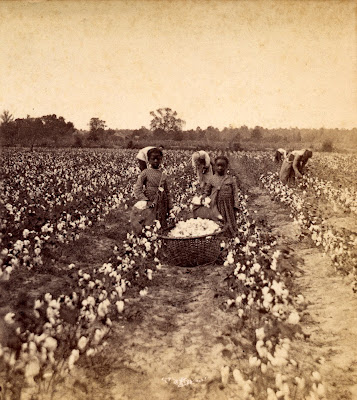
The hands are required to be in the cotton field as soon as it is light in the morning, and, with the exception of ten or fifteen minutes, which is given them at noon to swallow their allowance of cold bacon, they are not permitted to be a moment idle until it is too dark to see, and when the moon is full, they often times labor till the middle of the night. They do not dare to stop even at dinner time, nor return to the quarters, however late it be, until the order to halt is given by the driver.

The day's work over in the field, the baskets are "toted," or in other words, carried to the gin- house, where the cotton is weighed. No matter how fatigued and weary he may be- - no matter how much he longs for sleep and rest- - a slave never approaches the gin- house with his basket of cotton but with fear. If it falls short in weight- - if he has not performed the full task appointed him, he knows that he must suffer. And if he has exceeded it by ten or twenty pounds, in all probability his master will measure the next day's task accordingly. So, whether he has two little or too much, his approach to the gin- house is always with fear and trembling. Most frequently they have too little, and therefore it is they are are not anxious to leave the field. After weighing, follow the whippings; and then the baskets are carried to the cotton house, and their contents stored away like hay, all hands being sent in to tramp it down. If the cotton is not dry, instead of taking it to the gin- house at once, it is laid upon platforms, two feet high, and some three times as wide, covered with boards or plank, with narrow walks running between them.


This done, the labor of the day is not yet ended, by any means. Each one must then attend to his respective chores. One feeds the mules, another the swine- - another cuts the wood, and so forth; besides, the packing is all done by candle light. Finally, at a late hour, they reach the quarters, sleepy and overcome with the long day's toil. Then a fire must be kindled in the cabin, the corn ground in the small hand- mill, and supper, and dinner for the next day in the field, prepared. All that is allowed them is corn and bacon, which is given out at the corncrib and smoke- house every Sunday morning. Each one receives, as his weekly allowance, three and a half pounds of bacon, and corn enough to make a peck of meal. That is all- - no tea, coffee, sugar, and with the exception of a very scanty sprinkling now and then, no salt....


An hour before day light the horn is blown. Then the slaves arouse, prepare their breakfast, fill a gourd with water, in another deposit their dinner of cold bacon and corn cake, and hurry to the field again. It is an offense invariably followed by a flogging, to be found at the quarters after daybreak. Then the fears and labors of another day begin; and until its close there is no such thing as rest....

In the month of January, generally, the fourth and last picking is completed. Then commences the harvesting of corn....Ploughing, planting, picking cotton, gathering the corn, and pulling and burning stalks, occupies the whole of the four seasons of the year. Drawing and cutting wood, pressing cotton fattening and killing hogs are but incidental labors.


Source: Twelve Years a Slave: Narrative of Solomon Northrup (Auburn, N.Y., 1853).

Friday, May 6, 2011

Slave Grown Cotton in a Global Economy: Mississippi (1800-1860)

Mississippi History Now published an article in 2006 entitled, "Cotton in a Global Economy: Mississippi (1800-1860)," by Eugene R. Dattel that states, "William Faulkner, Mississippi’s most famous novelist, once said, “To understand the world, you have to understand a place like Mississippi.”


To the world, Mississippi was the epicenter of the cotton production phenomenon during the first half of the 19th century. The state was swept along by the global economic force created by its cotton production, the demand by cotton textile manufacturing in Europe, and New York’s financial and commercial dealings. Mississippi did not exist in a vacuum. So, in a sense, Faulkner’s words could be reversed: “To understand Mississippi, you have to understand the world.”
Mississippi’s social and economic histories in early statehood were driven by cotton and slave labor, and the two became intertwined in America. Cotton was a labor-intensive business, and the large number of workers required to grow and harvest cotton came from slave labor until the end of the American Civil War. Cotton was dependent on slavery and slavery was, to a large extent, dependent on cotton. After emancipation, African Americans were still identified with cotton production.

THE SLAVERY COMPROMISE


This particular chapter of the story of slavery in the United States starts at the Constitutional Convention of 1787 in Philadelphia, Pennsylvania. When the delegates wrote and agreed upon the Constitution, cotton production was virtually nonexistent in America. There were approximately 700,000 slaves in the United States at the time of the signing of the Constitution. The slave states of South Carolina and Georgia were adamant about having slavery protected by the Constitution. Connecticut’s Roger Sherman, one of the delegates who brokered the slavery compromise, assumed that the evil of slavery was “dying out … and would by degrees disappear.” He also thought that it was best to let the individual states decide about the legality of slavery. Thus, the delegates faced the question: should there be a United States with slavery, or no United States without slavery? The delegates chose a union with slavery.


Soon after the signing of the Constitution, cotton unexpectedly intervened in the 1790s and changed the course of America’s economic and racial future because of the simultaneous occurrence of two events: the mass production of textiles and the mass production of cotton. In the late 18th century, the process started in Great Britain where several inventions — the spinning jenny, Crompton’s spinning mule, and Cartwright’s power loom — revolutionized the textile industry. The improvements allowed cotton fabrics to be mass produced and, therefore, affordable to millions of people.

THE COTTON GIN


At the same time, Eli Whitney, a twenty-eight-year-old unemployed recent graduate of Yale University, journeyed to the South to become a tutor on a plantation. He soon became obsessed with the bottleneck in cotton production on his employer’s Georgia plantation. In 1793, the fledgling mechanic soon found a solution to the problem of cleaning cotton and the separation of the seed from the fiber. After a few months, he wrote the now-famous letter to his father in which he described his discovery: “I involuntarily happened to be thinking on the subject [of cleaning cotton] and struck out a plan of a Machine [to remove the cotton seed]…I concluded to relinquish my school and turn my attention to perfecting the Machine.” That machine was the cotton gin.


Whitney gave up his career as a teacher to devote full time to manufacturing cotton gins and making money. Sadly for Whitney, the cotton gin generated no profits because other manufacturers copied his design without paying him fees. He had obtained a patent on the cotton gin but it proved to be unenforceable. Whitney’s priorities, henceforth, were money and manufacturing. Whitney never seemed, as one historian noted, to care about slavery “one way or the other.”

DEMAND FOR COTTON


Whitney is given credit for unleashing the explosion of American cotton production which was, in turn, propelled by the seemingly insatiable appetite for cotton from the British cotton textile mills. A quick glance at the numbers shows what happened. American cotton production soared from 156,000 bales in 1800 to more than 4,000,000 bales in 1860 (a bale is a compressed bundle of cotton weighing between 400 and 500 pounds). This astonishing increase in supply did not cause a long-term decrease in the price of cotton. The cotton boom, however, was the main cause of the increased demand for slaves – the number of slaves in America grew from 700,000 in 1790 to 4,000,000 in 1860. A materialistic America was well aware of the fact that the price of a slave generally correlated to the price of cotton. Thus, the cotton economy controlled the destiny of African slaves.

Mill workers

By 1860, Great Britain, the world’s most powerful country, had become the birthplace of the industrial revolution, and a significant part of that nation’s industry was cotton textiles. Nearly 4,000,000 of Britain’s total population of 21,000,000 were dependent on cotton textile manufacturing. Nearly forty percent of Britain’s exports were cotton textiles. Seventy-five percent of the cotton that supplied Britain’s cotton mills came from the American South, and the labor that produced that cotton came from slaves.

Textile mill workers

Because of British demand, cotton was vital to the American economy. The Nobel Prize-winning economist, Douglass C. North, stated that cotton “was the most important proximate cause of expansion” in the 19th century American economy. Cotton accounted for over half of all American exports during the first half of the 19th century. The cotton market supported America’s ability to borrow money from abroad. It also fostered an enormous domestic trade in agricultural products from the West and manufactured goods from the East. In short, cotton helped tie the country together.


COTTON AND POPULATION

From the time of its gaining statehood in 1817 to 1860, Mississippi became the most dynamic and largest cotton-producing state in America. The population and cotton production statistics tell a simple, but significant story. The growth of Mississippi’s population before its admission to statehood and afterwards is distinctly correlated to the rise of cotton production. The white population grew from 5,179 in 1800 to 353,901 in 1860; the slave population correspondingly expanded from 3,489 to 436,631. Cotton production in Mississippi exploded from nothing in 1800 to 535.1 million pounds in 1859; Alabama ranked second with 440.5 million pounds.


MISSISSIPPI POPULATION


White “Free Colored” Slave Total
1800* 5,179 182 3,489 8,850
1810* 23,024 240 17,088 40,352
1830 70,443 519 65,659 136,621
1840 179,074 1,366 195,211 375,651
1850 295,718 930 309,878 606,526
1860 353,901 773 436,631 791,305
*Mississippi Territory (present-day Mississippi and Alabama)

MISSISSIPPI COTTON PRODUCTION
(millions of pounds)


1800 0
1833 70
1839 193.2
1849 194
1859 535.1

(Source: Cotton and the Growth of the American Economy: 1790-1860)

Cotton Gin

Mississippi and its neighbors – Alabama, western Georgia, Louisiana, Arkansas, and Texas – provided the cheap land that was suitable for cotton production. Cotton provoked a “gold rush” by attracting thousands of white men from the North and from older slave states along the Atlantic coast who came to make a quick fortune. Slaves were transported in a massive forced migration over land and by sea from the older slave states to the newer cotton states. In 1850, twenty-five percent of the population of New Orleans, Louisiana, was from the North and ten percent of the population in Mobile, Alabama, was former New Yorkers.

Native American Tribes of Mississippi

Mississippi attracted investors as well as residents. Auctions of cheap Indian lands as a result of cessions of land by the Choctaw and Chickasaw nations drew bidders from the South and East. For example, in the 1830s, the largest purchasers of Chickasaw land in Mississippi were the American Land Company and the New York Land Company. The two companies represented investors or speculators from New York, Boston, and other New Englanders.


New York City, not just Southern cities, was essential to the cotton world. By 1860, New York had become the capital of the South because of its dominant role in the cotton trade. New York rose to its preeminent position as the commercial and financial center of America because of cotton. It has been estimated that New York received forty percent of all cotton revenues since the city supplied insurance, shipping, and financing services and New York merchants sold goods to Southern planters. The trade with the South, which has been estimated at $200,000,000 annually, was an impressive sum at the time.

COMPLICITY OF WHITE AMERICA

New York Cotton Exchange

Most New Yorkers did not care that the cotton was produced by slaves because for them it became sanitized once it left the plantation. New Yorkers even dominated a booming slave trade in the 1850s. Although the importation of slaves into the United States had been prohibited in 1808, the temptation of the astronomical profits of the international slave trade was too strong for many New Yorkers. New York investors financed New York-based slave ships that sailed to West Africa to pick up African captives that were then sold in Cuba and Brazil.


In addition to dominating the slave trade, New York denied voting rights to its small free black population, which comprised only one percent of the population. New York accomplished this by imposing property ownership requirements for its free black residents, while white New Yorkers had no such restriction. New York's poor black population was effectively disfranchised. In 1857, seventy-five percent of Connecticut voters elected to deny suffrage to blacks, and even after the Civil War, voters there again denied black male residents the right to vote. Some western states, such as Indiana, Ohio, and Illinois, tried to exclude blacks at the same time they were aggressively recruiting millions of white European immigrants. White America, not just white southerners, helped determine that the destiny of black America would be in the cotton fields of the South for many decades to come.


On the eve of the Civil War, cotton provided the economic underpinnings of the Southern economy. Cotton gave the South power — both real and imagined. Cotton dictated the South’s huge role in a global economy that included Europe, New York, other New England states, and the American west. This economic growth exacted a severe and tragic human price through slavery and the prejudicial treatment of free blacks.


Mississippi was, therefore, both a captive of the cotton world and a major player in the 19th century global economy.


Eugene R. Dattel, a Mississippi native and economic historian, is a former international investment banker. His first book, The Sun That Never Rose, predicted Japan's economic stagnation in the 1990s. His next book, Cotton and Race in America (1787-1930): The Human Price of Economic Growth, will be published in 2007. (Posted October 2006 in the Mississippi Now).