Showing posts with label South Carolina Slavery. Show all posts

Wednesday, September 28, 2011

Black History In America: Boone Hall Plantation & Gardens in Mt. Pleasant, SC

Boone Plantation Slave Cabin

Boone Hall Plantation & Gardens in Mt. Pleasant, SC is proud to introduce a new groundbreaking addition to the Boone Hall experience. Visitors can now take a journey through our exciting new exhibit, "Black History In America."

Boone Plantation Slave Cabin

What really makes this exhibit unique is that this story will be told using eight of the original slave cabins located on Boone Hall Plantation. Each of the cabins on Slave Street present different themes in telling the black history story. Visitors are able to see the different aspects of daily life, how they worked and lived, struggles that were faced, as well as follow different periods of historical progression from the beginning all the way up to present day.

Boone Plantation Slave Cabin

Life size figures, pre-recorded narratives, audiovisual presentations, photos, pictures, biographical information, and actual historical relics, are interwoven and meshed together in displays throughout the cabins presenting this new exhibit.

Boone Plantation Slave Cabins

Themes for each cabin are as follows:
Boone Hall Plantation & Gardens in Mt. Pleasant, SC

Cabin 1 – Praise House
Cabin 2 – Slave Crafts
Cabin 3 – Their Life & Family
Cabin 4 – Archaeological Discoveries
Cabin 5 – Their Work and Life
Cabin 6 – Emancipation & Freedom
Cabin 7 – Struggle For Civil Rights
Cabin 8 – Heroes and Leaders
(http://boonehallplantation.com/beyond.php)

Boone Plantation Slave Cabin

The next part of our journey will take us past the original slave cabins along “the row of oaks,” as the driveway is referred to. For some people this part of the Boone Hall Plantation is their least favorite.
Boone Hall Plantation & Gardens in Mt. Pleasant, SC

As you approach the slave cabins you start to feel a sense of remorse that is, of course, unfounded. Nonetheless, you realize at this point that slavery was real in all its profound evil. As you peer into the blank windows of the cabins you see the meager living endured by thousands of slaves throughout time until abolishment.

Boone Plantation Slave Cabin

From the front door, to the right is usually the bed area, straight ahead is where food was often prepared and eaten, and finally off to the left is a small play or study area for the children. Along the way you come to some people that artistically recreate a craft originally brought over from Africa. That craft is basket weaving, which is very popular with the locals.

Boone Hall Plantation & Gardens in Mt. Pleasant, South Carolina

From the beginning all the way to the end of your tour, you will feel like you stepped into the past. You see what you might have done back then, in your mind. How life might have been, whether you would have liked to have been alive then, how the food would taste, all these things course through your mind like the Ashley River runs through the property. Sadness creeps up on you as you prepare to leave. As you turn back on the road leading away from the house, you know beyond a shadow of a doubt that you will return. (source: Hubpages)

Boone Hall Plantation & Gardens in Mt. Pleasant, SC

Boone Hall Plantation: Gullah Story About the Adam's Apple


Boone Hall Plantation in Mount Pleasant (boonehallplantation.com) has a walking tour of its slave cabin lane featuring different stories told in each of eight cabins – from the praise house churches, to the variety of jobs done by slaves, to the changed roles after emancipation, to the more recent struggle for civil rights. Boone Hall also puts on a live Gullah Theater presentation, celebrating the unique culture created by the slaves and their descendants along the sea islands.

Read more: The State

Boone Hall Plantation: Gullah Story About the Adam's Apple

Low Country Chapel Of Ease at St. Helena, South Carolina

During the Colonial period, chapels of ease were constructed by rice and cotton planters as houses of worship because their plantations were located so far from the churches in Beaufort. This tabby walled church was constructed between 1742 and 1747 for the planters of St. Helena Island. A forest fire destroyed most of it in 1886.

All that remain today are its tabby ruins and an adjacent cemetery. Tabby is a mixture of shell (an aggregate), lime (often made from burnt shells which serve as a cement), and water. It is put up in forms and allowed to harden. During the eighteenth and early nineteenth century, lowcountry planters used tabby to build not only their own dwellings, but also slave houses, dairies, barns, fences, and even some grave monuments. Tabby was used not because it was easy or particularly convenient, but because brick was in such short supply. Tabby tended to hold up very well, as long as its outer stucco "skin" was kept in good shape and as long as the building was "tied" together by internal timbers.

Chapel Of Ease at St. Helena, South Carolina

A quiet sea island in Beaufort County, St. Helena Island is perhaps best known for its historic connection to Gullah culture and language, still evident on the island today. The island is nestled between downtown Beaufort and the resort communities of Harbor Island and Fripp Island, so it enjoys the benefits of both rural and suburban life. The population of St. Helena (pronounced HEL-uh-nuh) hovers around 10,000. St. Helena is home to the Penn Center, a National Historic Landmark located on the site of one of the nation's first schools for freed slaves, which opened in 1862.

Chapel Of Ease's adjacent cemetery

Beaufort (pronounced "BU-fort") is the seat of Beaufort County, where Jean Ribault and his fellow Huguenots established Charlesfort in 1562. In French, "beau" means beautiful, handsome, lovely, or fine ... and after even the shortest of visits, you'll know both the city and county are aptly named. (Ironically, both are actually named for an Englishman, Henry Somerset, the Second Duke of Beaufort, who pronounced his name "BOW-fert," as in bow and arrow and Beaufort, North Carolina.)

Chapel of Ease


Monday, September 26, 2011

The State of South Carolina's Disdain Of The Value of Education

The State, South Carolina Homepage article "Nine ways the Civil War changed and continues to affect S.C.,"Sep. 25, 2011: 6. Disdain of the value of education

Before the Civil War, education in South Carolina was seen primarily as a private or religious affair. What value was there in educating a white farmhand or a black slave, which was, in fact, forbidden by law? On the eve of the war, only half the state’s white children had gone to school.
The state Constitution of 1868, written by African-Americans and Republicans during Reconstruction, established the right to a free public education for all for the first time. But, in impoverished post-war South Carolina, schools were poorly funded.

The post-war shift in the state’s limited wealth – from agricultural rural areas to industrial cities – accentuated the disparity between poor, inferior rural schools and better urban ones. South Carolina’s embrace of education also was slow and grudging. The state did not establish high schools until 1907, compulsory education until 1919 and a 12th grade until World War II, a move made after the military complained it had to reject too many S.C. draftees as uneducated or sickly.
South Carolina education lottery

In 1948, the state had 1,680 school districts. Funding ranged wildly from rural to urban schools, and black to white schools.

Then, black Clarendon County parents went to court, launching what would become the 1954 U.S. Supreme Court case that ended segregation. While education bills in the 1970s and 1980s sought to address school funding inequities, those issues remain unresolved, the subject of a more-than-decade-old court case, stuck in judicial limbo.

South Carolina education lottery

The passage of a lottery in 2000 was intended to help parents pay higher education costs. However, state funding of public colleges and universities – already among the lowest in the South – has dwindled. (source: The State, South Carolina Homepage)

Friday, September 2, 2011

Beautiful Wilmington, North Carolina Landmarks Built With Slave Labor

Thalian Hall Wilmington, NC


The Star News article"Civil War Anniversary - Traces of slavery still found in Wilmington," by Ben Steelman on 31 August 2011: When North Carolina seceded from the Union in 1861, nearly half of Wilmington's residents weren't consulted on the issue.


Out of a population of 9,552 in the 1860 federal census, 3,777 of those living in Wilmington were slaves. Another 573 were listed as "free persons of color," but African Americans were not allowed to vote in antebellum North Carolina, nor could they hold office.


And how did those slaves live?


Thalian Hall/City Hall, Wilmington, North Carolina


"Well, we can guess they worked long hours," said Gareth Evans, executive director of the Bellamy Mansion Museum at Fifth Avenue and Market Street. "There was lots of scrubbing, lots of emptying chamber pots, lots of toting water."


A century and a half after the Civil War, traces of the legacy of slavery can still be found in Wilmington.
Thalian Hall Wilmington, NC


Many of those traces can be found in some of its most impressive public buildings, such as the Thalian Hall/City Hall complex or the Bellamy Mansion itself.


Both of these structures were largely built by slave and free black labor by skilled craftsmen such as William B. Gould, a plasterer, or Abraham H. Galloway, a bricklayer who pocketed his own wages and paid his owner, Brunswick County planter Thomas Hankins, $15 per month.


Thalian Hall Wilmington, NC


"I remember the bricklayers, they was all colored," a former Wilmington slave recalled in a Depression-era interview for the federal Works Progress Administration and later compiled in George P. Rawick's "American Slave."


"The man that plastered the City Hall was named George Price, he plastered it inside. The men that plastered the City Hall outside, and put those columns up in front, their names was Robert Finey and William Finey, they both was colored. …


Thalian Hall/City Hall


"Yes'm they was slaves, mos' all the fine work 'round Wilmington was done by slaves. They called 'em artisans. None of 'em could read, but give them any plans, and they could follow them to the las' line."


Over at the Bellamy Mansion, now cased in glass, is palpable proof of the contributions. Some years ago, repairs revealed a piece of plaster with the florid signature of William B. Gould, the man who did the work.


Born in 1837, the son of an English father and a slave mother, Gould was a slave belonging to Nicholas Nixon, who owned a large plantation in what is now Porters Neck.


Bellamy Mansion Museum at Fifth Avenue and Market Street


Like many of the Wilmington slaves, however, Gould enjoyed considerably more liberty than slaves who were working on the rice plantations along the Cape Fear River or one of the "turpentine orchards" of the pine forests nearby.


Slaves in the building trades could, in effect, rent themselves out, usually in contracts that ran from the first of the year to the last. They gave their owners a share of what contractors paid them and kept the rest.


In some cases, if a slave was hardworking and lucky enough, he could save enough money to buy his own freedom and that of his family – if his owner would take the payment.


Rear View of the Bellamy Mansion, Wilmington, North Carolina


Still, life was not idyllic, even for these workmen. Slaves were closely scrutinized by the local law. Each night, a bell in the old Market House at the foot of Market Street tolled, signaling the curfew for the slaves.


In 1857, the 20-year-old bricklayer Abraham H. Galloway smuggled himself aboard a ship and sailed to freedom in the North. He could not make his payments to his master, Hankins, and apparently feared he would be shipped off to tougher work or sold to a meaner master, according to his biographer, historian David Cecelski.


Born in 1837 in Smithville (now Southport), Galloway, like Gould, had been the son of a white man, a Brunswick planter's son, and a slave woman. Wilmington would hear from him again.


Bellamy Mansion


In 1862, in the midst of the Civil War, Gould would escape as well. On the night of Sept. 21, he and seven other slaves slipped down to the riverfront, stole a small boat and began to row down the Cape Fear.


On a voyage that took a couple of days, hiding in the swamps by day, the eight slaves made their way down the Cape Fear River and out to sea, where they reached the Navy vessel USS Cambridge, which was part of the blockade of Wilmington.


Gould promptly enlisted in the U.S. Navy, serving for the rest of the war. He kept a journal of his wartime service, later published as "Diary of a Contraband" in 2002 by Stanford University Press. ("Contraband" was a Civil War term for an escaped slave.)


Urban Slave Quarters At The Bellamy Mansion In Wilmington, North Carolina


North Carolina forbade the teaching of slaves to read and write, but the law was widely ignored. Gould probably learned his letters in Sunday school at St. John's Episcopal Church, which he attended, said his great-grandson, William B. Gould IV, who edited the journals.


Not all Wilmington slaves, of course, were builders. At the Bellamy Mansion, Dr. John D. Bellamy and his family kept nine slaves: seven women, who worked as cooks and maids, and two men, Guy the butler and Tony the coachman who doubled as a handyman, according to Evans.


The women lived in a two-story brick dormitory building behind the house, apparently joined from time to time by the slaves of guests. (The slave quarters had a total of 10 privies, Evans noted.) Guy and Tony lived above the Bellamy stable, which is now the museum's visitors' center.

Slave Quarters Interior


The Spartan slave quarters are currently being restored with funding from a federal grant. Evans hopes the project can be completed by the end of the year.


Gould was not the only slave to leave a written account. James Johnson, born in 1847 in Smithville (Southport), was sold to a succession of Brunswick county boat builders and planters. He worked as a hostler (i.e., a stable groom), a field hand and as a coachman.


In a 15-page narrative, he recalled going out on Sundays "into the fields (to) scare the birds from the Indian corn and rice."


Life was tougher on the plantations. Johnson vividly recalled how his master tied him to a tree trunk and "flogged me until the blood streamed down my back, and then ordered some of the other Negroes to wash me in salt and water in order to cure my lacerated back as soon as possible."
Plantation Slave Quarters


As the Civil War broke out, Johnson noted that food grew more scarce. In the summer of 1862, like Gould, Johnson and some of his friends stole a boat and made their way to the Union blockader USS Stars and Stripes.


He made his way to England, working as a sailor and a boxer until he underwent a religious conversion. Later he traveled as an evangelist, leaving a written account of his life that Cecelski and Alex Meekins discovered in archives in Oldham, England.


After the war, Gould moved to Massachusetts, where he prospered as a building contractor and became active in the Grand Army of the Republic, a Union veterans' organization. He died in 1923, having seen all six of his sons serve in the armed forces in the Spanish-American War or World War I.


Bellamy Mansion Negro House c. 1859


Galloway's life was perhaps the most amazing. During the Civil War, he returned to North Carolina. Based in Union-occupied New Bern, he served as a Union spy and as a sometime recruiter of ex-slaves for the Union Army. After the war, he returned to Wilmington, where he became active in the Republican Party. He represented New Hanover County in the state's 1868 constitutional convention, then served in the state Senate until his death in 1870. Cecelski is currently writing a full-length biography of Galloway for the University of North Carolina Press, due for publication in 2012. (source: Star News, Ben Steelman, 31 Aug. 2011)


Tuesday, August 30, 2011

Richard Oswald: Slave trader, merchant

Richard Oswald: Slave trader, merchant and diplomat


Richard Oswald was the son of a Presbyterian minister. He was apprenticed to his cousins in Glasgow who had a successful trade in tobacco and he traveled to the Caribbean and the southern colonies of British North America on their behalf. In 1746 he moved to London and began his own business, initially supplying the army and Royal Navy as well as trading tobacco, but moving quickly into slaves and sugar. He augmented his business interests by marrying Mary Ramsay, the daughter of a wealthy Jamaican merchant. In 1747, he and several associates bought Bance (also Bunce or Bence) Island in the Sierra Leone river, one of the most active slave trading posts on the West African coast. Oswald built a golf course there for the benefit of white slave traders.
Bance (also Bunce or Bence) Island in the Sierra Leone river, one of the most active slave trading posts on the West African coast.
Oswald also acquired shares in slave ships, and plantations in the Caribbean, Florida and South Carolina. His ships could then carry slaves from Bance Island to plantations in the Americas and return to England with cargoes of sugar and tobacco. He was part of a group of Scottish merchants based in London who assisted each other financially, sharing their investments to spread the risk and ensure more reliable and consistent profits. Capital gained from investments in slavery financed investments in related products, such as tobacco and sugar production.


On July 25, 1782, official negotiations began. The preliminary articles were signed by Oswald for Great Britain, and John Adams, Benjamin Franklin, John Jay, and Henry Laurens for the United States on November 30, 1782. With almost no alterations, these articles were made into a treaty on September 3, 1783.


Most of the slaves Oswald traded were shipped to the southern colonies of British North America. One of his most important business associates there was the South Carolina planter and slave owner Henry Laurens. In 1781, Oswald lobbied successfully for Laurens' release after he was captured by the Royal Navy when he was returning from negotiating Dutch support for the American War of Independence. The following year, Oswald became an adviser to the British prime minister, Lord Shelburne. His knowledge of North America resulted in his appointment as one of the British negotiators at the 1783 Paris peace conference with the American colonies. Laurens was on the American team. The two sides agreed that the British should not take 'Negroes or other Property' from Americans when they withdrew from the American colonies.


Auchincruive House. Richard Oswald (a merchant from London, and a commissioner in Paris for peace negotiations with the Americans) bought the estate in 1764.
Oswald's London base was at Philpot Lane in the City of London, but his vast fortune enabled him to buy Auchincruive - an estate in Scotland where the Adam brothers built him a large house - as well as an extensive library and art collection. (BBC Business of Enslavement)

Friday, August 26, 2011

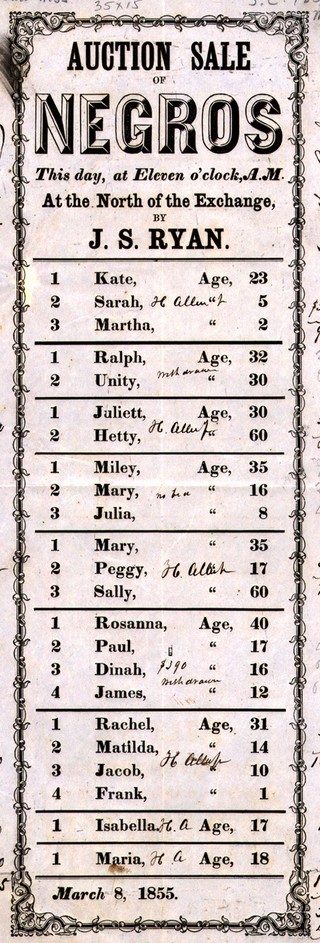
South Carolina Slave Auction Advertisement: March 5, 1855


Among the enslaved people who were sold at this particular auction in 1855, were 23 individuals that ranged from infants to 60 years old. Enslaved women represented an overwhelming majority of this sale (78%); Seventy percent (70%) were between the ages of 1-30 years old, 21% were between 31-40 years old and two 60 years old. This is a repeating pattern of the youthful skew of slaves who were sold at auction.


J.S. Ryan is the Old Slave Mart located in Charleston, South Carolina.

Monday, August 22, 2011

The Liquidated Slaves Of The William Barnwell Plantation House, Beaufort, South Carolina

The William Barnwell House is a historic Building in Beaufort, South Carolina and is a part of the Beaufort Historic District. It was built in 1816 by the critically acclaimed Gibbes Brothers for their sister, Sarah Reeve Gibbes. The property got its name from her husband, though, William Wigg Barnwell, who came from the prominent Beaufort family connected to Major William Hazzard Wigg, a Revolutionary War hero.


The William Barnwell House stayed with the Barnwells until 1895. It was then when the property was given to the city. The local government then used it as a schoolhouse, and then transformed it to an apartment building before shutting it down for disrepair. It was then rescued by the Historic Beaufort Foundation in 1973 from threats of demolition.

Estate Sale! By Order Of Executor. By Louis D. DeSaussure


On Wednesday, 19th Inst. at 11 o'clock a.m. will be sold in Charleston, South Carolina at the Ryan and Son's Mart in Chalmers Street, by the order of the Executor of the late Mr. and Mr. and Mrs. William Barnwell. A Prime Gang of 67 Negroes. Accustomed to the culture of Sea Island Cotton and Provisions, in Beaufort District. Amongst whom are several House Servants.


Conditions--One-third Cash; balance by Bond, bearing interest from day of sale payable in two equal Annual Instaments, to be secured by a Mortgage of the Negroes, and approved Personal Security. Purchasers to pay for papers.


The liquidation of the enslaved population of the William Barnwell Estate in Beaufort, South Carolina. According to the "List of Negroes," 70.1% 26 years old and under.


0-12 years old 18 26.8%
13-26 years old 29 43.8%
27-54 years old 18 26.8%
55- 70 years old 2 2%


Among the 18 children to be orphaned by this sale that are between the ages of 0-12 years old are: "Hector age 7, Affy age 5, Infant #1 nameless, Venus age 2, Young Patty age 3, Infant #2 without a name, Annie age 5, Ellen age 3, Isaiah a little 5 year old boy with one eye, Cimon age 3, Infant Mariah, Adam age 12, Infant Rose, an unsound Infant, Young Tannah 3 years old, and Jim age 10.


There were 29 teenagers and young adults between the ages of 13-26 years old. Children and teenagers represented the bulk of the enslaved population of the William Barnwell Plantation.


There were 18 adults between the ages of 27-55 years old, and only two people that were 70 years old.

Wednesday, July 13, 2011

Slavery at the South Carolina College in Columbia

Urban Slavery in Columbia, sc
DeSaussure College (1809) is the second-oldest building on campus, formerly the North Building and later Old North Building. Named for Carolina chancellor Henry William DeSaussure, it survived an earthquake in 1811 and a fire in 1851.
In the early 1800s, South Carolina College was a significant institution in the growing city of Columbia. In order to understand slavery on campus, it is necessary to examine the role of slaves in Columbia during this era. Contrary to popular belief, not all slaves lived on plantations. In some ways, urban slaves, such as those in Columbia, inhabited a very different world than their rural counterparts.
One major difference between urban and rural slavery was the high concentration of slaves in cities. Whereas great distances often separated small communities of rural slaves, urban slaves typically lived and worked in close proximity with one another. In 1830, approximately 1,500 slaves lived and worked in Columbia; this population grew to 3,300 by 1860. Some members of this large enslaved population worked in their masters’ households. Masters also frequently hired out slaves to Columbia residents and institutions, including South Carolina College. Hired-out slaves sometimes returned to their owner’s home daily; others boarded with their temporary masters.

The movement of slaves throughout Columbia fostered ample opportunities for interaction among blacks in public and private spaces. These relationships permitted communication among slaves and the city’s small community of free blacks. Legislators developed state and local statues to restrict the movement of urban slaves in hopes of preventing rebellion. Although various decrees established curfews and prohibited slaves from meeting and from learning to read and write, such rulings were difficult to enforce. Several prewar accounts note that many Columbia slaves were literate; some slaves even conducted classes to teach others to read and write. In spite of white efforts to prevent blacks from congregating, slaves and free blacks persevered to build a strong community of their own in Columbia.

Urban slaves also participated in white organizations throughout the city, though in limited roles. Many slaves attended services at local Baptist, Presbyterian, and Methodist churches, yet some struggled to obtain membership in these institutions. Jack, a college slave, applied for membership in the First Presbyterian Church in April 1820. Church leaders postponed this decision for nearly two years and consulted the college’s board of trustees regarding Jack’s character. Jack did not obtain membership before his death in 1822. Jack’s story reveals the close ties between campus slaves and their urban environment. It also provides evidence of whites’ utter disregard for the contributions of slaves throughout this period.

(source: http://slaveryatusc.weebly.com/urban-slavery-in-columbia.html)

Friday, June 24, 2011

South Carolina Slave Cabin Rescued and Restored

The Washington Times reported: CHARLESTON, S.C. | When Joe McGill spreads his sleeping bag on the floor of a slave cabin, he knows that spending the night there will conjure the specter of slavery.

Slave cabin before: "The two-room cabin "was in pretty bad shape. We managed to [salvage] maybe 50 percent of the original fabric," says Thomas Riddle, secondary social studies consultant at Greenville County Schools, who helped rescue the cabin. "We used many original wall studs, which were really cool because they were recycled from an earlier cabin. We used literally every scrap that we could." (source: National Trust for Historic Preservation)
"If I were a firm believer in ghosts and spirits and things of that nature, I don't think I could do this," said Mr. McGill, who is working to preserve buildings that are part of a past that many prefer to forget.

One night he heard dogs in the distance — a sound that recalled the search for runaways during slavery. He awoke on Mother's Day morning in a cabin thinking of children being sold from their mothers. Then he walked to the black graveyard on a plantation near Charleston.

"I thought, 'This is why I'm doing this — for those people in those graves to give them a voice for what they endured,'" said Mr. McGill, 48.

Mr. McGill, a program officer with the National Trust for Historic Preservation, spent Saturday night in a cabin at Hobcaw Barony near the coastal community of Georgetown.

The slave cabin after, with a new foundation, shingles, and framing, the cabin is scheduled to be dedicated Feb. 12, 2010. "The 23-by-16-foot structure was built before the Civil War by people enslaved by Dr. Thomas Blackburn Williams, and later became a home for families who worked on a nearby farm. The last occupants moved out in the early 1930s."(source: National Trust for Historic Preservation)
It was the fifth night this year that he has slept on a cabin floor, trying to attract attention to the need to preserve the structures and the history they hold.

Mr. McGill, who is black, is also a re-enactor with the 54th Massachusetts, the black Union regiment that fought at Battery Wagner on Charleston Harbor during the Civil War. He said that spending the night in the cabins helps him connect with his ancestors.

He first slept in a cabin at Boone Hall Plantation near Charleston a decade ago as part of a program for the History Channel titled "The Unfinished Civil War," which focused on the dispute over the Confederate flag flying over the South Carolina Statehouse.

During the past year, Joe McGill has slept in 22 former slave dwellings in six states. He does it to draw attention to the need to preserve the structures that are part of the heritage of blacks in America.
He has returned to the cabin project this year and meets with reporters wherever he goes to draw attention to the buildings. He said that preserving the cabins requires local efforts and his goal is to encourage people to save the ones that are left.

The cabins where Mr. McGill has stayed — such as those at Magnolia Plantation and Gardens near Charleston — have been restored, but many others have been neglected.

Mr. McGill started in May with a list from the State Historic Preservation Office showing cabins at about 30 sites. He thinks his effort is already helping because since he started the sleep-ins, three more cabins have been identified.

Magnolia Plantation Slave Quarters

He plans to sleep later this summer in a cabin in Anderson, in upstate South Carolina, and this fall in cabins in Alabama.

South Carolina once had thousands of slave cabins. Many did not survive because they were modestly constructed of wood or because people didn't want a connection with a dark chapter of history, Mr. McGill said.

Andy Chandler, who helps administer the National Register of Historic Places for the State Historic Preservation Office, said no firm figures are available on how many cabins are still standing in the state.

About 1,300 listings are on the register for South Carolina, and some may include sites with cabins. But, he said, since some sites have been on the register for decades, some of the cabins may not be there anymore. People who recommend sites for inclusion on the register don't always consider slave cabins worth mentioning. (source: The Washington Times)

Tours of the former slave cabin are available at the Rober Mountain Science Center's Living History Farm. The cabin was restored and moved from a site on Grove Road in Greenville. (GEORGE GARDNER/Staffer)

Slave cabin sleepovers