Showing posts with label transatlantic slavery. Show all posts

Thursday, June 30, 2011

The Trade In Men, Part 1 by W.E.B. DuBois

W.E.B. DuBois

Color was never a badge of slavery in the ancient or medieval world, nor has it been in the modern world outside of Christian states. Homer sings of a black man, a "reverend herald"

Of visage solemn, sad, but sable hue,
Short, woolly curls, o’erfleeced his bending head, . . .
Eurybiates, in whose large soul alone,
Ulysses viewed an image of his own.

Greece and Rome had their chief supplies of slaves from Europe and Asia. Egypt enslaved races of all colors, and if there were more blacks than others among her slaves, there were also more blacks among her nobles and Pharaohs, and both facts are explained by her racial origin and geographical position. The fall of Rome led to a cessation of the slave trade, but after a long interval came the white slave trade of the Saracens and Moors, and finally the modern trade in Negroes.
Slavery as it exists universally among primitive people is a system whereby captives in war are put to tasks about the homes and in the fields, thus releasing the warriors for systematic fighting and the women for leisure. Such slavery has been common among all peoples and was wide-spread in Africa. The relative number of African slaves under these conditions was small and the labor not hard; they were members of the family and might and did often rise to high position in the tribe.
Roman Slaves

Remembering that in the fifteenth century there was no great disparity between the civilization of Negroland and that of Europe, what made the striking difference in subsequent development? European civilization, cut off by physical barriers from further incursions of barbaric races, settled more and more to systematic industry and to the domination of one religion; African culture and industries were threatened by powerful barbarians from the west and central regions of the continent and by the Moors in the north, and Islam had only partially converted the leading peoples.
Egyptian Slaves

When, therefore, a demand for workmen arose in America, European exportation was limited by religious ties and economic stability. African exportation was encouraged not simply by the Christian attitude toward heathen, but also by the Moslem enmity toward the unconverted Negroes. Two great modern religions, therefore, agreed at least in the policy of enslaving heathen blacks, while the overthrow of black Askias by the Moors at Tenkadibou brought that economic chaos among the advanced Negro peoples and movement among the more barbarous tribes which proved of prime advantage to the development of a systematic trade in men.
Greek Slave

The modern slave trade began with the Mohammedan conquests in Africa, when heathen Negroes were seized to supply the harems, and as soldiers and servants. They were bought from the masters and seized in war, until the growing wealth and luxury of the conquerors demanded larger numbers. Then Negroes from the Egyptian Sudan, Abyssinia, and Zanzibar began to pass into Arabia, Persia, and India in increased numbers. As Negro kingdoms and tribes rose to power they found the slave trade lucrative and natural, since the raids in which slaves were captured were ordinary inter-tribal wars. It was not until the eighteenth and nineteenth centuries that the demand for slaves in Christian lands made slaves the object, and not the incident, of African wars.
Roman Slaves

In Mohammedan countries there were gleams of hope in slavery. In fiction and in truth the black slave had a chance. Once converted to Islam, he became a brother to the best, and the brotherhood of the faith was not the sort of idle lie that Christian slave masters made it. In Arabia black leaders arose like Antar; in India black slaves carved out principalities where their descendants still rule.

Muslim Slaves

Some Negro slaves were brought to Europe by the Spaniards in the fourteenth century, and a small trade was continued by the Portuguese, who conquered territory from the "tawny" Moors of North Africa in the early fifteenth century. Later, after their severe repulse at Al-Kasr-Al-Kabu, the Portuguese began to creep down the west coast in quest of trade.

They reached the River of Gold in 1441, and their story is that their leader seized certain free Moors and the next year exchanged them for ten black slaves, a target of hide, ostrich eggs, and some gold dust. The trade was easily justified on the ground that the Moors were Mohammedans and refused to be converted to Christianity, while heathen Negroes would be better subjects for conversion and stronger laborers. In the next few years a small number of Negroes continued to be imported into Spain and Portugal as servants. We find, for instance, in 1474, that Negro slaves were common in Seville.

There is a letter from Ferdinand and Isabella in the year 1474 to a celebrated Negro, Juan de Valladolid, commonly called the "Negro Count", (El Conde Negro), nominating him to the office of "Mayoral of the Negroes" in Seville. The slaves were apparently treated kindly, allowed to keep their own dances and festivals, and to have their own chief, who represented them in the courts, as against their own masters, and settled their private quarrels.

Between 1455 and 1492 little mention is made of slaves in the trade with Africa. Columbus is said to have suggested Negroes for America, but Ferdinand and Isabella refused. Nevertheless, by 1501, we have the first incidental mention of Negroes going to America in a declaration that Negro slaves "born in the power of Christians were to be allowed to pass to the Indies, and the officers of the royal revenue were to receive the money to be paid for their permits."

Monday, May 2, 2011

Liverpool Slave Connection

By Robert Barr, Associated Press
LIVERPOOL, England — Beatles lovers who seek out Penny Lane imagine it as that magical place "in my ears and in my eyes, there beneath the blue suburban skies." But it has a sinister undertone that still reverberates.

The street in Liverpool, home town of the Fab Four, is named after James Penny, a slave trader and investor in 11 voyages which took 500 to 600 captives at a time to the New World.


Penny was among the many who enriched themselves and their city on human trafficking until the slave trade was abolished 200 years ago. Their ships carried millions of human beings from West Africa to the plantations of the Americas in a triangular trade which also brought profitable cargoes of sugar, tobacco and rum to England.

Martins Bank - Liverpool

One of two panels at the public entrance to the Barclays (originally Martins) Bank building in Liverpool. It is a reminder of how Liverpool became a wealthy city, although the building itself is less than a century old, showing Neptune with his hands over two African slave children holding bags of money. If you download and zoom in you can make out the manacles on the wrists and ankles of the children (image and text from Flicker)


Liverpool's rise, says local historian Ray Costello, is summed up in the carving on a bank facade: two black children supporting Liverpool as Neptune.

"What it really means is that this bank was founded on the slave trade," Costello said.

It resonates all the more with the approach of the March 25 anniversary of the British parliamentary act that abolished the slave trade in Britain's colonies 200 years ago — though not slavery itself.

Liverpool's problem is its "hidden history — nobody wants to talk about it," said Eric Lynch, a black Liverpudlian who leads walking tours in the west coast city.

However, the past has not gone unacknowledged.

The city council formally apologized in 1999, expressing "shame and remorse for the city's role in this trade in human misery."


It has commissioned statues titled "Reconciliation," two abstract bronze figures embracing, which will be dedicated this year in Richmond, Va., and Benin, a West African port of call for Liverpool's slave ships.

Reconciliation statue

On Aug. 23, the anniversary of the slave uprising in French-ruled Haiti in 1791, Liverpool will open the International Slavery Museum. Part of its mission is recovering Liverpool's history, which remains a fraught issue.

Lynch, the tour guide, finds the echoes in the streets named for slave traders — Bamber, Banastre, Cunliffe, Gascoyne, Oldham, Seel, Tarleton; in a balcony railing made of chains by one of the businesses which depended on the trade; in the face of an African woman in the frieze around the ornate Town Hall.

Liverpool council member Barbara Mace last year proposed renaming streets associated with slavery, and was surprised to learn that Penny Lane was among them. After a lively controversy the proposal was withdrawn.

Liverpool was once the home of John Newton, the slave ship captain who became an ardent abolitionist and wrote the hymn "Amazing Grace."

The abolitionist Thomas Clarkson visited Liverpool in 1787, collecting horrifying stories from sailors and buying tools of the trade: chains, manacles, iron collars and branding irons which made effective publicity for William Wilberforce's 20-year campaign in Parliament to abolish the trade.


"By the end of the 19th century, a lot of rich families were trying to sanitize their wealth, and every trace of slavery they got rid of," said Costello, who has been researching the history of fellow blacks in his city for nearly half a century.

Liverpool: The new International Slavery Museum will include a state of the art education facility named after Anthony Walker. © Redman Design

What Liverpool needs to do, Costello says, is "take off its shades and see the blacks," who have been in the city since the 18th century but still find themselves mistaken for recent immigrants.

Blacks now represent 7% of the workforce in the city of 450,000.

Because the slaves sailed direct from Africa to the New World, Liverpool saw little of the trade at close quarters.

Richard Benjamin, director of the new museum, said that only 11 slaves are known to have been sold in the city. Some slaves who were given their freedom for fighting against the American Revolution made their way to Liverpool, while others came as crewmen on ships, Costello said.

The abolition act in 1807 was a milestone, but Britain waited another 26 years to outlaw slavery in the colonies; the United States followed in 1865 and Brazil in 1888.

Anti-Slavery International, founded by the leaders of Britain's abolition movement, estimates that 12 million people are in some form of slavery today, as bonded laborers or in the sex trade.

Slavery is now illegal everywhere, said Beth Herzfeld of Anti-Slavery International, but "laws today are not being implemented."

"We have to not just reflect on the reality and horrors of the slave trade but to see that people power had a very important role in overthrowing the trade, and that people today still have a role to play," she said.

Liverpool joined the slave trade in 1699 when a ship named Liverpool Merchant put to sea, carrying 220 slaves from West Africa to Barbados. Sir Thomas Johnson, a part-owner of the ship, is known as the founder of modern Liverpool; Sir Thomas Street is named for him.

By 1750, Liverpool had surpassed London and Bristol as a slave-trading port; 45 years later it controlled 80% of the British slave trade, representing two-fifths of the European total. In the peak year of 1798, 149 ships set off from Liverpool for Africa, officially with the capacity to carry 53,000 slaves.

By one accounting, Liverpool's traders transported 1,364,930 Africans in 5,249 voyages between 1699 and 1807.

Africans, often the captives of local chiefs, were paid for with cloth, kitchen pots and pans, muskets, gunpowder, flints, hats, mirrors, candles, beads and brandy.

A page displayed at the trans-Atlantic Slavery Gallery at the Maritime Museum in Liverpool details the profits of the voyage of the Enterprize in 1794. The ship sold 356 slaves and cleared a profit of 10,000 pounds — equivalent to about $2 million today.

Cutaway model of Slave ship. Liverpool Slavery Museum

It was a brutal trade, killing untold numbers of Africans in slave raids, by disease, shipwreck and mistreatment. Women captives were raped. Ship crews suffered heavy death rates from disease.

Alexander Falconbridge, a Bristol ship captain who became an abolitionist, said slaves on some ships were forced to lie on each other in crowded holds during a voyage of at least six weeks. Writing in 1788, he said, "the floor of their rooms was so covered with blood and mucus ... that it resembled a slaughterhouse. It is not in the power of the human imagination to picture to itself a situation more dreadful and disgusting."


Some denied it. Robert Norris, a former slave ship captain who was one of Liverpool's lobbyists in Parliament, claimed that after dinner the slaves aboard ship were given pipes, tobacco and musical instruments, "and when tired of music and dancing, they then go to games of chance."

Penny, another Liverpool lobbyist, told legislators that slaves slept aboard their ships "better than the gentlemen do on shore."

One of the worst atrocities was aboard the Liverpool slave ship Zong, which was wracked with disease; Capt. Luke Collingwood ordered the crew to throw 133 sick slaves overboard, then tried to claim against insurance for "loss of merchandise."

The abolitionist Granville Sharp demanded a murder prosecution, but the government's attorney responded: "It is madness; the blacks were property."


The Zong incident was one among many that fired the zeal of abolitionists — a mass movement built on networks of Quakers, with Sharp, Wilberforce and Clarkson in prominent leadership roles.


Josiah Wedgwood, the pottery pioneer, made an engraving of a kneeling slave in chains with the words "am I not a man and a brother?" Reproduced in the thousands on medallions, hat pins and brooches, it was worn by fashionable supporters of the cause.


In retrospect, the attitudes of some abolitionists now appear puzzling. Newton made two slave voyages even after being converted by the "amazing grace ... that saved a wretch like me."

"During the time I was engaged in the slave trade, I never had the least scruple as to its lawfulness. I was, upon the whole, satisfied with it, as the appointment Providence had marked out for me," Newton wrote.

However, he added, "I was sometimes shocked with an employment that was perpetually conversant with chains, bolts, and shackles."

Friday, April 29, 2011

Gullah of Hilton Head Island, South Carolina


The Gullah/Geechee people are descendants of enslaved Africans from various ethnic groups of west and central Africa. Brought to the New World and forced to work on the plantations of coastal South Carolina, Georgia, North Carolina and Florida, Gullah/Geechee people have retained many aspects of their African heritage due to the geographic barriers of the coastal landscape and the strong sense of place and family of Gullah/Geechee community members.

Today, the cultural and linguistic umbrella of the Gullah/Geechee Cultural Heritage Corridor extends from Wilmington, NC to Jacksonville, FL. People who identify as Gullah or Geechee represent the many ways that Africans in the Americas have held on to and amalgamated the traditions of Africa with the cultures they encountered both during and after enslavement.


Gullah of Hilton Head Island, South Carolina


See also:
Low Country Sweet Grass Basket Weaving
Charles Kuralt's America: South Carolina Low Country
Gullah Grub

Sunday, April 24, 2011

Moko Jumbies


ST.CROIX, U.S. VIRGIN ISLANDS–Five-year-old Willard John didn't see his destiny when he stared up at the moko jumbie stilt dancer towering over him ... he was just plain scared.

"When you're that small, and looking at a 13- or 14-foot character on stilts, it's definitely scary!" says the now-58-year-old St. Croix stilt dancer, who has made it his life's work to pass along the lively, lofty art form of his African ancestors.

The colourful craft of stilt dancing came to the Caribbean with enslaved West Africans, who brought their culture and indigenous religions with them.

The "moko" or "mocker" was the spiritual guardian of African villages, tall enough to reach the evil spirits, and drive them off by mocking them with supernatural, magical powers.

It's believed that another job of the African moko jumbie was to frighten children into adulthood – so maybe Willard had good reason to be scared as a kid.

Moko jumbie stilt dancing is mesmerizing. Rhythmic sounds of African drums evoke the spirits, while masked stilt dancers in colourful costumes appear from nowhere – gliding, almost floating in thin air.
"This current generation of stilt dancers has taken the art form to a level never seen before, skilfully combining dancing and acrobatics with complex synchronized choreography," says Mr. John of his gifted students at the Guardians of Culture Moko Jumbies and Moko Jumbie Academy."
The Caribbean moko jumbies combined influences from different religions of Africa, Europe and their new environment," says the stilt dancing historian, pointing out that in the mid-1800s the traditional costume in the U.S. Virgin Islands was a European woman's dress, adorned with African motifs, and petticoats underneath.

"It wasn't until the 1960s, after too many curious people kept trying to look up under the dress and upsetting the precarious balance of the stilt dancers, that pants became part of the modern costume," he laughs.

Whether in pants or a dress, moko jumbie stilt dancing is just as hard as it looks.

"It's very physical and very taxing to your muscles and your bones," says John, who has been performing the gliding, almost slow-motion movements on metres-high stilts for 34 years now, and is "planning to do this when I'm 100."

"The passion that I had when I first got on my stilts and did my first parade in 1975 – that passion and spirituality is still there today. And I've got all these young people around me, so I'm encouraged to keep up with them," says the talented teacher of his pleasure in sharing this leggy legacy.

"The art form originated in Africa and I want to always remind people of its spiritual African origins."

Willard John's passionate plan to preserve the moko jumbie legacy in St. Croix is just one history lesson to be learned in colourful classrooms throughout the island, full of vivid reminders of its African and European heritage.


Papa Moco Jumbie


It's carnival time in my town today
So papa & I get our costumes ready
Oh I cannot wait for everybody to see
when papa stands on his stilts
he becomes a moco jumbie

My papa's a moco jumbie
Stands tall as the eyes can see
I wish I was tall as daddy
He dances to bring harmony
Come on son, dance with me
I know I may be small but I wish I was tall
So for the carnival day I could moco jumbie my way

My papa's a moco jumbie
Stands tall as the eyes can see
I wish I was tall as daddy
He dances to bring harmony
and now he's dancing with me

And while I may be small we came up with a way
So for the carnival day I could moco jumbie my way

Me and my papa today, dancing down the carnival way

Wednesday, April 20, 2011

Scottish Tobacco Slave Money

Glasgow and tobacco

When settlers in North America started cultivating tobacco using slave labour, the economies of Virginia and Maryland were transformed. A small group of Glaswegian merchants dominated the booming transatlantic tobacco trade.


Scottish merchants created tobacco trading networks in Virginia, and by 1760 Glasgow had overtaken London as the main importer of tobacco. The influence of the powerful Glaswegian merchants spread throughout the Americas (often buying into estates in the Caribbean). Their most lasting influence can be seen in some of the major roads and buildings in Glasgow. Many of the old streets of Glasgow (Buchanan, Glassford, Ingram and Dunlop) testify to the success of the tobacco barons.

Buchanan Street, Glasgow, Scotland, UK

One of the city's most impressive buildings was built in 1778 by William Cunninghame, a prominent Glaswegian tobacco baron. Cunninghame headed one of three major syndicates that controlled the flow of tobacco into Scotland. He developed a string of outlets and representatives in the tobacco colonies, which bought tobacco from the planters and stored it until Cunninghame's ships arrived. Cunninghame's trading system was one of the most efficient and swift in the North Atlantic and it yielded enormous profits.


He invested some of these profits in Cunninghame Mansion. This townhouse cost a staggering £10,000 to build and is thought to be one of the finest houses in Scotland. After his death it became part of the Royal Bank of Scotland, later an exchange for local merchants, then part of the telephone exchange. In 1996 it became the Gallery of Modern Art. It stands today as a reminder of Glasgow's links to tobacco cultivated by enslaved people, and the profits tobacco yielded to the major Scottish merchants who dominated the trade.

source: BBC

Thursday, March 24, 2011

Report On The Maroons of Jamaica, 1865

A CURIOUS CHAPTER IN NEGRO HISTORY.; The Maroons of Jamaica-- Their Origin and their Present Position.

In the accounts published by the Jamaica newspapers of the late negro insurrection in that island, we find it stated that a people called the Maroons were called upon by the governor of the colony to assist in suppressing the outbreak, and that they rendered prompt and valuable aid to both the civil and military authorities in the disturbed district. The following is the proclamation that was issued to them by His Excellency the Governor at the commencement of the disturbances:

Maroons of Jamaica! We have great trust in you as loyal subjects of the Crown!

In times gone by you did the Crown good service!

Your services are again required! You may earn rewards and honor by your loyalty!

A brutal, murderous, and barbarous insurrection has broken out in St. Thomas in the East! Peaceable, unoffending men (who have ever been your friends) have been killed!

The Governor and the government call upon you to join our forces, and of yourselves separately, to do all that lies in your power to assist to put down this murderous outbreak.

Martial law has been proclaimed!

A reward of $2,000 will be paid to you or to any one, who will take PAUL BOGLE, a principal ringleader, and $500 for any ringleader in these outrages.

Seize and hand over to the nearest military station any of the rebellions people wherever you may find them, and for so doing, and for any information you may give to any of our magistrates, officers, soldiers, or other persons in authority, you will in due time be suitably rewarded.

Issued under the authority of His Excellency the Governor and Executive Committee.

God save the Queen.

It will be seen, from the opening sentences of this address, that the Maroons of Jamaica have a history, and as many people, after reading the recent news from that island, have expressed a curiosity to know who the Maroons are, we propose briefly to relate their history.

As to race, the Maroons are negroes -- pure blacks. As to habitat, several thousands of them are to be found in Jamaica, dwelling in mountain settlements or townships of their own, apart from the other portion of the black population. For a time a number of them found a home in the British Province of Nova Scotia, but were subsequently removed to Sierra Leone, where they have intermingled with the native African population. How these case to be separated from their brethren in Jamaica, first becoming dwellers in the wintry North, and afterward finding their way to "fatherland," will appear in the sequel.

In the year 1655, an English combined naval and military expedition, under the joint command of PENN and VENABLES, was sent out by CROMWELL for the conquest of the Island of St. Domingo; but having failed in that object, those commanders, unwilling to return to England without having something commensurate to the importance of their enterprise, turned their attention to the Island of Jamaica -- at that time belonging to Spain -- and soon made themselves masters of it. The Spanish inhabitants are said to have possessed before the attack of the English about 1,500 enslaved Africans, most of whom, on the surrender of their masters, retreated to the mountain fastnesses of the island, from whence they made frequent excursions to harass the English.

Maj.-Gen. SEDGWICK, one of the British officers, in a letter to Secretary THURLOE, (1656,) predicted that these blacks would prove a thorn in the sides of the English; adding, that they gave no quarter to his men, but destroyed them whenever they found an opportunity, scarcely a week passing without their wounding one or more of them; and as the soldiers became more confident and careless, the negroes grew more enterprising and bloody-minded. The General's prediction was verified by events, and the English soon found it necessary to employ a military force for the subjugation of these dangerous neighbors.
After years of irregular warfare, and of varying successes on both sides, the blacks at length found themselves so hard pressed by the English, that the main body of them, under the command of a negro named JUAN DE BOLAS, whose place of retreat in the Parish of Clarendon (Jamaica) still retains his name, solicited peace, and surrendered to the English on terms of pardon and freedom. A large party, however, remained in their retreats within the mountains, where they not only augmented their numbers by natural increase, but after the island became more thickly sown with plantations, they were frequently reinforced by fugitive slaves. These becoming more confident, made frequent raids on the interior plantations, and intimidated the whites from venturing to any considerable distance from the sea-coast.

This was the origin of the Maroons. According to Mr. LONG, the historian of Jamaica, the word maroon signifies, among the Spanish Americans, hog-hunter, the woods at that time abounding with the wild boar, and the pursuit of them constituting the chief employment of the fugitive negroes. But BRYAN EDWARDS, who wrote a history of the West Indies toward the end of the last century, says that, according to the Encyclopedie -- a French work -- the term is derived from the Spanish word simaram, which signifies a monkey, and was applied to the fugitive negroes because, like that animal, they retreated into the depths of the woods, coming out only to collect the fruits to be found in the immediate neighborhood of their retreats.

The Maroons proved troublesome and indomitrule foes to the English settlers. Forces were repeatedly sent out against them, but every attempt to subjugate them tailed. They continued to distress the island for upwards of forty years, during which time, says LONG, forty-four acts of Assembly were passed, and at least £240,000 expended for their suppression; and in 1730 they were grown so formidable, under a very able General named CUDJOE, that it was found necessary to strengthen the colony against them by two regiments of regular troops, which were afterward formed into independent companies, and employed, with other hired parties, for their reduction. All this failed. Resort was then had to the Mosquito Indians, who, it was thought, would be more than a match for the Maroons in bush-fighting. Two hundred of those people were accordingly imported into Jamaica, and employed against the dreaded enemy. But the Maroons baffled the Indians, and continued to bid defiance to the colonists, who, in their extremity, were compelled to advise Governor TRELAWNEY, in 1738, to propose overtures of peace to the chiefs. These overtures were accepted; articles of pacification were signed; and certain lands in the island, amounting in the whole to several thousand acres, were assigned to the Maroons in perpetuity. The preamble of the articles is curious and is worth transcribing here. It is as follows:
"In the name of God, amen. Whereas Capt. CUDJOE, Capt. ACCOMPONG, Capt. JOHNNY, Capt. CUFFEE, Capt. QUACO, (all African names, except Johnny,) and several other negroes, their dependents and adherents, have been in a state of war and hostility for several years past against our sovereign Lord the King and the inhabitants of this island; and whereas, peace and friendship among mankind, and the preventing the effusion of blood is agreeable to God, consonant to reason and desired by every good man; and whereas, His Majesty King GEORGE H., King of Great Britain, France, and Ireland, of Jamaica Lord, Defender of the Faith, &c., has by his letters patent dated February the 24th, 1738, granted full power and authority to JOHN GUTHRIE and FRANCIS SADLER, Esquires, to negotiate and finally conclude a treaty of peace and friendship with the aforesaid Capt. CUDJOE, and the rest of the captains, adherents, and others his men, they mutually, sincerely, and amicably have agreed to the following articles," &c., &c.

According to this treaty the Maroons were to reside within certain boundaries, apart, from allother negroes.
Jamaican Maroon Map 1794

Peace having been thus established, the Maroons settled upon the lands which had been assigned them, and employed themselves in a sort of rude tillage, which was performed principally by the women, while the young men hunted the wild boar, whose flesh they prepared for market by a peculiar process of their own, in which no salt was used. They were employed also by the plantars in capturing slaves who had run away from the plantations, receiving so much per head for the fugitive negroes they took. For nearly sixty years they gave no further trouble to the colonists; but in 1795 they once more raised the standard of revolt. The cause of this outbreak, known in Jamaica history as the "Maroon war," was a trifling incident; but the conduct of the Maroons on the occasion shows the spirit of that people. It appears that one of their number at Trolawney Town had been convicted before the Magistrate on a charge of having stolen two pigs, and was sentenced to receive thirty-nine lashes. The flogging was given by the black overseer of the prison in which the negro slaves were confined for punishment; and that a Maroon should be treated like a slave -- flogged like a slave by a black overseer -- aroused the indignation of these people, who forthwith flew to arms to avenge their wounded honor.


Negotiation was tried by the whites, and failed. The aged men and the more moderate among the Maroons counseled prudence and forbearance, but the younger and more impetuous spurned this advice, and hostilities were commenced. Troops in considerable numbers were sent against them in their mountain settlements, but for months they succeeded in keeping the military at bay, cutting off several detachments of soldiers, both of the regulars and militia; while they occasionally sallied forth from their fastnesses, burning plantations and killing the white people living on them. At length, as a dernier ressort, the expedient was hit upon of employing Spanish bloodhounds to track them in the woods, and one hundred of these ferocious animals, accompanied by forty chasseurs, or hunters, were imported from the Island of Cuba for that purpose. No sooner did the Maroons hear of the arrival of these dogs than they expressed a willingness to come to terms, and soon after a treaty was concluded, the principal conditions being that the Maroons should ask pardon of the King on their knees -- that the Legislature of the colony should fix their residence in such part of the island as it might think proper -- and that the Maroons should deliver up all the fugitive slaves living among them.
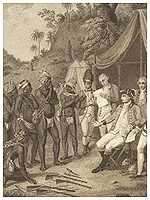
Peace was thus restored; but on the plea that the Maroons had failed to comply with the last-named condition, the Legislature, instead of assigning them lands for a new settlement in some other part of Jamaica, adopted a resolution to transport the late belligerents in a body from the colony. Accordingly in June, 1796, six hundred of them were shipped off to Nova Scotia, where they settled; but after a few years, on the ground that they were found intractable and troublesome, they were deported to the black settlement of Sierra Leone.

The conduct of the Assembly in causing these people to be transported was considered by many at the time a gross breach of faith, and Gen. WALPOLE, who commanded the forces that had been employed in their subjugation, and concluded the treaty of peace with them, declined to receive a sword, for which the Assembly had voted the sum of five hundred guineas, as an acknowledgment of his valuable services. There were three other settlements of the Maroons in Jamaica, but these not having been drawn into hostilities, were allowed to remain; and it is to their descendants, who still live very much as their fathers lived in the last century, that Gov. EYRE issued his proclamation during the late troubles in that island. The services to which the Governor refers, as rendered by the Maroons to the Crown in times past are, we suppose, the share of military duty they bore during a rebellion of the slaves in the parish of St. Mary, Jamaica, in the year 1760, and the assistance they gave to the militia toward the suppression of the negro revolt of 1831-32, when the slaves in the western part of the island rose in insurrection.

Tuesday, March 22, 2011

PBS Secrets Of The Dead: Slave Ship Mutiny


PBS Program: Secrets of the Dead "Slave Ship Mutiny"


When the Meermin set sail from Madagascar for South Africa on a hot summer’s day in 1766, the Dutch crew had no idea they were about to make history. The ship was filled to capacity with human cargo, slaves bound for hard labor building the Dutch West India Company’s colony at Cape Town.

But the Meermin with its crew and cargo would never make it to Cape Town. Instead, in a dramatic altercation, the slaves mutinied and managed to overpower the Dutch crew, ordering the ship be sailed back to Madagascar and freedom. But the crew of experience sailors deceived the slaves and turned the boat around each evening to make for Cape Town. And so the circumstances for a dramatic climax – and shipwreck – were laid when the ship and its desperate passengers finally spied land.

Watch the "Slave Ship Mutiny" as it tracks the efforts of archaeologists, historians and slave descendants to discover the full story of this dramatic historical event. They want to learn what happened on the Meermin, how the slaves were able to overpower their captors, and why the ship ended up wrecked on a wild, windswept beach 200 miles east of Cape Town.


The slave ship Meermin set sail from Madagascar for South Africa in 1766, but the ship would never make it to Cape Town, the slaves mutinied and managed to overpower the Dutch crew, ordering the ship be sailed back to Madagascar and freedom.Watch the full episode. See more Secrets of the Dead.

The Slave Ship Zong Case


William Turner, Slave Ship (Slavers Throwing Overboard the Dead and Dying, Typhoon Coming On), 1840


The Zong Massacre was an infamous mass-killing of African slaves that took place on the Zong, a British ship owned by James Gregson and colleagues in a Liverpool slave-ship firm. The resulting court case was a landmark in the battle against the African Slave Trade of the eighteenth century.(source Nation Master)

The Zong was a Dutch ship which had been captured by the British. Its original name, Zorg (Dutch for 'care') was misread as Zong.(source Nation Master)


The Zong left Sao Tomé, an island off the west coast of Africa, on September 6, 1781 carrying some 170 slaves and a crew of 17 en route to England on the Middle Passage captained by Sir Luke Collingwood. Its first destination was to be Jamaica. On November 27, 1781 it arrived at an island which the crew believed to be Jamaica.(source Nation Master)


The ship had taken on more slaves than it could safely transport. By November 29, 1781, this overcrowding, together with malnutrition and disease, had killed seven of the crew and approximately sixty African slaves - Captain Collingwood decided to throw the remaining sick slaves overboard.
Captain Collingwood

He assumed that as the slaves were considered in law to be cargo he could claim the loss against the insurance policy so, as the ship's insurance would not pay for sick slaves or slaves that died of illness, gave orders for the 133 slaves to be drowned. The policy allowed that if a slave went over the side alive, then the Liverpool ship-owners could claim but that if a slave died on board, then the insurers would not pay because that would be deemed to be bad cargo management and therefore not covered by the policy. Later, it was claimed that the slaves had been jettisoned because it was required "for the safety of the ship" as the ship did not have enough water to keep them alive for the rest of the voyage. This claim was later disproved; the ship had 420 gallons of water left on arrival on December 22 in Jamaica.(source Nation Master)

The ship´s owners brought a suit against the insurers,which came to court, twice, in March 1783, demanding to be paid £30 for each slave. The British court stated that there was ”no doubt that (though it shocks one very much) the case was the same as if horses had been thrown overboard” and ruled that the ship-owners could not claim insurance on the slaves because the lack of sufficient water demonstrated that the cargo had been badly managed. No officers or crew, however, were charged or prosecuted for the calculated killing of 133 people.

Indeed, the Solicitor-General, John Lee, declared that a master could drown slaves without “a surmise of impropriety”. He stated: "What is this claim that human people have been thrown overboard? This is a case of chattels or goods.Blacks are goods and property;it is madness to accuse these well-serving honourable men of murder. They acted out of necessity and in the most appropriate manner for the cause. The late Captain Collingwood acted in the interest of his ship to protect the safety of his crew.To question the judgement of an experienced well-travelled captain held in the highest regard is one of folly, especially when talking of slaves.The case is the same as if horses had been thrown overboard." (source Nation Master)