Showing posts with label Revolutionary War. Show all posts

Thursday, August 18, 2011

Thomas Jefferson's Broken Promise to Thaddeus Kosciuszko

History Network News article, "Why We Should All Regret Jefferson's Broken Promise to Thaddeus Kosciuszko," by Gary B. Nash and Graham Russell Gao Hodges .

Thomas Jefferson


In March 1798, Tadeuz Kościuszko, a hero of the American and Polish revolutions, and Thomas Jefferson, Vice President of the United States, huddled in a cramped second-story room in Philadelphia to make a pact of honor centered on the Pole’s sizable American estate. Kościuszko, who had returned to the United States to a hero’s welcome less than a year before, anxiously wanted to leave for Paris to avoid entrapment by the Alien and Sedition acts. (Jefferson, estranged from President John Adams and hoping to use Kosciuszko’s prestige on a secret mission to convince the French not to wage war with the United States, prepared a fake passport for Kosciusko.) Before the Pole departed, he and Jefferson constructed a will to dispose of $15,000 (Kosciuszko’s Revolutionary pay) after his death. The two men labored together to produce a document with the potential to alter American history.
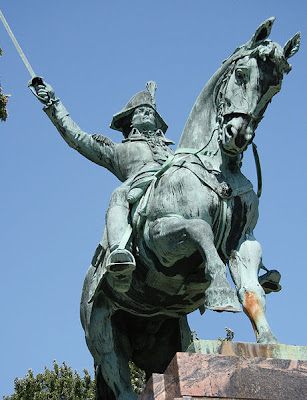

Tadeuz Kościuszko


Kościuszko’s first version deserves quotation. Though the spelling and syntax are eye-straining, the crude yet eloquent prose convey how passionately the romantic Polish revolutionary had embraced abolitionism.


I beg Mr. Jefferson that in the case I should die without will or testament he should bye out of my money So many Negroes and free them, that the restante [remaining] sums should be Sufficient to give them aducation and provide for thier maintenance, that . . . each should know before, the duty of a Cytyzen in the free Government, that he must defend his country against foreign as well as internal Enemies who would wish to change the Constitution for the worst to inslave them by degree afterwards, to have good and human heart Sensible for the Sufferings of others, each must be married and have 100 Ackres of land, wyth instruments, Cattle for tillage and know how to manage and Gouvern it well as well to know [how to] behave to neyboughs [neighbors], always wyth Kindnes and ready to help them . . . . T. Kościuszko.


Thomas Jefferson


In this unconventional but emotion-packed will, Kościuszko expressed the convictions and commitments that made him such an admirable man for black Americans. Drawing on his long-standing belief that the downtrodden could prosper--peasants, as well as slaves--if given their freedom under favorable conditions, he tried to promote universal liberty and give Jefferson the opportunity to lead Southerners in a quest to remove the stain of slavery from the new nation.


Tadeuz Kościuszko


A second revised will, entirely in Kościuszko’s hand like the first, included a change of immense significance. Rather than the vague reference in the original version to use Kościuszko’s legacy to free “so many Negroes,” the rewritten will specified that “I do hereby declare and direct that should I make no other testamentary disposition of my property in the United States I hereby authorize my friend Thomas Jefferson to employ the whole thereof in purchasing Negroes from among his own or any others.” Kościuszko surely made this crucial change with Jefferson’s consent, for Jefferson agreed to be the executor, as well as the beneficiary, of the will. Was Jefferson thinking of Sally Hemings, her daughter Harriet who was now not quite three, and the newborn Beverley, born just ten days before Jefferson witnessed Kościuszko’s signing of the will?


Jefferson endorsed Kościuszko’s scheme with a full heart, regarding the Pole as “the truest son of liberty I have even known.” For Jefferson, a promise at any time was a serious matter; but given freely under these conditions, it was to be held sacred. And for the next twenty years, Jefferson did not waver in his commitment to his Polish friend, maintaining a warm correspondence with Kosciuszko and, as they grew old together on opposite sides of the Atlantic, even invited him to live out his last years at Monticello and bury his bones alongside those of the Sage of Monticello.


Thomas Jefferson


Kosciuszko died on October 15, 1817. After several years of vacillation, Jefferson withdrew from his pact of honor with Kosciuszko by pleading in a Virginia court in Charlottesville that he could not serve as executor of his friend’s estate and would not use the money to free his slaves. As William Lloyd Garrison would say many years later, “What an all-conquering influence must have attended his illustrious example,” if he had taken the lead to abolish slavery. Merrill Peterson, for all his admiration for Jefferson, was anguished by this retreat: “The object of [Kosciuszko’s] will was lost. Had Jefferson felt stronger about the object, he would have ventured the experiment, despite statutory obstacles and the shortness of years, for the experiment [of freeing his slaves] was one he often commended to others and, indeed, one he may have himself suggested to Kosciuszko.”
Tadeuz Kościuszko
Thaddeus Kosciuszko was one of the first European volunteers to aid the American revolutionary cause in 1776. A brilliant Polish military engineer, Kosciuszko designed and constructed fortifications to help defeat the British, most notably at Saratoga and West Point in New York.


Why did Jefferson, while throwing himself energetically into the creation of the University of Virginia, plead that he was too old and tired to carry out Kosciuszko’s will and betray the trust of his Polish compatriot? One of the key reasons was Jefferson’s allegiance to the Old Dominion aristocracy and his devotion to sustaining the economic and cultural leverage of the white South in national politics. He also feared offending friends, especially slaveowners already shaken by the actions of others in Virginia who had released slaves from bondage. In a time when we are accustomed to seeing President George W. Bush reject scientific analysis on fearsome problems, stack regulatory commissions with those devoted to non-regulation, and stake out policy positions on the basis of insider friends and their deep-pocket interests, this earlier abandonment of an honor-bound pact with Kosciuszko has a peculiar odor.


As Kosciuszko’s will, abandoned by Jefferson, made its way through the courts, many complications arose. The estate was finally awarded by the Supreme Court in 1852, 26 years after most of Jefferson’s slaves had been auctioned on the rolling lawn at Monticello to extinguish his debts, to Kosciuszko’s descendants. For years in Poland, Kosciuszko’s countrymen held the view that the American Civil War could have been averted if the Polish hero’s philanthropic, abolitionist plan had been implemented. When the slaves at Monticello mounted the auction block to be sold off after the Founding Father died—the slaves that could have been freed if Kosciuszko’s will had been honored—a small-town editor in a Susquehanna River town asked how Jefferson, “surely the champion of civil liberty to the American people,” left “so many human beings in fetters to be indiscriminately sold to the highest bidder." In biting words, the editor wrote: “Heaven inspired Jefferson with the knowledge ‘that all men are created equal.’ He was not forgetful—in his last moments he ‘commended his soul to God, and his daughter to his country;’ but to whom did he commend his wretched slaves?"


Polish Son of Liberty: Thaddeus Kosciuszko

THADDEUS KOSCIUSZKO: A POLISH SON OF LIBERTY


Visitors to the battlements at Ticonderoga, the Saratoga Battlefield, and West Point soon become aware of the engineering genius of a young Polish officer who served with distinction in the Continental Army through, out the American Revolution. In addition, students of ethnic history can point to this same modest nobleman as an early benefactor of American blacks.


For Tadeusz Andrzej Bonawentura Kosciuszko, the principles expressed in the Declaration of Independence became a way of life. Thomas Jefferson, its author and Kosciuszko's close friend, called him "the purest son of liberty . . . that I have ever known, the kind of liberty which extends to all, not only to the rich." Throughout a long lifetime (1746-.1817) the idealistic Pole directed all his energies and substance to the cause of freedom in America and in his native Poland, and to humanitarian endeavors on two continents.


Born into a "land poor" family of the Polish gentry, Thaddeus Kosciuszko received a "gentleman's" education, with emphasis on the classics, mathematics, drawing, and French, followed by three years as student and instructor at the Royal School for cadets at Warsaw where he attained the rank of captain. A royal stipend then enabled the promising young officer to spend five years in France where he studied government and economics as well as engineering, military science, architecture, and art. (Called by his contemporaries "a beautiful limner," he executed likenesses of various leaders of the American Revolution, including a pastel portrait of Jefferson and a devastating caricature of the controversial General Charles Lee.)


On his return to Poland in 1774 he found no market for his talents and, following an unfortunate love affair. he borrowed money on his share of the family estate and went to Dresden. Reports of the American Revolution fired his imagination. Taking passage, he appeared in Philadelphia in August, 1776, and offered his credentials to the Continental Congress.
Thomas Jefferson


Military engineers were in short supply, and Congress gave him an appointment with the rank of colonel, in charge of fortifying the Delaware River at two points. In the spring of 1777 General Horatio Gates invited Kosciuszko to inspect the fortifications then underway at Fort Ticonderoga. Finding blockhouses "all erected in the most improper places," nevertheless, as a foreigner, he hesitated to impose his own plan. "I would choose rather to leave all, return home and plant Cabbages," he re ported.


He remained to assist in the construction of the log boom bridge that linked "Ti" with Mount Independence and supervised the fortification of that eminence as well as works on the Ticonderoga side. Kosciuszko's superiors disregarded his advice to mount guns on Sugar Loaf Hill. A few weeks later Burgoyne advanced on Ticonderoga, and on July 5 the Americans faced a British battery atop Sugar Loaf (renamed Mount Defiance) and were forced to evacuate the fort.


In the ensuing American retreat Kosciuszko ordered obstructions placed in the path of the British. demolished bridges, and rendered Wood Creek unnavigable. On him rested the responsibility of selecting and fortifying camps and posts. He constructed numerous fortifications at Van Schaick's Island and on Haver Island. north of Albany. But his great achievement was the selection and fortification of Bemis Heights, where Burgoyne was defeated in the decisive Battle of Saratoga in October, 1777.


The ability to get along well with people (in contrast to certain other foreign officers) as well as his reputation as a capable engineer won the soft-spoken, genial Pole an appointment in March, 1778 as "Chief Engineer of the Middle Department" in charge of the fortification …f West Point. In the twenty-eight months he remained at West Point he constructed a chain of redoubts and forts, the principal one being Fort Putnam, and transformed the highlands wilderness into a bastion which effectively deterred British invasion up the Hudson.


In a rocky valley the gentle aristocrat laid out a private retreat -- a garden [still to be seen at West Point) with a fountain and cascades -- carrying soil by hand to nurture the flowers he planted. Also at West Point there re mains a tradition that he shared his meager rations with British prisoners there. The Australian grandson of one of these prisoners some decades later repaid this kindness by taking care of a Polish traveler in Australia who would otherwise have died of yellow fever.


Kosciuszko left West Point in August, 1780 and served the remainder of the war under General Nathanael Greene in the South. Returning north in 1783, he was admitted to the Order of the Cincinnati and promoted to brigadier general. On November 25, 1 783 he took part in Washington's triumphal march into New York City and is believed to have been present at Fraunces Tavern when Washington bade farewell to his officers.


In 1784 he returned to Poland where he lived a simple life in his country home, leaving it to lead a Polish army in several attempts to free Poland from Russian control, thereby becoming a national hero. He returned to the United States in 1797-1798 and visited his Revolutionary War friends. Congress then granted him $15,000 due in back pay for his wartime service and gave him a land grant of 500 acres in Ohio. Kosciuszko had freed his own serfs or reduced their service. His years in the American South had aroused his compassion for American slaves. Before he returned to Europe in 1798 he drew up a will, appointing Jefferson executor and directing that the money from the sale of his Ohio land be used to purchase and free slaves and provide for their education. After his death this land became Ohio State University. The proceeds were to be used to found a school for blacks in Newark, New Jersey, but Thomas Jefferson just gave black people the middle finger.


from: THE CORRESPONDENT (1972), The New York State American Revolution Bicentennial

Sunday, April 3, 2011

Lord Dunmore's Proclamation


A proclamation.

As I have ever entertained Hopes that an Accommodation might have taken Place between Great-Britain and this colony, without being compelled by my Duty to this most disagreeable but now absolutely necessary Step, rendered so by a Body of armed Men unlawfully assembled, bring on His Majesty’s [Tenders], and the formation of an Army, and that Army now on their March to attack His Majesty’s troops and destroy the well disposed Subjects of this Colony. To defeat such unreasonable Purposes, and that all such Traitors, and their Abetters, may be brought to Justice, and that the Peace, and good Order of this Colony may be again restored, which the ordinary Course of the Civil Law is unable to effect; I have thought fit to issue this my Proclamation, hereby declaring, that until the aforefaid good Purposes can be obtained, I do in Virtue of the Power and Authority to me given, by His Majesty, determine to execute Martial Law, and cause the same to be executed throughout this Colony: and to the end that Peace and good Order may the sooner be [effected], I do require every Person capable of bearing Arms, to [resort] to His Majesty’s standard, or be looked upon as Traitors to His Majesty’s Crown and Government, and thereby become liable to the Penalty the Law inflicts upon such Offences; such as forfeiture of Life, confiscation of Lands, &c. &c. And I do hereby further declare all indentured Servants, Negroes, or others, (appertaining to Rebels,) free that are able and willing to bear Arms, they joining His Majesty’s Troops as soon as may be, for the more speedily reducing this Colony to a proper Sense of their Duty, to His Majesty’s Leige Subjects, to retain their [Quitrents], or any other Taxes due or that may become due, in their own Custody, till such Time as Peace may be again restored to this at present most unhappy Country, or demanded of them for their former salutary Purposes, by Officers properly authorised to receive the same.

Given under my Hand on board the ship William, off Norpole, the 7th Day of November, in the sixteenth Year of His Majesty’s Reign.

Dunmore.

(God save the King.)


By November 14, 1775, when John Murray, Earl of Dunmore and royal governor of Virginia, issued his proclamation, his plan to offer freedom to slaves who would leave their patriot masters and join the royal forces was already well underway.


Dunmore understood that such an act would have a wide-ranging effect. Not only would it disrupt production, it was also feed the growing fear among the colonists of armed slave insurrections. Planters would be distracted from waging war against Britain by the necessity of protecting their families and property from an internal threat. At the same time, Dunmore's own force of 300 soldiers, seamen and loyalist recruits, cut off from the support of British troops in Boston, would be reinforced by black fighting men and laborers.

Word of Dunmore's plan was known as early as April, when a group of slaves presented themselves to him to volunteer their services. He delayed the decision by ordering them away, but the Virginia slaveholders' suspicions were not allayed. On June 8, 1775, Dunmore left Williamsburg, taking refuge aboard the man-of-war Fowey at Yorktown. Over the next five months, he reinforced his troops by engaging in a series of raids and inviting slaves aboard the ship. On November 7, Dunmore drafted a proclamation, and a week later he ordered its publication. It declared martial law and adjudged the patriots as traitors to the Crown; more importantly, it declared "all indented servants, Negroes, or others...free that are able and willing to bear arms..."


Response from the colonists was immediate. Newspapers published the proclamation in full, and patrols on land and water were intensified. Throughout the colonies, restrictions on slave meetings were tightened. The Virginia Gazette warned slaves to "Be not then...tempted by the proclamation to ruin your selves" and urged them to "cling to their kind masters," citing the fact that Dunmore himself was a slave holder.

In December, the Virginia Convention issued its own proclamation as a broadside, declaring that runaways to the British would be pardoned if they returned in ten days, but would be severely punished if they did not. The document began with a reminder of the penalty for slave insurrection -- death without benefit of clergy -- though in practice, it was used sparingly during the war.

By then, 300 black men had been inducted into "Lord Dunmore's Ethiopian Regiment," armed, and outfitted in military uniforms inscribed with the words "Liberty to Slaves." By early June, however, Dunmore's forces had been decimated by smallpox and the patriot's defenses. In August, the British destroyed over half of their own ships and sailed out of the Potomac, taking the 300 healthiest blacks with them.

Although probably no more than 800 slaves actually succeeded in reaching Dunmore's lines, word of the proclamation inspired as many as 100,000 to risk everything in an effort to be free. (soruce: PBS)