Showing posts with label slave narrative. Show all posts

Saturday, May 7, 2011

Twelve Years a Slave: Narrative of Solomon Northrup

"THERE IS NO SUCH THING AS REST"

Solomon Northrup was a free black who was kidnapped in New York and sold into slavery for twelve years. He was finally returned to freedom through the efforts of New York's governor. In the following selection he describes how cotton was raised on his Louisiana plantation.

The hands are required to be in the cotton field as soon as it is light in the morning, and, with the exception of ten or fifteen minutes, which is given them at noon to swallow their allowance of cold bacon, they are not permitted to be a moment idle until it is too dark to see, and when the moon is full, they often times labor till the middle of the night. They do not dare to stop even at dinner time, nor return to the quarters, however late it be, until the order to halt is given by the driver.
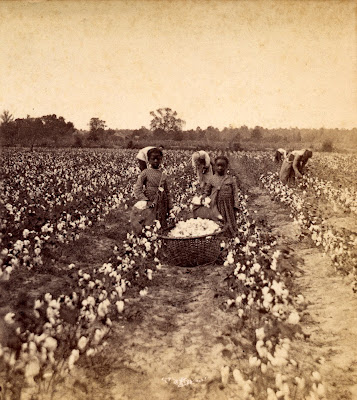
The day's work over in the field, the baskets are "toted," or in other words, carried to the gin- house, where the cotton is weighed. No matter how fatigued and weary he may be- - no matter how much he longs for sleep and rest- - a slave never approaches the gin- house with his basket of cotton but with fear. If it falls short in weight- - if he has not performed the full task appointed him, he knows that he must suffer. And if he has exceeded it by ten or twenty pounds, in all probability his master will measure the next day's task accordingly. So, whether he has two little or too much, his approach to the gin- house is always with fear and trembling. Most frequently they have too little, and therefore it is they are are not anxious to leave the field. After weighing, follow the whippings; and then the baskets are carried to the cotton house, and their contents stored away like hay, all hands being sent in to tramp it down. If the cotton is not dry, instead of taking it to the gin- house at once, it is laid upon platforms, two feet high, and some three times as wide, covered with boards or plank, with narrow walks running between them.


This done, the labor of the day is not yet ended, by any means. Each one must then attend to his respective chores. One feeds the mules, another the swine- - another cuts the wood, and so forth; besides, the packing is all done by candle light. Finally, at a late hour, they reach the quarters, sleepy and overcome with the long day's toil. Then a fire must be kindled in the cabin, the corn ground in the small hand- mill, and supper, and dinner for the next day in the field, prepared. All that is allowed them is corn and bacon, which is given out at the corncrib and smoke- house every Sunday morning. Each one receives, as his weekly allowance, three and a half pounds of bacon, and corn enough to make a peck of meal. That is all- - no tea, coffee, sugar, and with the exception of a very scanty sprinkling now and then, no salt....


An hour before day light the horn is blown. Then the slaves arouse, prepare their breakfast, fill a gourd with water, in another deposit their dinner of cold bacon and corn cake, and hurry to the field again. It is an offense invariably followed by a flogging, to be found at the quarters after daybreak. Then the fears and labors of another day begin; and until its close there is no such thing as rest....

In the month of January, generally, the fourth and last picking is completed. Then commences the harvesting of corn....Ploughing, planting, picking cotton, gathering the corn, and pulling and burning stalks, occupies the whole of the four seasons of the year. Drawing and cutting wood, pressing cotton fattening and killing hogs are but incidental labors.


Source: Twelve Years a Slave: Narrative of Solomon Northrup (Auburn, N.Y., 1853).

Tuesday, April 26, 2011

Frederick Douglass on Slavery

Frederick Douglass

"If at any one time of my life more than another, I was made to drink the bitterest dregs of slavery, that time was during the first six months of my stay with Mr. Covey. We were worked in all weathers. It was never too hot or too cold; it could never rain, blow, hail, or snow, too hard for us to work in the field. Work, work, work, was scarcely more the order of the day than of the night. The longest days were too short for him, and the shortest nights too long for him. I was somewhat unmanageable when I first went there, but a few months of this discipline tamed me. Mr. Covey succeeded in breaking me. I was broken in body, soul, and spirit. My natural elasticity was crushed, my intellect languished, the disposition to read departed, the cheerful spark that lingered about my eye died; the dark night of slavery closed in upon me; and behold a man transformed into a brute!" -- Frederick Douglass, 1845

___________

Frederick Douglass, Narrative of the Life of Frederick Douglass, An American Slave, Written by Himself, (Boston: Anti-Slavery Office, 1845); reprint, edited with an introduction by David W. Blight (Boston: Bedford Books, 1993), 74.

Born in Slavery

My own Mammy, Mary, was the master's own daughter. Master told all the slave drivers to leave her alone and not whip her. This made the overseers jealous of her and caused trouble. John Sanders was one of the white overseers who treated her bad, and after I was born and got strong enough (I was a weakling for three-four years after birth), to do light chores he would whip me just for the fun of it. It was fun for him but not for me. I hoped to whip him when I grew up. That is the one thing I won't ever forget. He died about the end of the War so that's one thing I won't ever get to do. --Salomon Oliver

The master of the house was better to us than the mistress. We didn't have to work very hard, because we was so young, I guess. We cut weeds along the fences, pulled weeds in the garden and helped the mistress with the hoeing. We had to feed the stock, sheep, hogs, and calves, because the young masters wouldn't do the work. In the evening we were made to knit a finger width and if we missed a stitch we would have to pull all the yarn out and do it over. The master's girls taught us to read and write. We didn't have hardly any clothes and most of the time they was just rags. We went barefoot until it got real cold. Our feet would crack open from the cold and bleed. We would sit down bawl and cry because it hurt so. Mother made moccasins for our feet from old pants. Late in the fall master would go to Hannibal or Palmyra and bring us shoes and clothes. We got those things only once a year. I had to wear the young master's overalls for underwear and linseys for a dress. --Emma Knight

I was owned by Charles Mitchell until I was 15 years old. They were fairly nice to all of their slaves and they had several of us. I only got whipped once in the whole 15 years there. (That was because I was working in the garden with one of the owner's daughters and I pulled up something that she did not want pulled up, so she up and slapped me for it. I got so mad at her, I [chased her into the house] and of course I got whipped for that.) I did not even have to sleep in the cabins. I slept on a pallet in the bedrooms with old marse's children. I was a pet anywhere I worked, because I was always very neat and clean, and a good worker. When I was 15 years old, I was brought to the courthouse, put up on the auction block to be sold....for $1500. That broke my father's heart.... --Delicia Patterson

I's hear tell of dem good slave days but I ain't nev'r seen no good times den.... I recollects once when I was tryin' to clean de house like old miss tell me, I finds a biscuit and I's so hungry I et it, 'cause we nev'r see sich a thing as a biscuit only some times on Sunday mornin'. We jes have corn braid and syrup and some times fat bacon, but when I et dat biscuit and she comes in and say, "Whar dat biscuit?" I say, "Miss, I et it 'cause I's so hungry." Den she grab dat broom and start to beatin' me over de head wid it... and I guess I jet' clean lost my head 'cause I know'd better dan to fight her if I knowed anything 'tall, but I start to fight her and de driver, he comes in and he grabs me and starts beatin' me wid dat cat-o'-nine-tails, and he beats me 'til I fall to the floor nearly dead. He cut my back all to pieces, den dey rubs salt in de cuts for mo' punishment. Lawd, Lawd, honey! Dem was awful days. When de ole marster come to de house he say, "What you beat dat nigger like dat for?" And the driver tells him why, and he say, "She can't work now for a week...." He sho' was mad and he tell ole miss she start de whole mess. I still got dem scars on my ole back right now, jes' like my grandmother have when she die and I's a-carryin' mine right on to do grave jes' like she did. --Jenny Proctor

Husbands allays went to de woods when dey know de wives was due fo' a whippin', but in de fiel' dey dare not leave. Had to stay dere, not darin' even to look like dey didn't like it. Charlie Jones was one slave dat had his wife workin' in de same fiel' wid him [planting tobacco in Virginia].... Annie was big wid chile an' gittin' near her time, so one day she made a slip an' chopped a young shoot down. Old man Diggs, de overseer, come runnin' up screamin' at her an' it made her mo' nervous, an' she chopped off 'nother one. Ole overseer lif' up dat rawhide an' beat Annie 'cross de back an shoulders 'till she fell to de groun'. An' Charlie he jus' stood dere hearin' his wife scream an' astarin' at de sky, not darin' to look at her or even say a word. --Jordan Johnson

Grandma said slaves had to pick so many pounds of cotton a day, and they were given an awful whippin' if they didn't get this amount. My grandma said she was small and just couldn't get her proper amount, but was jolly and always ran to get water for the other slaves when they wanted it. At the end of the day one of the men would tell another, "Give that little gal five pounds of cotton, She's all right." When they evened her up, she wouldn't get a beatin', but lots of time she would come up short and would have to take the whippin'. All the slaves who had fallen short had to stand in line with their backs bare for their whippin'. Grandma said that often she was whipped until she could barely grunt. --W.P. Jacobs


Monday, March 7, 2011

Henry In A Box: Mailed To Freedom


The baggage handlers ignored the "This Side Up With Care" label and rudely shoved the wooden box onto the steamship deck with those words exactly on the bottom. They would certainly have been surprised to learn that inside the crate was a man—Henry Brown, a Richmond slave who was mailing himself to freedom.

Brown was fully prepared to "conquer or die" on his mission, and at that point the latter looked more likely. Positioned upside down, he felt his eyes and the veins in his face begin "swelling as if they would burst." He endured for an hour and a half until two men flipped the box on its side to sit on it. The swelling subsided; his head cleared. Henry Brown, it seemed, just might conquer his bondage, after all.
Born in Louisa County, Va., in 1815, Brown's natural intelligence was quickly noticed by his master, who allowed him to go on errands as he grew older. On those trips off the plantation, Brown devoured any knowledge of the world at large he could gain.

When Brown was 15, his "uncommonly kind" master died, and he was sent to work in Richmond's tobacco industry. While there, he witnessed the retaliations against blacks brought on by Nat Turner's failed 1831 slave revolt, and saw bondsmen whipped, hanged and beaten in the streets. He also endured the vagaries of a series of overseers and experienced firsthand that there was "no law by which the master may be punished for his cruelty."
He married a woman named Nancy and then had to experience one of the most heartbreaking aspects of slave existence when she and their three children were sold away to North Carolina in 1848. Brown watched his wife, children and other slaves pass by on their way out of town. As the miserable gaggle walked on, he resolved to escape their fate, and it was not long before he came upon the idea of "shutting myself up in a box, and getting myself conveyed as dry goods to a free state."

Brown enlisted the aid of James C.A. Smith, a free black, and Samuel Smith, a white storekeeper who helped for a price. Brown paid him $86 that he had managed to squirrel away in exchange for Smith arranging shipment to Philadelphia abolitionist James Miller McKim.

On March 29, 1849, Brown squeezed his 5-foot-8-inch, 200-pound frame into a wooden crate 3 feet long, 2 feet wide and 2.6 feet deep. With "three gimlet holes" opposite his face for air and fortified only with a bladder of water, he began his "battle of liberty," as he called it, at Richmond's express office.
He bumped and thumped for 27 hours as the box went from wagon, railroad baggage car, the deck of that miserable steamboat, wagon, another railroad car, ferry, railroad car yet again, and the final delivery wagon that took him to McKim's home in Philadelphia.

McKim and a group of abolitionist friends were awaiting their special delivery, and gathered around the box. Brown kept quiet. Finally, he heard someone ask, "Is all right within?" He replied, "All right.'' The box was broken open. Brown tried to stand and promptly passed out, but he had won his battle for liberty.

Henry "Box" Brown and his escape became a cause celebre in the North, but Southerners saw his escape as more Yankee meddling with their property, and pushed even harder for passage of the Fugitive Slave Act, which would force the federal government to help return escaped slaves. When that act passed in 1850, Brown had to flee to England.

Brown enjoyed his life in England. He published his autobiography and dramatized his escape onstage. He remarried and in 1875 returned to the United States. The man who mailed himself to freedom died in 1879.


REPRESENTATION OF THE BOX,

In which a fellow mortal travelled a long journey, in quest of those rights which the piety and republicanism of this country denied to him, the right to possess.

As long as the temples of humanity contain a single worshipper, whose heart beats in unison with that of the God of the universe; must a religion and a government which could inflict such misery upon a human being, be execrated and fled from, as a bright angel, abhors and flees the touch of hideous sin.

(source: Narrative of Henry Box Brown, Who Escaped from Slavery, Enclosed in a Box Three Feet Long, Two Wide, and Two and a Half High. Written from a Statement of Facts Made by Himself. With Remarks Upon the Remedy for Slavery, by Charles Stearns "Henry Box Brown," 1849)

Wednesday, September 30, 2009

'What we are in justice entitled to': A 1865 letter from a freedman

'What we are in justice entitled to':
A 1865 letter from a freedman


To My Old Master, Colonel P.H. Anderson, Big Spring, Tennessee

Sir:


I got your letter and was glad to find you had not forgotten Jourdon, and that you wanted me to come back and live with you again, promising to do better for me than anybody else can. I have often felt uneasy about you. I thought the Yankees would have hung
you long before this for harboring Rebs they found at your house. I suppose they never heard about your going to Col. Martin's to kill the Union soldier that was left by his company in their stable. Although you shot at me twice before I left you, I did not want to hear of your being hurt, and am glad you are still living. It would do me good to go back to the dear old home again and see Miss mary and Miss Martha and Allen, Esther, Green, and Lee. Give my love to them all, and tell them I hope we will meet in the better world, if not in this. I would have gone back to see you all when I was working in the Nashville hospital, but one of the neighbors told me Henry intended to shoot me if he ever got a chance.

I want to know particularly what the good chance is you propose to give me. I am doing tolerably well here; I get $25 a month, with victuals and clothing; have a comfortable home for Mandy (the folks here call her Mrs. Anderson), and the children, Milly, Jane and Grundy, go to school and are learning well; the teacher
says grundy has a head for a preacher. They go to Sunday- School, and Mandy and me attend church regularly. We are kindly treated; sometimes we overhear others saying, "The colored people were slaves" down in Tennessee. The children feel hurt when they hear such remarks, but I tell them it was no disgrace in Tennessee to belong to Col. Anderson. Many darkies would have been proud, as I used to was, to call you master. Now, if you will write and say what wages you will give me, I will be better able to decide whether it would be to my advantage to move back again.
A
s to my freedom, which you say I can have, there is nothing to be gained on that score, as I got my free- papers in 1864 from the Provost- Marshal- General of the Department of Nashville. Mandy says she would be afraid to go back without some proof that you are sincerely disposed to treat us justly and kindly -- and we have concluded to test your sincerity by asking you to send us our wages for the time we served you. This will make us forget and forgive old scores, and rely on your justice and friendship in the future. I served you faithfully for thirty- two years and Mandy twenty years. At $25 a month for me, and $2 a week for Mandy, our earnings would amount to $11,680. Add to this the interest for the time our wages has been kept back and deduct what you paid for our clothing and three doctor's visits to me, and pulling a tooth for Mandy, and the balance will show what we are in justice entitled to. Please send the money by Adams Express, in care of V. Winters, esq, Dayton, Ohio. If you fail to pay us for faithful labors in the past we can have little faith in your promises in the future. We trust the good Maker has opened your eyes to the wrongs which you and your fathers have done to me and my fathers, in making us toil for you for generations without recompense. Here I draw my wages every Saturday night, but in Tennessee there was never any pay day for the Negroes any more than for the horses and cows. Surely there will be a day of reckoning for those who defraud the laborer of his hire.

In answering this letter please state if there would be any safety for my Mil
ly and Jane, who are now grown up and both good- looking girls. You know how it was with Matilda and Catherine. I would rather stay here and starve and die if it comes to that than have my girls brought to shame by the violence and wickedness of their young masters. You will also please state if there has been any schools opened for the colored children in your neighborhood, the great desire of my life now is to give my children an education, and have them form virtuous habits.

P.S. -- Say howdy to George Carter, and thank him for taking the pistol from you when you were shooting at me.


From your old servant,


Jourdon Anderson