Showing posts with label British slavery. Show all posts

Tuesday, August 30, 2011

Lloyds of London Insurance for the Slave Trade

Because in all of the whole human race
Mrs Lovett, there are two kinds of men and only two
There's the one they put in his proper place
And the one with his foot in the other one's face
Look at me, Mrs Lovett, look at you. (Sweeney Todd lyrics)


A history of insurance starting with Lloyd’s of London


Lloyd’s of London is neither a company nor a corporation. It is basically a British insurance market. It serves as a meeting place where multiple financial backers or “members”, whether individuals, who are known as “Names” or corporations, come together to pool and spread risk. Their main business is in the reinsurance market.
The market began in Edward Lloyd’s coffeehouse around 1688 in Tower Street, London. His establishment was a popular place for sailors, merchants, and ship owners. Lloyd’s main business with his customers was to provide reliable shipping news, which he gleaned from all his different customers and then fed back to them. The shipping industry community frequented the place to discuss insurance deals among themselves.


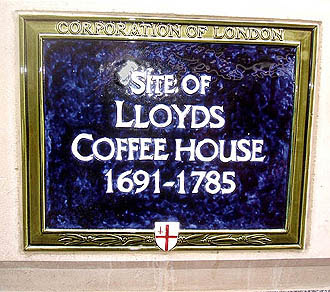
Soon after Christmas in 1691, the coffee shop moved to Lombard Street, where today a blue plaque commemorates its location. Long after Lloyd’s death in 1713 the arrangement continued until 1774 when the participating members of the insurance arrangement formed a committee and moved to the Royal Exchange, and called itself The Society of Lloyd’s.

Between 1688 and 1807, slave trading became one of the primary constituents of all British trade, and the dangers in the slave trade meant that insurance of the ships was of major concern. The insurance of ships engaged in slave trading became one of the primary sources of Lloyd’s business as Britain established itself as the chief slave trading power in the Atlantic. With slave-trading forming such a prominent part of Lloyd’s business, the organization was one of the chief opponents to the abolition of the slave trade.


In 1838 the Exchange burned down and, although rebuilt, many of Lloyd’s early records were lost. In 1871, the first Lloyd’s Act was passed in Parliament which elevated the business to a legal footing. The Lloyd’s Act of 1911 set out the Society’s objectives, which include the promotion of its members’ interests and the collection and dissemination of information.


It soon became apparent that the membership of the Society, which was largely made up of market participants, was too small in relation to the risks that it was underwriting and the small market capitalization. Lloyd’s commissioned a secret internal inquiry, known as the Cromer Report, which reported in 1968. This report advocated the widening of membership to non-market participants, including non-British subjects and women, and to reduce the onerous capitalization requirements, which created a minor investor known as a ‘mini-Name’. (source: Health Insurance Net)


There's a hole in the world like a great black pit
and the vermin of the world inhabit it
and its morals aren't worth what a pig can spit
and it goes by the name of London...
At the top of the hole sit the privileged few
Making mock of the vermin in the lonely zoo
turning beauty to filth and greed...
I too have sailed the world and seen its wonders,
for the cruelty of men is as wondrous as Peru
but there's no place like London! (lyrics: "No Place Like London" from Sweeney Todd)


Richard Oswald: Slave trader, merchant

Richard Oswald: Slave trader, merchant and diplomat


Richard Oswald was the son of a Presbyterian minister. He was apprenticed to his cousins in Glasgow who had a successful trade in tobacco and he traveled to the Caribbean and the southern colonies of British North America on their behalf. In 1746 he moved to London and began his own business, initially supplying the army and Royal Navy as well as trading tobacco, but moving quickly into slaves and sugar. He augmented his business interests by marrying Mary Ramsay, the daughter of a wealthy Jamaican merchant. In 1747, he and several associates bought Bance (also Bunce or Bence) Island in the Sierra Leone river, one of the most active slave trading posts on the West African coast. Oswald built a golf course there for the benefit of white slave traders.
Bance (also Bunce or Bence) Island in the Sierra Leone river, one of the most active slave trading posts on the West African coast.
Oswald also acquired shares in slave ships, and plantations in the Caribbean, Florida and South Carolina. His ships could then carry slaves from Bance Island to plantations in the Americas and return to England with cargoes of sugar and tobacco. He was part of a group of Scottish merchants based in London who assisted each other financially, sharing their investments to spread the risk and ensure more reliable and consistent profits. Capital gained from investments in slavery financed investments in related products, such as tobacco and sugar production.


On July 25, 1782, official negotiations began. The preliminary articles were signed by Oswald for Great Britain, and John Adams, Benjamin Franklin, John Jay, and Henry Laurens for the United States on November 30, 1782. With almost no alterations, these articles were made into a treaty on September 3, 1783.


Most of the slaves Oswald traded were shipped to the southern colonies of British North America. One of his most important business associates there was the South Carolina planter and slave owner Henry Laurens. In 1781, Oswald lobbied successfully for Laurens' release after he was captured by the Royal Navy when he was returning from negotiating Dutch support for the American War of Independence. The following year, Oswald became an adviser to the British prime minister, Lord Shelburne. His knowledge of North America resulted in his appointment as one of the British negotiators at the 1783 Paris peace conference with the American colonies. Laurens was on the American team. The two sides agreed that the British should not take 'Negroes or other Property' from Americans when they withdrew from the American colonies.


Auchincruive House. Richard Oswald (a merchant from London, and a commissioner in Paris for peace negotiations with the Americans) bought the estate in 1764.
Oswald's London base was at Philpot Lane in the City of London, but his vast fortune enabled him to buy Auchincruive - an estate in Scotland where the Adam brothers built him a large house - as well as an extensive library and art collection. (BBC Business of Enslavement)

Saturday, August 27, 2011

Old St. Louis Hotel and Slave Market in New Orleans

On the corner of St. Louis and Chartres streets in 1838, the St. Louis hotel opened. It was also called the City Exchange Hotel. Two years later it burned down but was quickly rebuilt. The main entrance to the hotel led into the exchange, a beautiful domed rotunda where every afternoon between noon and 3 p.m. the auctions were held. In this elegant hotel, the center of Creole society before the Civil War, was located perhaps the most infamous of the slave auction blocks. There was more than one.

Auction Block: Saint Louis Hotel, New Orleans, Louisiana


In 1842, George Buckingham reported walking through the rotunda. The auctioneers, he said, were "endeavouring to drown every voice but his own. ... One was selling pictures and dwelling on their merits; another was disposing of some slaves. These consisted of an unhappy family who were all exposed to the hammer at the same time. Their good qualities were enumerated in English and in French, and their persons were carefully examined by intending purchasers, among whom they were ultimately disposed of, chiefly to Creole buyers; the husband at 750 dollars, the wife at 550, and the children at 220 each."


Slaves were sold on this spot at the old St. Louis hotel, which had also served as the state Capitol and the site of Carnival balls. The hotel was on St. Louis between Chartres and Royal streets. Damaged in a 1915 storm, it was demolished two years later.
Indeed, in her 1852 novel Uncle Tom's Cabin, Harriet Beecher Stowe imagined a New Orleans hotel rotunda as the place where Uncle Tom and his fellow slaves from the St. Clare plantation were sold.


In the antebellum years, Creole gentlemen drank in the hotel's bar and attended with their wives and daughters fabulous balls and concerts. One of the most spectacular events held in the hotel was in honor of the visiting Henry Clay. During the winter of 1842-43, the great statesman paid an official visit to New Orleans, and a dinner and ball was held. Six hundred people sat down to dinner at $100 dollars each. While they dined, they were entertained by the French Opera orchestra.
Rotunda, Old St. Louis Hotel, New Orleans, Louisiana


During Reconstruction, the hotel was used for a few years by the state Legislature. Then the hotel was renovated and given a new name: the Royal Hotel, but it soon became neglected and very run-down because visitors preferred the St. Charles Hotel. Writer John Galsworthy paid a visit to New Orleans in 1912. He and his friends were taken into the old hotel on a tour to view the rotunda and the slave auction block. Their guide was an old woman who reminisced: "Yes, suh. Here they all came -- 'twas the finest hotel -- before the war-time; old Southern families -- buyin' an' sellin' their property."
In 1915, the old closed-up building was a veritable haven for rats and a bubonic plague scare made way for the demolition of the hotel. In its place stands the Omni Royal Orleans hotel.


The luxurious Omni Royal Orleans hotel at the corner of St. Louis and Chartres streets stands on a site once home to a hotel rotunda that was the site of the city's most infamous slave-auction block.
The Constitution of the United States included a provision that abolished the international slave trade after 1808. This boosted domestic slave trafficking. Since there was a large demand for slaves in Louisiana, Alabama and Georgia for the cultivation of sugar and cotton, slave traders went throughout the upper South to purchase slaves to be sold at auction in the lower South. Slaves from Virginia were especially desired for their training and intelligence and brought the highest prices.


Slaves in the upper South feared being sold into the lower South because of the harsh conditions and the hot climate. But hundreds of thousands of African Americans were forced to migrate South, tearing apart families. New Orleans became the center of the slave trade, especially after 1840, and the slave auction was one of the most cruel and inhumane practices of slavery.


Slave-trading firms kept "slave pens," where they held the people waiting to be sold or auctioned off. The rooms usually held fifty to 100 slaves, crowded together in unspeakable conditions before they were taken to one of the markets: the St. Louis Hotel, the St. Charles Hotel or the exchange on Esplanade Avenue.
Old St. Louis Hotel, New Orleans


Frederika Bremer, a Danish writer who visited one of the slave markets in the 1850s, described the black men and women, "silent and serious" standing against the walls. "I saw nothing especially repulsive in these places," wrote Bremer, "excepting the whole thing." (source: Best of New Orleans)

St. Augustine, Florida Slave Market

St. Augustine Record, on 2 December 2001, "St. Augustine once a hub of slave trade," by Margo Pope: ST. AUGUSTINE -- Four and a half centuries ago, St. Augustine was the hub of the slave trade in Spanish colonial Florida, a distinction that continued through the early 1800s. The slave trade was part of the city's economy from its founding in 1565, when Spanish explorer and founder Pedro Menendez de Aviles included black slaves among the New World's first Spanish settlers.


In fact, said St. Augustine historian Susan Parker, the Spanish Crown was one of the largest slaveholders, putting slaves to work on the city's defenses.


And, though many of the records from that period are lost, documents from the Catholic Church reveal slavery's deep roots in North Florida's history. In 1606, one year before the founding of Jamestown, Va., the first documented slave birth was recorded in St. Augustine. Agustin was baptized in the Catholic faith. He was the son of Agustin and Francisca, both listed as slaves in church baptismal records.


Church documents from what is called the First Spanish Period, 1565 to 1763, were taken from St. Augustine to Cuba in 1763 when the British occupied Florida. Some records were lost. But St. Augustine's main church, now called the Cathedral Basilica, has records dating to 1594.


Parker said church documents show how the royal government worked through slave owners to record slaves' marriages and births. "The Church is so prominent in this role," Parker said.

Parker said there are misconceptions regarding what early slavery was like in St. Augustine. Many people today have an image of slavery from movies about the pre-Civil War American plantations, she said. Though a plantation society did exist around St. Augustine in the 18th century, the first slaves, primarily from Africa, worked in Spanish households in town.


"In a lot of the homes, they did the hard tasks," Parker said."You would have a female domestic slave, a male slave for hard work but you wouldn't have slave quarters [as on plantations]."


And not all remained slaves. Fort Mose became the first town for free blacks in Spanish Florida, in 1738. Mose was then the northern defense outpost for St. Augustine. Those slaves who converted to Catholicism and worked at the fort were given their freedom.


Under British rule


From 1763 to 1783, when the British ruled Florida, more of a plantation society-style developed in St. Augustine. Historian Daniel Schafer said St. Augustine maintained its dominant position in the slave trade under British rule, but it did so with more of an economic and less of a domestic slant. Schafer is a professor of history at the University of North Florida and has studied the roots of slavery in Florida from its African origins.


In the 20-year occupation of St. Augustine by the British, slave ships regularly arrived, either after stopping in the American colonies or coming directly in from Africa.


As the British settled in East Florida, agricultural plantations were built apart from the center of town. British residents coming to Florida from the Carolinas and Georgia brought slaves with them to work in the fields. Florida's British Gov. James Grant had African slaves, but Lt. Gov. John Moultrie, Schafer said, had third-, fourth- and fifth-generation slaves born in America.

Principal slave suppliers to east Florida were South Carolinian Henry Laurens, who provided mostly African-born slaves, as well as John Graham of Savannah, Ga., and Richard Oswald of Scotland. Oswald, said Schafer, had a slave "factory" on Bance Island in what is now part of Sierra Leone, Africa. Oswald brought hundreds of slaves for his plantation near St. Augustine, as well as to sell to others.


Ships coming into the Port of St. Augustine would carry about 100 Africans at a time, Schafer said. The slave population of this period also included West Indies natives.


Slave buildings at the Kingsley Plantation, St. Augustine, FL
The building on the right is made of crushed shells. It's also where the slaves undertook the dangerous and back-breaking task of processing the sugar cane.


Spanish rule returns


Spanish rule returned in 1784 and St. Augustine's slave center image remained. In fact, more than a quarter of the recorded population were slaves. According to a 1784 report by the Spanish governor back to Spain, St. Augustine recorded 574 black residents and 1,418 white residents, without distinction of free or slave. In 1797, the census recorded 1,007 white residents, 483 slaves and 102 free black residents.


By 1802, St. Augustine had been back under Spanish rule for almost 20 years. The slave trading business was changing worldwide as European countries, and the American colonies started banning the importation of African slaves. Spain did not.


"You have Liverpool, a center for the slave trade and all these ships from Africa there and suddenly, there is a ban," Schafer said. "So they pack up and head for [ports in] Fernandina and St. Augustine," he said.


The second Spanish occupation continued until 1821, when Spain transferred Florida to the United States. Parker said the slave culture in St. Augustine expanded because it not only included the slaves who returned with Spanish owners in 1784, but it still had some from the British period, African born and American born.


In this second Spanish period, she said, the slaves were also holding "jobs" when they are not working for their owners. This was an attempt to buy their freedom. They worked as butchers, seamstresses, rowers for boats. They held parties to sell products.


"Whatever they did, it took a long time," she said. "Most would have been paid only 1 1/2 to 2 pesos a day and the minimum to buy their freedom would have been about 400 pesos."


Parker said public slave sales likely were held on the steps of Government House at the opposite end of the town market on the Plaza de la Constitucion. But private sales also took place in town.


"They were private sales between owners and they may have been at the market to do other business when they did this," she said. (source: Florida Times Union)

Wednesday, August 17, 2011

The Transatlantic Slave Trade

The Ghanaian Times article "Less-Known Participating Nations In The Slave Trade,"from 26 February, 2011, by Godwin Yirenkyi, discusses the history of the transatlantic slave trade:


Recently I asked a Chilean journalist after a tour of the Cape Coast Castle whether there are black people, that is, descendants of the many African slaves taken there during the period as is the case in other South American countries. She answered no, apart from occasional visitors, adding that Chile never took part in that abominable trade. I showed her references to the contrary that slaves were taken there and she was surprised.


This short introduction is one reason behind the multi-national initiative led by UNESCO for more research and education to break a long silence surrounding the sordid story of to pave way for total healing, reconciliation and peace.


For even though you will not find forts and castles (infamous for their use as stations for the trafficking of African captives for use as slaves in the Americas between the 15th-19th ) belonging to nations like France, Spain and the United States on the Ghanaian coast where most of these relics are found in Africa, historical records show that these nations, and others shown in this article were, nevertheless, active participants in the slave trade.


Though contemporary history say that the Portuguese were the first to discovering Ghana (the then Gold Coast in 1471, the French historians claim their travelers were the first to have arrived in 1383, having founded two short-lived settlements named Petit Paris and Petit Dieppe somewhere along the western coastline as well as built a lodge at Takoradi. They say that the French trade had ended by the time the Portuguese arrived but until 1872 when Britain formally colonized the Gold Coast, the French navy never stopped foraging frequently along the coast.


The bastion de France


Fort William at Anomabu, for example, started was originally a French trading post built by them in 1751 but was captured two years later by the British. In retaliation, according to Reindorf, the French bombarded Cape Coast Castle and seized it from the British, thus enabling them to gain access to the gold and slave trade. In 1779 they captured Fort Orange, Sekondi, from the British but left soon afterwards. The French are also believed to have established a small fort at Amoku, 10 kilometers east of Anomabu on land purchased for 450 ounces of gold. They stayed at Christiansborg for some years and probably built a trading station at Ada that lasted for some time. France became the fourth largest slave trading nation and Nantes, in the Bay of Biscay became the slave trade capital just as Liverpool won disrepute as England's slave trade capital.


Ghanaian sailors have a legend that the frequent storms in the bay are the result of the many slave corpses dumped in the place by the slave ships.


Slave Trade maps show that the French sent many slaves from East Africa to the Seycheles, Mauritius and Madagascar.
Bunce Island, Serra Leone


Until the late 1700s the Spaniards, who started the trans-Atlantic slave trade with the Portuguese and later became the main buyers of slaves in the Americas, obtained their supplies from other Europeans without coming to the West African mainland. By the 1494 Treaty of Tordesillas, signed between Spain and Portugal, the African coast was awarded to Portugal by the Pope. Hence the Spaniards who got the New World did not feature prominently in direct trading activities in West Africa except for their enclaves of Equatorial Guinea and Sao Thome. Early records, however, indicate that they traded for sometime at Arguin in modern Mauritania in the 15th century.
The nearest that Spain ever came to settling in the former Gold Coast was in 1756 when the Danes sent an agent, Prof. Moldenhauer, to Madrid to negotiate, unsuccessfully, the exchange of their fort at Ada on the Volta River for the Spanish Crab Island, also known as Bisque, in the West Indies. By 1830, the Spaniards were visiting the country during the governorship of Captain George Maclean, and one of the charges brought against the governor by his opponents during investigations into his activities was that he allowed Spanish slavers to buy provisions on the coast. In 1848, the British warship Kingfisher and an American cruiser Yorktown attacked the last slave trading station run by the Spaniards at Cess River, in Liberia, and freed 3,000 captives.
Elmina Castle


The activities of the Portuguese, after they were driven away from Elmina Castle by the Dutch in 1637 is also not well known since it was generally assumed that they were driven away completely from the country after they ceded the rest of their possessions to the Dutch in a treaty in 1641. The treaty stipulated that they should not trade here and that if they wanted to trade on the Lower Coast, that is at Fida (Ouidah) and Porto Novo, they should first drop anchor first at the Dutch fort and pay a large tariff. Records, however, show that the Danes bought Christiansborg from them in 1660 and built another small fort called Fort Xavier in 1679 in the area from where they were driven off in 1683. Around this period they were also said to have put up another less-known trading lodge along the Accra coast which they named Ft. Vicente. Between 1811 and 1816, Portuguese vessels frequented Accra looking for captives to buy. During the abolition period, a notorious Portuguese slave trader by name Don Jose Mora continued buying slaves in the Keta area till he finally moved to Little Popo and Grand Popo in modern Benin after the Danes tried to arrest him.


Ft. Groot Fredericksburg at Princess Town, Ghana


The Portuguese stayed on in Guinea Bissau, Principe and Sao Thome where they had established large sugar plantations since the late 15th and 16th centuries. Sao Thome also served as an entreport for the slave trade to Europe and the Americas. Further down they held the monopoly in Angola where millions of captives were sent to Brazil from Fort San Miguel, and also along the East African coast where they operated from Mozambique, Zanzibar and Lamu Islands as well as Mombasa in Kenya. Their main legacy in Ghana today is the Elmina Castle, near Cape Coast. Linguists claim they also left a few words that have become part of the local Ghanaian vocabulary such as dash (gift), paano (bread), palava (meeting), fetish (idol) and sabola (onion). The word used for slave catching, panyarring was also believed to have come from the Portuguse word panyar, meaning catch.


Ft. Groot Fredericksburg at Princess Town, Ghana


Due to the name change, people often forget that the Brandenburgs, who in 1683 built Ft. Groot Fredericksburg at Princess Town, and two other lodges at Akwida (1685) and Takrama (1687), were Germans. Brandenburg was the name of East Germany before it was united with neighboring provinces to become Germany. In the 17th cenury they took over a Spanish station at Arguin in Senegal and were also present at Whydah, Benin, for sometime. However, the full extent of German involvement in the slave trade in West Africa and the Americas is not known. At one time they tried to acquire a part of the Virgin Islands, but Togo and Cameroon were the main centers of their activities in West Africa.
Ft. Groot Fredericksburg at Princess Town, Ghana


Virtually unknown among the European slave traders of West Africa were the Courlanders, a small Germanic nation (population 200,000) situated in the present Republic of Latvia in the Baltics. The Courlabders built a small fort on St. Andrews Island (James Island) in the Gambia in 1652 and colonized Tobago in the 17th century and established sugar, cotton and rum plantations wiith about 7,000 slaves. The British seized James Island in 1661.


Ft. Groot Fredericksburg at Princess Town, Ghana


It is not known how far Brazil which received the largest number of slaves participated in slave buying since most documents of the slave trade were purposely burnt in that country. But one Brazillian slave trader called Cossar Corquila Lima was known to have established a large trading post at Vodza, near Keta. After his death in 1862, his domestic slave and agent who inherited him renamed himself Geraldo Lima, married his wives and continued with the trade, causing much trouble with the Adas and their Danish allies.


Ft. Groot Fredericksburg at Princess Town, Ghana


West Africa was not the only place that suffered from the ravages of the slave trade. The huge Congo, for example, was owned by King Leopold II of tiny Belgium, who had no colonies in the New World yet sold thousands of slaves to the Americas and enslaved the natives at home in a manner far worse than what Arab slave traders were doing before the Belgians arrived.


According to the National Geographic (Sept. 1992) the greatest number of slaves taken to the Americas came from the Congo-Angola region while another report (March 1973) indicated that the Congo endured more than three centuries of slaving, losing hundreds of thousands of people to the labour-hungry New World. From Boma, 90km inland, the Flemish traders assembled the captives then moved them to Banana Island at the mouth of the Congo River their main slave port for shipment.


Simultaneously, the native population at home was brutally forced to collect ivory and rubber in what became known as the rubber atrocities, rigorously implemented by state agents long after the abolition of slavery. Belgium's Royal Museum of Central Africa has on display symbols of the shameful trade including shackles and collar rings that once bonded Congolese slaves. In the same museum can be seen life-size mannequins depicting Congolese slaves and Arab slave buyers.


Records indicate that American slavers in the 1700s took part directly in the buying of captives from Africa, which they called the Circuit trade as distinct from Triangular Slave Trade. The first American slavers dispatched by Boston merchants in 1644 included the Rainbow which took a number of captives to Barbados. Later they became more active and started using what became known as rum boats, which were smaller and faster than the European ones, to cross the Atlantic with cargoes of rum to intoxicate potential African slave traders, and then return to America via the West Indies to offload their captives and stock up with molasses to take home and make it into more rum. One hundred and fifteen gallons of rum bought a male captive and ninety-five for a female. Records indicate that about twenty rum boats were in service by 1758.
The Swedes played an active role in the slave trade within the brief 17 years that they spent in the Gold Coast. By 1638 they had founded a colony called New Sweden on the Christina River around present Wilmington in the Delaware River valley of the United States which they held till 1655 when it was abandoned owing to pressure by the Dutch who were staging a comeback after losing it previously to local Indians. In 1640 they constructed Fort Witsen at Takoradi then began another one at Anomabo. Ten years later the Swedish African Company led by Heinrich Caerlof constructed a short-lived lodge at Butre. In 1657 they made Carolusburg Castle, Cape Coast, their headquarters, before they lost it together with Christiansborg, Osu, to the Danes. They were not heard of again after they were driven off by the Danes shortly afterwards. In the West Indies they had one island, St. Barthelemy, for themselves from 1784-1877.
Sweden's eastern neighbour, Norway also took part in the slave trade jointly with Denmark of which it was then a part. That explains why a slave ship called the Fredensborg, named after an erstwhile fort at old-Ningo, near Tema, which was returning to its home port after discharging a cargo of slaves at St. Croix in the Caribbean sunk near the town of Arundel, Norway, in 1768. Dr. Paul Isert, a Danish surgeon who wrote extensively about the period stated how, for some inexplicable reason the climate seemed unsuitable for the Norwegians. When they arrive in this land, the surgeon wrote, even though they have never before in their lives been ill, they behave like a fresh-water fish that has been placed in salt water. They become misanthropic, fretful, and do not know why. First they complain of a headache, usually accompanied by vomiting; after 24 hours often follow convulsions, and the patient dies a man who had been perfectly healthy 48 hours earlier.
Another less-known aspect of the trans-Atlantic slave is the fact that besides the United States, Central America, the West Indies and Brazil which are often mentioned, several thousands slaves were also taken to Bolivia, Colombia, Peru, Chile, Argentina, Ecuador, Venezuela, Paraguay and Uruguay. Lima became a major redistribution center from where slaves, some brought directly from Africa around Cape Horn were sent into the interior of the continent never to be heard of again.


The atrocities of slavery were not limited to the black people of Africa. At the time of the abolition of the trans-Atlantic slave trade, the British, French and Australians were tricking and kidnapping thousands of Melanesian captives to work in the sugarcane fields of Australia, Fiji, New Caledonia and other Pacific colonies. Among the kidnappers, also known as the black birders was one Ross Lewin who often disguised himself as an Anglican bishop to trick islanders to come to his ship, while another called James Murray enticed villagers to paddle their canoes to his schooner with promises of trade in beads, pipes and tobacco and then took them by force and sold them.


(source: Ghanaian Times)

Tuesday, August 9, 2011

Abolition Medallion

Abolition Medallion 1834


This medal was given to all school children in Tewkesbury schools in 1834 to celebrate the abolition of slavery in the British Empire.


This side depicts a freed slave with a radiant light shining upon him. His arms are raised to heaven and he holds broken manacles in his hands.


Under his feet is a broken whip and broken manacles lay on the ground around him.


He stands by a broad leaf plant – either tobacco or sugar cane – and around the edge of the medal is verse 23 from psalm 118: ‘This is the Lord's doing; It is marvelous in our eyes’. In the background there is a hut and palm trees.


The centre top of the medal has a suspension hole so it can be worn. The other side of the medal has the following text: "In commemoration of the extinction of colonial slavery throughout the British Dominions in the reign of William the IV August 1, 1834".


The Slavery Abolition Act that outlawed slavery in British colonies was passed on August 23, 1833.


On August 1, 1834 all slaves in the British Empire were emancipated, but those still working were indentured to their former owners in an "apprenticeship" system, which was not abolished until 1838.


Slave owners received massive amounts of compensation, but the slaves received nothing. (source: Bolton Museum and Archive Service, UK)

Back Pay: Reparations for Slavery

A Jamaican Newspaper, the Gleaner, published an article entitled "Back pay for slavery," on 7 August 2011, by Carolyn Cooper, Contributor to the Gleaner:

THE PRINCIPLE of reparations was established long ago in the 1833 Act for the Abolition of Slavery throughout the British colonies. But there was a catch to the act - not much different in essence from the original sin of catching Africans for enslavement in the Americas. Reparations were to be made to the perpetrators of human trafficking, not to the victims.


This is how the act opens: "Whereas divers persons are holden (held) in slavery within divers of His Majesty's colonies, and it is just and expedient that all such persons should be manumitted and set free, and that a reasonable compensation should be made to the persons hitherto entitled to the services of such slaves for the loss which they will incur by being deprived of their right to such services ... ," etc.


This is a classic example of the diabolical mindset of 'wicked white people'. Slaveholders were legally entitled to the services of their slaves and therefore had a right to 'reasonable compensation' for loss of service. The enslaved had no such rights or entitlements. They were freed with nothing in their two long hands; just like that rather sad-looking couple standing in a basin of water in New Kingston's 'Emancipation Park'.


Statues in Emancipation Park, Kingston, Jamaica


When I talk about 'wicked white people' I don't mean specific individuals who have done me personal wrong. I'm not speaking about singular acts of evil. It's a far bigger issue. What concerns me is the collective crimes against humanity committed by gravalicious people who consider themselves absolutely entitled by God and nature to dominate the world. In many instances, these self-proclaimed rulers just happen to be white.


In the age of colonial conquest, 'wicked white people' as a special interest group committed crimes of unapologetic horror. They ravaged other people's bodies, souls, lands and histories; they vandalised sacred objects and then locked them away in 'museums' - those cemeteries of other people's culture. 'Wicked white people' invading and stealing, stealing, stealing without conscience.


I know I'm going to be accused of racism for exposing 'wicked white people' to public scrutiny in this way. But that's just another ploy of 'wicked white people' and their collaborators to perpetuate mental slavery. It's racism to talk about racist behaviour. But actual racist behaviour is not racism. It's just human nature. What an irony!


Justice versus expediency


So let's say instead that 'nice and decent' white people agreed that it was "just and expedient" to set the enslaved free. But the yoking of justice and expedience in the Act for the Abolition of Slavery reveals the central philosophical and practical dilemma at the heart of the emancipation enterprise.


Justice seemingly puts emancipation on solid moral ground. Expedience erodes all claims to moral authority. It was expedient to emancipate enslaved Africans because plantation slavery had become an expensive proposition. The substitution of beet for cane turned West Indian sugar into a rather sour deal.


After centuries of mostly verbal outrage - incessant talk, talk, talk about 'wicked white people' - we, the collective victims of transatlantic slavery, must finally decide to take legal action in the largest class-action suit in the history of the world. This is a truly wonderful idea. Not the wishy-washy, everyday sense of 'wonderful', meaning simply 'great'; it's the mind-blowing, original meaning of the word: full of wonder.


Five hundred years after the rape of the body and land of the original inhabitants of this part of the world; 500 years after the violent uprooting and enslavement of millions of Africans, we, their descendants, both native and immigrant, must lay claim to rights of reparation.


In the sweet by and by


Enslaved Sugar Plantation Labour


For many Africans in the diaspora, it is in religion that we find hope for reparations. The Christian religion seems to recommend long-term investment in the celestial stock market. The concept of reparations has best been expressed in pious hymns like this: "In the sweet by and by I'll have a mansion so bright and so fair, won't it be glorious when I get there in the sweet by and by?" God will repair the breach. God is the ultimate human rights arbitrator.


Then we have those Africans who want hard cold cash in the here and now. Think of the title song from the movie The Harder They Come: "They tell me bout the pie up in the sky waiting for me when I die. But between the day you born and when you die, they never seem to hear even your cry. So as long as the sun will shine, I'm gonna get my share, what's mine. The harder they come, the harder they fall, one and all."


That's an excellent anthem for the Reparations Movement, the Garveyism of our times. It's the same kind of daring that made Marcus Garvey conceive the Universal Negro Improvement Association and Communities League: a global movement of African peoples who see themselves as having a shared history and a common destiny.


And don't think it's a joke. With derisive laughter cynics like to say, 'when you get the money you can check me.' But the Jews got compensation from the Germans; Japanese-Americans got compensation for the atrocities committed against them. Why not Africans? I'd like to know what, exactly, our National Commission on Reparations is doing about it.


If you think that after 500 years it's now too late for reparations, just remember Psalm 90:4 in which David, himself a Jew, converses with the Supreme Arbitrator: "For a thousand years in thy sight are but as yesterday when it is past." Come to think of it, all we're really talking about is half a day's back pay. (source: The Gleaner)