Showing posts with label King Leopold. Show all posts

Tuesday, April 26, 2011

Tintin In The Congo Analysis


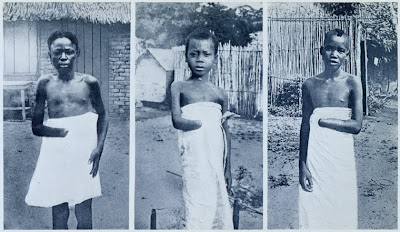
This article was written in French and was totally translated, from a post at dooyoo. After reading a number of articles regarding Tintin au Congo, this one seems to be sensitive to both the author of the Tintin comic series (the French call them "albums") and the reader. So many others simply dismiss the racism as "political correctness" running a muck. The Tintin images are difficult to view, in light of the historical atrocities of King Leopold. The King that impoverished a nation, enacted genocide and stole the wealth of a nation with the help of turn-coat former Confederate Henry Morgan Stanley. It's not "political correctness" that seems too trite and trivial in light of King Leopold's crimes. But, every great historical crime has a cute propaganda laden children's book to justify and whitewash the crime scene.

I don't know who the author is, but as stated before, it is well written, the ending needs a bit of tightening-up, but it could just be poorly translated. --Ron Edwards

******

Big fan of Hergé's work, I am always (and still am) found as the majority of readers, extremely uncomfortable to Tintin in the Congo.


While Tintin is generally regarded by all readers as a hero without fear and without reproach, always ready to go save the poor and to descramble the most dangerous political situations for democracy, yet there is two albums that make a part of shadow humanistic adventures of the hero: Tintin in the Land of the Soviets and Tintin in the Congo. These two albums, whose adventures are located respectively in the former Soviet empire and the former Belgian colony, attempt, too, in an exemplary way in the world history of the twentieth century. They are mostly illustrations "remarkable" the image that the West, here in Belgium, may get the rest of the world including the African people under the yoke of colonial nations. It is packed images that represent a very particular mindset.

As part of an academic work, I had to make a comparative study between the two versions of Tintin in the Congo (1930 and 1946), by attaching myself mainly on the theme of political correctness, and I will try to summarize in broad strokes.

The version we all know today, compared with the first edition published serially in the Little twentieth of June 5, 1930, has many changes (imutiles?) By Herge himself on the particular representation of black, d a graphical perspective, screenwriting, and linguistics. Indeed, in this period of beginning of the end of colonial empires, the birth of a culture of "discovery" of the world, some environmental awareness, the rebirth of a minority culture, Europe is guilty , and married a whole new ideology.

It was obvious that Tintin in the Congo experience a period of disgrace and bad press to do so Casterman, that forced the author to rework the album. Accusations of racism that Herge was a victim throughout his career started, and it was then to present the album in a form more acceptable.
I find it important to address the circumstances of the creation of the first Tintin in the Congo and the various deviations now seen the replay of this album (now found in facsimile) within ' hinge between a century racist ideology and patronizing, and rise of a collective consciousness to rehabilitate the image of minorities, ie the advent of political correctness: The story of the late nineteenth and early twentieth century is reflected in the heyday of the great European colonial powers. A colony, I need to remember is stricto sensu a territory occupied and administered by a nation outside its borders, and still attached to the mainland by close ties. The goal of the colonizing countries was of course take advantage of a territory and its riches, priceless in terms of Africa, but also assume, in all "sincerity," a civilizing mission and morally redeeming involving indigenous peoples, through technical progress, Christianity and labor.

The Western image of the indigenous at the time of colonial exhibitions, that is simply the recovery of indigenous ways of life in zoos is full of racism in the sense that the West is convinced of the quasi-animal blacks, and his intellectual and moral inferiority.


For reference, an extract of the definition of the word negro from the Grand Larousse dictionary of the nineteenth century, written by Pierre Larousse himself:

"It is in vain that some philanthropists have tried to prove that the species negro is as intelligent as white species (...) If the Negroes are similar to some animal species by their anatomical forms, by coarse instincts, they differ and approach the white men in other respects we must take utmost account. They are endowed with speech and words we can build relationships with them intellectual and moral, we can try to raise them to us (...) ". striking, no?
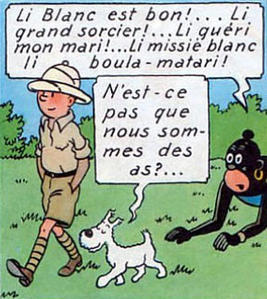

Collective representation shows blacks at worst aggressive at best totally incompetent, lazy, just smart and almost incapable of practicing a foreign language without distorting it.

Belgium is the beautiful part in this movement imperialist occupying the Congo, now Democratic Republic of Congo from 1876 to 1960. When Tintin returns from the Land of the Soviets, the first idea is to Hergé's hero from America to fight against gangsterism in Chicago. But this time the Belgian Congo in dire need of manpower and metropolitan officials. Tintin's popularity is so extraordinary and so the abbot Wallez Brussels Catholic priest, a staunch defender of the colonial cause and editor of the Petit Herge Twentieth which works before being recovered by Casterman in 1931 requires Hergé transpose the next adventures of the reporter in the Congo. The scenario of the album is very simple and you know Tintin, as is the case in all his first album, simply hand over the other continent as a reporter, with all the paraphernalia necessary for shooting and sound recording. Once there, the hero will live a succession of ups and downs with no real logical sequence leading to the imprisonment of American gangsters who wish to hand over the diamond mines of the country. It is here by no means a purely humanist, as was the case itself many times in his other adventures, as all the country's wealth was controlled by the colonizers. It was implicitly to fight against any form of looting of Belgian heritage, not Africa. This adventure will allow it to patrol the African territory, to implicitly emphasize the importance of the contribution of Europeans in the Congo.


If Congo had the worst atrocities during its occupation by Belgium, no evidence of such abuse on the African people, nor any aggression from the West are represented in Tintin in the Congo, except the acts of gangsters in the pay of Al Capone. If the reading today from the album leaves a deep unease to the reader (even in its new version), one of the twenties there yet rediscover all that the collective imagery conveyed in a simplistic way at that time: Africa is a vast paradise, land of every adventure and distinction from whites, land populated by uneducated individuals but devoting a cult following in Western Christian culture, and just waiting to rise up to their level. Due to the transposition of these vast colonial clichés, this ad made in Congo is becoming an apology for the white man, through Tintin himself. His triumphant arrival in Africa - which also strongly resembles a self-advertising the Little Twentieth, suggesting that Africans attach great importance to the news and culture internationally and have closely followed the adventures of anti- Tintin Bolshevik countries. They are, in fact, a savior and an ideal model. This trick will allow technology to be recognized as king in the M'Hatuvu an indigenous tribe, or chief of the tribe of Ba Baoro'm honorific accept it without asking questions and without any humility. The image of the gentle missionary who will save him from death and that we will see at the head of a mission with children at school also has a great importance. It is an endearing image in the colonial ideal, especially since the missions had a high importance in the process of Christianization of Africa


All African representatives are present in this album: idyllic cruise to rally the continent, vast land and beautiful scenery, amazing wildlife and dangerous, large outflows hunts lions or leopards very popular among rich Europeans, etc.. But this exotic, there are other more dubious references.

The graphical representation of blacks is quite striking. The characters are drawn so rude, and their image is a caricature: small, puny, air consistently amazed with exaggerated lips, and dressed in ridiculous getups: unlike the beautiful costume worn by colonial Tintin 's they are not in rags, blacks trying to dress in Western style, just like their models, even if it is completely unsuitable climates and situations, such as the mantle at the neck fur or even a tie to the topless. They are also observed with an air often aggressive and defiant, ready to pounce.


Blacks are represented as big children, fearful, lazy, incapable of any initiative, deeply gullible, naive and superstitious. Hergé The way to give voice to blacks is also very representative of the collective imagery. Uses terms specific to Swahili culture, such as Muganga which means one who healed so he's talking about these characters in "negro boy" in a permanent form of grammatical imperfection. The sentences are quite understandable, but they recall more of a mixed language deliberation, rather than a difficulty in speaking, and to make sentences in a foreign language. This standard language of the social representation of Black is now outlawed in the name of political correctness.

I think the violence of the dialogues of Tintin against blacks is exemplary, and you certainly do not escape: it is not strictly speaking of insults, but very often mark of authority or contempt. "Silence! You ... We will repair your dirty little machine!" In passing, the use of the word negro, innocently used at the time, but now completely irrelevant, as it has taken a real connotation racist nowadays. In the first version, taking flight from the onslaught of pygmies, Tintin, uses the word nigger mean who has very dark skin, today disappeared from common usage, but then found insulting and degrading . This violence is not confined only to individuals but is also found to African wildlife. Actions speak for themselves (butchering a monkey, a rhino exploded, killing fifteen free antelopes, etc..) and indifference and contempt that Tintin has towards animals are quite similar to a form of appropriation of African culture.


Their beliefs and forms of power based on the tribal system are systematically ridiculed. Conversely, the power of Tintin on the natives is taken very seriously, and the hero himself: as a result of an election over a dispatch to the head of a tribe, he hesitates, not declare "I just started my tour in my village ... and already I see, as everywhere fights." The term "as everywhere" is interesting because obviously the blacks do not belong to a civilized people ... It is also launching in speedy justice, uncompromising and sure of himself (see the scene of the straw hat).


The famous episode of the collision between the car and the locomotive of Tintin is certainly the most striking feature of the album, as it summarizes the attitude of European and African stereotypes presented above. The Congolese and technological inferiority first described here, since a single trans-Saharan car overcomes a locomotive and its cars, vulgar wooden crates. After a quick apology, Tintin interrupts net protests claiming his natural authority over the natives, hands on hips "Come! at work! ... "" Are not you ashamed? Let a dog do all the work! . The nervousness is a legitimate and portrays blacks as a form of irritability, of laziness. Also included in this scene's supposed flirtation ridicule blacks, hoping their attire move closer to the ideal dress in European fashion. Finally, note that if Tintin is responsible for the accident, he comes out despite the glorious little effort made to repair the train, and who is devoting recognition.

The whole album is a demonstration of social relations between the colonists and the colonized, and the will to power, condescension and paternalism of whites against blacks. The insistence of Tintin through dialogue to systematically minimize blacks means that reveal vulnerabilities of a nation implies the need to bring him help. It is therefore an implicit justification of the colonizer, and you can see in this album by Hergé active in the construction of black identity.


Ethnocentrism can be termed as the fact that a civilization judge any other culture in relation to hers that she considers better than others. This ideology was obviously massively popular there are still a century in a context of "world conquest by the West. For the idea of ​​colonization is meaningful to the public, who at the time was already heavily steeped in the bourgeois prejudices ethnocentric, it was therefore a construction of the identities of colonized peoples, what has contributed Hergé Tintin in the Congo. It was primarily to build the colon as a standard and reference. A gradual fall of European colonial empires, the birth will be added to a large international humanist conscience. The proliferation of media and currents of thought of human ecology will lead to European civilization in a giant mea culpa. Belgium feels the Congo, its wealth and its role on the local population to escape. Its abuses are beginning to be revealed to the public, and decolonization in the acts is often painful. Ethnocentrism back in speeches, and should therefore review the social representation of Africa and blacks. The politically correct attitude of erasing all about derogatory, demeaning and hitting is the norm. In this way, the Tintin in the Congo in 1930, and his share of stereotypes, prejudices suddenly finds himself in complete disagreement with the crop now in order. It is not politically correct, and is apprehended by readers with embarrassment.

In 1931, Editions Casterman ensure the exclusivity of Hergé's albums in French. They publish the first version of Tintin in the Congo after the serial publication the previous year at Little Twentieth. This fall we have said, and for long a period of public disaffection (and for good reason ...), editions imposed in 1946 to Hergé to rework the album to make it more ideologically acceptable. The new edition of Tintin in the Congo transform does not however prevent him from being completely shunned by the public in the sixties, following the increase in problems related to decolonization.

The first visible changes in the album are great. For editorial reasons, Hergé was forced to reduce his album to 62 pages then exercised in Casterman, while its first edition contained 109, which in no way affects the course of history, the size of each block being reduced. The other significant asset is the development of full color album. The refinement of the character as a landmark since then tintin keep this silhouette.


If the frame of the story has not changed, many details have been altered or simply removed to better meet contemporary ideological.

Hergé has erased all references to scriptwriting language or colonial involvement of Belgium in the Congo. Apart from its colonial holding and attending a mission, Tintin is more than just a reporter out to discover exotic in a country where it is known that research and adherence to Western culture. The metamorphosis of the episode of the class of mission is also very revealing of what bothered at the time. This is undoubtedly one of the most contested fields of the album. In the original edition, Tintin replaced at short notice a sick teacher and envisions a geography lesson to small black before being interrupted by a leopard. "My dear friends, I will talk today about your fatherland Belgium! ...." The reference to Belgium will also be removed, let alone that the term "your" presupposes a political and cultural integration of indigenous peoples in colonial countries. The course then becomes a simple math, more neutral.

In this dialectic, the reader of the new edition could legitimately expect to find major changes in the linguistic attributes of the African population. The talk "negro boy" is now considered a form of social impairment Black. We saw how the language presented in the first edition is enlarged and imperfect. The new edition seems to have fully complied with these characteristics. However, if there are scenes where the African French speaking now quite correct, there are also scenes where people speak a French normal start talking in an Africanized French. No logic seems to have been followed by Hergé in this case.


It seems to me that the most significant difference lies in the dialogues of Tintin and Snowy towards Africans. The marks of authoritarian discourse against blacks, for the sake of preserving the colonial ideology are mitigated. Manifestations of Western prejudices about blacks are much less stressed. The vocabulary extravagant version of 1930 for us today also disappeared. Thus the term "negro" appearing twice in the first version, disappears completely in 1946 and used the word nigger in the prosecution of the pygmies, humiliating expression is also completely forgotten But generally, the attitude toward Tintin African culture has not changed. Although he no longer treats animals dirty creatures, we see nevertheless continue its massacres. The white man is still considered a hero, marks deference is no shortage (carried in triumph, kneeling election as head of a village) and the representation of blacks is still very stereotypical: the design of the new lighter refined version of the slave trade, now represented with a figure more realistic and less simian. Their aggressive air has disappeared to be replaced often to clean air, stunned, certainly, but jovial and friendly. However, their childlike appearance is still relevant. . The scene "news" of the collision between the car and the locomotive illustrates this point. Blacks are always presented in outrageous ways: their clothes have not changed, just as they are reluctant to go to work and get dirty, and Coco, the boy reporter is still gone into hiding after being scared. "The dirty little machine" becomes an "old-Tchouk Tchouk! But Tintin retains his conduct as a leader.


I sincerely doubt the value of the new edition of Tintin in the Congo. Reading the new version of the album mind readers over the age of childhood. A child more easily rise up against the massacre of fifteen antelope or implosion of the rhinoceros. Only much later, in the light of his conscience humanistic and respectful of all races, and especially expert in African history from slavery that the reader will reject it, seeing it as denial other. I think that Hergé never rework of this album. His changes have finally deeply changed nothing, and perhaps worst of all.


Okay, the cartoon is the form most widely used in humor and comedy. The characters are often enlarged to give more spice to the stories and situations. The cartoon child is precisely the temple of humor. The plot of the stories of the adventures of Tintin, certifying all accounts are being punctuated with gags, dialogue tasty. Nevertheless, the question "Can you laugh at all? "Added the question of the responsibility of the author towards his silent propaganda against Belgian children of the 30s.
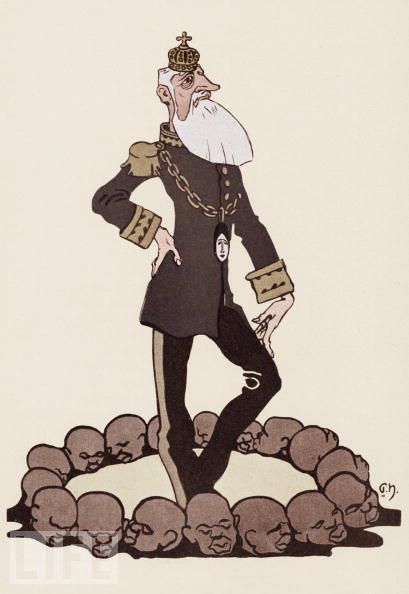
King Leopold estimated death toll of native Congolese between 2-15 million. Expropriating the Congolese natural resources and enslaving the indigenousness people of the Congo, made King Leopold one of the richest men on the planet.


"For the Congo, as for Tintin in the Land of the Soviets, it is that I was fed the prejudices of the bourgeois milieu in which I lived ... It was in 1930. I knew this country than in telling people at the time: "The Negroes are great kids ... Luckily for them that we're here! etc.. And I have drawn these Africans, according to these criteria there, in pure paternalistic spirit of the times was that, in Belgium (...) "

Tintin and I, interviews with Numa Sadoul, Casterman


Hergé evidently wants to clear itself of its past mistake. While one might wonder about his lack of critical thinking, it is quite logical to see this album in the foundations of one of the biggest trials of the century literary past: Herge / Tintin Is Racist ?


Thursday, April 21, 2011

An 1890 Open Letter to Leopold II, King of the Belgians and Sovereign of the Independent State of Congo

George Washington Williams, “An Open Letter to His Serene Majesty Leopold II, King of the Belgians and Sovereign of the Independent State of Congo By Colonel, The Honorable Geo. W. Williams, of the United States of America,” 1890

Good and Great Friend,

I have the honour to submit for your Majesty’s consideration some reflections respecting the Independent State of Congo, based upon a careful study and inspection of the country and character of the personal Government you have established upon the African Continent.

His Serene Majesty Leopold II
It afforded me great pleasure to avail myself of the opportunity afforded me last year, of visiting your State in Africa; and how thoroughly I have been disenchanted, disappointed and disheartened, it is now my painful duty to make known to your Majesty in plain but respectful language. Every charge which I am about to bring against your Majesty’s personal Government in the Congo has been carefully investigated; a list of competent and veracious witnesses, documents, letters, official records and data has been faithfully prepared, which will be deposited with Her Britannic Majesty’s Secretary of State for Foreign Affairs, until such time as an International Commission can be created with power to send for persons and papers, to administer oaths, and attest the truth or falsity of these charges.

Henry M. Stanley

There were instances in which Mr. HENRY M. STANLEY sent one white man, with four or five Zanzibar soldiers, to make treaties with native chiefs. The staple argument was that the white man’s heart had grown sick of the wars and rumours of war between one chief and another, between one village and another; that the white man was at peace with his black brother, and desired to “confederate all African tribes” for the general defense and public welfare. All the sleight-of- hand tricks had been carefully rehearsed, and he was now ready for his work. A number of electric batteries had been purchased in London, and when attached to the arm under the coat, communicated with a band of ribbon which passed over the palm of the white brother’s hand, and when he gave the black brother a cordial grasp of the hand the black brother was greatly surprised to find his white brother so strong, that he nearly knocked him off his feet in giving him the hand of fellowship. When the native inquired about the disparity of strength between himself and his white brother, he was told that the white man could pull up trees and perform the most prodigious feats of strength. Next came the lens act. The white brother took from his pocket a cigar, carelessly bit off the end, held up his glass to the sun and complaisantly smoked his cigar to the great amazement and terror of his black brother. The white man explained his intimate relation to the sun, and declared that if he were to request him to burn up his black brother’s village it would be done. The third act was the gun trick. The white man took a percussion cap gun, tore the end of the paper which held the powder to the bullet, and poured the powder and paper into the gun, at the same time slipping the bullet into the sleeve of the left arm. A cap was placed upon the nipple of the gun, and the black brother was implored to step off ten yards and shoot at his white brother to demonstrate his statement that he was a spirit, and, therefore, could not be killed. After much begging the black brother aims the gun at his white brother, pulls the trigger, the gun is discharged, the white man stoops . . . and takes the bullet from his shoe!

By such means as these, too silly and disgusting to mention, and a few boxes of gin, whole villages have been signed away to your Majesty.

Former Confederate Soldier Henry Morgan Stanley

When I arrived in the Congo, I naturally sought for the results of the brilliant programme: “fostering care”, “benevolent enterprise”, an “honest and practical effort” to increase the knowledge of the natives “and secure their welfare”. 1 had never been able to conceive of Europeans, establishing a government in a tropical country, without building a hospital; and yet from the mouth of the Congo River to its head-waters, here at the seventh cataract, a distance of 1,448 miles, there is not a solitary hospital for Europeans, and only three sheds for sick Africans in the service of the State, not fit to be occupied by a horse. Sick sailors frequently die on board their vessels at Banana Point; and if it were not for the humanity of the Dutch Trading Company at that place—who have often opened their private hospital to the sick of other countries—many more might die. There is not a single chaplain in the employ of your Majesty’s Government to console the sick or bury the dead. Your white men sicken and die in their quarters or on the caravan road, and seldom have Christian burial. With few exceptions, the surgeons of your Majesty’s Government have been gentlemen of professional ability, devoted to duty, but usually left with few medical stores and no quarters in which to treat their patients. The African soldiers and labourers of your Majesty’s Government fare worse than the whites, because they have poorer quarters, quite as bad as those of the natives; and in the sheds, called hospitals, they languish upon a bed of bamboo poles without blankets, pillows or any food different from that served to them when well, rice and fish.

I was anxious to see to what extent the natives had “adopted the fostering care” of your Majesty’s “benevolent enterprise” (?), and I was doomed to bitter disappointment. Instead of the natives of the Congo “adopting the fostering care” of your Majesty’s Government, they everywhere complain that their land has been taken from them by force; that the Government is cruel and arbitrary, and declare that they neither love nor respect the Government and its flag. Your Majesty’s Government has sequestered their land, burned their towns, stolen their property, enslaved their women and children, and committed other crimes too numerous to mention in detail. It is natural that they everywhere shrink from “the fostering care” your Majesty’s Government so eagerly proffers them.


There has been, to my absolute knowledge, no “honest and practical effort made to increase their knowledge and secure their welfare.” Your Majesty’s Government has never spent one franc for educational purposes, nor instituted any practical system of industrialism. Indeed the most unpractical measures have been adopted against the natives in nearly every respect; and in the capital of your Majesty’s Government at Boma there is not a native employed. The labour system is radically unpractical; the soldiers and labourers of your Majesty’s Government are very largely imported from Zanzibar at a cost of £10 per capita, and from Sierra Leone, Liberia, Accra and Lagos at from £1 to £1/10 per capita. These recruits are transported under circumstances more cruel than cattle in European countries. They eat their rice twice a day by the use of their fingers; they often thirst for water when the season is dry; they are exposed to the heat and rain, and sleep upon the damp and filthy decks of the vessels often so closely crowded as to lie in human ordure. And, of course, many die.


Upon the arrival of the survivors in the Congo they are set to work as labourers at one shilling a day; as soldiers they are promised sixteen shillings per month, in English money, but are usually paid off in cheap handkerchiefs and poisonous gin. The cruel and unjust treatment to which these people are subjected breaks the spirits of many of them, makes them distrust and despise your Majesty’s Government. They are enemies, not patriots.


There are from sixty to seventy officers of the Belgian army in the service of your Majesty’s Government in the Congo of whom only about thirty are at their post; the other half are in Belgium on furlough. These officers draw double pay—as soldiers and as civilians. It is not my duty to criticise the unlawful and unconstitutional use of these officers coming into the service of this African State. Such criticism will come with more grace from some Belgian statesman, who may remember that there is no constitutional or organic relation subsisting between his Government and the purely personal and absolute monarchy your Majesty has established in Africa. But I take the liberty to say that many of these officers are too young and inexperienced to be entrusted with the difficult work of dealing with native races. They are ignorant of native character, lack wisdom, justice, fortitude and patience. They have estranged the natives from your Majesty’s Government, have sown the seed of discord between tribes and villages, and some of them have stained the uniform of the Belgian officer with murder, arson and robbery. Other officers have served the State faithfully, and deserve well of their Royal Master.

From these general observations I wish now to pass to specific charges against your Majesty’s Government.

FIRST.—Your Majesty’s Government is deficient in the moral military and financial strength, necessary to govern a territory o 1,508,000 square miles, 7,251 miles of navigation, and 31,694 square miles of lake surface. In the Lower Congo River there is but One post, in the cataract region one. From Leopoldville to N’Gombe, a distance of more than 300 miles, there is not a single soldier or civilian. Not one out of every twenty State-officials know the language of the natives, although they are constantly issuing laws, difficult even for Europeans, and expect the natives to comprehend and obey them. Cruelties of the most astounding character are practised by the natives, such as burying slaves alive in the grave of a dead chief, cutting off the heads of captured warriors in native combats, and no effort is put forth by your Majesty’s Government to prevent them. Between 800 and 1,000 slaves are sold to be eaten by the natives of the Congo State annually; and slave raids, accomplished by the most cruel and murderous agencies, are carried on within the territorial limits of your Majesty’s Government which is impotent. There are only 2,300 soldiers in the Congo.

SECOND.—Your Majesty’s Government has established nearly fifty posts, consisting of from two to eight mercenary slave-soldiers from the East Coast. There is no white commissioned officer at these posts; they are in charge of the black Zanzibar soldiers, and the State expects them not only to sustain themselves, but to raid enough to feed the garrisons where the white men are stationed. These piratical, buccaneering posts compel the natives to furnish them with fish, goats, fowls, and vegetables at the mouths of their muskets; and whenever the natives refuse to feed these vampires, they report to the main station and white officers come with an expeditionary force and burn away the homes of the natives. These black soldiers, many of whom are slaves, exercise the power of life and death. They are ignorant and cruel, because they do not comprehend the natives; they are imposed upon them by the State. They make no report as to the number of robberies they commit, or the number of lives they take; they are only required to subsist upon the natives and thus relieve your Majesty’s Government of the cost of feeding them. They are the greatest curse the country suffers now.

THIRD.—Your Majesty’s Government is guilty of violating its contracts made with its soldiers, mechanics and workmen, many of whom are subjects of other Governments. Their letters never reach home.

FOURTH.—The Courts of your Majesty’s Government are abortive, unjust, partial and delinquent. I have personally witnessed and examined their clumsy operations. The laws printed and circulated in Europe “for the Protection of the blacks” in the Congo, are a dead letter and a fraud. T have heard an officer of the Belgian Army pleading the cause of a white man of low degree who had been guilty of beating and stabbing a black man, and urging race distinctions and prejudices as good and sufficient reasons why his client should be adjudged innocent. I know of prisoners remaining in custody for six and ten months because they were not judged. T saw the white servant of the Governor-General, CAMILLE JANSSEN, detected in stealing a bottle of wine from a hotel table. A few hours later the Procurer-General searched his room and found many more stolen bottles of wine and other things, not the property of servants. No one can be prosecuted in the State of Congo without an order of the Governor-General, and as he refused to allow his servant to be arrested, nothing could be done. The black servants in the hotel, where the wine had been stolen, had been often accused and beaten for these thefts, and now they were glad to be vindicated. But to the surprise of every honest man, the thief was sheltered by the Governor General of your Majesty’s Government.


FIFTH—Your Majesty’s Government is excessively cruel to its prisoners, condemning them, for the slightest offences, to the chain gang, the like of which can not be seen in any other Government in the civilized or uncivilized world. Often these ox-chains eat into the necks of the prisoners and produce sores about which the flies circle, aggravating the running wound; so the prisoner is constantly worried. These poor creatures are frequently beaten with a dried piece of hippopotamus skin, called a “chicote”, and usually the blood flows at every stroke when well laid on. But the cruelties visited upon soldiers and workmen are not to be compared with the sufferings of the poor natives who, upon the slightest pretext, are thrust into the wretched prisons here in the Upper River. I cannot deal with the dimensions of these prisons in this letter, but will do so in my report to my Government.


SIXTH.—Women are imported into your Majesty’s Government for immoral purposes. They are introduced by two methods, viz., black men are dispatched to the Portuguese coast where they engage these women as mistresses of white men, who pay to the procurer a monthly sum. The other method is by capturing native women and condemning them to seven years’ servitude for some imaginary crime against the State with which the villages of these women are charged. The State then hires these woman out to the highest bidder, the officers having the first choice and then the men. Whenever children are born of such relations, the State maintains that the women being its property the child belongs to it also.

Not long ago a Belgian trader had a child by a slave-woman of the State, and he tried to secure possession of it that he might educate it, but the Chief of the Station where he resided, refused to be moved by his entreaties. At length he appealed to the Governor-General, and he gave him the woman and thus the trader obtained the child also. This was, however, an unusual case of generosity and clemency; and there is only one post that I know of where there is not to be found children of the civil and military officers of your Majesty’s Government abandoned to degradation; white men bringing their own flesh and blood under the lash of a most cruel master, the State of Congo.

SEVENTH.—Your Majesty’s Government is engaged in trade and commerce, competing with the organised trade companies of Belgium, England, France, Portugal and Holland. It taxes all trading companies and exempts its own goods from export-duty, and makes many of its officers ivory-traders, with the promise of a liberal commission upon all they can buy or get for the State. State soldiers patrol many villages forbidding the natives to trade with any person but a State official, and when the natives refuse to accept the price of the State, their goods are seized by the Government that promised them “protection”. When natives have persisted in trading with the trade-companies the State has punished their independence by burning the villages in the vicinity of the trading houses and driving the natives away.

EIGHTH.—Your Majesty’s Government has violated the General Act of the Conference of Berlin by firing upon native canoes; by confiscating the property of natives; by intimidating native traders, and preventing them from trading with white trading companies; by quartering troops in native villages when there is no war; by causing vessels bound from “Stanley-Pool” to “Stanley-Falls”, to break their journey and leave the Congo, ascend the Aruhwimi river to Basoko, to be visited and show their papers; by forbidding a mission steamer to fly its national flag without permission from a local Government; by permitting the natives to carry on the slave- trade, and by engaging in the wholesale and retail slave-trade itself.


NINTH.—-Your Majesty’s Government has been, and is now, guilty of waging unjust and cruel wars against natives, with the hope of securing slaves and women, to minister to the behests of the officers of your Government. In such slave-hunting raids one village is armed by the State against the other, and the force thus secured is incorporated with the regular troops. I have no adequate terms with which to depict to your Majesty the brutal acts of your soldiers upon such raids as these. The soldiers who open the combat are usually the bloodthirsty cannibalistic Bangalas, who give no quarter to the aged grandmother or nursing child at the breast of its mother. There are instances in which they have brought the heads of their victims to their white officers on the expeditionary steamers, and afterwards eaten the bodies of slain children. In one war two Belgian Army officers saw, from the deck of their steamer, a native in a canoe some distance away. He was not a combatant and was ignorant of the conflict in progress upon the shore, some distance away. The officers made a wager of £5 that they could hit the native with their rifles. Three shots were fired and the native fell dead, pierced through the head, and the trade canoe was transformed into a funeral barge and floated silently down the river.


TENTH.—Your Majesty’s Government is engaged in the slave-trade, wholesale and retail. It buys and sells and steals slaves. Your Majesty’s Government gives £3 per head for able bodied slaves for military service. Officers at the chief stations get the men and receive the money when they are transferred to the State; but there are some middle-men who only get from twenty to twenty-five francs per head. Three hundred and sixteen slaves were sent down the river recently, and others are to follow. These poor natives are sent hundreds of miles away from their villages, to serve among other natives whose language they do not know. When these men run away a reward of 1,000 N’taka is offered. Not long ago such a recaptured slave was given one hundred “chikote” each day until he died. Three hundred N’taka—brassrod-—is the price the State pays for a slave, when bought from a native. The labour force at the stations of your Majesty’s Government in the Upper River is composed of slaves of all ages and both sexes.

ELEVENTH.—Your Majesty’s Government has concluded a contract with the Arab Governor at this place for the establishment of a line of military posts from the Seventh Cataract to Lake Tanganyika territory to which your Majesty has no more legal claim, than I have to be Commander-in-Chief of the Belgian army. For this work the Arab Governor is to receive five hundred stands of arms, five thousand kegs of powder, and £20,000 sterling, to he paid in several instalments. As I write, the news reaches me that these much- treasured and long-looked for materials of war are to be discharged at Basoko, and the Resident here is to be given the discretion as to the distribution of them. There is a feeling of deep discontent among the Arabs here, and they seem to feel that they are being trifled with. As to the significance of this move Europe and America can judge without any comment from me, especially England.

TWELFTH—The agents of your Majesty’s Government have misrepresented the Congo country and the Congo railway. Mr. H. M. STANLEY, the man who was your chief agent in setting up your authority in this country, has grossly misrepresented the character of the country. Instead of it being fertile and productive it is sterile and unproductive. The natives can scarcely subsist upon the vegetable life produced in some parts of the country. Nor will this condition of affairs change until the native shall have been taught by the European the dignity, utility and blessing of labour. There is no improvement among the natives, because there is an impassable gulf between them and your Majesty’s Government, a gulf which can never be bridged. HENRY M. STANLEY’S name produces a shudder among this simple folk when mentioned; they remember his broken promises, his copious profanity, his hot temper, his heavy blows, his severe and rigorous measures, by which they were mulcted of their lands. His last appearance in the Congo produced a profound sensation among them, when he led 500 Zanzibar soldiers with 300 camp followers on his way to relieve EMIN PASHA. They thought it meant complete subjugation, and they fled in confusion. But the only thing they found in the wake of his march was misery. No white man commanded his rear column, and his troops were allowed to straggle, sicken and die; and their bones were scattered over more than two hundred miles of territory.

CONCLUSIONS
Against the deceit, fraud, robberies, arson, murder, slave-raiding, and general policy of cruelty of your Majesty’s Government to the natives, stands their record of unexampled patience, long-suffering and forgiving spirit, which put the boasted civilisation and professed religion of your Majesty’s Government to the blush. During thirteen years only one white man has lost his life by the hands of the natives, and only two white men have been killed in the Congo. Major Barttelot was shot by a Zanzibar soldier, and the captain of a Belgian trading-boat was the victim of his own rash and unjust treatment of a native chief.

All the crimes perpetrated in the Congo have been done in your name, and you must answer at the bar of Public Sentiment for the misgovernment of a people, whose lives and fortunes were entrusted to you by the august Conference of Berlin, 1884—1 885. I now appeal to the Powers which committed this infant State to your Majesty’s charge, and to the great States which gave it international being; and whose majestic law you have scorned and trampled upon, to call and create an International Commission to investigate the charges herein preferred in the name of Humanity, Commerce, Constitutional Government and Christian Civilisation.

I base this appeal upon the terms of Article 36 of Chapter VII of the General Act of the Conference of Berlin, in which that august assembly of Sovereign States reserved to themselves the right “to introduce into it later and by common accord the modifications or ameliorations, the utility of which may be demonstrated experience”.

I appeal to the Belgian people and to their Constitutional Government, so proud of its traditions, replete with the song and story of its champions of human liberty, and so jealous of its present position in the sisterhood of European States—to cleanse itself from the imputation of the crimes with which your Majesty’s personal State of Congo is polluted.

I appeal to Anti-Slavery Societies in all parts of Christendom, to Philanthropists, Christians, Statesmen, and to the great mass of people everywhere, to call upon the Governments of Europe, to hasten the close of the tragedy your Majesty’s unlimited Monarchy is enacting in the Congo.


I appeal to our Heavenly Father, whose service is perfect love, in witness of the purity of my motives and the integrity of my aims; and to history and mankind I appeal for the demonstration and vindication of the truthfulness of the charge I have herein briefly outlined.

And all this upon the word of honour of a gentleman, I subscribe myself your Majesty’s humble and obedient servant,

GEO. W. WILLIAMS

Stanley Falls, Central Africa,
July 18th, 1890.

Monday, April 4, 2011

Ota Benga The Congolese Pygmy Man in the Bronx Zoo

Ota Benga (1883-1916) was an African Congolese Pygmy, who was put on display in the monkey house at the Bronx Zoo in New York in1906


The Man in the Zoo

BY GEOFFREY C. WARD

On Sunday, September 9, 1906, a freshly painted sign greeted visitors to the Monkey House at the Bronx Zoological Gardens:

The African Pygmy, “Ota Benga.”
Age, 23 years. Height, 4 feet 11 inches.
Weight 103 pounds,
Brought from the Kasai River, Congo Free State, South Central Africa,
by Dr. Samuel P. Verner.
Exhibited each afternoon during September.

Inside, in a large open-air cage whose floor had been artfully strewn with bones to suggest its occupant’s supposed savagery, sat a diminutive man in a hammock, wearing a jacket and trousers but no shoes, quietly weaving mats and occasionally getting up to shoot arrows at a bale of hay. Late in the day an orangutan was let into the cage, and man and ape were encouraged to play together, hugging and chasing each another while the mostly white crowd laughed and applauded: ”. . . the pygmy was not much taller than the orangutan,” The New York Times reported, “and one had a good opportunity to study their points of resemblance. Their heads are much alike, and both grin in the same way when pleased.”

It is a tribute to the astonishing resilience of the human spirit that the displaced Pygmy was ever even momentarily pleased, as a fascinating but flawed new book about him makes clear. Ota Benga: The Pygmy in the Zoo (St. Martin’s Press, 320 pages, $22.95) was written by Harvey Blume and Phillips Verner Bradford, the grandson of Samuel Phillips Verner, the missionary-adventurer who found the little man in the African forest and brought him back to the New World—twice.


Samuel Verner was a high-strung South Carolinian, raised on Robinson Crusoeand the works of David Livingstone and Henry M. Stanley and trained for the mission field. He began his travels to the Congo region at twenty-two in search of souls but soon edged away from the church in favor of a series of schemes meant to lure investors to Africa that never quite came off. He was a vivid and prolific writer about his adventures and had brought back from his first expedition two Africans, and so in 1903, when the Louisiana Purchase Exposition, soon to open in St. Louis, wanted Pygmies imported for the area of the fairgrounds called the Anthropology Department, it seemed logical to turn to Verner.

He was given a sort of shopping list: twelve Pygmies, six more Africans of miscellaneous tribes, plus all the paraphernalia of daily living they would need to set themselves up as authentic exhibits in St. Louis. Verner did his best in the face of persistent fever, but in the end he could persuade just five Pygmies to accompany him to America.

One of them was Ota Benga. He had been out hunting when forces in the pay of Belgium, on the prowl for rumored ivory, butchered his hunting band, including his wife and children. By the time Verner happened upon him he had become a slave of the Baschilele people and had little to lose by crossing the great water. Verner bought him with salt and a few yards of cloth.

Teeth sharpening is practiced by both men and women in the tribes of the Congolese Pygmies and the Mentawai people of Indonesia. Children from both of these tribes file their teeth as part of their spiritual practices and rites of passage —to prove themselves worthy to the tribe.

At the St. Louis fair Ota Benga and his companions found themselves living alongside a rich but eclectic sampling of aboriginal people from everywhere: Ainus from Japan, Patagonian “giants” from South America, Kwakiutls from the Northwest Coast (who had to ask for a stockade to shield their baskets and totem poles from what they tactfully called the white man’s “taking qualities”), Igorots from the Philippines, allowed to appear in their traditional loincloths only over the objections of Theodore Roosevelt, who argued that trousers would be more likely to reassure any visitors who still harbored doubts about the wisdom of acquiring the Philippines.

The Pygmies were among the most popular attractions. They were made to snap their filed teeth at visitors, perform ritual dances, compete in “Anthropology Days,” a sort of aboriginal Olympics, during which they excelled only at mud fighting. “When a white man comes to our country,” one of Ota Benga’s companions complained to a reporter, “we give them presents. . . . The Americans treat us as they do our pet monkey. They laugh at us and poke their umbrellas into our faces.”

Later, when the autumn air turned so cold that even the blankets lent the Pygmies by their Indian neighbors proved inadequate and they took shelter inside their huts, visitors heaved bricks through the windows to drive them out again.

At 21, Ota Benga was brought to the United States by African explorer Samuel Verner. Verner displayed Ota Benga alongside six other male and female pygmies of the Mbuti tribe at the St. Louis World Fair in 1904

At the closing ceremonies in December 1904, the president of the fair asked if the Pygmies wished to stay in America. They shouted no, in unison, and Samuel Verner dutifully escorted them back to the Congo, then stayed on, collecting specimens and making big plans for his own trading post. Meanwhile, Ota Benga remarried, only to have his second wife die of snakebite. Alone again, with neither a family nor a hunting band of his own, and stubbornly fond of Verner despite everything, he eventually demanded to be brought back to America, to start a new life there. If Verner did not take him, he vowed, he would kill himself.

The two men landed at New York in the summer of 1906, along with crates of artifacts and a small menagerie with which Verner hoped to restore his fortunes. Nothing seemed to work out, and with creditors closing in, Verner finally unloaded his animals on the Bronx Zoo and made Ota Benga’s extended stay there part of a package deal.

At first the Pygmy simply wandered the grounds unnoticed, wearing ordinary clothes, earning his keep by feeding the primates. But the zoo’s director, William T. Hornaday, had a showman’s gaudy instincts. His original plans to have a fully peopled American Indian village on the grounds had never quite worked out. Now he made his small guest a big attraction. BUSHMAN SHARES A CAGE WITH BRONX PARK APES, Said The New York Times, and forty thousand people turned out on a single afternoon to see the “wild man from Africa.”

Not everyone was pleased. “Our race, we think, is depressed enough without exhibiting one of us with the apes,” said the Reverend James H. Gordon, chairman of the Colored Baptist Ministers’ Conference. “We think we are worthy of being considered human beings, with souls.”

As a black man Gordon objected primarily to the exhibition’s naked racism, but as a Baptist he had another agenda: Exhibition of a human being and an orangutan together, with its suggestion that zoo-goers were somehow seeing the missing link, would encourage Darwinism. “This is a Christian country,” Gordon explained, “and the exhibition evidently aims to be a demonstration of the Darwinian theory of evolution. The Darwinian theory is absolutely opposed to Christianity and a public demonstration in its favor should not be permitted.”

Even some whites began to object. “I lived in the south several years, and consequently am not over fond of the negro,” one wrote, “but believe him human. I think it a shame that the authorities of this great city should allow such a sight as … a negro boy on exhibition in a monkey cage.”

Director Hornaday could never quite understand what all the fuss was about—after all, he told a reporter, the Pygmy “has one of the best rooms in the primate house”—but he now let Ota Benga out of his cage to wander the grounds. Throngs followed wherever he went, “howling, jeering and yelling,” according to the Times. “Some of them poked him in the ribs, others tripped him up, all laughed at him.” His keepers teased him too, and one especially hot afternoon, when he started to remove his clothes and got sprayed with a hose for his trouble, he went for one of them with a knife and had to be manhandled back into his cage. BENGA TRIES TO KILL, reported the New York Tribune.

In the end Hornaday decided his prize exhibit had become more trouble than he was worth and turned him over to the Reverend Gordon, who also headed the Howard Colored Orphan Asylum in Brooklyn. There, studying alongside children one-third his age, Ota Benga did learn to write a little. But, Howard finally admitted, “his age was against his development. It was simply impossible to put him in a class to receive instructions . . . that would be of any advantage to him.” And he showed an alarming interest in some of the older girls.

In 1910 Ota Benga finally asked to be allowed to attend the Baptist Seminary at Lynchburg, Virginia. There he received Christian baptism, had his name changed to Otto Bingo, even had his filed teeth capped.

He worked at a series of desultory jobs—grounds keeping, feeding chickens, sorting tobacco leaves—but only the forest seemed permanently to hold his interest. In summertime he slept in the hayloft of the seminary’s president, fashioned bows and arrows for small boys, and led them into the woods to hunt small game. Sometimes, on his way home in the evening, he would board the bus and pay his fare with a wild bird’s egg or a rabbit he’d brought home from the forest.

On the afternoon of March 20, 1916, Ota Benga lit a fire behind the carriage house where he lived in summer. He removed the caps from his teeth. When his small companions asked him to lead them into the woods again, he turned them away. Once they were safely out of sight, he shot himself through the heart. (source: American Heritage Magazine October 1992 Volume 43, Issue 6)